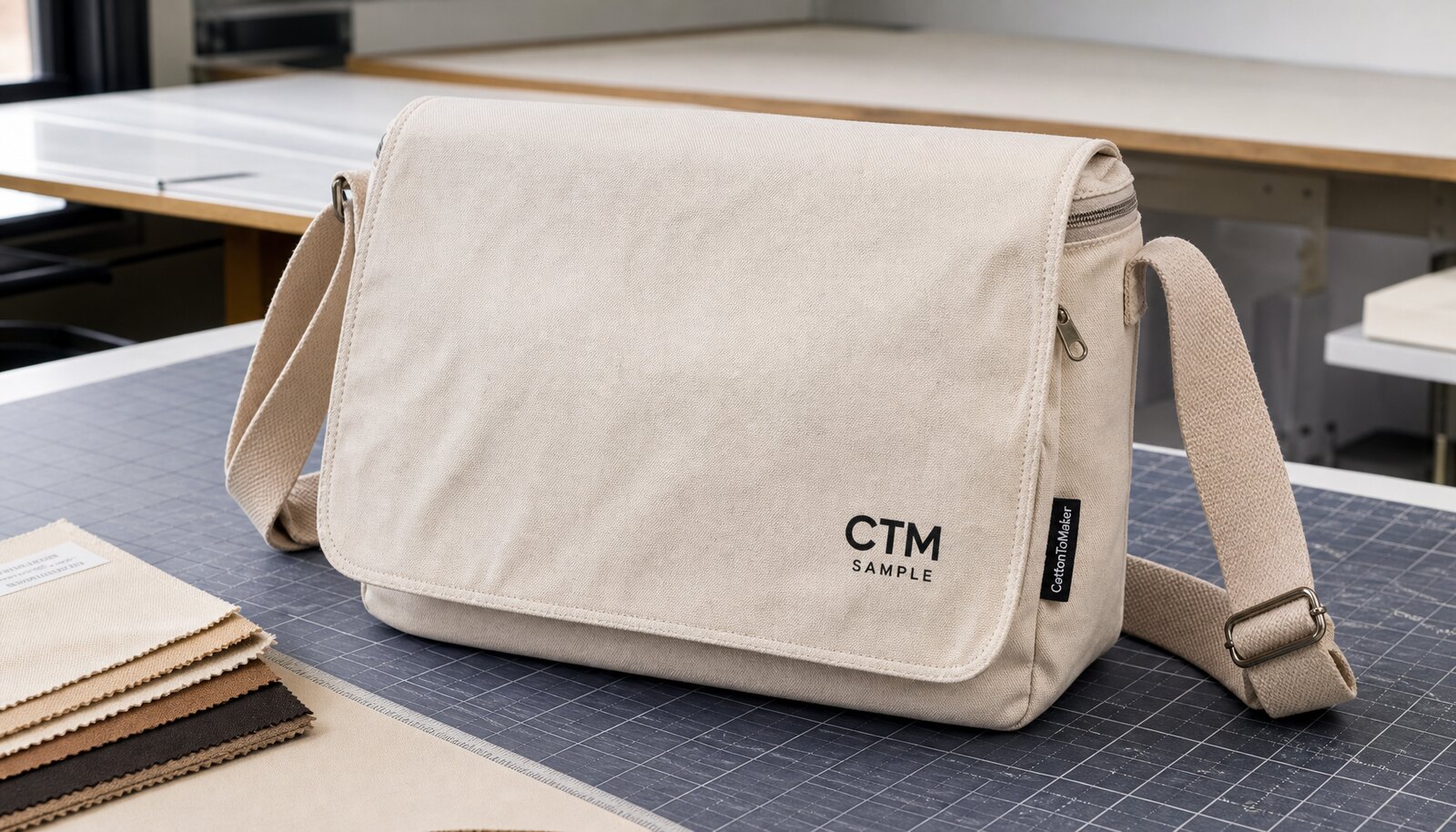
Why Branding Specs Fail on Canvas Crossbody Bags
The most common RFQ problem is not the logo itself. It is that the buyer sends a front-view image and asks for a branded canvas crossbody bag without locking the fabric weight, logo size, print method, seam position, strap detail, and packing method. The factory then quotes based on assumptions, and competing suppliers may not be pricing the same bag.
Canvas crossbody bags are more difficult than flat tote bags because the logo often sits on a flap, pocket, curved seam, zipper panel, or strap. These areas bend, rub against clothing, and may be folded during packing. A branding method that looks acceptable on a flat canvas swatch can crack, pucker, shift, or transfer when used on the final bag.
- Avoid RFQs that say only "canvas bag with logo"; specify structure, fabric, logo method, and position.
- Treat the flap, strap, pocket, and side label as separate branding zones with different production limits.
- Ask each supplier to quote the same logo size and same fabric weight before comparing unit prices.
- Approve a physical branded sample if the order is for retail, distributor resale, or long-term brand use.
Start With the Bag Structure Before the Logo
A canvas crossbody bag can mean a small phone pouch, a vertical event bag, a flap messenger style, or a zip-top daily carry bag. Each structure changes how the brand mark is seen and how it wears during use. A logo on a front flap has high visibility, but it bends every time the user opens the bag. A logo on a side label is lower impact, but it is stable and consistent for repeat production.
For procurement teams, the best approach is to define the bag platform first, then choose the branding method. If the bag needs to carry documents, tablets, samples, or travel items, the body size, gusset, strap width, and hardware strength will influence the correct fabric and decoration choice.
- For mini crossbody bags, use small woven labels, embroidery, or compact screen print to avoid crowding the front panel.
- For flap messenger bags, confirm whether the logo is printed on the flap before sewing or after assembly.
- For zip-top crossbody bags, keep the logo away from zipper curves and top seam distortion.
- For heavier daily-use bags, specify reinforced strap tabs and check whether the logo area stays flat after sewing.
Choose Canvas Weight That Matches the Branding Method
Fabric weight affects both bag performance and logo quality. A light canvas may reduce cost and carton weight, but it can wrinkle more during sewing and packing. A heavier canvas gives a more structured look, but it can create bulky seams and may require stronger needles, larger seam allowances, and more careful embroidery backing.
For many branded crossbody programs, 10 oz to 16 oz cotton canvas is the practical range. Around 10 oz works for lightweight event or promotional use. Around 12 oz is a common balance for branded merchandise. Around 14 oz to 16 oz suits more structured retail bags, but buyers should check weight, stiffness, and freight cost before committing.
- Ask for fabric in oz and GSM because factories and mills may describe canvas differently by market.
- Use natural canvas for an organic look, but approve shade tolerance because natural cotton is not perfectly uniform.
- Use dyed canvas when brand color control is important, but confirm dye lot, color fastness, and MOQ.
- Use washed canvas only when a soft vintage effect is acceptable, because washing can change final size and logo appearance.
Match the Logo Method to the Artwork and Use Case
Screen printing is usually the first method to check for canvas crossbody bag branding because it handles solid logos well and works at practical bulk quantities. It is suitable for simple marks, slogans, and one to three color artwork. The buyer should confirm ink type, print size, curing process, and whether the fabric surface is smooth enough for clean edges.
Embroidery gives a raised, premium feel, but it is not suitable for every logo. Small text, gradients, and very fine outlines can become unreadable. On lighter canvas, embroidery also needs backing and tension control to avoid puckering. Woven labels are useful when the buyer wants consistent branding across many bag styles, especially if the same label is used on totes, pouches, backpacks, and messenger bags.
- Use screen print for solid artwork with clear color separation and moderate order quantities.
- Use embroidery for small chest-mark style logos, initials, or premium retail details.
- Use woven labels for repeat programs where brand consistency matters more than a large front logo.
- Use heat transfer only after testing adhesion and cracking on the selected canvas surface.
- Use leather or PU patches only after confirming stitching, edge finishing, and color transfer risk.
Control Logo Placement With Production Measurements
A digital mockup is useful for discussion, but it is not enough for production. The factory needs measurable placement instructions. For example, the logo center can be 70 mm from the bottom edge of the flap and 45 mm from the right side seam, or the woven label can be inserted 30 mm below the top edge of the side seam. These numbers reduce interpretation errors during cutting and sewing.
Placement tolerance should also be agreed. Canvas bags are sewn products, not molded plastic items. Small variation will occur due to fabric handling, seam folding, and pressing. A realistic RFQ asks the factory to state standard placement tolerance for the selected logo method and to mark the logo position on the pre-production sample.
- Provide logo size in millimeters, not only percentage on a PDF mockup.
- Reference fixed points such as flap edge, pocket seam, zipper opening, or side seam.
- Avoid placing artwork too close to curved corners, buckle straps, magnetic snaps, and thick seam intersections.
- For panel printing before sewing, include bleed area and keep key logo elements away from seam allowance.
Understand MOQ Logic Before Comparing Quotes
MOQ is not only one number. A canvas crossbody bag may have separate minimums for fabric purchase, dyeing, webbing strap, lining, zipper color, hardware finish, woven label, print screens, embroidery setup, and carton printing. A low advertised bag MOQ may still become expensive if the buyer requests custom dyed fabric, custom jacquard strap, and multiple logo positions.
When comparing suppliers, ask them to separate standard material MOQ from customized material MOQ. If the brand can accept natural canvas, stock black webbing, and a single-color screen print, MOQ and lead time are usually easier to manage. If the buyer needs a custom Pantone fabric, color-matched strap, branded lining, and retail hangtag, the factory must book more materials and the order needs more planning.
- Ask whether the quoted MOQ is for the bag style, logo method, fabric color, or total order quantity.
- Confirm whether multiple artwork versions can be combined under one MOQ if the bag body is identical.
- Check whether print screen charges apply per color, per logo size, and per logo position.
- For distributor programs, consider one common base bag with different woven labels or hangtags to control MOQ.
Sample Approval Should Copy Bulk Production Conditions
A sample made with substitute fabric or a digital logo sticker does not protect the buyer from bulk risk. The sample should use the intended canvas weight, strap material, zipper, hardware, lining, print ink, embroidery thread, label, and packing fold. If the exact material is not available at sampling stage, the factory should state the difference clearly and provide a swatch or trim card for approval.
Buyers should evaluate the sample as a production tool, not as a showroom item. Open the flap, adjust the strap, load the bag with the expected contents, rub the printed area with a dry white cloth, and check whether the logo remains visible when the bag is worn. If the product will be sold online, also check whether the bag keeps its shape after flat packing.
- Approve fabric swatch, lab dip if dyed, logo strike-off, trim card, and full bag sample where applicable.
- Measure the sample capacity using real intended contents such as tablet, documents, bottle, or event kit.
- Check logo position after the bag is filled, because fabric tension can change the visual center.
- Record all sample comments in one approval sheet so the factory can apply changes before bulk cutting.
Packing and Lead Time Affect Logo Quality
Packing is often treated as a shipping detail, but it directly affects branding. A fresh screen print can transfer if printed panels touch each other under carton pressure. A flap logo can get a crease line if the bag is folded across the artwork. Metal hardware can mark light canvas if there is no tissue or separation during packing.
Lead time should include artwork confirmation, material booking, sample making, sample review, bulk material preparation, cutting, branding, sewing, finishing, inspection, and packing. If the buyer changes artwork after the print screen is made or changes fabric color after dyeing is booked, the production calendar resets. A practical RFQ separates each stage so both sides understand where delays can occur.
- Ask for recommended flat packing or folded packing based on logo position and carton size.
- Use tissue or protective paper when dark print, metal hardware, or coated patches contact light canvas.
- Confirm whether barcode labels, hangtags, and carton marks are included in the quote.
- Request carton dimensions and gross weight early so freight teams can compare air, sea, and courier options.
Specification comparison for buyers
| Spec decision | Recommended option | When it fits | Buyer risk to check |
|---|---|---|---|
| Main body fabric | 12 oz to 16 oz cotton canvas, dyed or natural, pre-shrunk if tight size tolerance is required | Retail, staff uniforms, travel merchandise, and premium promotional programs | Low GSM may collapse after packing; heavy canvas may increase freight cost and make seams bulky |
| Front logo method | Screen print for 1 to 3 solid colors; embroidery for small premium marks; woven label for repeat retail identity | Most crossbody bag branding on flap or front pocket | Artwork with fine lines can fill in on rough canvas; embroidery can pucker if backing is not specified |
| All-over or large-area artwork | Panel printing before sewing, with seam allowance included in artwork file | Fashion drops, licensed artwork, or full-surface retail designs | Logo elements may disappear into seams or flap fold if print position is approved only on a flat mockup |
| Strap branding | Jacquard woven strap, printed cotton webbing, or small woven side label | Brand programs where the bag is often worn with the body panel partly hidden | Printed straps need rub testing; jacquard straps require higher MOQ and longer material preparation |
| Closure and hardware | Zipper under flap, magnetic snap, or metal buckle depending on price point and security need | Daily carry, campus, event retail, or light travel use | Hardware finish can stain light canvas if plating quality and packing separation are not checked |
| Packing method | Flat packed with tissue between printed panels; individual polybag only if retail hygiene or barcode control needs it | Bulk distributor orders, ecommerce cartons, and retail replenishment | Fresh print can transfer during compression; folded flaps can create pressure marks on large logos |
Buyer checklist before sampling
- Confirm bag style: flap crossbody, zipper top crossbody, mini messenger, or vertical phone bag before asking for price.
- State finished size in width x height x gusset, plus strap width and adjustable length range.
- Specify canvas weight in oz or GSM, not only fabric name. For reference, 12 oz canvas is commonly around 400 GSM, depending on weave and finishing.
- Send artwork as vector file with Pantone or CMYK reference, actual logo size, and exact placement from bag edges.
- Choose branding method by fabric surface, logo detail, quantity, and durability requirement instead of asking for the cheapest logo.
- Request pre-production sample approval with fabric, color, logo, strap, hardware, lining, and packing matched to bulk order.
- Ask the factory to quote carton dimensions, gross weight, packing ratio, and whether bags are flat packed or folded.
- Separate sample lead time, bulk production lead time, and material booking time in the RFQ.
Factory quote questions to send
- What canvas weight, composition, and finishing are included in your quote, and can you provide a swatch before sampling?
- Is the logo printed after cutting, before sewing, or after bag assembly, and how will that affect position tolerance?
- What is the minimum order quantity for the bag body, custom dyed fabric, custom strap, woven label, and each print color?
- What artwork format do you need, and what is the smallest readable line width on this canvas surface?
- Can you quote screen print, embroidery, woven label, and heat transfer separately for the same logo position?
- What sample cost and sample lead time apply for a real branded sample using bulk materials?
- What inspection points do you control for logo position, strap strength, zipper function, seam strength, and carton packing?
- What are the carton size, carton weight, pieces per carton, and recommended loading method for export?
Quality-control points to confirm
- Check fabric GSM or oz against the approved swatch, allowing for normal weaving and finishing tolerance agreed before order.
- Measure finished bag size after sewing, not only cut panel size, because seam allowance and shrinkage affect capacity.
- Compare logo color against approved Pantone or signed sample under consistent light.
- Check print adhesion, rub resistance, and cracking after bending the flap and strap area.
- Inspect logo placement from fixed reference points such as flap edge, side seam, or pocket opening.
- Pull-test strap joints, D-rings, sliders, and handle stitching according to the intended load.
- Open and close zippers, snaps, and buckles repeatedly to catch rough sliders, weak magnets, or plating defects.
- Review packing compression, carton strength, barcode placement, and whether printed panels touch each other.