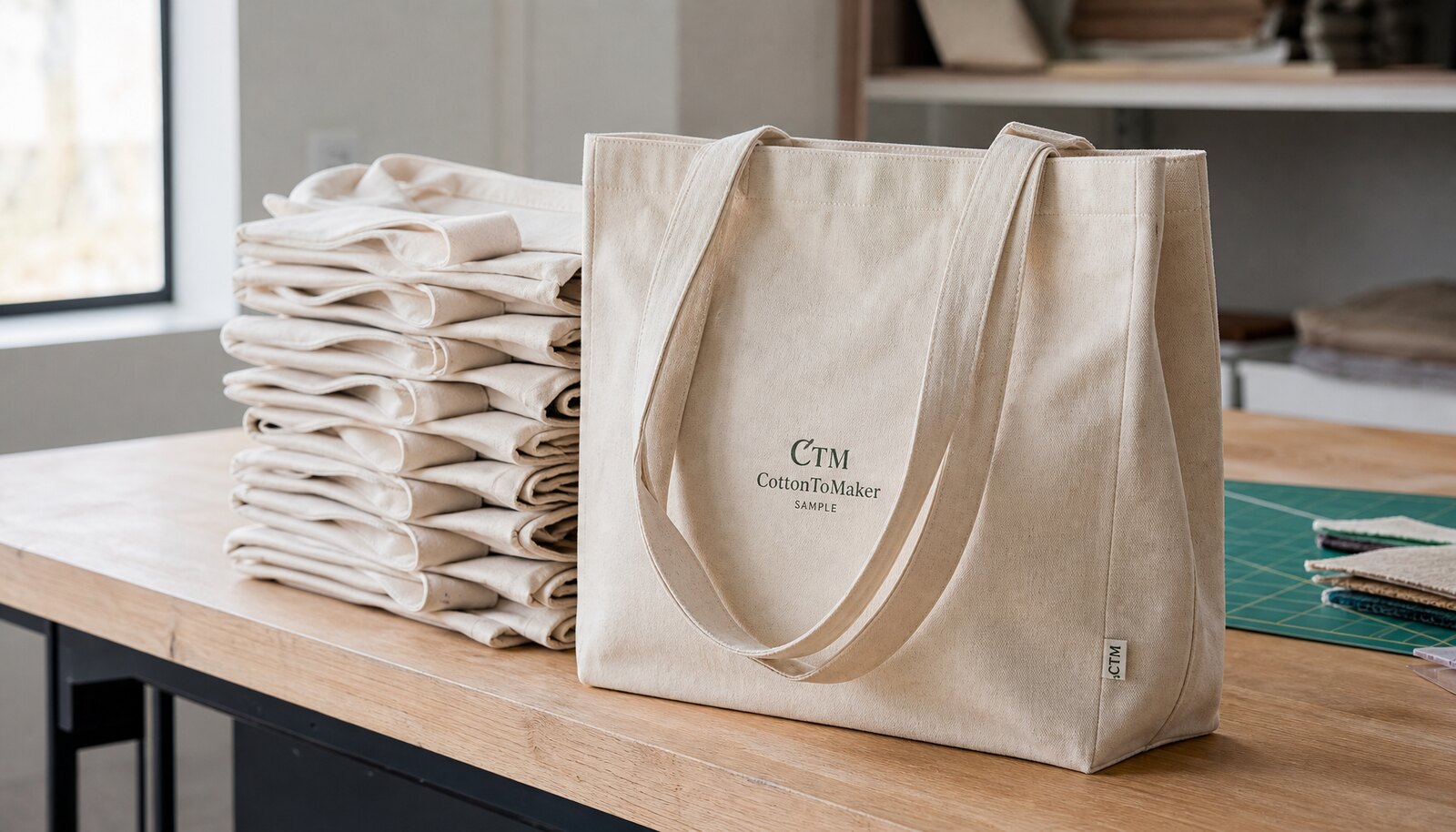
Start With the Event Role, Not the Tote Trend
Procurement teams buying canvas conference bags for wellness brands often start with appearance and end up fixing function later. That creates avoidable rework. For event giveaways, the bag is not a fashion accessory; it is a carrying tool, a brand surface, and a packing item that must move through receiving, storage, and distribution without drama. A tote that looks premium in a mockup can still fail if it tips over once filled, crushes the logo when folded, or takes too much time to pack at scale.
The first question should be the event role. Is the bag handed out at registration, placed in hotel rooms, included in a sponsored kit, or distributed from a booth? Each use case changes the spec. A simple handout can be lighter and less structured. A bag that must carry samples through a multi-day conference usually needs stronger seams, more stable gusseting, and a packing method that does not create heavy creasing. If the event team is asking for a premium look, procurement should translate that into construction choices instead of styling language.
For wellness brands, the useful target is often a medium tote that feels substantial enough to reuse after the event but not so overbuilt that freight, MOQ, and sewing time rise unnecessarily. Reuse matters because many attendees will carry the tote beyond the conference floor. That makes durability, print legibility, and easy packing more valuable than decorative extras. Once the role is written clearly, the rest of the sourcing decision becomes easier to compare across suppliers and budgets.
A concise internal brief helps. Write one sentence that says what the bag must carry, where it will be distributed, and how it should be packed. That single step improves the quality of every quote you receive. It also prevents the common situation where marketing wants a polished giveaway, events wants a fast handout, and procurement receives three different answers from the same supplier because no one defined the operating requirement.
- Write the bag’s primary job in one sentence: handout, sponsor kit, VIP gift, or sample carrier.
- List the exact items the bag must hold during the event, not the items someone hopes it can hold someday.
- Decide whether the tote should feel lightweight, structured, or premium before requesting prices.
Size, Gusset, and Handle Specs Determine Real Usability
A tote can look generous on screen and still be awkward in use. For conference giveaways, the most practical sizes are usually in the 12 x 14 x 4 in, 13 x 15 x 4 in, or 14 x 16 x 5 in range, because those dimensions often fit brochures, product cards, and one or two sample items without making the bag oversized. These are not magic numbers; they are useful starting points for comparing quotes. The key is to match the opening size and gusset to the actual contents, not to a generic promotional standard.
The gusset matters more than many buyers expect. A deeper gusset changes the bag’s usable volume, how easily it stands on a table, how it stacks in cartons, and how the panel behaves once filled. A flat tote can look neat but may not hold a sample bottle cleanly. A tote with too much depth can look bulky and increase material usage. When a tote must carry both literature and product samples, the gusset should be chosen after a real load test, not from a guess.
Handle design affects comfort and packing. A short handle may be fine for a giveaway that is immediately boxed or carried home in a short walk, but it can be uncomfortable in a crowded event setting. Shoulder-length handles are usually more practical for conferences because attendees often carry phones, coffee, or notebooks at the same time. Procurement should ask for handle drop, not just cut length. Handle drop tells you how the bag will sit on the body, which is more useful than a raw number on its own.
Other useful details are often missed in a short quote request: whether the bag should stand upright when empty, whether the top opening needs to stay open at a registration counter, and whether the structure should prevent a sample bottle from tipping. Those choices can change the gusset depth, reinforcement, and carton pack count. For any event with fixed inserts, the safest move is to test the tote with the actual brochure and sample set before approving bulk production.
- Specify finished dimensions and gusset depth in the RFQ, not only the flat panel size.
- Ask for handle drop and handle width so comfort and sewing cost can both be assessed.
- Test the tote with the exact event items before final sample approval.
Fabric Weight Should Match Load, Print, and Reuse Expectations
Canvas is a broad material category, so the same label can hide very different behavior. For event totes, buyers often use 8 oz to 10 oz canvas for lighter handouts and move to 10 oz to 12 oz when the bag must carry more weight or support repeated reuse. That range is a procurement benchmark, not a law. It is useful because it gives suppliers a common reference point, but the better decision comes from matching fabric body to the actual load and the print method.
Fabric weight affects more than the feel of the tote. Heavier cloth often improves structure, but it also increases fabric consumption, sewing time, carton weight, and freight cost. A slightly lighter bag with stronger seams may perform better than a heavy bag with weak reinforcement. Buyers should ask for the full build, not just the cloth weight: weave density, finishing treatment, thread type, seam allowance, and whether the bag includes lining or interfacing. If the supplier offers recycled-content canvas, confirm whether the material shows visible flecking, shade variation, or a softer hand that could affect the brand presentation.
Natural canvas is common because it photographs well and suits wellness aesthetics. Dyed canvas can support brand colors, but it usually brings more variation risk across lots and reorders. If the event is part of a recurring program, consistency should matter as much as initial cost. For that reason, many buyers prefer a stable base fabric with fewer finishing variables. It is easier to reorder a simple, repeatable tote than a complex one that looks slightly different every time it is produced.
Because there is no universal fabric benchmark for every tote program, ask suppliers to state their method clearly. If they cite fabric weight, request whether it is based on the greige cloth, finished cloth, or an in-house estimate. If possible, request a swatch from the same fabric code and compare it to the approved sample. That gives procurement a better basis for understanding whether the quote is built on the same cloth or just a similar-looking option.
- Use GSM or oz/yd² and ask whether the weight is pre- or post-finishing.
- Ask whether the sample cloth and bulk cloth come from the same mill or fabric code.
- If the tote must carry products, test seam and handle performance with a filled sample before approving the fabric.
Printing Choices Should Be Based on Artwork, Not Habit
The print method should follow the artwork and the use case, not a default habit. For many wellness-brand conference bags, one-color or two-color screen printing is the most practical choice because it is durable on canvas and relatively straightforward to repeat. It also works well for bold logos and clean messaging. But screen print has limits: fine text, gradients, and detailed artwork can lose clarity, especially on a textured canvas surface. If the logo is built around delicate lines or color transitions, the decoration method needs to be chosen with more care.
Digital print can support more complex artwork, but the result depends on the canvas texture, ink behavior, and process control. On coarse cloth, small details may soften if the supplier does not manage registration carefully. Embroidery can make a tote feel more premium, but it adds cost, can pucker lighter fabric, and usually makes less sense when the branding area is large. Woven patches or sewn labels can be a useful middle ground: they add a finished look without forcing the entire panel to carry a complex print.
For procurement, the key question is not which method sounds best in marketing language. It is how the method behaves when the tote is folded, packed, carried, and reused. Ask the supplier for a strike-off or print proof on the actual canvas, not only a digital mockup. If the bag will be distributed at scale, define what variation is acceptable in color depth and print position. That keeps the buyer realistic without lowering the bar for blurry text, weak opacity, or misaligned graphics.
A good rule is to keep the logo area as simple as the brand allows. The larger the print, the more important the canvas texture becomes. If the tote will be folded into a kit, the print should be positioned so it does not crease across the main artwork line. That simple adjustment often prevents an avoidable complaint when the bags are opened at the event.
- Use the smallest logo size that remains clear at arm’s length and does not crowd the panel.
- Keep the print away from folds, seams, and corners that can distort the image after packing.
- Request a strike-off on the actual canvas before approving bulk production.
A Useful Spec Matrix Makes Quotes Comparable
A tote quote becomes useful only when the supplier is quoting the same bag. Without a spec matrix, buyers often compare different fabrics, different handle lengths, different print counts, and different packing assumptions as if they were the same product. That creates false savings. A spec matrix keeps the request disciplined and lets each supplier respond to the same scope.
The matrix should cover the variables that actually change the commercial outcome: finished dimensions, gusset depth, fabric weight, weave type, handle length, handle reinforcement, print method, number of colors, print location, packing format, carton count, and target use case. If a team needs help deciding where to spend money, the matrix also exposes which features are optional and which are functional. For example, a heavier cloth may improve presentation, but better reinforcement may matter more for the event load. The matrix makes those tradeoffs visible.
This is where procurement can avoid a polished-RFQ tone and instead work like a buyer in the field. Ask which feature is solving a problem and which feature is purely aesthetic. If the tote is only carrying brochures, a simpler build may be enough. If the tote includes a bottle, a sample pouch, and a program booklet, the build needs more structure. The best quote is not the cheapest one; it is the one that matches the event with the least amount of hidden assumption.
Use the table below as a working reference, then adjust it to your event. The point is not to standardize every wellness giveaway. The point is to give suppliers enough precision that their quotes can be normalized instead of guessed.
- Compare versions of the same tote, not unrelated products.
- Keep one spec sheet as the approved baseline for repeat orders.
- Ask the supplier to identify any assumption that could change price later.
Typical Wellness Event Tote Spec Matrix
The matrix below is a practical starting point for a standard conference giveaway tote. It is meant to help buyers compare options with fewer hidden variables. If your event has a heavier load, a more premium brand position, or a tighter receiving window, adjust the inputs before requesting final pricing. The matrix works best when it is paired with a sample pack or load test, because field use often exposes issues that a product photo will not show.
Use the matrix to compare the effect of one change at a time. For example, hold size steady and compare 8 oz versus 10 oz canvas. Then hold fabric steady and compare one-color screen print versus two-color print. Then hold the bag constant and compare bulk fold versus tissue wrap. This method shows where your extra spend is going and prevents suppliers from bundling tradeoffs into a single unit price. If you later ask for a second round of pricing, you will already know which variables matter most.
| Spec item | Practical buyer choice | What it changes | What to ask the supplier | |---|---|---|---| | Finished size | 12 x 14 x 4 in to 14 x 16 x 5 in | Fit, presentation, freight cube | Confirm exact finished dimensions and tolerance | | Canvas weight | 8 oz, 10 oz, or 12 oz | Structure, durability, cost | State whether weight is pre- or post-finishing | | Handle style | Hand-carry or shoulder-length | Comfort, sewing cost, packing | Ask for handle drop, width, and attachment method | | Decoration | 1-color screen print, 2-color screen print, embroidery, patch | Artwork clarity, cost, lead time | Request strike-off on the actual cloth | | Packing | Bulk folded, tissue-wrapped, polybagged, kitted | Event readiness, labor, carton size | Ask for pack count and carton dimensions | | Supplier route | Factory, trading company, local decorator, stock distributor | Control, speed, repeatability | Confirm who owns fabric, sewing, and packing | | Quality basis | Basic visual check or AQL-style inspection | Risk level at shipment | Ask for defect thresholds and inspection photos |
- Use the matrix to compare one variable at a time.
- Confirm whether the quote includes packing, labeling, and cartons.
- Ask for a sample made to the same matrix, not a different shortcut spec.
Compare Supplier Routes by Control, Speed, and Repeatability
Supplier route matters because not every procurement goal is the same. A direct factory is often the best fit when the tote spec is custom enough that construction control matters. It is easier to align the cloth, sewing, print, and packing under one approval path. The tradeoff is that the buyer has to manage the specification carefully and allow time for sampling and material confirmation. If the buyer is not ready to define tolerances or approve a sample against a written spec, factory sourcing can become slower than expected.
Trading companies can widen the quote field quickly, which is useful when the team wants market coverage or needs help coordinating multiple steps. Their value is coordination, but the buyer should still verify whether they control production or are simply relaying assumptions from another workshop. The same is true for local decorators working from stock blanks. They can move fast for a simple logo, but their control over the underlying tote body may be limited if the blanks vary by lot.
Stock distributors are usually the fastest route, but they suit basic promotional needs more than custom event programs. If the goal is quick distribution with minimal construction risk, they can be practical. If the goal is to deliver a branded wellness experience with a specific bag feel, they may not offer enough control. Nearshore suppliers sit between those two extremes: they can offer shorter transit times and easier communication while still supporting moderate customization.
The right question is not which route is best in theory. It is which route fits the event calendar, the brand standard, and the reorder plan with the fewest hidden assumptions. For recurring wellness conferences, repeatability often matters more than the cheapest first order. A supplier that can reproduce the same bag six months later is usually more valuable than one that wins on unit price but cannot lock the build.
- Ask who owns the fabric, who cuts, who prints, who sews, and who packs.
- Verify whether the supplier can repeat the same bag on a reorder six months later.
- Treat unusually low MOQ as a signal to check whether the item is stock goods rather than true custom production.
Normalize Quotes So Commercial Differences Are Visible
Two quotes can look close and still represent very different offers. One may include only the sewn tote body. Another may include setup, folding, labels, carton work, and freight assumptions. One may quote a lighter cloth that lowers unit cost but changes the tote’s feel. Another may quote a heavier cloth that increases freight and handling but supports better reuse. If procurement compares only the headline unit price, the wrong offer can look like the best one.
Normalize the quote by separating the cost drivers. Ask for the tote body, print setup, recurring print cost, packing labor, cartonization, inserts or labels, freight basis, and duty assumptions. Also ask whether the price is EXW, FOB, DDP, or an informal landed-cost estimate. This is important for event planning because a quote that omits inland freight, customs work, or repacking labor can appear competitive and then fail late in the process. The goal is not to remove every variable; it is to make the variables visible enough that you can compare like with like.
If a supplier’s price is unusually low, check what is missing before assuming it is a bargain. The low offer may rely on a thinner fabric, a looser tolerance, a simpler pack-out, or a sample that is nicer than bulk production. Ask the supplier to list any one-time setup fee separately from recurring unit charges. If there is a second logo location or a color change, clarify whether it affects only the first production run or every reorder. That one question often prevents later friction.
A clean quote comparison also helps internal stakeholders. Marketing can see what premium finishes really cost, events can see the pack-out implications, and procurement can see the true landed-cost impact. When everyone reviews the same normalized structure, the discussion becomes about business tradeoffs rather than about which quote was easier to read.
- Compare the same dimensions, fabric weight, handle style, print method, and packing format across all quotes.
- Separate one-time charges from recurring unit costs.
- Ask the supplier to identify assumptions that could change the price later.
Lead Time Planning Should Follow the Event Calendar Backward
Conference tote sourcing is schedule-driven, so the planning should run backward from the event date. Sampling, artwork approval, fabric confirmation, sewing, packing, transit, and receiving each take time. The mistake most teams make is counting only production days and ignoring the time needed for artwork changes or sample review. A wellness summit with a fixed launch date cannot absorb a late bag delivery, so the procurement plan should show which step is most likely to slow the order before the PO is placed.
Simple stock-based tote programs can move quickly if the base bag is already available and the branding is straightforward. Custom programs take longer because the supplier must confirm cloth, cut panels, check print registration, and often approve packing details. If the bags will be kitted with brochures or products, allow time for a pack trial. A bag that looks approved in a flat sample can still create issues when the event insert is added. That is why a real packing test matters more than a clean mockup.
For recurring wellness events, the best time-saver is a locked approved spec sheet. That file should record fabric code, finished dimensions, handle construction, print method, carton count, and packing instructions. With that baseline, the next order is less likely to drift from the last one. It also makes reordering easier when the event team changes or a new buyer takes over. In procurement terms, repeatability is part of lead-time control because it reduces the chance of having to rework the spec midstream.
If the lead time is tight, prioritize the decisions that carry the most production risk: cloth availability, print method, and packing complexity. Size and handle changes are usually manageable; special fabric or complex kitting can become the schedule bottleneck. A smart buyer does not just ask for the fastest date. A smart buyer asks which variables are likely to delay the date and removes them early.
- Work backward from the handout date and include sample review time.
- Ask the supplier which step most often causes delay: cloth sourcing, print approval, or packing.
- Save the approved spec sheet so future orders can be quoted against the same baseline.
QC Should Use Measurable Acceptance Criteria
Quality control is where a tote becomes dependable rather than merely acceptable. A useful QC plan starts with measurable criteria, not vague language like 'good finish' or 'nice sewing.' If the approved size is 13 x 15 x 4 in, define the tolerance. If the logo must sit centered on the panel, define the allowable distance from centerline or the top edge. If the bag needs to carry a filled sample load, define the load and the seam behavior that will be considered acceptable. Measurable standards reduce arguments at shipment time.
At minimum, procurement should ask how the factory checks fabric weight, print registration, stitch count, reinforcement, odor, carton labeling, and pack quantity. The most visible defects are usually poor print alignment, loose threads, broken stitches, and marked fabric. Less obvious issues matter too: a tote that shrinks too much after finishing, a handle that twists because the webbing was cut unevenly, or a gusset that makes the bag lean when loaded. Those defects may not show in a single product photo, which is why a sample review or photo report is not enough by itself for event-critical orders.
It helps to classify defects. A major defect might be a handle sewn out of position, missing artwork, or a torn seam. A minor defect might be a loose thread that can be trimmed before packing. A critical defect might be contamination, wrong artwork, or a seam failure under normal load. Once those categories are written down, both the supplier and the buyer have a clearer basis for acceptance. If the order is important enough to be used in a public event, use a pre-shipment inspection or an AQL-based check instead of relying only on factory self-reporting.
QC should also include pass/fail thresholds that the receiving team can understand quickly. Examples include exact carton count, correct SKU labeling, no mixed designs, and no visible oil, ink transfer, or odor on opening. If the bags are shipped folded, the fold line should not run through the main logo area or create a permanent crease that weakens the presentation. Those details sound small, but they are often what attendees notice first when they pick up the bag.
- Define numeric tolerances for size, print position, and fabric weight where possible.
- Use major, minor, and critical defect categories so inspection decisions are consistent.
- Request a pre-shipment photo report or third-party inspection for event-critical orders.
Specification comparison for buyers
| Option | Best fit | Tradeoffs | Typical quote signal | Buyer decision check |
|---|---|---|---|---|
| 8 oz stock canvas tote | Light handouts, brochures, low-cost booth giveaways | Lowest material cost, but less body and lower reuse value | Usually the fastest path with lower MOQ and simpler sampling | Choose only if the tote will carry light items and the print is simple |
| 10 oz standard canvas tote | Most conference giveaways, mixed collateral, moderate reuse | Good balance of price and structure; can still feel soft if unreinforced | Often the best baseline for comparing suppliers on equal terms | Use when you need a credible event tote without overbuilding |
| 12 oz heavier canvas tote | Sample kits, premium wellness events, stronger reuse expectation | Higher fabric and sewing cost; freight weight and carton cube increase | Lead time may extend if the mill or finishing is less standard | Use when the bag must hold more weight or look more retail-ready |
| Shoulder-handle tote with reinforcement | Multi-item handout kits, attendee carry use, longer event days | More sewing time, more material at stress points | Quote should show handle width, attachment method, and reinforcement detail | Check whether the handle drop is comfortable with the actual load |
| One-color screen print | Simple wellness logos, high-volume distribution, strong durability | Best for bold artwork; not ideal for gradients or fine detail | Lowest setup complexity and usually the easiest to repeat | Use if the logo can be read clearly at arm’s length |
| Two-color or more complex decoration | Brands that need more visual polish or multiple message layers | Higher setup risk, more proofing time, more chance of registration issues | Expect clearer separation of setup fees and print charges | Require a strike-off on the actual canvas before bulk approval |
| Bulk-folded packing | Fastest, lowest-cost event distribution | Less presentation value; creasing can affect first impression | Usually the simplest packing quote | Use when speed and cost matter more than retail presentation |
| Kitted or tissue-wrapped packing | Sponsor kits, VIP bags, premium event delivery | Adds labor, pack controls, and carton complexity | Quote should separate packing labor from tote manufacturing | Use only when the event experience needs a more finished presentation |
Buyer checklist before sampling
- Write the tote’s actual job first: brochure handout, sample carrier, sponsor kit, or VIP giveaway.
- Test the bag with the real brochure, bottle, box, or insert—not a generic placeholder item.
- Specify finished dimensions, gusset depth, handle drop, handle width, and reinforcement method in the RFQ.
- State fabric weight in GSM or oz/yd² and ask the supplier to confirm whether that weight is pre- or post-finishing.
- Choose print method based on artwork complexity, abrasion exposure, and expected handout volume.
- Request a pre-production sample using the actual cloth, thread, and decoration method.
- Lock packing details early: bulk folded, tissue-wrapped, polybagged, labeled, or event-kitted.
- Normalize quotes by separating unit bag cost, setup charges, packing labor, freight, and duty assumptions.
- Confirm carton pack count and carton dimensions against your warehouse or event receiving rules.
- Save the approved spec sheet so future orders can be compared against the same baseline.
Factory quote questions to send
- What exact fabric weight are you quoting, and is that measured before or after finishing?
- Can you confirm the finished dimensions, gusset depth, handle drop, and handle width in millimeters or inches?
- How many print colors and print locations are included, and what is the setup charge for each additional color or position?
- What is your MOQ by fabric color and by print design, and does MOQ change if we add lining, a pocket, or a zipper?
- Do you manufacture the bag in-house, or do you outsource cutting, sewing, printing, or packing?
- What sample can you provide before bulk production: blank mockup, material swatch, strike-off, or full pre-production sample?
- What tolerance do you hold for size, fabric weight, print position, and stitch alignment?
- How are the bags packed per carton, what is the carton size, and what is the gross weight per carton?
- What inspection steps do you perform before shipment, and can you share photo evidence or an AQL-based inspection report?
- What parts of the quote are one-time setup charges versus recurring unit charges, and what could still be added later as a surcharge?
Quality-control points to confirm
- Fabric weight should stay within the agreed tolerance, and the lot should not show thin spots, heavy slubbing, or uneven weave density visible at normal viewing distance.
- Finished dimensions should be within the agreed tolerance, for example ±0.5 cm to ±1.0 cm on smaller totes or ±0.25 in to ±0.5 in on larger totes, depending on the spec sheet.
- Handle length, handle drop, and reinforcement stitching should be consistent across the lot, with no loose ends, skipped stitches, or misaligned attachment points.
- Box-X, bar-tack, or top-stitch reinforcement should be complete and centered; broken thread tails or partial stitching should be treated as a defect.
- Print placement should stay within the approved location tolerance, such as ±0.3 in to ±0.5 in from centerline or top edge depending on the artwork.
- Ink should not smear, crack, or ghost under normal handling; screen print should be opaque enough to cover the canvas texture without flooding fine letters.
- If the bag uses embroidery or patches, backing should not pucker the fabric beyond the approved sample and no loose threads should remain on the front face.
- Carton counts should match the purchase order exactly, with no short packs, mixed designs, or unlabeled cartons at receiving.
- Odor, staining, and contamination should be checked on both body fabric and packing materials before sealing cartons, especially on natural or dyed canvas.
- If a bag is shipped folded, the fold line should not cut through the logo area or create a permanent crease that distorts the print on arrival.