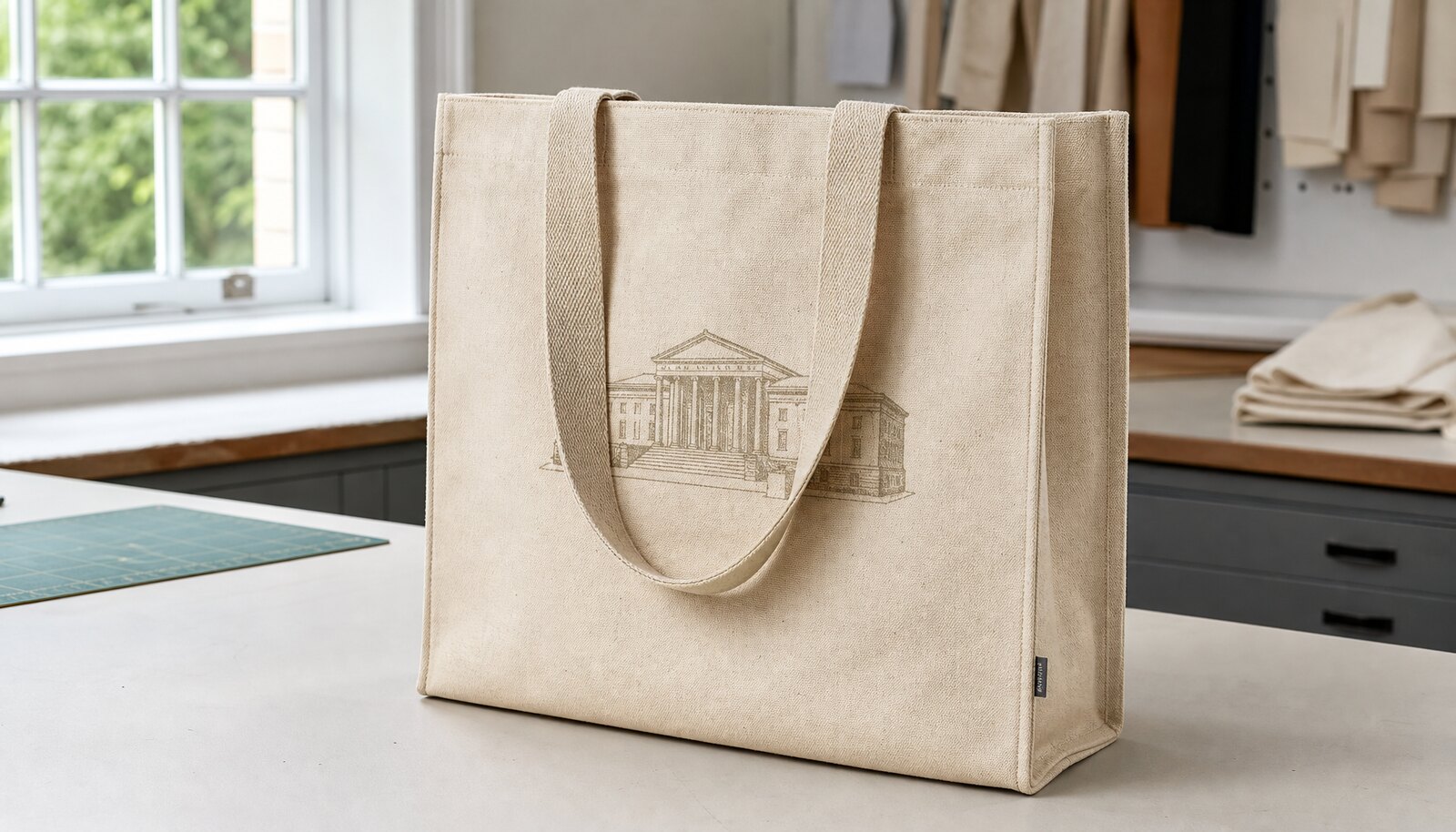
Start With the Use Case, Not the Tote
Museums often buy conference bags for several different moments at once. The same bag might be handed to delegates at registration, used to carry catalogs around the venue, and then taken home as a reusable souvenir. That makes the buying brief more complicated than a standard promo order because the bag has to look appropriate in public, survive real handling, and still make sense on a unit-cost spreadsheet.
The right spec starts with the contents, the audience, and the expected afterlife of the bag. A tote that only needs to hold a brochure and a notebook can stay relatively light and flat. A tote that must carry a program, a water bottle, and retail purchases needs more structure and a stronger base. If procurement does not define that use case early, suppliers will quote different assumptions and the comparison will be misleading.
For buyer teams searching for canvas conference bags for museums sustainable packaging comparison, the real question is not whether the bag is simply canvas. It is whether the bag and its pack format support reuse, avoid unnecessary secondary packaging, and still perform well enough that the bag is not discarded after the event. A product that is used five times is usually a better packaging outcome than one that looks greener on paper but fails in use.
- Use case first: delegate pack, retail handoff, sponsor gift, or multipurpose reusable tote.
- Load expectation second: flat collateral only, mixed printed material, or heavy carry items.
- Brand expectation third: neutral functional bag, visible sponsor piece, or museum-quality souvenir.
Compare Material Options and Sustainability Proof
The strongest sustainability conversations in canvas tote buying are concrete, not aspirational. Buyers should compare the material options by what can be proved, what can be repeated on reorder, and what will actually reduce waste in the full supply chain. A natural cotton canvas bag may be simpler to source and easier to decorate, but that does not make it a better sustainability choice unless the material and production method are documented. A recycled cotton version may support a stronger claim, but the fiber mix, traceability, and batch consistency need closer scrutiny.
Organic cotton can be useful when the museum wants a more formal material story, yet the value only exists if the certificate scope is valid and matches the actual production line. The same is true for recycled content. Ask whether the claim applies to the yarn, the fabric, or only a component of the bag. Ask whether the proof is a mill certificate, a third-party certification, or simply a supplier declaration. Those are not interchangeable in procurement terms.
The practical test is whether the supplier can support the words used in the quote. If the bag is marketed as recycled, request the percentage basis, the chain-of-custody path, and any certificate number that covers the relevant facility. If the buyer needs a restricted-substances check, ask for test evidence against the destination market’s list rather than a vague “eco-friendly” statement. For many buyers, the best sustainability gain is not a claim at all, but a reduction in extra packaging, overprinting, and rework.
- If the factory cannot document the claim, do not put the claim in the quote or on the packaging.
- If the bag uses mixed fibers, ask how the supplier measures the reported percentage.
- If the sustainability message depends on reduced packaging, ask for the carton and pack plan before approving the art.
Choose the Right Construction for the Load
Construction decisions are where many tote projects either become genuinely useful or quietly disappointing. Flat bags are efficient and economical, but they have limited capacity and can feel thin if the contents are bulky. A modest gusset usually gives the best balance for museum events because it allows the bag to carry brochures, catalogs, and small retail items without adding the cost and weight of a heavily engineered retail tote.
Handle design matters just as much. Self-fabric handles can keep the look consistent, but cotton webbing often feels more comfortable in hand and is usually better for repeated carry. Buyers should also watch the handle drop. A tote with a handle that is too short will sit awkwardly under the arm, and a handle that is too long can make the bag drag when full. If the bag will be used all day at a conference, comfort becomes a real quality issue rather than a minor preference.
There is also a hidden cost in overbuilding. A heavy base board, thick lining, or extra pockets can improve perceived value, but they may also slow sewing, increase freight weight, and push the bag into a different price tier. If the tote is meant to be a practical conference carrier rather than a retail fashion item, simpler construction with good reinforcement is often the more defensible procurement choice.
- Flat tote: best for light packs and the lowest material use.
- Modest gusset: best default for museum conferences and mixed contents.
- Reinforced base or lining: use only when the contents justify the extra cost and weight.
- Cotton webbing handles usually perform better than narrow self-fabric handles when the bag will be reused often.
Treat Branding as a Manufacturing Decision
Branding on canvas is not only a design choice. It changes the production method, the setup cost, the usable artwork area, and sometimes the durability of the bag itself. A simple one-color screen print usually works well on medium-weight canvas when the logo is bold and the text is legible at a decent size. It is often the cleanest option for museum identity marks because it keeps the quote readable and the print process straightforward.
Where buyers get into trouble is trying to force too much detail onto a textured bag. Small text, thin rules, and complicated gradients can disappear or fill in. A heat transfer can solve some of that detail problem for short runs, but buyers should not assume every transfer behaves the same on canvas. Ask how it wears, whether it cracks, and whether the print still looks acceptable after handling. If the bag is going to be reused, the print needs to tolerate real use rather than just look good in a photo.
A woven label or restrained embroidery can work when the museum wants a more understated presentation, but those methods should be sampled carefully on the chosen fabric. Heavy stitching can distort lighter canvas, and a label placed too close to a seam can look like an afterthought. The safest approach is usually to compare two or three versions side by side: one clean print, one quieter premium treatment, and one plain sample. Procurement can then judge not only cost but also visual fit for the museum context.
- Use screen print when the artwork is simple, the logo needs strong contrast, and unit cost matters.
- Use heat transfer only when the artwork requires detail that print cannot hold, and verify durability before bulk approval.
- Use woven labels or embroidery for restrained premium branding, but check fabric distortion on the actual canvas weight.
- Ask for the exact print area and the smallest line thickness the factory can hold without fill-in.
Compare Supplier Models Before You Compare Prices
A low price from the wrong supplier model can turn into a difficult project. Direct factory sourcing usually offers the best control over fabric, sewing, and packing, which matters if the museum expects repeat orders or consistent brand presentation across multiple events. The tradeoff is that the buyer has to be more precise with the spec, because the factory will usually work to the details it receives rather than filling in the gaps.
A trader or local converter can be useful when the order is small, the design changes often, or the buyer needs simpler communication and domestic billing. That route can reduce coordination burden, but it can also hide the real production conditions. If the quote comes through a middle layer, procurement should still ask who is actually cutting, sewing, printing, and packing the bags. Without that, the buyer cannot judge the real manufacturing control or the true source of any claim.
For museum teams comparing several quotes, the point is not to force every order through the same sourcing route. The point is to understand what each route is good at and what it obscures. Direct factory is usually strongest on repeatability. A trader may be strongest on convenience. A local decorator may be strongest on speed. The right choice depends on whether the museum values fewer surprises, faster communication, or lower administrative overhead.
- Direct factory: best for repeatable specs, custom reinforcement, and tighter QC.
- Trader or converter: useful for small mixed programs, but ask for the actual producer’s identity and responsibility split.
- Local decorator: helpful for tight deadlines or domestic fulfillment, especially when shipping complexity matters more than unit price.
- Do not compare a factory quote and a trader quote until the production assumptions are made identical.
Build an RFQ That Forces Like-for-Like Quotes
Most tote buying problems begin with vague RFQs. If one supplier assumes a 10 oz bag with bulk packing and another assumes a 12 oz bag with individual polybags, the final comparison will be distorted before procurement even starts. A useful RFQ should make the supplier answer the same questions in the same order: size, fabric, handle, print, label, pack format, documentation, sample path, and lead time.
The cleanest RFQs use measured dimensions and production language, not shopping language. State the finished width, height, and gusset. State the handle drop. State the exact print position and artwork size. If a recycled or organic claim is part of the project, say whether the claim must appear on the bag, on the carton, or only in internal procurement records. That matters because some suppliers can support the material claim but not the packaging language.
This is also where buyers can avoid hidden version drift. Ask the supplier to quote the same bag in multiple quantities, with the same fabric and the same artwork, so the unit price curve is visible. Ask for what changes when the order size drops below MOQ. If the supplier cannot explain the threshold, the quote is too loose to compare safely.
The best RFQ output is not just a price. It is a record of what the price includes and what it excludes. That record becomes the basis for the approval sample, the production order, and the receiving inspection later on.
- State finished dimensions, not approximate size ranges.
- Identify whether any sustainability claim needs to appear on the bag, carton, or only in procurement documents.
- Ask for price breaks at 500, 1,000, and 3,000 pieces using the same spec.
- Require the supplier to list exclusions explicitly, especially setup fees, label costs, and special packing.
Approve Samples Like a Buyer, Not a Graphic Designer
A museum tote sample should be judged as a working product. The first check is dimensional: does the finished piece match the spec sheet once seams are sewn and handles are attached? The second check is functional: does it carry the expected contents without deforming or stressing the seams? The third check is visual: does the bag still look like a museum-appropriate item when it is full, folded, and handled by a visitor?
Buyers often stop at a clean front view photo or a neat strike-off, but that misses the most important defect paths. Seam twist at the gusset, short handles, crooked labels, and print distortion on a textured weave are the kinds of issues that appear only on a physical sample. The sample should be approved with realistic contents inside, not empty on a table. If the museum plans to hand out a catalog and a bottle, the sample should be loaded that way before signoff.
Keep one approved sample sealed and identify it clearly as the control reference. If a later batch is slightly different, there should be no debate over what was originally approved. This is especially useful when multiple event dates or reorders are involved. The best procurement teams treat the sample as a production standard, not a keepsake.
- Measure the sample against the spec sheet after sewing, not just before cutting.
- Load the bag with the intended contents before approving handle comfort and seam performance.
- Keep one sealed approved sample as the control reference for future batches.
- If artwork is complex, ask for a pre-production sample or strike-off in addition to the physical tote.
Use QC Checks That Match the Real Risks
Quality control for canvas conference bags should focus on the failures that matter in use. The first is material control: fabric composition, finished weight, and color consistency. The second is construction control: seam quality, handle reinforcement, and dimension accuracy. The third is presentation control: print registration, label placement, folding, and carton count. Those are the areas where small mistakes become visible at the event or in the store.
A useful QC plan should be written in plain production language. For example, if the handle reinforcement is a box stitch with an X, say so. If the print must stay within a certain alignment tolerance, say so. If the factory must reject bags with loose thread, puckering, or visible contamination, say that plainly in the production note. Buyers should also ask for the supplier’s internal inspection method so they know how defects are screened before the shipment reaches the buyer’s team.
For sustainability-focused orders, QC should include the claim itself. If the tote or its packaging says recycled, organic, or reduced-plastic, the wording should match the documentation on file. A mismatched label claim is a procurement problem, not a design preference. That is why the QC checklist should cover both the physical product and the paperwork behind it.
- Check fabric weight, composition, and shade consistency before shipment.
- Inspect handle reinforcement, seam straightness, and label placement.
- Confirm print density, cure quality, and abrasion resistance if the bag will be reused.
- Verify carton counts, folding pattern, and pack cleanliness.
- Match any sustainability wording on the product or carton to the proof on file.
Reduce Packaging Waste Without Creating Handling Problems
Packaging is part of the sustainability comparison, not an afterthought. A tote that arrives in individual polybags may look cleaner, but the extra plastic can undermine the packaging-reduction story if retail presentation is not required. In many conference programs, bulk folded cartons are enough. That approach lowers secondary material use and usually improves shipping efficiency as well.
The tradeoff is that bulk packing needs more discipline. Bags must be folded consistently, cartons must be counted accurately, and the packed finish must still look acceptable when the delegate receives the tote. If the museum is handing bags out at registration, the pack format should support quick distribution rather than retail shelf appeal. If the bags are being sold in a shop, a cleaner presentation may justify some extra packaging, but buyers should still ask whether a paper band or minimal wrap can replace full polybagging.
This is also where freight economics and sustainability can align. Cleaner folding, tighter cartonization, and fewer secondary materials can reduce shipped volume and handling time at the same time. The buyer should ask the supplier to propose the most efficient pack format for the actual channel, not a one-size-fits-all retail format. That produces a better comparison than only asking for the lowest unit price on the bag itself.
- Bulk folded cartons are usually the best option for conference distribution.
- Individual polybags should be reserved for retail resale, long storage, or presentation-sensitive channels.
- Ask whether paper bands, minimal wraps, or no secondary packaging are acceptable for the channel.
- Request carton dimensions and gross weight so freight impact can be compared honestly.
Compare Landed Cost, Lead Time, and Reorder Control
The cheapest factory price is not always the lowest landed cost. Heavier fabric, special packing, extra labels, and longer freight volume can change the total quickly. Buyers should compare the same bag across suppliers on a landed basis: unit price, setup cost, sample cost, packing format, carton efficiency, and the shipping assumption attached to the quote. If one supplier quotes ex-works and another includes inland pack-out, those offers are not equivalent until procurement normalizes them.
Lead time also needs to be broken into pieces. Sample approval, artwork corrections, fabric sourcing, production, packing, and dispatch each carry their own delay risk. A project with a fixed conference date should not rely on a single promised number without buffer. The more version changes the bag has, the more the buyer should insist on a clear approval deadline and an explicit cut-off for artwork revisions.
For reorder programs, control matters more than novelty. The buyer should ask the supplier to archive the approved spec, the signed sample reference, and the final carton format. That makes the second order faster and lowers the chance of drift. A good supplier relationship for museum tote programs is one where the specification becomes stable enough that the team can reorder without re-litigating the same details every time.
- Compare total landed cost, not only ex-factory unit price.
- Break lead time into sample, approval, production, and dispatch milestones.
- Set an artwork freeze date so revisions do not push the shipment past the event window.
- Archive the approved sample and final spec for reorder consistency.
Specification comparison for buyers
| Decision area | Option to compare | Best fit | Lifecycle or sustainability tradeoff | What to request from the supplier |
|---|---|---|---|---|
| Fabric choice | Natural cotton canvas | Programs that want a straightforward textile with broad availability and simple decoration | Usually easier to source and compare, but it does not automatically qualify as a lower-impact choice unless you can verify fiber origin and processing | Composition statement, finished GSM or oz, dye or bleach treatment details, and any restricted-substance test report |
| Fabric choice | Recycled cotton canvas or recycled cotton blend | Buyers trying to support recycled-fiber messaging while keeping the look of a canvas tote | Can improve recycled-content claims, but recycled cotton often varies more in color and hand feel; traceability matters | Recycled-content proof, traceability statement, lot-level consistency notes, and certification documents if the factory claims one |
| Fabric choice | Organic cotton canvas | Museums with a tighter sustainability narrative and willingness to pay for certified fiber control | Can support a stronger material story, but certification scope and chain-of-custody need to be checked carefully | Valid certificate number, scope coverage, transaction certificate where applicable, and mill-to-factory traceability |
| Bag structure | Flat tote | Light event packs, guidebook handouts, or lower-volume conference kits | Uses less fabric and folds efficiently, but load capacity is limited and the bag may feel less substantial | Finished dimensions, seam allowance, handle drop, and a sample packed with the intended contents |
| Bag structure | Modest gusset with reinforced base | Most museum conference programs that need room for catalogs, notebooks, and a water bottle | Adds material and sewing time, but usually improves reuse and reduces premature failure | Gusset depth, reinforcement method, stitch pattern, and load-test result with realistic contents |
| Branding method | 1-color screen print | Simple museum identity marks and sponsor-safe branding on medium-weight canvas | Low ink usage and strong legibility when artwork is simple, but it is not ideal for tiny text or fine gradients | Artwork file review, print size, ink type, mesh recommendation, and an approved strike-off or pre-production sample |
| Branding method | Woven label, small embroidery, or stitched side mark | Premium-looking bags where the museum wants restrained branding | Can feel more durable and less ink-intensive, but may add cost and can distort lighter fabric | Label artwork, placement drawing, stitch density or weave specs, and a sample showing finished placement |
| Packing approach | Bulk folded carton pack | Conference distribution where bags are handed out in quantity | Reduces secondary packaging and shipping volume, but folding discipline becomes important | Carton count, fold orientation, carton dimensions, gross weight, and photo of packed carton pattern |
| Packing approach | Individual polybag or retail-ready pack | Store sales, long storage, or channels that need cleaner presentation | Better for presentation control, but usually increases plastic use and labor | Polybag thickness, pack method, and whether a paper band or alternate low-plastic format is acceptable |
Buyer checklist before sampling
- Define the use case first: delegate pack, museum-store giveaway, retail sale, sponsor gift, or long-term reusable conference bag, because each one changes the right size, finish, and pack format.
- Lock the bag dimensions in finished measurements, not only in a sketch, and specify whether the quoted fabric weight is finished weight or raw weight.
- Ask the supplier to state the exact fiber composition and, if you are making a recycled or organic claim, request the proof that supports it.
- Specify handle length, handle drop, reinforcement method, and whether the handles are self-fabric or cotton webbing.
- Confirm the print position, print size, number of colors, and acceptable variation for alignment and color density.
- Request a pre-production sample or sealed reference sample before bulk approval, and keep one approved sample as the control standard.
- Write down the packing method: bulk folded, individual polybag, paper band, carton count, and whether any extra inserts are required.
- Compare quotes at the same order quantities, ideally at 500, 1,000, and 3,000 pieces, so setup cost and material cost are visible.
- Ask for the lead-time breakdown: sample lead time, production time, packing time, and the date by which artwork must be final.
- Confirm the shipping terms and documents you need for customs, distributor handoff, or museum procurement records.
Factory quote questions to send
- Is the quoted fabric weight finished weight or raw weight, and what tolerance do you allow on production lots?
- What is the exact fiber composition, and can you share proof for any recycled or organic claim?
- What is your MOQ by fabric color, print color, and bag size, and how does the unit price change across 500, 1,000, and 3,000 pieces?
- Which print method is included in the quote, and what are the limits for line thickness, small text, and artwork density?
- Can you share the seam construction at the handle attachment and bottom gusset, including stitch type and reinforcement pattern?
- What sample stages are available before mass production, and what are the charge and lead-time policies for each one?
- How will the bags be folded, packed, and cartonized, and what carton dimensions and gross weight should we expect?
- What QC checkpoints do you run before shipment, and what defects are treated as rejectable?
- Which restricted-substance or material tests can you provide for the target market, and who pays for retesting if the buyer requests it?
- Can you supply production photos, carton marks, and final packing counts before shipment is released?
Quality-control points to confirm
- Fabric composition, finished GSM or oz, and color must match the approved spec and control sample.
- The fabric should be even, with no obvious slubs, contamination, or batch-to-batch shade jumps that would stand out in a tote meant for public use.
- Handle length, handle drop, and left-right symmetry should stay within the agreed tolerance.
- Handle attachment points should show consistent reinforcement, with no skipped stitches, loose thread, or weak anchoring at the mouth of the bag.
- The bag body should keep the agreed dimensions after sewing, not just before cutting.
- The bottom gusset and side seams should remain straight, with no twisting, puckering, or misalignment when the bag is empty and when it is filled.
- Print should register cleanly, with no blur, cracking, over-inking, or obvious mismatch between first and last pieces in the run.
- Label, woven tag, or side mark should be centered, secure, and free from fraying or crooked placement.
- If the bag is meant to be reused, a simple load test should be run with realistic contents such as catalogs, notebooks, and a bottle before shipment approval.
- Carton counts, folding orientation, carton marks, and packing labels should match the packing list exactly, with no missing or mixed SKUs.