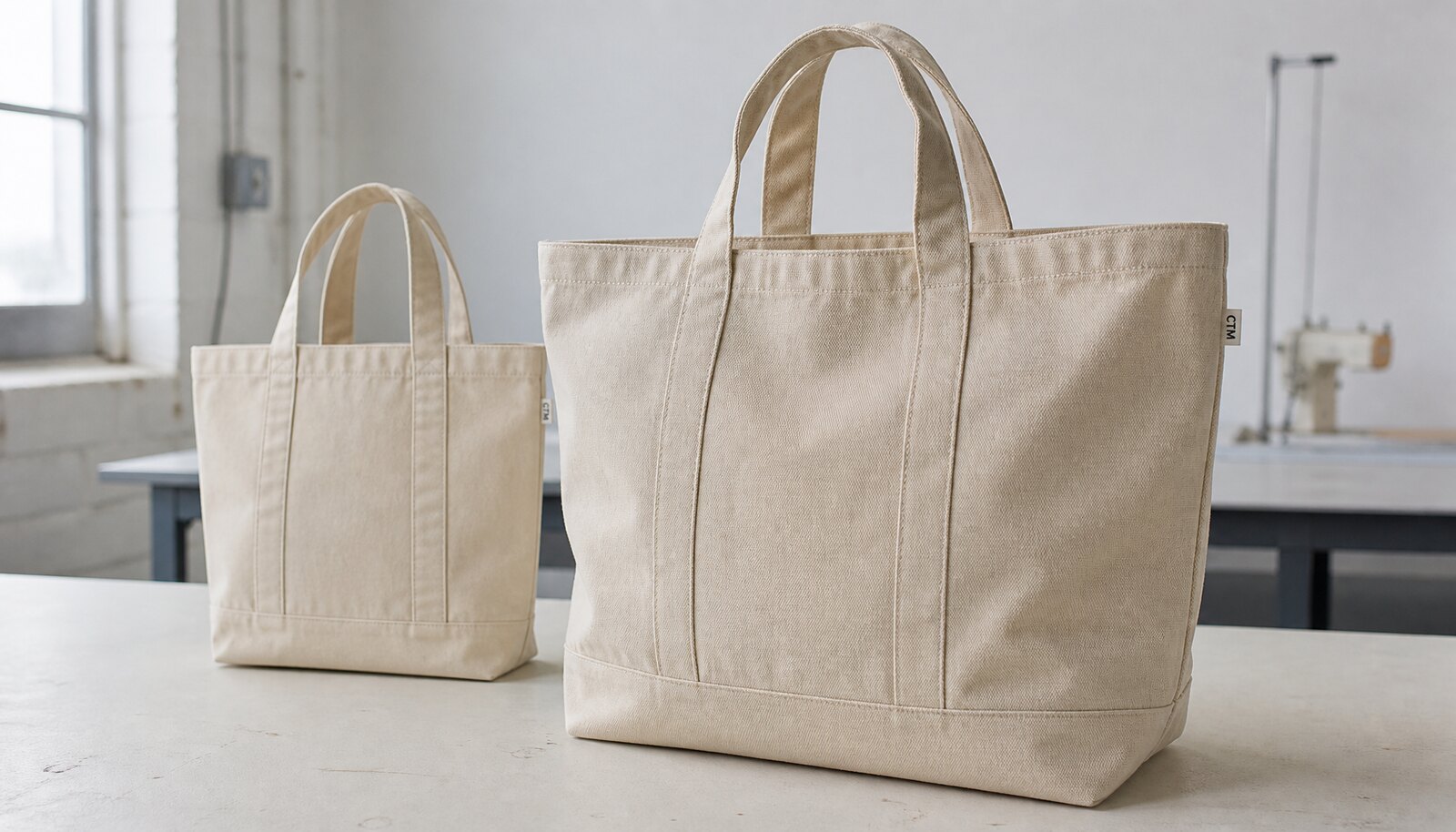
What winery buyers actually need from a conference tote
Winery buyers do not use conference bags for only one purpose. The same tote might carry tasting notes at a trade show, a brochure stack at a distributor meeting, or a gift set in a tasting room. That matters because the bag is doing more than holding paper. It is part of the brand presentation, part of the carry experience, and sometimes part of the retail product itself. A bag that is fine for a short giveaway may look cheap once it is sitting next to a bottle, a hardcover card set, or a premium membership insert.
That is why the first sourcing decision is not print color or bag style. It is the use case. If the bag is only carrying handouts, the buyer can stay in a lighter construction with simple open-top access. If it must carry a bottle or live on a retail shelf, the spec needs more body, better seam reinforcement, and a cleaner finish. Buyers who skip that first step usually end up comparing quotes for bags that are not actually interchangeable, then spend the rest of the RFQ cycle trying to reconcile apples with pears.
- Trade-show use prioritizes access, print visibility, and low unit cost.
- Retail use prioritizes finish quality, stiffness, and repeatable construction.
- Bottle-carry programs need stronger seams and a more stable bottom.
- The use case should be written before the supplier starts quoting.
Set the base construction before you ask for price
For a standard winery conference tote that mainly carries brochures and tasting materials, 10 oz canvas is usually the practical starting point. It gives enough body to avoid a limp, giveaway look without jumping immediately into a heavier and more expensive build. When the bag is expected to carry heavier inserts, a catalog stack, or a single bottle, 12 oz canvas becomes a safer spec because it improves shape retention and reduces visible stress around the seams. The important procurement move is not to treat the ounce number as a slogan. Ask the supplier to quote the same style in more than one fabric weight so you can see the real cost difference.
Size and structure matter just as much as fabric weight. A useful conference bag usually needs a bottom gusset, a clean top hem, and handles that are wide enough to stay comfortable under load. Write finished dimensions, handle drop, and handle width into the RFQ instead of letting the factory default to a generic tote pattern. A buyer-side tolerance helps too. For example, many teams set a separate tolerance on finished size and a tighter one on print placement. Without those numbers, a bag can pass on paper and still arrive with a profile that feels off in hand.
- Use 10 oz as a practical baseline for paper-carrying conference use.
- Move toward 12 oz when the bag must hold a bottle or premium inserts.
- Do not leave size, gusset depth, or handle drop to the factory's standard template.
- Write tolerances into the spec so inspection is not subjective.
Build seams and handles for real load, not just sample photos
Most tote failures start at the stress points. If the side seams are too light, the bag twists. If the handle anchors are not properly bartacked, the load concentrates on a small area and the bag starts to open at the top edge. For that reason, buyers should ask for the actual seam method, not a generic description like reinforced construction. The factory should state whether the bag uses double-needle stitching, how the seam allowance is formed, and how many bartacks are used at each handle anchor. Those details are more useful than broad marketing language because they tell procurement where the labor and the risk really sit.
The simplest approval test is also the most revealing. Fill the sample with the actual brochure stack, bottle mock-up, or gift set the bag is expected to carry, then lift it by one handle, set it down, and repeat the movement several times. Watch the gusset, the handle root, and the top hem. A good bag should keep its shape, show no skipped stitches, and avoid seam puckering. If the bag feels fine empty but deforms once loaded, the construction is not strong enough for the program, no matter how clean the print looks.
- Ask for seam method, seam allowance, and bartack count in writing.
- Check side seams and handle roots under load, not only in a flat sample photo.
- A reinforced label is not a substitute for structural sewing.
- If the bag twists under one-hand lift, the construction needs revision.
Choose decoration that survives folding, storage, and repeat use
For most winery programs, one-color screen print is still the most practical decoration route. It holds up well on natural canvas, keeps the bag visually calm, and is easier to repeat across reorders than more elaborate artwork. A woven side label or hem label can add a premium cue without forcing a large, loud logo onto the front panel. That matters for wineries, where the bag often needs to look refined rather than promotional. Full-color graphics are possible, but they tend to add cost and complexity without improving the buyer's use case unless the tote itself is being sold as a retail fashion item.
The issue to manage is not only artwork. It is print durability. Ask the supplier how the logo will behave after folding, handling, and carton compression. A print that looks strong at first glance but cracks on a fold line is a reject for a repeat-use bag. The safest request is a strike-off or printed sample on the actual canvas color, followed by a practical handling check. Fold the sample, carry it, place it into a carton, and inspect it again. The bag should still look aligned and clean after that cycle. If the print is likely to be reused often or sold at retail, ask whether the ink or transfer method has any wash or rub-resistance language that can be written into the spec.
- One-color screen print is the default for most winery conference bags.
- Woven labels work well when the brand wants a quieter premium look.
- Do not approve decoration from a digital proof alone; inspect a strike-off on the actual fabric.
- Check the print after folding and handling, not only when the bag is flat.
Compare supplier routes with a procurement lens
A direct factory is usually the best route when the program will repeat, the bag needs custom sizing, or the buyer wants real control over fabric, stitch, and decoration. The upside is fewer layers and better consistency on reorder. The tradeoff is that procurement has to write a sharper spec and manage approvals more carefully, because the factory will build exactly what is written. A trading company or sourcing agent can make sense when the order includes multiple items, such as bags, inserts, and packaging, but the buyer should still insist on knowing the actual factory and the exact production line used for the tote.
Domestic decorators who work from imported blanks are useful for rush projects and very small quantities, but they have a different risk profile. The blank bag may change between runs, and the print result can vary if the underlying tote is not controlled. That route can be perfectly rational for a short deadline, but it is not the same as buying a repeatable custom build. The buyer-side question is simple: which route gives you the lowest real risk for the channel and timeline you have? The answer is not always the lowest ex-factory number.
- Direct factory routes are strongest when repeatability and spec control matter.
- Trading companies help when the procurement package spans multiple SKUs.
- Imported blanks can be fine for speed, but reorder consistency is weaker.
- Ask who actually sews, who prints, and who owns the sample approval record.
Use MOQ as a design variable, not a sales objection
MOQ is not a fixed industry truth. It changes with color, print count, packaging, and fabric availability. A natural canvas bag with one-color print and bulk folding usually has a more manageable MOQ because the factory does not need custom dyeing or special packing labor. Once the program adds multiple print colors, zippers, custom labels, or retail-ready polybags, the MOQ climbs because each extra setup adds time and line changeovers. For winery buyers, the smarter approach is to quote the base bag and the premium version separately so the team can see where the cost jumps actually begin.
Price breaks matter just as much as minimums. Ask the supplier to quote 500, 1,000, and 3,000 pieces if the bag might scale. That gives procurement a view of the reorder curve and the true impact of setup charges. It also exposes which supplier is hiding tooling, screen preparation, packaging, or label work inside the unit price and which one is billing those items separately. A clean RFQ makes those differences visible. A bad RFQ makes every quote look comparable when it is not.
- MOQ usually rises with custom dye, multiple print colors, labels, and retail packing.
- Ask for tier pricing at more than one volume so the reorder curve is visible.
- Compare the base version and premium version separately.
- Separate screens, labels, carton changes, and sampling from unit price.
Approve samples in three stages, not one
A disciplined sample process has three steps: blank prototype, decorated sample, and pre-production sample. The blank sample proves the size, fabric feel, handle shape, and stitch behavior. The decorated sample proves logo placement, print opacity, and overall look. The pre-production sample is the real gate because it should reflect the final fabric lot, final print setup, and final packing method. If a supplier skips that last step, the buyer is accepting bulk risk before the production line is actually locked.
The sample should be evaluated with real contents. Put the brochure stack, bottle mock-up, or gift set into the bag and check how the weight lands on the handle anchor and gusset. Measure the handle drop when the bag is loaded, not when it is empty. Inspect the top hem for roll, the seams for puckering, and the print for drift or edge distortion after the bag has been folded and reopened several times. If the bag is intended for retail, also check odor and visible finishing residue. A sample that looks acceptable in a flat photo but fails once filled is not ready for bulk approval.
- Blank sample checks construction, size, and handle feel.
- Decorated sample checks logo placement and print quality.
- Pre-production sample must reflect the final fabric, final print method, and final packing.
- Use the real insert load when approving the sample.
Write packing, carton counts, and freight assumptions into the RFQ
Packing is part of the product. If the bags are going to a warehouse or a distributor stock program, bulk folding in master cartons usually gives the best landed cost. If they are going to retail shelves or membership kits, individual polybags may be required, but the buyer should expect more labor, more carton volume, and more freight weight. This is why carton count cannot be left to the supplier's standard. The correct pack count depends on the finished bag size, fold pattern, and how much compression the bag can take without permanently creasing the logo area.
The RFQ should ask for carton dimensions, gross weight, outer marks, and pallet assumptions if the order will be palletized. Those details matter because canvas bags can be deceptively bulky even when empty. A quote that looks cheap on the unit price can become expensive once freight and warehouse receiving are added. Ask the supplier to show how the bag is folded, where the print lands in the fold, and whether a paper insert or protective layer is needed to keep the logo clean. If the receiving team cannot count the cartons quickly and accurately, the packing spec is not good enough yet.
- Bulk folding is usually the lowest-cost packing route.
- Retail packing adds labor, volume, and freight cost.
- Define carton count by bag size and fold pattern, not habit.
- Ask for carton dimensions, gross weight, and outer marks before you compare quotes.
Separate lead time into milestones and inspection gates
Lead time should never be reduced to a single number. A useful schedule separates artwork approval, sample approval, bulk sewing, decoration, inspection, and transit. That matters because a delay in any one step can move the shipment date, and not every step can be recovered by rushing the factory. For a straightforward bag with stock canvas and one-color print, the supplier may be able to move quickly once the sample is approved. Add custom dyeing, complex packaging, or multiple decoration passes and the timeline stretches. The buyer should insist on a calendar, not a promise.
Inspection should sit between bulk completion and freight booking. That keeps the buyer from paying to move rejected cartons. The safest process is to require a pre-ship inspection against the approved sample, the packing list, and the carton label format. If a print position shifts, a carton mark is wrong, or the bag count per carton changes, the issue should be corrected before shipment. The real risk is rarely the sewing itself. It is the combination of late artwork changes, peak-season capacity, and a weak approval chain.
- Ask for a milestone calendar, not a single delivery promise.
- Separate sample time, bulk time, inspection time, and freight time.
- Do not book freight until the pre-ship inspection is passed.
- Late artwork changes are one of the easiest ways to blow the schedule.
Compare landed cost and remove the RFQ mistakes that distort it
The quote that matters is not the lowest factory price. It is the lowest usable-bag cost after freight, packing, duty, and reject risk are considered. A thin bag with poor print cure or weak handles can end up more expensive than a better-built tote because it creates complaints, rework, or warehouse sorting. Procurement should compare landed cost at the same spec level, not chase a low number that only looks attractive because the quote omitted setup, packing, or shipping assumptions.
The cleanest way to avoid distortion is to use one spec sheet for every supplier. The sheet should lock the use case, fabric weight, finished dimensions, handle dimensions, decoration method, carton count, and target quantity. That leaves less room for the supplier to quote a different bag under the same headline description. A solid RFQ also reduces the amount of back-and-forth around seam construction, print placement, and packing. In a buyer-side workflow, clarity is cheaper than revision.
- Compare usable-bag cost after freight and packing, not only ex-factory price.
- A low quote is not good if the bag fails inspection or requires rework.
- Use the same spec sheet for every supplier so the bids are actually comparable.
- Clarity in the RFQ is a cost control measure, not administrative overhead.
Specification comparison for buyers
| Decision point | Buyer-side recommendation | Cost driver | Failure mode to check |
|---|---|---|---|
| Supplier route | Direct factory with in-house sewing and printing | Lower markup, tighter control over fabric and stitch details, easier reorder consistency | Confirm the same factory that quotes the bag also sews and decorates it, not a silent subcontractor |
| Supplier route | Trading company or sourcing agent for mixed-category programs | Convenience and consolidated procurement, but with an extra margin layer | Write the final factory spec into the PO and confirm who owns sample approval, carton marks, and inspection |
| Supplier route | Domestic decorator on imported blanks for urgent or very low-volume runs | Faster turnaround, but higher unit price and weaker restock control | Check whether the blank bag can be matched on reorders and whether print placement shifts between lots |
| Fabric weight | 10 oz canvas for standard conference kits | Balanced body, cost, and packing efficiency | A bag that is too light slumps and shows seam stress after the first few uses |
| Fabric weight | 12 oz canvas for premium retail or bottle-carrying sets | More fabric and sewing labor, plus higher freight weight | Confirm handle reinforcement and carton weight before approving the quote |
| Seam construction | Double-needle or otherwise reinforced seams with documented bartacks at handle anchors | More sewing minutes and more QC attention | Do not accept a vague 'reinforced' note without seam allowance, stitch type, and bartack count |
| Handle construction | Wide handles with measured drop and clean turn-ins | More fabric and labor, especially if handles are doubled | Narrow handles cut into the hand; the wrong drop makes the bag awkward over a jacket |
| Decoration route | One-color screen print plus a woven side label for most winery programs | Lowest decoration cost with repeatable output | Watch for poor opacity, poor cure, or print crossing a seam or fold line |
| Packing route | Bulk fold in master cartons for distribution or warehouse stock | Lowest packing cost and smallest carton volume | Protect the logo fold, confirm the exact pack count, and avoid crushed cartons |
Buyer checklist before sampling
- Define the end use first: trade-show handout, tasting-room retail item, club kit insert, or bottle-carry tote.
- Write the finished size, gusset depth, handle length, handle width, and target tolerance into the RFQ.
- Lock the canvas weight in oz or gsm and state whether the bag must use stock natural canvas or a dyed fabric.
- Specify seam construction at the side seams, bottom seam, and handle anchors, and ask for bartack count.
- Choose the decoration method, logo placement, print colors, and the durability expectation for folding and handling.
- Ask for price breaks at 500, 1,000, and 3,000 units so the reorder curve is visible.
- Request blank, decorated, and pre-production samples before any bulk release.
- Define carton quantity, carton dimensions, gross weight, carton marks, and whether polybags are required.
- Confirm the lead-time breakdown separately for artwork approval, sampling, bulk sewing, inspection, and transit.
- Compare landed cost, not just ex-factory price, and reject any quote that hides setup, packing, or freight assumptions.
Factory quote questions to send
- What is the exact canvas weight in oz and gsm, and what is the finished fabric width used for this quote?
- What seam construction do you use on the side seams, bottom gusset, and handle anchors?
- How many bartacks are placed on each handle anchor, and what seam allowance is built into the bag?
- What tolerances do you hold on finished dimensions, handle drop, and print placement?
- Is the decoration done in-house, and who owns the screens, plates, or embroidery files for a reorder?
- What is the MOQ by color, print color count, and packaging format?
- What are the setup charges for screens, digitizing, labels, hangtags, or custom cartons?
- How many pieces go into each master carton, and what are the carton dimensions and gross weight?
- Can you provide a blank sample, a decorated sample, and a pre-production sample on the final fabric and print method?
- What does your production schedule look like by milestone, and what transit mode is assumed in the lead time?
Quality-control points to confirm
- Fabric weight, weave, and color match the approved sample or the written tolerance.
- Finished size, gusset depth, handle width, and handle drop fall within the agreed tolerance range.
- Side seams, bottom seams, and handle anchors show no skipped stitches, seam puckering, or loose thread clusters.
- Bartacks are present where specified and are consistently placed across the lot.
- Print placement matches the approved artwork and does not drift across seams, folds, or edges.
- Print opacity is consistent on natural canvas and does not look patchy in daylight.
- Printed areas do not show visible cracking, flaking, or smearing after repeated folding and handling during inspection.
- No oil marks, stains, needle damage, or objectionable odor are present on random carton checks.
- Carton counts, outer labels, PO numbers, style codes, and color codes match the packing list.
- Polybag, warning label, pallet pattern, and carton crush protection match the approved packing method.