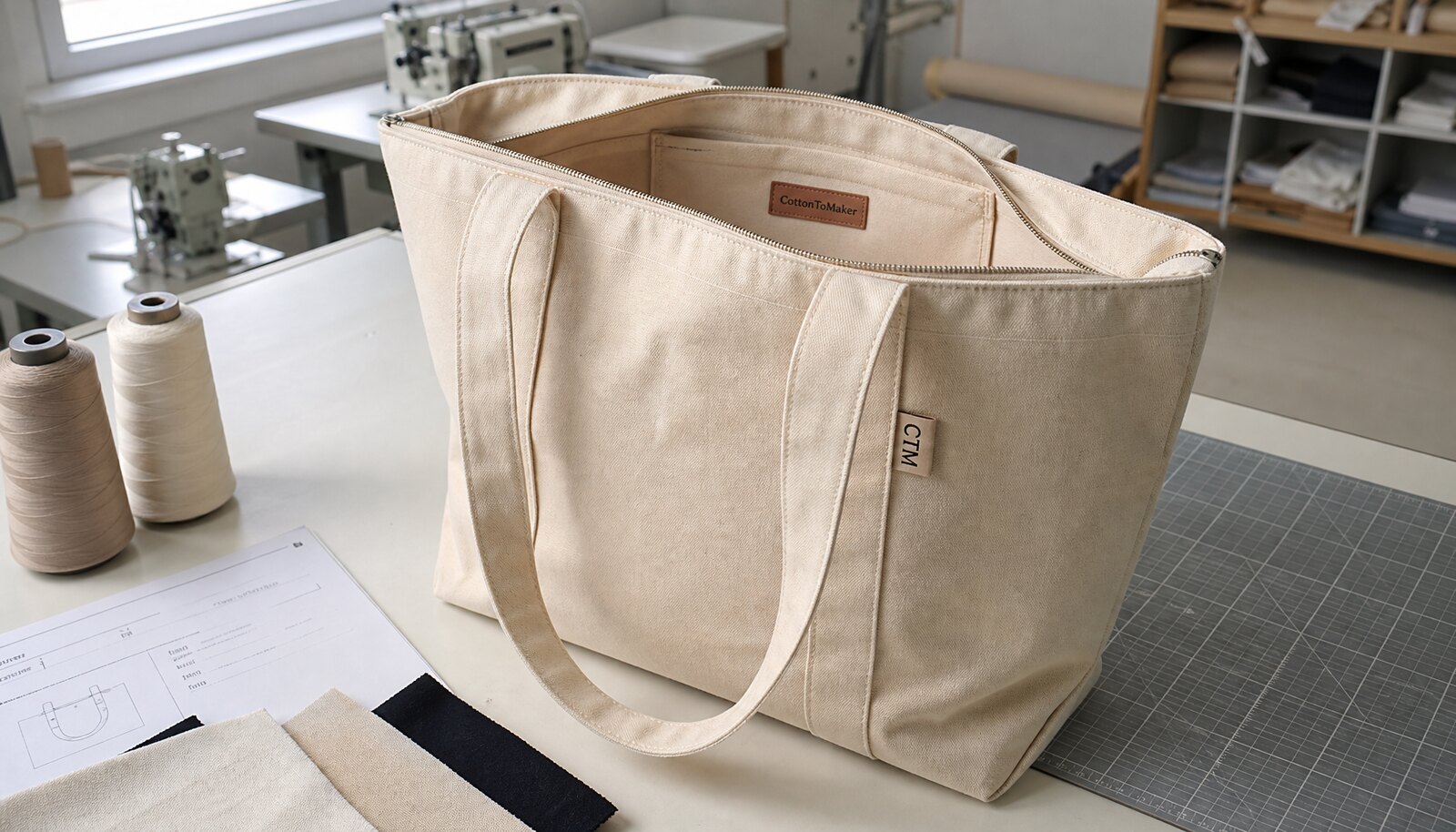
1. Start with the use case, not the bag name
For wineries, a canvas conference bag can play three very different roles: a trade-show handout, a tasting-room retail item, or a private-label gift bag that goes out with wine club shipments. Those uses sound similar on a product sheet, but they drive different specs, different packing, and different QC risk. If the brief starts with the item name instead of the use case, the supplier will usually send a generic tote quote and leave the buyer to discover the problems later.
The biggest sourcing mistake in this category is underestimating what the bag must actually carry. A bag for brochures and a tasting sheet can be built lightly and folded flat. A bag that carries a bottle needs a stronger base, tighter seam control, and handles that can take real load without distortion. A retail bag also has to look finished sitting on a shelf, which means the cloth, branding, and fold all matter as much as the price. Before asking for any quote, define the first-use scenario, the contents, and the likely re-use pattern.
It helps to write the brief in commercial terms rather than in creative language. A winery buyer should be able to say: this is a bottle-capable, retail-facing canvas conference bag for private-label resale; it must hold one standard bottle plus printed collateral; the brand mark must be visible from three feet; and the pack format must be shelf-ready. That level of clarity prevents vague spec drift and gives the factory something that can actually be made to the same standard twice.
- Flat collateral only: slimmer body, lighter canvas, simpler closure, and lower sewing complexity.
- Retail or club gifting: stronger structure, cleaner finish, and a more deliberate brand label or patch.
- Bottle carry: wider gusset, reinforced base, stronger handles, and a load test before approval.
- Mixed-use bag: specify the heavier of the two use cases, not the easier one, or the order will underperform in the harder scenario.
2. Build a spec the supplier can quote without guessing
A usable sourcing plan starts with a drawing or measurement sheet, not a logo file. The supplier needs the finished body size, gusset depth, handle length, handle drop, closure style, and the position of any print, pocket, label, or zipper. If those fields are missing, each factory will make its own assumption and the quotes will not compare cleanly. For private label programs, that is how one buyer ends up paying for a sample that looked fine on screen but changed shape in production.
For wineries, the dimension questions are more important than they sound. A narrow tote may look neat but fail once a bottle and collateral are inserted. A wide tote may hold the contents but feel floppy unless the canvas weight and bottom structure are balanced. A good spec should state both the nominal measurement and the acceptable tolerance. For example, a buyer can ask for a finished width, height, and gusset with a practical tolerance band, plus a note on whether the bag is measured flat or assembled. That removes ambiguity at the quoting stage and again during inspection.
If the bag includes a zipper, pocket, or interior divider, describe those in a separate line item. Those features affect sewing time, hardware sourcing, and defect risk. They should never be hidden inside a single tote price. A winery program that wants a premium feel should also decide whether the bag is designed to stand upright or to pack flat. Upright presentation usually requires stronger canvas, more consistent seam geometry, and better carton control.
- State finished dimensions in a consistent format: width × height × gusset, with the measuring method noted.
- Specify handle drop and handle length separately; a long handle is not always a comfortable one.
- List every add-on as its own line: pocket, zipper, snap, divider, patch, or lining.
- Include a reference load: brochure pack, one bottle, or one bottle plus collateral.
3. Compare fabric options with winery use in mind
For most winery programs, 12 oz canvas, or about 340 gsm, is the entry point that still feels credible. It works for flat collateral, event handouts, and lighter retail use, but on a larger bag it can look soft or sag at the base. As the bag size increases, or if it must carry a bottle, many buyers move up to 14 oz or 16 oz canvas, roughly 400 to 450 gsm. That thicker cloth gives a more structured body, hides minor wrinkles better, and improves the perceived value of the bag when a customer touches it in-store.
Do not let the supplier describe fabric only as heavy, premium, or thick. Ask whether the quoted weight is finished weight or greige weight, because those can be very different once the cloth is washed or processed. Also ask about weave density and finish. A tighter plain weave often prints more cleanly than a loose weave, and a washed finish can soften the hand but may also reduce crispness at the edges of a logo. For wineries, the visual result matters because the bag is usually part of the brand environment, not just a carry item.
Material traceability is worth asking for even in a relatively simple canvas bag order. The practical ask is not a full audit pack for every pilot run; it is a basic document trail that shows where the fabric came from, what it is made of, and whether the same material will be used in bulk as in the approved sample. If the supplier cannot tell you which fabric lot is used for the sample, the buyer has no protection against a silent cloth change later.
- 12 oz / 340 gsm: good for event carry and light collateral.
- 14 oz / 400 gsm: balanced choice for retail and club gift programs.
- 16 oz / 450 gsm: better for premium positioning, bottle carry, and a more structured body.
- Ask whether the fabric is raw natural, bleached, dyed, or washed, because each finish changes appearance and print response.
- Request fabric composition records or batch traceability for the sample cloth and bulk cloth.
4. Use a side-by-side product spec comparison before you ask for price
A procurement-grade comparison should compare the bag itself, not just supplier routes. The table below is the practical one to use when briefed to factories or trading partners, because it shows how the choice of bag construction changes the commercial outcome. It also keeps the winery buyer focused on the features that matter in use, instead of getting distracted by a low unit price that only applies to a stripped-down version.
The point of a real specification comparison is to expose trade-offs early. A flat tote is usually the cheapest and easiest to repeat, but it may not hold a bottle safely. A gusseted bag can solve that, but only if the seam allowance, base reinforcement, and handle anchors are built properly. A retail-ready version may need a woven label, a cleaner fold, and better carton presentation. Once those differences are visible in one table, the buyer can decide whether to launch with a simpler body and upgrade later, or to pay for the premium construction up front.
This table is also useful when comparing samples from different factories. If one sample looks better but uses a lighter cloth, and another uses stronger handles but a larger tolerance on the logo, you can see where the real compromise sits. That makes the review conversation much more useful than a generic “sample A versus sample B” discussion.
5. Choose branding that survives folding, shelf life, and repeat handling
Screen print remains the most practical default for winery private label bags because it is predictable and repeatable on natural canvas. One or two spot colors usually deliver the cleanest result. If the artwork is too detailed, the weave of the cloth can blur fine edges and the bag starts to look less premium, even if the design is attractive in digital form. A buyer should ask the supplier to show a print proof on the actual canvas, not a smooth paper mockup.
Embroidery can add perceived value, but it is not automatically better. It works best on a thicker bag body or on a separate patch panel that is then sewn to the tote. Direct embroidery on lighter canvas can pull the fabric or create an uneven face if the backing is not right. Woven labels and stitched side tabs are often the most durable brand cue because they survive folding and repeated customer handling. For wineries, that matters because the bag may be used long after the event or club shipment that first introduced it.
A practical private-label stack for this category is one-color front print, woven side label, and, if needed, a small hangtag that carries SKU or campaign messaging. That keeps the bag usable in daily life and avoids over-branding. If the design calls for gradients, watercolor art, or photo-like artwork, a transfer or digital method may be needed, but the supplier should provide adhesion and edge durability evidence for that method on the actual cloth. Ask how the print responds to folding, rubbing, and moisture, because conference bags are handled more than they are admired.
- Screen print: best for solid logos, repeat orders, and stable unit cost.
- Embroidery: best on thicker canvas or on a sewn patch, not on thin tote bodies.
- Woven label: best for durable private-label identity on the side seam or top edge.
- Heat transfer or digital: best for complex artwork, but require fold, rub, and edge checks.
6. Read supplier routes and quote structure separately
The supplier route changes how much control the buyer really has. A direct sewing factory gives the clearest line of sight into fabric, stitching, print, and packing, but only if the buyer provides a complete spec and knows how to judge samples. A trading company can coordinate small mixed programs and manage communication, but the buyer should still ask for the actual factory name and confirm who owns QC decisions. A local decorator is helpful when speed matters, though the blank bag choice is usually already fixed by the time the quote arrives.
For wineries, the route should match the stage of the program. If this is a one-time event bag, a local or regional source may be enough. If the bag is part of a private-label range that will be reordered, the buyer should care more about repeatability, dye lot control, and carton consistency than about the fastest response on the first quote. The risk is not that one route is always better. The risk is that the wrong route hides the real factory and makes it hard to correct defects or replicate the approved sample later.
The commercial quote itself should be broken into parts. Ask for the bag body, branding, hardware, packaging, sample fee, and freight assumptions as separate lines. That makes it easier to compare a direct factory against a trading company or decorator. It also makes hidden value visible: one supplier may look more expensive on unit price but include better packing and fewer downstream receiving costs. Another may appear cheaper but omit the labels, inserts, or carton marks that your warehouse will still need.
- Direct factory: strongest control when the spec is fixed and repeat orders are likely.
- Trading company: useful for coordination, but insist on factory identity and QC ownership.
- Local decorator: useful for speed, not usually the lowest landed cost.
- Hybrid route: workable if the sample approval, bulk factory handoff, and deviation owner are written down.
7. Treat MOQ as a design lever, not just a supplier rule
MOQ is mostly the result of setup costs, not a random policy. If the bag uses stock natural canvas, one print color, and standard handles, the factory can often accept a lower quantity because the line can move without special material orders. Once the buyer asks for custom dye, a zipper, a pocket, lining, or multiple print positions, the MOQ usually rises because each added choice creates a procurement or sewing step that cannot be spread across many orders. That is why a project can jump in cost faster than the buyer expects.
The best way to control MOQ is to separate what is essential from what is nice to have. For a winery launch, a clean body shape, a good label, and one sharp print often deliver more brand value than a dozen small upgrades. If the first order is meant to test sell-through, keep the bag body standard and use low-risk branding elements that are easy to repeat. Then, if the product moves well, the second order can add more customization once the buyer knows the channel can absorb it.
A useful sourcing tactic is to ask for price breaks at 500, 1,000, and 3,000 pieces using the same approved spec. That shows whether the supplier is pricing setup fairly and whether the bag is worth scaling. It also helps the buyer see whether a larger order is really a better deal once freight, packing, and inspection are included. In private-label programs, the cheapest pilot is not always the cheapest path; the right pilot is the one that proves the concept without locking the buyer into a spec that underperforms in the field.
- Lowest MOQ: stock canvas, one-color print, standard trim, simple packing.
- Medium MOQ: custom print location, zipper, pocket, or lining.
- Higher MOQ: dyed body fabric, custom hardware, or mixed-size programs.
- Use a pilot run to validate sell-through before committing seasonal volume.
8. Quote landed cost, not just ex-factory price
A unit price is only meaningful when the buyer knows what is inside it. A quote that looks cheap can become expensive once packing, sample revisions, carton changes, inland freight, and extra label work are added. Ask for the same bag body across every quote so the comparison is clean. If one supplier includes a woven label, another includes retail polybags, and a third quotes bulk only, the numbers are not directly comparable. The buyer needs to normalize the scope before comparing the sticker price.
For winery programs, landed cost also includes the commercial cost of delay. If a supplier underestimates the packaging need or fails to confirm carton marking requirements, the warehouse may spend extra time relabeling or repacking the bags on arrival. That labor cost is real even if it does not appear on the purchase order. The best buying practice is to ask each supplier to quote the same packing method, same carton count, same destination, and same Incoterm whenever possible. That does not eliminate risk, but it does make the hidden differences visible.
If you are comparing suppliers at the same time, ask them to identify every excluded item in writing. A good quote should say whether sample fees are refundable, whether print setup is one-time, whether freight is included, and whether cartons are retail-ready or just shipping cartons. That detail is not paperwork for its own sake. It is how a procurement team avoids approving a quote that looks clean but leaves the buyer with extra work after goods arrive.
- Require separate lines for sample fee, print setup, trim, packing, and freight assumption.
- Compare quotes only after the same packing scope is applied to all suppliers.
- Track cost per sellable unit, not only cost per piece off the sewing line.
- Ask the supplier to list exclusions and change-order triggers before you approve the PO.
9. Specify QC thresholds that match bottle-carry risk
The quality plan should focus on defects that customers will actually notice or that will fail in use. For a winery bag, those are usually weak handle anchors, crooked branding, seam puckering, zipper problems, thread tails, and fabric shade drift between cartons. If the bag is going to be sold at retail, cosmetic variation that might pass on a one-time event giveaway can become a problem because customers will compare units side by side. A buyer needs a reject standard before production begins, not a debate after the first shipment lands.
A stronger QC brief should include measurable thresholds. For example, the bag should be inspected for consistent seam allowance, clean stitch lines, and acceptable logo placement tolerance. Handle anchors should use bar-tacks or boxed reinforcement, and those stitches should be checked for missed penetrations or loose ends. If the bag is meant to carry a bottle, set a load or pull test so the supplier knows what “strong enough” means in numbers, not in adjectives. A practical procurement file should also state the inspection method: 100% checks for critical branding and closures, plus AQL sampling for general appearance and sewing consistency.
A useful AQL starting point for noncritical apparel-like goods is often around major 2.5 and minor 4.0, but the buyer can tighten that for premium retail bags or for any run with closures and bottle load risk. The exact number should match the brand promise and the destination. If the bags are going directly to a warehouse, carton damage, shade inconsistency, or loose stitching can be controlled before receipt by setting a clear failure threshold. In practice, the supplier should know which defects are immediate rejects, which can be repaired, and which are acceptable within tolerance.
- No skipped stitches, popped seams, or open needle holes at handle anchors.
- Logo placement must stay within the agreed placement window and not visibly skew.
- For bottle-carry use, set a pull or load test threshold and reject any bag that distorts beyond it.
- Use 100% checking for critical branding and closure functions, plus AQL sampling for general appearance.
- Define failure thresholds for seam opening, zipper failure, and unacceptable shade variance before production starts.
10. Control packing, documents, and launch timing like a repeat program
Packing is part of product quality, not a separate administrative task. Canvas bags wrinkle, pick up dust, and show fold lines quickly, so the fold method needs to be controlled from sample to shipment. If the bag will be sold in a tasting room, the logo should face out and the bag should fold the same way every time. If it will be bundled into club shipments, bulk packing may be better, but the warehouse still needs a consistent carton pack count and clear carton labels. In either case, ask the supplier to show a carton photo before shipment.
Documentation matters because a private-label winery bag often sits at the edge of retail, hospitality, and promotional purchasing. The buyer may need basic proof of fabric composition, a record of the approved sample, and a way to trace which carton came from which production run. That does not mean demanding a full compliance library from every supplier on a small pilot order. It does mean asking for the records that support the claims being made. If a factory says the cloth is a certain weight or origin, there should be something more than a sales line supporting that statement.
Timing is the final part of the sourcing plan. The safest launch path is to freeze the spec before the wine event calendar gets crowded, then use a pilot order to validate fit, branding, and pack-out. After the pilot, revise once if needed, lock the master sample, and then place the bulk order. That sequence is slower on paper than placing a large order from a rendering, but it is faster in real life because it avoids redesign, rework, and warehouse exceptions. For a private-label winery program, the true goal is not only getting the first order made. It is getting the second order repeated with no surprises.
- Use the same fold instruction in sample, pilot, and bulk.
- Ask for carton photos, pack counts, and master carton marks before shipment.
- Keep the approved drawing, master sample, and artwork file in one place for reorder use.
- Build time for sample approval, artwork revision, and freight booking into the launch schedule.
Specification comparison for buyers
| Supplier option | What to verify | Commercial advantage | Buyer risk to control |
|---|---|---|---|
| Direct sewing factory | fit-test photos with reference bottle, bottom reinforcement close-up, handle load proof, and final carton photo set | Better sample-to-bulk control and faster production feedback | May be weaker on export paperwork or branded packing unless checked early |
| Trading company | Factory name, production photos, trim-source proof, and who owns QC decisions | Can coordinate small mixed orders and extra services | Markup can hide real factory capability and slow defect decisions |
| Specialized bag workshop | bottle fit, bottom reinforcement, handle or cord strength, divider option, seam allowance, and upright stability | More practical for detailed construction, trims, and repeat programs | Capacity may be limited during peak seasons |
| Low-price general supplier | cotton canvas, jute, felt, nonwoven, or laminated paper sized to bottle diameter, weight, and condensation risk | Useful for simple promotional runs with loose specs | Material downgrades, weak packing, and vague inspection scope can erase savings |
| Retail-ready supplier | upright or flat packing, bottle-protection insert, carton count, moisture control, and retail display orientation | Can handle labels, SKU separation, carton marks, and receiving rules | Higher unit cost must be compared against reduced warehouse work |
| Compliance-focused supplier | Fabric records, labeling review, test plan, and production traceability | Safer for retail programs and repeat brand orders | Documentation claims need evidence, not only sales language |
| Local sample room plus bulk factory | Signed sample, bulk factory handoff, first-piece photos, and deviation owner | Good for complex branding before large production | Sample room quality may not match bulk line unless handoff is controlled |
Buyer checklist before sampling
- Define the use case first: tasting-room retail, trade show handout, wine-club gift, bottle carrier, or mixed merch bag.
- Lock the target finished size, gusset depth, handle drop, and closure before asking for pricing.
- Set the fabric target in real terms, such as 12 oz / 340 gsm, 14 oz / 400 gsm, or 16 oz / 450 gsm.
- Choose the branding stack: one-color screen print, embroidered patch, woven side label, or a combination.
- Ask for quote tiers at 500, 1,000, and 3,000 pieces if the supplier can support them.
- Request each quote as a line-item sheet: bag body, print, trim, sample fee, packaging, carton pack, and freight assumption.
- Ask for fabric composition and traceability records for the exact mill batch or fabric lot being quoted.
- Approve a physical pre-production sample against the approved drawing, not only a digital proof.
- Confirm carton labels, pack counts, fold method, and retail presentation before the order starts.
- Set a QC standard for logo placement, seam strength, zipper function, and label consistency.
Factory quote questions to send
- What is the quoted fabric weight in finished form, and is it pre-washed, bleached, dyed, or raw natural canvas?
- Which mill or fabric lot is being used, and can you share a composition or traceability record for that cloth?
- What is the exact finished size, seam allowance, gusset width, handle length, and handle drop?
- Which print method is included, and what is the setup cost per color, placement, or screen?
- If the bag includes a zipper, what gauge, slider type, stop method, and cycle test standard are you using?
- What is the exact MOQ by colorway, and does it change if we add a pocket, lining, patch, or custom hardware?
- What sample stage is included: artwork mockup, pre-production sample, or production sample?
- How are the bags packed: bulk, tissue, polybag, insert card, or retail-ready carton pack?
- What carton size, pack count, gross weight limit, and master carton marks are included in the quote?
- What quality standard do you inspect to, and what is 100% checked versus AQL sampled?
Quality-control points to confirm
- Fabric weight must match the approved spec within a defined tolerance and not thin out at the fold line or gusset.
- Handle anchors should use boxed stitching or bar-tacks at both ends, with no loose thread bundles.
- Seam allowance should stay consistent; a practical target is no visible wandering that changes the bag shape or causes puckering.
- Logo placement must stay within the agreed placement window, with no obvious skew across the lot.
- Print color should match the approved physical reference and should not crack when folded or rubbed lightly.
- If a zipper is included, it must run smoothly end-to-end with no tooth gaps, wave, or seam pull.
- Side seams and bottom seams must remain straight, with no skipped stitches, popped seams, or open needle holes.
- Label, patch, and hangtag positions must stay consistent from bag to bag in the same lot.
- Cartons must be packed to avoid crushing, abrasion, dust pickup, and moisture exposure during transit.
- Shade variation must be controlled across cartons; specify whether mixed lots are acceptable or must be segregated.