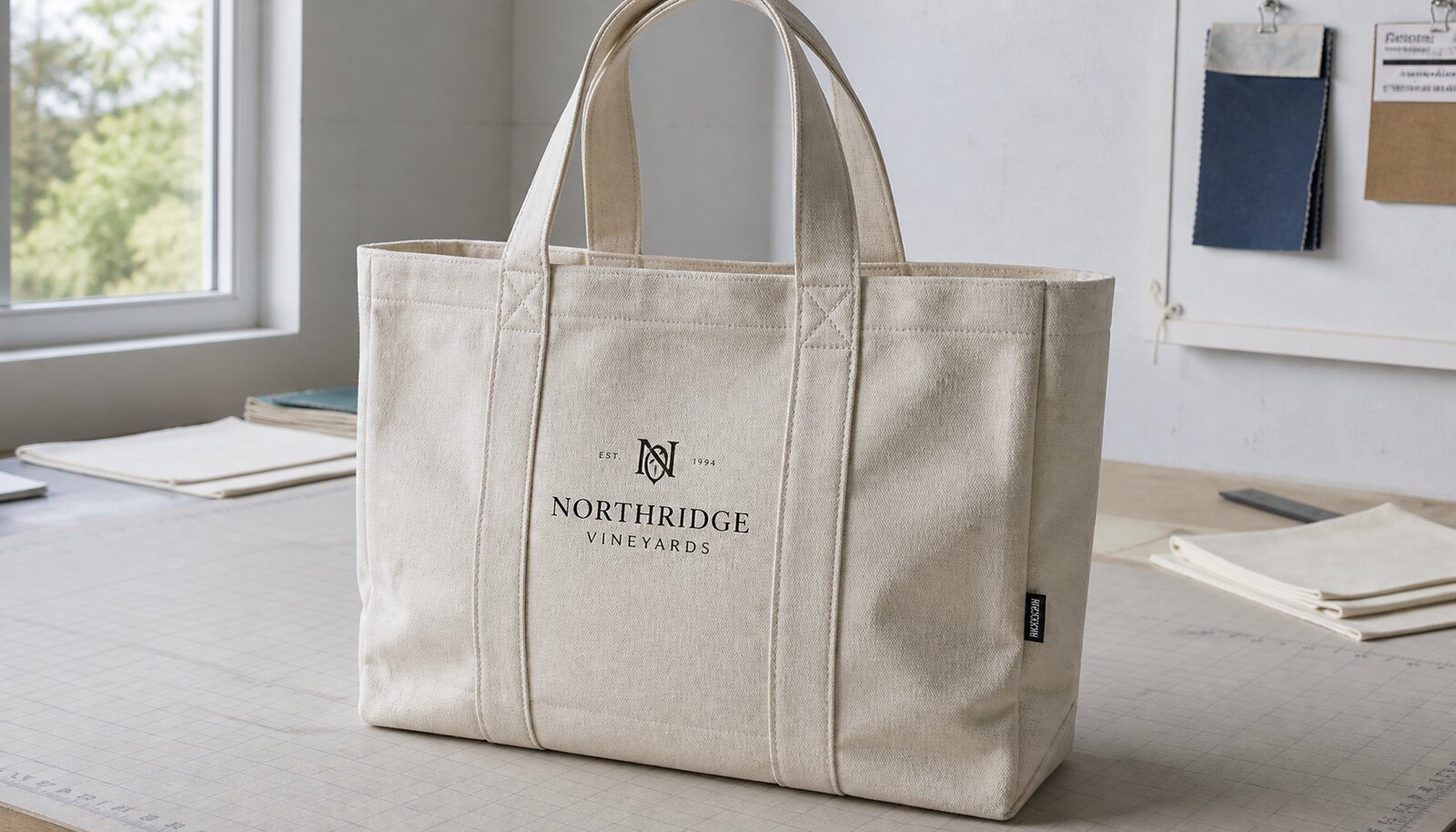
1. Start With the Use Case, Not the Bag Shape
Canvas conference bags for wineries are usually ordered for one of four jobs: event kits, tasting-room giveaways, staff conference packs, or retail-friendly branded merch. Those use cases overlap, but they do not carry the same risk. A kit that holds brochures and a notebook can be built around lighter canvas and simpler stitching. A bag that may carry a bottle, a boxed sample, or heavier collateral needs stronger handles, better base support, and tighter control of fabric consistency. If the use case is vague, suppliers will quote different assumptions and you will end up comparing unrelated products.
For winery buyers, the visual expectation matters as much as the load. The bag should look natural and considered, not cheap or overly shiny. That means the material decision is not only about strength. It is also about handfeel, print clarity, wrinkle behavior, and whether the bag still looks presentable after it has been folded, shipped, and handled at an event. The best spec starts with three facts: what the bag carries, where it will be used, and how the brand wants it to read in person.
- Use a lighter build for literature-only conference kits.
- Move to heavier canvas and base reinforcement if the bag may carry a bottle or sample pack.
- Keep the spec aligned with the channel: event giveaway, tasting-room retail, or premium corporate gift.
- Do not let the supplier choose the structure until the use case is written into the RFQ.
2. Canvas Weight Sets the Cost and Durability Ceiling
For most procurement conversations, canvas weight is the fastest way to separate viable options from guesswork. Typical ranges are 10 oz, 12 oz, 14 oz, and 16 oz, which roughly map to 340, 410, 475, and 540 gsm, depending on the mill and finishing process. A 10 oz bag is often enough for handouts and flat event materials. A 12 oz bag is the practical middle ground for winery conference use because it gives enough body without becoming too stiff. A 14 oz bag starts to feel more premium and usually tolerates heavier contents better. A 16 oz bag is closer to a heavy-duty carry item and makes sense when presentation and load capacity both matter.
Do not treat weight as a stand-alone proxy for quality. Yarn quality, weave density, and finishing process change the result materially. Two bags both described as 14 oz can feel very different if one is loosely woven and the other is tightly woven with better finishing. Buyers should ask for finished fabric weight, weave count, width, and whether the fabric is measured before or after washing and shrink control. If the supplier cannot describe that cleanly, the quote is too vague for a real procurement comparison.
- 10 oz to 12 oz is usually enough for brochures, catalogs, and lightweight giveaways.
- 12 oz to 14 oz is the safest middle ground for winery conference bags.
- 16 oz fits heavier loads, more shape retention, and a premium retail feel.
- Always separate greige weight from finished fabric weight in the quote.
3. Weave, Finish, and Shrink Control Affect Print Quality
Most conference bags use a plain weave, but the quality of that weave is what determines whether the bag looks refined or merely functional. A tight plain weave gives print sharper edges and reduces show-through. A looser weave can look more rustic, but it also makes fine artwork less reliable and can expose slubs or yarn irregularity in a way that feels accidental rather than deliberate. For winery branding, that distinction matters because many buyers want a natural look that still feels clean and premium. If the logo includes a crest, fine text, or thin strokes, a tighter weave is usually the safer choice.
Finish is where many orders drift. Raw canvas can shrink, crease, and shift after cut-and-sew, which affects panel alignment and print placement. Washed or pre-shrunk canvas costs more, but it reduces distortion and improves first-impression consistency. Bleached canvas can make logos read more crisply, while natural canvas usually feels more grounded and less processed. Dyed canvas gives stronger color control but introduces shade variation and colorfastness risk. The buyer should define which of those outcomes matters most before asking for prices, because each one changes the fabric route and quality-control burden.
- Choose a tighter weave if the logo has small text or thin strokes.
- Use washed or pre-shrunk canvas if you want to reduce shrinkage and improve consistency.
- Natural canvas is easier to position as a casual premium item, but it can show specks and yarn variation.
- Dyed canvas needs rub and colorfastness testing before bulk approval.
4. Construction Choices Change the Quote More Than Buyers Expect
A conference bag can be unlined, partially lined, or fully lined, and that choice changes both cost and perceived quality. Unlined bags are simple and economical, but the inside can look unfinished and seams may show through the body. Partial lining is often the best commercial compromise for winery programs because it cleans up the most visible interior areas without adding the full labor burden of a fully lined bag. Full lining gives the cleanest presentation and hides seam construction, but it raises material use, sewing time, and inspection complexity. If the bag is being handed out at an event, partial lining is usually enough. If it is being sold as retail merchandise, full lining can be justified.
Base support and handle reinforcement matter just as much as the lining decision. A base insert can help the bag stand upright on a conference table and keep the silhouette from collapsing in transit. PE board and EVA board are more stable than a thin cardboard insert if the bag needs to survive rougher handling or moisture exposure. Handle reinforcement should be written into the spec, not assumed. Buyers should ask for handle width, handle fold construction, stitch count at the anchor point, and whether the handle is joined with bartacks or a box stitch pattern. Those details are what usually determine whether a bag feels durable in real use.
- Use unlined or partially lined construction for event giveaways and budget-controlled projects.
- Use a full lining only when the presentation standard is high enough to justify the extra labor.
- Select a base insert if the bag must stand upright or hold heavier contents.
- Do not add a zipper unless the use case actually needs it.
5. Branding Method Should Match the Fabric and the Run Size
For winery conference bags, the logo usually needs to look clean, restrained, and intentional. Screen print is still the most practical option for solid logos, block lettering, and simple artwork at volume. It is repeatable and typically gives the best cost control when the artwork is stable across reorders. Transfer print works when the artwork contains gradients or more complex detail, especially at smaller quantities, but it introduces extra variables in heat transfer behavior and handfeel. Embroidery can look premium, yet it can pucker lighter canvas or distort on soft panels, so it is usually better for a small mark or label area than for a large filled design.
Do not treat branding as a cosmetic afterthought. The canvas surface, weave density, and finish all affect ink hold, edge sharpness, and how small the artwork can be without breaking down. Ask the supplier for the minimum line thickness, smallest readable text size, and the curing method used for the chosen print. If the winery wants a quieter look, a woven label or stitched patch can be a better choice than full-face printing. That decision often produces a more premium result and reduces the risk of print inconsistency across production lots.
- Use screen print for large, simple winery logos and stable repeat orders.
- Use transfer print only when the artwork needs gradients or complex detail at lower volume.
- Use embroidery or a woven label for a quieter, more premium brand mark.
- Confirm rub fastness and edge sharpness on the actual canvas, not on a substitute swatch.
6. Ask Suppliers About Fabric Lot Control and Trim Traceability
This is where buyer diligence pays off. A solid supplier should be able to tell you which fabric mill the canvas came from, whether the order will be cut from one booked lot or multiple rolls, and how shade variation is managed between rolls. That matters because canvas can vary enough to be visible across a carton even when the nominal weight is the same. For higher-value commercial use, the buyer should also ask who supplies the label, zipper, snap, board insert, and thread. If trims are sourced from different vendors, the factory should still be able to trace them by supplier, lot, and incoming inspection record. That traceability is what lets you diagnose a problem quickly if an issue appears in bulk.
The practical risk is not just a bad component. It is inconsistency across the order. A factory that uses booked fabric lots, incoming shade checks, and trim records can usually explain why a sample matches or misses the bulk. A supplier that cannot name the fabric source, the finishing method, or the trim vendor is a higher-risk choice, even if the quote is attractive. Buyers should also ask whether production will be run on one line or split between lines, because mixed-line production can create variation in stitch density and fold quality. For procurement, transparency is not a luxury; it is what makes the spec auditable.
- Ask whether the order is cut from one fabric lot or multiple rolls.
- Confirm the fabric mill, finishing process, and any wash or shrink-control step.
- Request traceability for trim vendors: labels, zippers, snaps, boards, and thread.
- Ask whether the order will run on one sewing line or multiple lines.
7. Sampling Has to Prove Dimensions, Appearance, and Load
A photo sample is useful for design sign-off, but it does not prove the bag is production-ready. The buyer needs a physical pre-production sample made from the final fabric, final trims, and final print method. That sample should confirm the opening shape, handle drop, logo placement, seam behavior, and how the bag sits when filled. For winery conference bags, the sample should be tested with the intended contents: brochures, notebooks, tasting notes, and, if relevant, a bottle or heavier item. If the bag twists, collapses, or opens at the seams, the construction still needs work before bulk approval.
The approval step should be tied to measurable criteria. A useful sample review measures the critical dimensions, checks print placement against the approved artwork, and confirms that the bag does not distort beyond the agreed tolerance when loaded. Buyers should also inspect the sample under the same lighting condition that will be used for approval because natural canvas can shift visually under different light sources. The sample should answer a direct question: does this bag match the intended commercial use, not just the mockup?
- Approve a physical pre-production sample, not just a photo.
- Test the sample with the actual intended contents and carry weight.
- Measure the critical dimensions and note acceptable tolerance before bulk release.
- Reject any sample that hides construction problems behind a good-looking print.
8. Use Measurable QC Criteria Before You Release Bulk
QC gets vague too quickly unless the buyer writes numbers into the approval standard. For a canvas tote, the measurable checks should cover fabric weight, dimensions, stitch quality, print quality, and load performance. A practical tolerance band for finished dimensions is usually narrow enough to catch real drift but broad enough to reflect production reality. The buyer should define body width, body height, gusset depth, and handle length, then state the acceptable variation in writing. The same is true for stitch density at the seams and bartacks. If a supplier cannot hold a consistent stitch count per inch or equivalent metric at the key stress points, the bag will vary visibly from sample to shipment.
Load testing should be realistic, not theatrical. If the bag is intended for brochures and notebooks, it should be tested at a relevant service load. If it may carry a bottle or sample product, the test weight should reflect that use case and hold for a defined duration without seam opening, handle tearing, or obvious deformation. For print, buyers should check color consistency, edge clarity, and rub resistance on the actual fabric. A simple acceptance rule works better than a subjective impression: if the print cracks, smears, or rubs off under a normal handling simulation, it is not production-ready.
- Set dimensional tolerances for body width, body height, gusset, and handle length.
- Specify a stitch density or seam standard at the handle ends and stress points.
- Define a practical load-test threshold tied to the intended contents.
- Require rub testing and visual inspection of print edges on the actual canvas.
9. Packing and Logistics Should Be Written Into the Spec
Packing changes both cost and product condition. A canvas bag folded too tightly can hold a crease through the logo area, while an over-packed carton can crush the body and distort the handle shape. If the bags are for retail resale, individual polybags, a defined fold method, and cleaner presentation standards may be necessary. If the bags are only for event distribution, bulk packing can reduce labor and carton count. The buyer should decide this upfront because the packing method affects carton measurements, freight planning, and the first impression when the goods arrive.
Lead time should be broken into actual production steps rather than one blanket promise. Fabric booking, print setup, sample approval, sewing, finishing, packing, and cartonization can all move independently. Custom dyeing, wash finishing, woven labels, and special packaging usually add time, and the delay is often in the supplier chain rather than the sewing floor. For winery programs that have a fixed event date, buyers should ask which steps are on the critical path and whether any are dependent on external approval. That makes the schedule more honest and reduces last-minute surprises.
- Use a fold method that keeps the logo face clean and avoids deep creasing.
- Match the pack style to the channel: bulk for giveaways, individual pack for retail.
- Ask for carton measurements and gross weight before finalizing freight planning.
- Treat custom labels, special packing, and dyeing as lead-time drivers, not free extras.
10. Write the RFQ So Quotes Are Actually Comparable
A usable RFQ for canvas conference bags for wineries needs more than size and logo. It should lock the finished fabric weight, weave finish, print method, lining choice, base support, handle reinforcement, closure type, packing method, and carton count. Once those decisions are fixed, suppliers can price the same product. Without that structure, one quote may be for a 12 oz unlined bag and another for a 14 oz partially lined bag, and both will appear to be quoting the same item. That is how procurement drift starts before the first sample even arrives.
The RFQ should also separate fixed requirements from optional ones. If the buyer can accept either natural or bleached canvas, say so. If a woven label is acceptable in place of print, say so. But if the goal is a fair supplier comparison, keep the spec stable through the first quote round and use one approval gate for the sample. That discipline makes reorders easier, reduces interpretation errors, and gives the buyer a cleaner landed-cost comparison when the bag is later ordered again for another event or season.
- Write the fabric, finish, and GSM into the RFQ, not just the bag size.
- State the print method and logo placement in measurable terms.
- Fix the packing and carton spec before asking for a final price.
- Use the same spec sheet for every quote so the comparison stays valid.
Specification comparison for buyers
| Spec decision | Recommended option | When it fits | Buyer risk to check |
|---|---|---|---|
| Fabric route | Direct factory with booked fabric lots | Repeat orders, tighter shade control, and clearer workmanship accountability | Confirm whether all panels come from one lot and whether shade variation is allowed between rolls |
| Canvas weight | 12 oz natural canvas for standard conference use | Brochure kits, notebooks, tasting notes, and light collateral | Require finished weight in GSM or oz after washing/finishing, not a greige estimate |
| Heavy-load version | 14 oz to 16 oz canvas with reinforced base and handles | Bags that may carry a bottle, boxed sample, or retail resale load | Check seam bulk, stiffness, and freight weight before approving the spec |
| Weave and finish | Tight plain weave with pre-shrunk or washed finish | When logo clarity, shape retention, and a premium handfeel matter | Loose slub and uncontrolled shrinkage can distort print placement and finished size |
| Branding method | Screen print for simple marks, woven label for subtle branding | One-color or two-color winery logos with clean edges | Confirm curing, rub fastness, and minimum line thickness on the actual canvas |
| Structure | Partial lining with a reinforced base | Need shape without paying for a full lining on every unit | Unlined bags can look unfinished; full lining raises cost and lead time |
| Closure | Open top or simple snap | Giveaway bags, tasting events, and conference kits | Zippers add cost, alignment risk, and extra inspection points |
| Sampling route | Pre-production sample using final fabric and trims | First order, new supplier, or any spec with multiple options | A photo alone is not enough to approve color, handfeel, or stitch quality |
Buyer checklist before sampling
- Define the real load case first: documents only, documents plus bottle, or retail resale use.
- Lock the target canvas weight in GSM or oz and allow only a narrow tolerance.
- Choose the fabric route: natural, bleached, dyed, washed, or pre-shrunk.
- Specify the print method, logo size, minimum line thickness, and Pantone target if needed.
- Decide whether you need lining, a base insert, handle reinforcement, or a closure.
- Set the finished dimensions and acceptable tolerance before quoting starts.
- Require a pre-production sample made from final materials, not a generic mock sample.
- Compare quotes on the same carton pack, the same trim spec, and the same shipping term.
Factory quote questions to send
- What is the finished fabric weight in GSM or oz, and what weave density is being used?
- Is the canvas stock supported by one lot only, or will the order be split across multiple fabric lots?
- Which print method are you pricing, and what is the smallest line or text size that will reproduce cleanly?
- Are lining, base board, bartacks, zipper, snap, or woven label included in the unit price?
- What are the exact size tolerances for body width, height, gusset, and handle length?
- Do you provide a pre-production sample, and what changes will trigger a new sample charge?
- How are the bags packed, how many per carton, and what is the carton gross weight and measurement?
- What is the lead time after sample approval, and which items usually extend production?
Quality-control points to confirm
- Fabric weight matches the approved spec within the agreed tolerance, measured after finishing and before cutting.
- Weave is even, with no thin spots, oil marks, contamination, broken yarn clusters, or visible shade mismatch across panels.
- Finished dimensions stay within tolerance for body width, body height, gusset, and handle drop.
- Stitching is straight and consistent, with no skipped stitches; bartacks at handle ends are dense and fully anchored.
- Critical seam areas meet the agreed stitch density and do not open under a practical load test for the intended use.
- Print position, color density, and edge sharpness match the approved sample, with no ink cracking after rub testing.
- Handles, base insert, and lining sit flat, with no twisting, exposed raw edges, loose trim ends, or puckering.
- Carton count, labeling, fold method, and pack method match the PO and do not create transit damage or crushing.