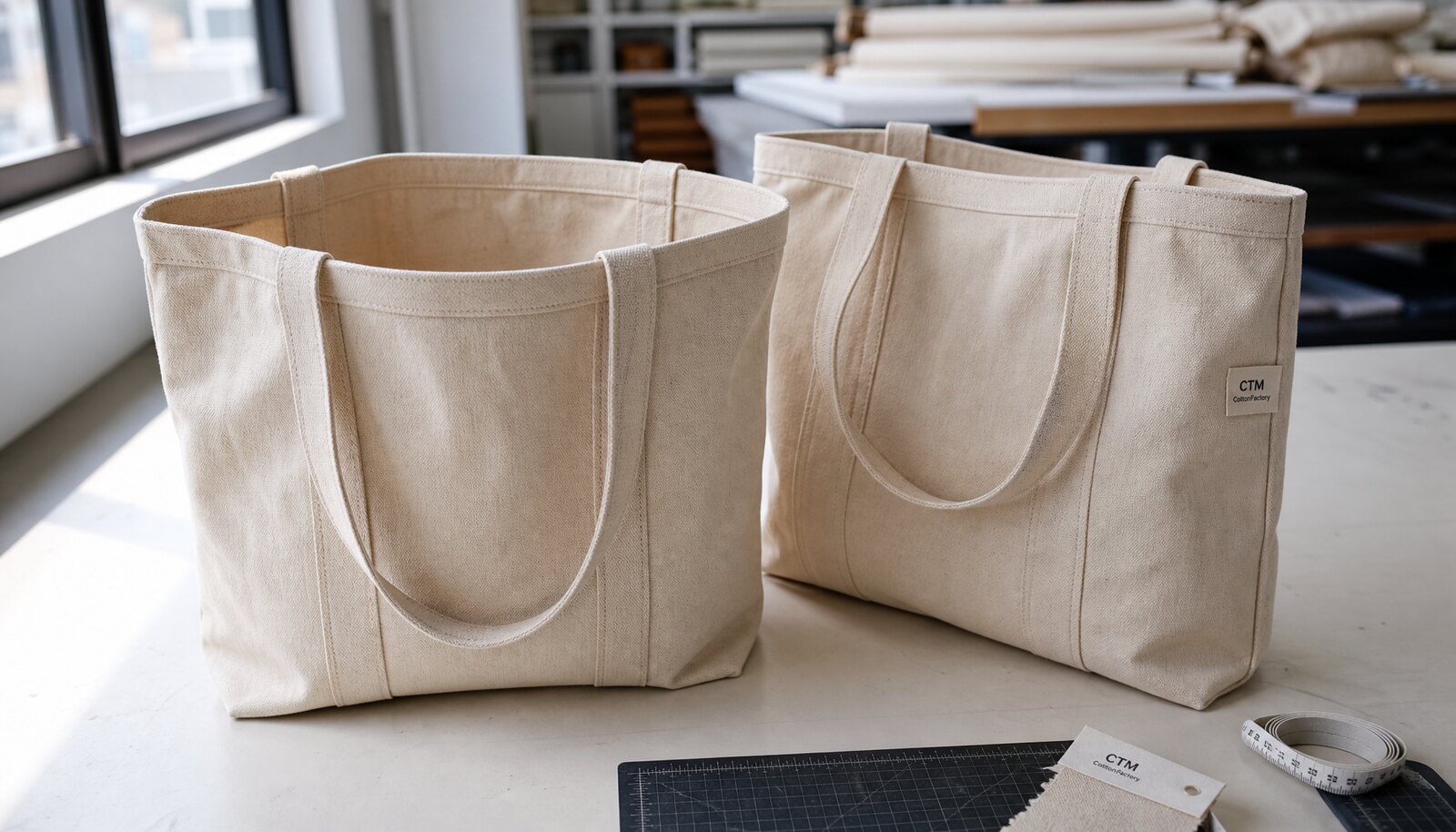
What The Sample Must Prove
A sample is not a courtesy item. For a wellness brand ordering canvas conference bags, it is the only physical proof that the supplier understands the real brief. The bag has to move through registration desks, breakout sessions, and post-event travel without looking flimsy or drifting away from the brand standard. Buyers usually discover problems in the sample room that would become expensive once the bags are packed and distributed.
Treat the first sample as a test of three things: the structure matches the spec sheet, the artwork sits correctly on the body, and the build can survive real use. Wellness event kits often carry brochures, product vials, journals, snacks, water bottles, and samples with odd shapes. A bag that looks clean on a flat table but twists, dents, or shows the logo in the wrong place under load is not ready for signoff.
The right sample should answer procurement questions quickly. Can the supplier hold the size? Did they use the stated fabric weight? Is the handle reinforcement strong enough for repeated carry? Does the bag still present well after folding, unpacking, and light abrasion? If the sample cannot answer those questions clearly, the order spec is not finished yet.
- Test the bag with the actual contents planned for the event, not a generic weight.
- Review the sample flat, in hand, and after a short rest to catch shrink and recovery issues.
- Check whether the logo reads properly when the bag hangs naturally, not only when laid flat.
- Use the first sample to define the production standard, not personal preference.
Lock Fabric And Structure Before You Review Artwork
Do not start with the logo. Start with the canvas. For most conference programs, 12 oz or about 410 gsm is the safest baseline because it balances cost, hand feel, and carry strength. Lighter material can work for brochure-only distributions, but it often feels thin once attendees add bottles or boxed samples. Heavier canvas can feel more premium, yet the extra cost only makes sense if the bag will be reused or the event kit is genuinely dense.
Finished size matters more than nominal cut size. A tote that measures correctly before stitching can still land short after seam allowance, shrinkage, and flattening. Buyers should specify width, height, gusset depth, handle drop, and seam allowance on one sheet, then require the supplier to mark measured points on the sample photo set. If the bag has to stand on a table, the bottom panel and gusset need to be defined early. If it is meant to hang on a shoulder, handle drop matters as much as overall height.
Fabric origin and lot control are worth asking about at this stage. Ask for the roll ID, dye lot, finish, and whether the canvas was pre-shrunk or calendered. Those details affect both appearance and repeatability. A quote that only says cotton canvas is not enough for a buyer who needs the next order to match the first one.
- State fabric weight in both GSM and oz so sourcing teams do not compare mismatched quotes.
- Use finished dimensions, not cut size, and include acceptable tolerance in the spec.
- Define handle width, handle drop, and reinforcement style before you ask for print samples.
- Ask for the fabric roll ID and dye lot so the sample can be tied back to bulk production.
Choose The Build That Matches The Use Case
The structure should follow the event behavior, not the other way around. An open-top tote is often the right answer for fast handouts, low-friction distribution, and short event lifecycles. It keeps the quote simpler and avoids extra failure points. A zipper top makes more sense when the bag is expected to travel, hold loose product, or serve as a reusable retail carry bag after the event. The decision should be based on use, not on whether a closed bag looks more finished in the sample room.
Gusset depth is the other high-impact choice. A shallow gusset reduces material use but can crush boxed inserts and force the contents to distort the front panel. A deeper gusset improves volume and shape retention, yet it changes cutting efficiency and can raise the minimum order. If the event kit includes bottles, thick catalogs, or rigid samples, the buyer should ask for a bag that can hold the contents upright without bowing the side seams.
Reinforcement is not optional when the tote will be used throughout a conference day. The handle anchor, bottom corners, and side seams need a clear construction callout. If the supplier suggests a shortcut, ask whether they would put that same build in front of a retail buyer. That question usually reveals whether the build is robust or merely adequate for a photo.
- Use an open top for fast distribution and lower-cost event kits.
- Use a zipper when the bag will travel or carry loose items that can spill.
- Specify gusset depth if the bag has to hold bottles, boxes, or sample kits.
- Require reinforcement at the handle anchor and bottom corners if the bag will be reused.
Make Branding Readable And Repeatable
Artwork is where many sourcing teams lose control. Screen printing remains the most practical option for most wellness conference bags because it gives strong color control and works well for simple logos, short taglines, and one to three spot colors. It also keeps unit economics stable when the run is large enough to absorb setup. Embroidery can look premium on heavier canvas, but it adds thickness, can distort lighter panels, and needs careful backing control. Patches and woven labels are useful when the mark is small or the brand wants a more tactile finish.
The buyer should define print placement in millimeters, not in vague language like centered or near the top. Ask for edge clearance, artwork scale, and the exact print area relative to seams and the bottom fold. A logo that lands too close to a seam will distort after packing, while a logo that is too high may disappear when the bag is held by the handle. The approved sample should also carry the actual file version used for production, not a cleaned-up mockup that exists only in email.
Color control needs written references. If the brand uses a Pantone, approve the chip or strike-off against the actual canvas, because natural fabric can shift perceived color. If the art includes fine text or thin lines, check readability at normal viewing distance and at the expected print size. A mark that looks sharp in a proof but blurs on canvas is not a passing sample.
- Freeze the artwork file version before printing the approval sample.
- Use written color references and inspect them on the actual fabric, not on screen only.
- Approve the exact print area and the clearance from seams, handles, and folds.
- If the logo has small text, test readability at the distance people will actually see it.
Read The Quote As A Production Plan
A useful quote should read like a production plan. It needs the fabric weight, dimensions, handle construction, closure type, print method, sample fee, setup charges, labels, packing method, and lead time for each stage. If the quote rolls packaging, decoration, and freight into one number, the comparison is already distorted. Procurement teams should ask each supplier to quote the same specification and the same packing basis before comparing price.
The first MOQ tier matters more than the lowest unit price. Custom canvas bags often get cheaper only when the factory can spread setup costs across a larger quantity. If a supplier offers a much lower first quote but a steep jump in the reorder tier, that is a sign the opening order is being subsidized. Ask for at least two quantities so you can see the shape of the pricing curve. The right comparison is not just cheap versus expensive. It is whether the supplier rewards continuity and repeat business with a stable production model.
A proper quote should also show which items are separate charges. Screen setup, embroidery digitizing, woven labels, hangtags, individual sleeves, and carton markings can all affect the landed cost. If the sample fee is creditable against the bulk order, that should be written clearly. If it is not, the buyer should know that before the sample is released.
- Request itemized pricing so packaging and decoration are not hidden inside the unit price.
- Compare at least two quantity tiers to understand the reorder economics.
- Make sure sample fee, setup charges, and tooling are written separately.
- Confirm the same spec, same packing basis, and same freight assumption across suppliers.
Verify The Factory Behind The Sample
A polished sample photo is not proof of control. Buyers need to know who actually cuts, prints, sews, and inspects the bag. Ask whether the sample came from the same line that will produce bulk, or from a small sample room that uses different operators and different equipment. If the answer is vague, the sample may not be a reliable indicator of the final run.
The most useful evidence is boring and specific: roll numbers, lot numbers, production line references, dated photos, and a signoff chain that shows who approved what. If the factory uses a trading layer, ask the intermediary to name the actual manufacturer and define who owns defects, remake cost, and delivery delays. Responsibility cannot float between three different inboxes once production starts. It needs to be written into the quote and the purchase order.
Compliance evidence matters too. Depending on your market, ask for a material declaration, restricted substance statement, and any available audit summary or test report. If the product will touch consumer goods or move through a retail channel, the buyer should know whether the dye lot is stable, whether the fabric can be traced back to a mill, and whether any recycled or organic claim can be documented. If a claim cannot be supported on paper, it should not be printed on the bag.
- Ask for roll IDs and dye lot numbers so the sample can be traced back to the fabric source.
- Confirm whether the sample was made on the bulk line or only in a sample room.
- Request the signoff chain for artwork, structure, and packing so responsibility is clear.
- File any material declaration, restricted substance statement, or audit evidence with the quote record.
Set Measurable QC Thresholds Before Signoff
Quality control should be written in numbers, not adjectives. A bag that is neat, sturdy, or premium is still too subjective for procurement. Put acceptance thresholds in the record before the sample is signed off. The goal is simple: the buyer should know what counts as pass, what counts as rework, and what is an automatic rejection. That removes the arguments that usually happen after production has already started.
For dimensions, use a tolerance that reflects the size of the bag. A common approach is +/-5 mm on smaller measurements and +/-10 mm on larger ones. Handle drop should be measured separately because a tote can be the right height and still carry badly if the handles are too short or uneven. On stitch quality, ask for a minimum stitch density on the main seams and require reinforcement at every anchor point. If the sample shows loose ends, skipped stitches, or obvious puckering, do not let the supplier talk you into accepting it as hand-finished variation.
Artwork needs the same level of discipline. Put the acceptable registration window in writing, usually within 1.5 mm for simple marks and within 2 mm for multi-color art. If color accuracy matters to the brand, define the Delta E target against the approved strike-off. For a natural canvas body, slight variation can be acceptable if it is written into the spec. What should never be tolerated is a logo that has drifted, faded, or been placed inconsistently across the sample and bulk expectation.
- Measure finished dimensions on the flat sample after it has rested, not only when it comes out of the pack.
- Use a written tolerance for handle drop, seam placement, and gusset depth.
- Set a registration window for print and a color target against the approved strike-off.
- Define zero-tolerance defects separately from minor cosmetic variation so the supplier knows what cannot pass.
Treat Packing And Labeling As Part Of The Product
Packing affects more than freight cost. It changes crease lines, print rub, retail presentation, and warehouse receiving time. If the bags will ship to an event organizer or a distributor, the fold method should be approved on the sample because a bad fold can leave a permanent crease across the logo. If the bags will enter a warehouse, the packing format has to support fast count checks and accurate SKU intake.
Decide early whether each tote will be packed flat, in a sleeve, or in a polybag. Retail channels usually need a cleaner presentation and sometimes a printed insert or barcode label. Direct-to-event distribution may prefer flat packs to reduce labor and cube. Either way, the outer carton marks should match the purchase order exactly, including size, color, quantity, and destination code. Label errors are a common source of avoidable delay because they force manual relabeling at receiving.
Ask the supplier to show the carton count, the inner pack count, and the fold orientation in the sample photos. If the bag is printed, check whether the fold line crosses the decoration area. If it does, the print will rub or crease during transit. That is a packaging problem, not a printing problem, and it should be fixed before the PO is released.
- Approve the fold method so the logo does not sit on the main crease line.
- Specify whether the tote ships flat, in a sleeve, or in a polybag.
- Write carton count, carton marks, and SKU labels into the approval record.
- Check barcode placement and scan readability if the bags will enter a warehouse system.
Control Revisions And Freeze The Golden Sample
Revision loops get expensive when nobody distinguishes a minor correction from a structural change. Moving a logo a few millimeters is not the same as changing canvas weight, adding a zipper, or altering the handle build. Before the supplier makes changes, the buyer should state whether the next round is a simple correction sample or a new pre-production sample that resets the timing. If that distinction is not clear, lead times and cost will drift quietly.
Version control should be explicit. Every comment sheet should include the sample date, the spec version, and the file name used for artwork. If the factory sends a revised bag, ask it to correct only the flagged item unless the revision list says otherwise. That keeps small problems from turning into a full rebuild. It also makes it easier to compare before-and-after photos and understand what changed.
Once the sample is accepted, retain one sealed reference bag. Label it with the supplier name, date, spec version, and final signoff initials. That single bag is often more valuable than the email thread because it gives the buyer a physical benchmark for future reorder checks, factory audits, and incoming inspection disputes.
- Separate cosmetic edits from structural changes before asking for a revision.
- Record the sample date, spec version, and artwork file name on every review sheet.
- Retain one sealed golden sample for reorder and dispute reference.
- State whether the next round is a correction sample or a new pre-production sample.
Turn Signoff Into A Reorder File
The best approval process leaves behind a reorder file, not just a memory of what was accepted. That file should contain the signed spec, the approved artwork, the final sample photos, the packing diagram, the factory contact, and the MOQ ladder. When the next wellness event comes around, the team should be able to quote the bag again without rebuilding the brief from scratch. That is where the procurement value shows up: faster buying, fewer mistakes, and less back-and-forth with suppliers.
Before you release the PO, translate the sample into landed cost. Include freight, duty, warehousing, carton handling, and any relabeling needed for the destination channel. The cheapest ex-factory price is not necessarily the best program if it creates extra labor at receiving or causes a rush freight charge later. Buyers who control event calendars should also check replenishment timing. A bag with a strong first quote but unstable supply is more expensive in practice than a slightly higher quote with predictable output.
For wellness brands, the goal is repeatability. The approved canvas conference bag should be easy to reorder, easy to inspect, and easy to distribute without surprises. If the sample file gives the factory a stable reference and gives the buyer a clean comparison baseline, the next order will move much faster than the first one did.
- Save the final spec pack in one shared location so the next quote uses the same baseline.
- Include freight, duty, warehouse handling, and relabeling in the landed cost view.
- Keep supplier contact details and escalation paths with the reorder file.
- Use the approved sample as the benchmark for all future production checks.
Specification comparison for buyers
| Spec decision | Recommended option | When it fits | Buyer risk to check |
|---|---|---|---|
| Fabric weight | 12 oz / 410 gsm canvas | Most conference kits with brochures, samples, and a bottle | Verify actual GSM, weave consistency, and shrinkage on the delivered roll |
| Handle build | Double-fold handles with box-X reinforcement | Bags that will be carried all day or loaded with heavier inserts | Check stitch count, handle symmetry, and anchor pull strength |
| Closure | Open top | Fast handout programs with simple contents and tight budgets | Confirm the top hem stays flat and contents do not spill in transit |
| Closure | Zipper top | Travel kits, retail resale, or loose contents | Check zipper gauge, pull feel, and smooth operation at the corners |
| Branding method | Screen print | Flat logo art with one to three spot colors | Verify color match, registration, and cure after fold and rub tests |
| Branding method | Embroidery or patch | Small premium marks on heavier canvas | Watch for panel distortion, thread fray, and backing visibility |
| Packing format | Flat-fold in master carton | Direct ship to warehouse or event partner | Confirm the fold line avoids print creases and carton count is exact |
| Packing format | Individual sleeve or polybag | Retail use or distributor handoff | Check bag code, barcode placement, and sleeve material before mass pack-out |
| Sourcing path | Direct factory sample from the bulk line | Custom spec, repeat orders, or strict QC control | Ask for the machine line, roll number, and signoff chain |
Buyer checklist before sampling
- Signed spec sheet with finished size, gusset depth, handle drop, seam allowance, and artwork placement on one version-controlled document
- Approved physical sample with measured dimensions, weight, and photos of the front, back, bottom, side seam, and handle anchor points
- Fabric roll ID, GSM, weave type, finish, and dye lot recorded before bulk cutting starts
- Artwork file version, Pantone or CMYK references, print area, and edge clearance locked before the next sample round
- Confirmation that the sample was produced from the same fabric lot, print setup, and production line intended for bulk
- Sample fee, setup charge, MOQ, reorder tier, and lead time written on the same quote version
- Compliance pack requested and filed, including material declaration, restricted substance statement, and any factory audit evidence available
- QC thresholds, defect classes, and AQL or acceptance rule agreed before the PO is released
- Packing diagram approved, including fold method, polybag or sleeve choice, carton count, carton marks, and barcode format
- One retained golden sample sealed with date, supplier name, and final signoff initials for reorder reference
Factory quote questions to send
- What exact canvas weight, weave, finish, and shrinkage allowance are included in the quote?
- Is the quoted sample made in the same sample room or on the same line as bulk production?
- Which fabric roll ID, dye lot, and print setup will be used for the approved sample and the first production run?
- What is the unit price at the first MOQ tier and at the reorder tier, and what changes between them?
- Which charges are separate from unit price, including sample fee, screen setup, embroidery digitizing, labels, and packing?
- What lead time applies to sample production, pre-production approval, bulk production, and any rework?
- What overrun or underrun tolerance applies, and how do you handle short shipments on custom orders?
- What carton count, carton dimensions, and outer label format are assumed in the quote?
- Which compliance documents can you supply on request, such as material declarations, factory audit summary, or test reports?
- If a revision is needed, what changes trigger a simple correction versus a full new sample and price reset?
Quality-control points to confirm
- Finished width, height, and gusset should be within +/-5 mm for dimensions under 400 mm and within +/-10 mm for larger dimensions, measured flat after the sample has rested
- Handle drop should be within +/-5 mm of the signed spec, and both handles should match each other within 3 mm
- Main seams should show 7-9 stitches per inch, or the equivalent, with no skipped stitches, puckering, or loose thread longer than 5 mm
- Load-bearing anchors should use the approved box-X or bartack pattern, with no distortion or thread break after a 20% overload lift test
- Print registration should stay within 1.5 mm for simple one-color marks and within 2 mm for multi-color art
- Brand color on the logo area should stay within Delta E 2.0 of the approved strike-off unless a wider natural-canvas range was signed off in writing
- No critical defects are acceptable, including holes, open seams, oil marks, stains, broken zippers, or contamination
- No more than one major defect should appear on a sample, and any major issue in size, print placement, or reinforcement requires a remake before bulk release
- If a zipper is specified, it should pass 20 open-close cycles without snagging, skipped teeth, or pull-tab failure
- Packed units should match the PO count exactly, with barcode or carton labels readable on first scan and no visible print rub from the packing method