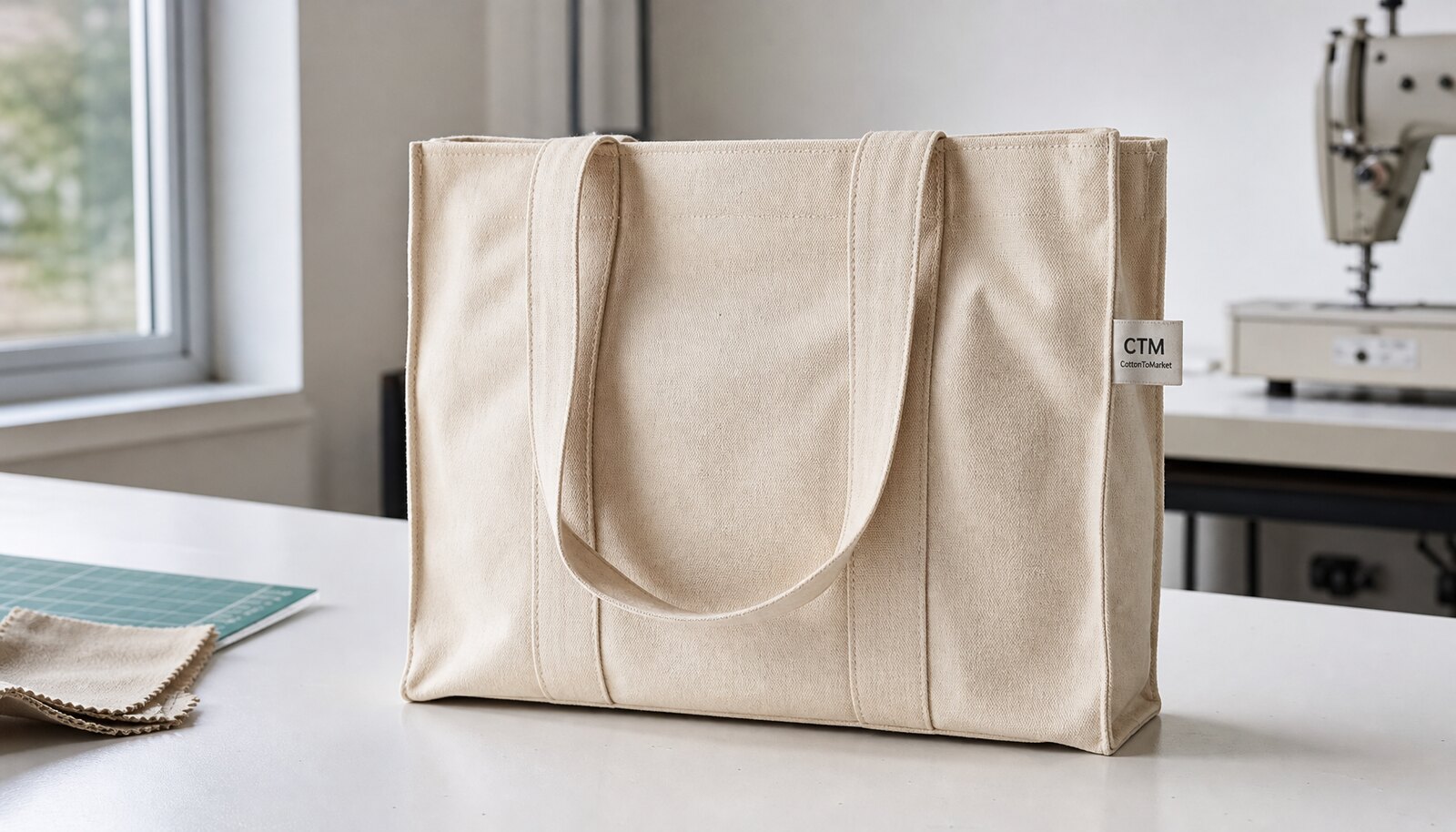
1. Start With The Event Use Case, Not The Tote
For wellness brands, a conference bag is not just a giveaway. It carries a notebook, brochure stack, bottle, sample kit, and sometimes retail items that need to look presentable at check-in and on camera. The sourcing brief should start with the use case, not with the word tote. A retreat welcome bag, a trade-show handout, a staff kit, and a premium retail bag all need different fabric weight, construction, and branding treatment.
Wellness buyers also care more about tone than many general promo buyers. A bag for supplements, skincare, candles, herbal tea, or a guided retreat usually performs better in natural canvas, soft off-white, stone, sage, or charcoal than in a loud promo color. It has to support the brand visually, but it also has to survive venue wear, luggage compression, and product photography. That means the sourcing plan must balance look, load, and logistics from the first RFQ.
The cleanest way to brief the factory is to define the bag by destination and behavior. Is it a one-time event handout? Is it a premium reusable retail item? Is it a hybrid bag that must do both jobs? The more clearly the buyer describes the real use, the less likely the supplier is to quote a generic promo tote with weak reinforcement or a shape that collapses when filled.
If the bag will be seen by buyers, stockists, or retail partners, say so in the brief. A tote that looks acceptable on a conference table can still fail a retail review if the seams are uneven, the print sits too high, or the fabric feels too soft in hand. For private-label programs, the bag is part of the product line, not just event collateral.
- Define whether the bag is for conference handout, retreat retail, staff kit, or premium welcome pack before you quote it.
- List the actual contents the bag must carry, including rough weight and whether any items are rigid or sharp-edged.
- Treat the visual brief as part of the product spec, especially if the brand leans natural, minimal, or eco-positioned.
2. Lock The Physical Spec Before You Price It
A usable canvas conference bag spec starts with finished size, gusset depth, and handle drop. For many wellness programs, a body around 14 to 16 inches wide, 15 to 16 inches high, and 4 to 5 inches deep is practical because it holds a program booklet, product samples, and a bottle without becoming bulky. If the bag must fit inside a mailer carton, sit on a retail shelf, or pack into an event box, the shape matters as much as the dimensions.
Do not let the supplier quote from a vague description like medium tote. Ask for finished size after sewing, not cut size before stitching, because those are not interchangeable. A factory can cut generously and still deliver a bag that measures short after seam allowance and shrinkage are applied. The RFQ should also specify whether dimensions are outer dimensions or body dimensions, whether the bag is measured laid flat, and which tolerance applies to each side.
Handle design is another place where buyer intent gets lost. A short hand-carry handle may be fine for a light handout bag, but a shoulder-carry event tote needs a different drop and often stronger reinforcement. Decide whether the handles are self-fabric, webbing, or a combination. Also decide whether the top is open, zippered, or tied. Each choice changes sewing time, material use, carton pack, and defect risk.
A clean spec sheet should also state whether the bag includes an internal pocket, divider, snap, or zipper pull. Those details affect not only cost but also production sequence. The point is not to over-engineer a simple tote. The point is to make sure every factory is quoting the same product instead of a different interpretation of the same words.
- Use finished size, not cutting size, in the RFQ and sample sheet.
- Set a target handle drop that matches the expected load and carrying style.
- Decide on open top, zipper, or pocket before quote comparison starts so suppliers price the same bag.
3. Pick Fabric Weight And Build For Real Load
Canvas weight is the first place where a private-label tote wins or loses its feel. A 10 oz canvas, about 280 gsm, can work for a light conference giveaway, but it will feel softer and may collapse when the bag is filled. A 12 oz canvas, about 340 gsm, is usually the safer baseline for a structured branded bag because it balances drape, printability, and cost. If the bag must carry heavier samples, bottles, or hard items, 14 oz or about 400 gsm is a more durable choice, though it raises material cost, sewing effort, and freight weight.
Canvas is not one generic fabric. The buyer still needs to confirm fiber content, yarn structure, finish, and whether the material is raw, pre-washed, or pre-shrunk. Raw canvas can look natural and premium, but it may have more variability in hand feel and dimensions. A pre-washed or controlled-shrink fabric is usually easier to hold to size after cutting and sewing. If the brand wants a softer, lived-in appearance, that can be specified, but it should not be left to supplier preference.
Construction detail matters just as much as fabric weight. Reinforcement at the handle join is critical, especially if bottles or sample kits will be loaded into the bag. Ask for bar-tacks or dense reinforcement stitching at each stress point, a stable bottom seam, and a clean seam allowance on side panels and gussets. For heavier contents, consider a lining or bottom board if the event kit needs the bag to stand on a table. Those extras increase cost, but they also reduce complaints when the tote is actually used.
It helps to think in buyer scenarios rather than abstract weight ranges. For a welcome bag that holds paper inserts and one or two small items, 10 to 12 oz may be enough. For a conference bag that carries samples, a water bottle, and a brochure stack, 12 oz is the safer baseline. For a retail-grade bag that may be reused after the event, the buyer should ask for a sample loaded to a realistic weight and inspect whether the seams, handles, and bottom hold shape without distortion.
- 10 oz is light-use; 12 oz is the safer private-label base; 14 oz is better for heavier kits.
- Ask whether the fabric is raw, pre-washed, or pre-shrunk if size control matters.
- Specify reinforcement at handle joins and bottom seams because those are the failure points under load.
- If the bag must stand upright, ask whether a bottom board or firmer base insert is available.
4. Choose A Logo Method That Still Looks Premium
The branding method should match both the visual style and the production reality. For most canvas conference bags, a one-color or two-color screen print is the most efficient option because it gives a clean front panel and keeps setup manageable. A water-based print usually feels softer on natural canvas, while a heavier ink build can sit on the surface and look less refined if the art is too large or the screen is not well controlled. Embroidery can work for small marks, but it can pucker lighter canvas and add stiffness if the stitched area is too wide.
For private label, a woven side label or small sewn brand tab often does more work than a large front print. It keeps the bag clean for photography and still gives the buyer a visible ownership mark. If the brand uses a retreat or premium wellness positioning, a small stitched label or tight patch application can feel more considered than a loud logo block. Placement matters: the logo should be centered, repeatable from sample to bulk, and large enough to read at handoff without dominating the bag.
When comparing print or label methods, the buyer should ask what can go wrong in bulk. For screen print, ask about color registration, mesh count, and whether the artwork has fine lines that may break up on textured canvas. For woven labels, ask whether the edge is heat-cut or sewn cleanly, and whether the label will fray after handling. For patches, ask how the patch is attached and whether the edge lifts after flexing. These are not cosmetic details; they determine whether the bag still looks branded after shipment and event use.
A useful rule is to keep the front panel simple unless the brand story specifically needs more visual treatment. A bag overloaded with graphics, slogans, and multiple logo placements can look promotional rather than private label. For wellness brands, restraint often photographs better and is easier for buyers, stockists, and event organizers to approve.
- Use screen print for simple artwork and repeatable pricing.
- Use a woven label or side tab when you want a cleaner front panel and stronger private-label ownership.
- Do not compare print methods without comparing artwork size, color count, placement, and surface texture.
- Request a rub test or abrasion check if the logo sits on a high-contact panel.
5. Select The Right Supplier Route And Verify The Factory
The cheapest-looking quote is often just the least specific one. A direct factory can usually control fabric selection, sewing quality, and carton packing better than an intermediary, which matters when you need a repeat program or a spec that will be reordered. A trading company can be useful if you need a broader product mix or do not have time to manage multiple factories, but the buyer should expect less transparency on where the cost sits. A local decorator or domestic finisher can make sense for rush fill-ins, but the unit price usually rises once you scale beyond a small event drop.
For wellness brands, the best route is often a direct factory for the core bag plus a local partner for overflow or urgent domestic reorders. That keeps the main spec stable while protecting the launch calendar. If the order is time-sensitive, ask where fabric, labels, and printing actually happen, and whether the same site handles cutting, sewing, packing, and inspection. If the answers are split across multiple subcontractors, the buyer should ask who owns final quality responsibility and who signs off deviations.
Supplier verification should be document-led, not verbal. Ask for the legal company name, factory address, business registration, recent photos of the production area, and evidence that the quoted product is actually being made in-house or under managed subcontracting. If the supplier claims compliance, ask for the actual report, not a logo on a brochure. If they claim they have made a similar bag, ask for date-stamped production photos, not only polished sample-room images.
A useful red flag is when the supplier avoids specifics about the line, waves away tolerances, or keeps saying they can do everything. That usually means the buyer has not yet reached a real production conversation. The right supplier route is the one that can explain the construction, show the material source, and commit to a clear approval path before the first sample is cut.
- Direct factory works best when the bag is being reordered or tied to a larger private-label line.
- Trading companies help with complexity, but buyers need to pin down what is actually included in the price.
- Local decoration is useful for short timelines, but it should not be mistaken for a long-term cost benchmark.
- Ask who owns final QC decisions when the supply chain includes more than one site.
6. Read Quotes As A Cost Model, Not A Sticker Price
A usable quote should separate the cost drivers. The main ones are fabric weight, print setup, number of colors, reinforcement details, labels, packing labor, cartons, and freight basis. A single all-in number is only useful if the supplier states exactly what it covers. If one factory quotes EXW and another quotes FOB, you are not comparing the same thing. The same issue appears with packing: one supplier may include a polybag and barcode sticker while another leaves them out and charges later. That difference can distort a procurement decision more than the unit price suggests.
The quote should also show whether the supplier is pricing from standard cloth or from a dyed or reserved lot. A custom color canvas, a branded lining, or a special zipper pull often changes the purchasing logic because the factory has to lock in material and setup earlier. Ask for quantity breaks so you can see whether the price curve is realistic for your forecast. A quote that barely improves as volume rises may be hiding setup costs in the base price. A quote that drops too steeply may be underpricing something important, such as inspection, carton work, or packaging detail.
MOQ logic belongs in the quote review, not as an afterthought. A lower MOQ is usually possible when the bag uses standard canvas, a single artwork, and simple packing. The moment you add custom dye, multiple print colors, lining, zipper hardware, or special labels, the MOQ tends to rise because the factory must reserve more setup time and material. That is normal. What matters is whether the supplier can explain the reason in production terms rather than in vague sales language.
For a private-label program, the cheapest first order is often the one that is easiest to repeat. If the bag can be reordered with the same fabric, same print, and same pack-out, the buyer gets a better long-term cost base even if the initial unit price is not the lowest in the tender.
- Compare quotes only after you align Incoterm, packing, carton count, and artwork count.
- Request quantity breaks so you can see how the unit cost moves when you scale the order.
- Treat labels, hangtags, and carton work as real costs, not as freebies unless they are written into the quote.
- Ask whether the quoted price assumes standard canvas stock or a reserved/custom fabric lot.
7. Set Sample Approval Rules Before Bulk Starts
The sample stage is where most tote problems can be prevented cheaply. A good flow is artwork sign-off, fabric confirmation, pre-production sample, then bulk. That sequence matters because a sample made in the wrong cloth, wrong color, or wrong print method can give false confidence. The pre-production sample should reflect the real bulk material, the real logo placement, and the real packing method. If the supplier changes fabric or label placement after sample approval, the sample should no longer be treated as the control reference.
A practical approval sheet should include size tolerance, logo position tolerance, handle length, seam quality, and reinforcement quality. For a sewn canvas bag, a tolerance band around plus or minus 1 cm on main body dimensions is usually workable, but the buyer should set separate tolerances for handle length and logo position because those are more visible to end users. The sample should also be inspected for symmetry: one handle sitting higher than the other, a skewed gusset, or a tilted logo can make a bag look cheap even when the fabric is fine.
The bag should be tested loaded, not just viewed flat. If the handles bite into the hand, the bottom seam strains, or the side seam twists when the bag is filled with a bottle and notebook, the sample is not approved for bulk even if the print looks good. Ask for first-piece approval before the factory runs the full order, especially if the bag has a zipper, pocket, lining, or heavier reinforcement. A first-piece checkpoint catches cutting errors and placement drift early, when correction is still cheap.
For buyers who need a robust approval trail, keep a sample record with dated photos of the front, back, side seam, bottom seam, label, and loaded test. Store the approved sample reference with the PO, because later disputes are much easier to resolve when both sides can point to the same control sample and the same tolerance sheet.
- Use the pre-production sample as the golden reference for bulk approval.
- Check the bag loaded with the actual contents it will carry at the event.
- Reject samples with sloppy handle reinforcement, print drift, skew, or obvious size variation.
- Keep dated sample photos and the approved physical sample linked to the PO.
8. Specify Packing, Labeling, And Cartons Early
Packing decisions affect both the product and the warehouse. A wellness brand may prefer a flat-folded bag with tissue wrap or a paper belly band instead of a plastic polybag, especially if the line is positioned as natural or low-waste. If the bags are going directly into a retailer or 3PL, barcode labels, carton marks, and inner-pack quantities should be fixed before production starts. Changing the pack format after sewing usually costs more time than the label itself, and it often creates receiving issues downstream.
Carton planning matters more than many buyers expect. A small change in fold size can alter carton dimensions, and carton cube drives freight cost, pallet count, and receiving speed. Flat-packed bags are usually the safest export option because they hold shape better and reduce random crushing. If the bag needs hangtags or retail stickers, make sure those are placed on the correct panel and are readable at receiving. The factory should know whether the goods go to a distribution center, a retail back room, or direct to event storage, because each destination creates different pack-out needs.
For procurement teams, the packing spec is also a quality control tool. A clear inner-pack count and carton label reduce warehouse confusion and help identify whether a shortage came from production or pack-out. Ask the supplier whether cartons are single-style or mixed-style, whether each carton is marked with PO and SKU details, and whether moisture protection is included for long transit. If the order will sit in storage before an event, moisture control and carton integrity are not optional details.
A good way to avoid later rework is to treat packaging like a line item in the RFQ. State whether the buyer wants flat pack, folded with tissue, polybagged, or retail-ready, and specify whether the bag must be shipped in master cartons only or on pallets. The fewer assumptions the factory has to make, the fewer receiving problems the buyer has to solve.
- Choose flat packing unless there is a clear retail reason to use another format.
- Lock inner-pack quantity and barcode position before production begins.
- Ask for carton dimensions early so freight and warehouse cube are not guessed at the last minute.
- Clarify whether cartons are single-SKU or mixed-SKU before the order is confirmed.
9. Plan Lead Time Around The Real Bottlenecks
For planning purposes, a straightforward order can take roughly 7 to 14 days for sampling and 25 to 45 days for bulk after sample approval, before freight is added. That is an example range, not a promise, and it assumes the fabric is available, the artwork is final, and the factory is not waiting on custom trim. Custom-dyed canvas, woven labels, complex print registration, or special packing can extend the schedule quickly. If the event date is fixed, the buyer should work backward from the ship date, not the delivery date, and build a margin for freight delay.
The usual bottlenecks are fabric reservation, print screen approval, trim procurement, and carton production. If the order includes multiple SKUs or colorways, the factory may need to stage each one separately. The safest way to protect a calendar is to freeze the spec early and keep late changes out of the bulk run. Wellness brands often discover too late that they want to add a slogan, change the label style, or modify the pocket after the sample is approved. Those changes are not trivial because they affect cutting, stitching, and the packing line.
If the calendar is tight, ask the supplier for a critical-path schedule. That should show what happens first, what can overlap, and which step holds the shipment if there is a delay. A supplier that can name the bottleneck is usually more reliable than one that just says they will try to speed it up. Buyers should also confirm whether the factory books raw cloth early or only after deposit, because canvas availability can become the hidden schedule risk on repeat orders.
For buyer teams managing launch dates, the best habit is to set internal sign-off deadlines that are earlier than the supplier’s promised dates. That protects the program from artwork rework, internal approval delays, and the inevitable small correction that appears after the first sample lands.
- Work backward from the event or launch date and leave room for freight, customs, and receiving.
- Assume custom labels, print revisions, and dyeing will add time unless the factory states otherwise in writing.
- Freeze the artwork before bulk if the calendar matters more than speculative design changes.
- Ask for a simple critical-path schedule when the order is date-sensitive.
10. Turn The RFQ Into A Repeatable Private-Label Program
A clean RFQ should read like a production brief, not a marketing note. Include the finished size, fabric target, artwork files, logo placement, closure type, label requirements, packing method, carton marks, destination, and target order quantity. Add the business context too: conference handout, retreat welcome pack, or retail tote. That context helps the supplier decide whether to quote for durability, shelf appeal, or speed. If you leave out the use case, you usually get a generic tote that looks acceptable on paper and awkward in hand.
To make bids actually comparable, send the same document to every supplier and ask them to confirm each line item back to you. The supplier response should show what is included, what is excluded, what is optional, and what could change the price. This is especially important for private-label orders because label application, hangtags, fold method, and inner pack can all look minor until they create differences in labor and receiving cost. A quote that looks low because it excludes packing is not a lower-cost bid if the buyer must add those steps later.
The final buying decision should not rely only on unit price. Pick the supplier that can repeat the spec, explain the cost drivers, and show a clear sample path. A slightly higher price is often justified if the factory is disciplined on measurements, packing, and communication. For a private-label wellness program, the real cost of a bad order is not just the bag itself. It is the time lost re-approving artwork, the event team scrambling for replacements, and the damage to the brand standard when the wrong tote lands in the market.
A good procurement plan also records the decision logic. If you choose a higher-cost supplier because they gave better traceability, clearer QC records, or a stronger delivery path, write that down. It helps future reorders stay consistent and makes the next sourcing round faster.
- Send one spec sheet to every supplier so the bids are directly comparable.
- Choose the quote that explains assumptions clearly, not the one with the shortest price line.
- Use the first order to build a repeatable product spec that can be reordered without redesign.
- Record why the winning supplier was chosen so reorders do not restart from zero.
Specification comparison for buyers
| Supplier option | What to verify | Commercial advantage | Buyer risk to control |
|---|---|---|---|
| Direct sewing factory | fabric swatch, approved sample, seam close-ups, logo test photos, packing pilot, and final inspection evidence | Better sample-to-bulk control and faster production feedback | May be weaker on export paperwork or branded packing unless checked early |
| Trading company | Factory name, production photos, trim-source proof, and who owns QC decisions | Can coordinate small mixed orders and extra services | Markup can hide real factory capability and slow defect decisions |
| Specialized bag workshop | bag size, gusset, handle drop, seam allowance, stitch density, reinforcement patch, and loading expectation | More practical for detailed construction, trims, and repeat programs | Capacity may be limited during peak seasons |
| Low-price general supplier | 8-12 oz cotton canvas, 120-220 gsm cotton, recycled cotton, or blended fabric selected by use case and target price | Useful for simple promotional runs with loose specs | Material downgrades, weak packing, and vague inspection scope can erase savings |
| Retail-ready supplier | fold method, inner bundle, carton count, carton mark, moisture protection, SKU separation, and warehouse receiving needs | Can handle labels, SKU separation, carton marks, and receiving rules | Higher unit cost must be compared against reduced warehouse work |
| Compliance-focused supplier | Fabric records, labeling review, test plan, and production traceability | Safer for retail programs and repeat brand orders | Documentation claims need evidence, not only sales language |
| Local sample room plus bulk factory | Signed sample, bulk factory handoff, first-piece photos, and deviation owner | Good for complex branding before large production | Sample room quality may not match bulk line unless handoff is controlled |
Buyer checklist before sampling
- Finished bag size, gusset depth, and handle drop are written in the RFQ with the measurement method stated (flat laid, outer dimension, or finished sewn size).
- Fabric content, weave, and weight are fixed: for example 100% cotton canvas at a named GSM, or a cotton blend if that is intentional.
- The buyer specifies whether the fabric is raw, washed, pre-shrunk, bleached, dyed, or recycled cotton, because each choice changes hand feel and shrink behavior.
- Artwork file format, print colors, logo size, and placement are approved before sampling starts.
- The bag use case is defined: conference handout, retreat welcome kit, retail tote, PR mailer, or staff pack.
- Closure, lining, pocket count, reinforcement points, and handle construction are included in the spec sheet.
- Packing format is defined: flat-folded, tissue-wrapped, polybagged, belly-banded, or retail-ready with hangtag and barcode.
- Carton count, carton dimension, and pallet requirement are included so the buyer can forecast freight and warehouse receiving.
- The supplier has confirmed the sample stages, who signs off each stage, and what changes require a new sample or a revised quote.
- Quote terms are aligned across suppliers: same Incoterm, same freight basis, same packing assumption, and same included accessories.
Factory quote questions to send
- What is the exact fabric specification, including fiber content, GSM, weave, finish, and whether the canvas is pre-washed or pre-shrunk?
- Is the quoted fabric from stock, reserved stock, or custom purchase? If custom, what is the minimum fabric order and who carries the leftover risk?
- What is included in your unit price: cutting, sewing, reinforcement, print setup, labels, hangtags, inner packing, carton packing, and export cartons?
- What is the MOQ by fabric color, by artwork, and by label type? Can the same base bag carry multiple logos or only one art set per order?
- What are the sample charges for a first sample and a pre-production sample, and which of those charges are deductible from the bulk order?
- What are your measurement tolerances for finished size, handle length, logo placement, and seam alignment? Please state the tolerance in centimeters or millimeters.
- Which printing method are you quoting, and what are the limits for color count, coverage area, and fine-line detail on textured canvas?
- If the bag includes a pocket, zipper, lining, or snap, what are the added labor and material costs for each item?
- What is the standard carton pack, gross weight, and carton dimension for this order?
- What inspection standard do you use before shipment, and who approves release if the bulk output misses the signed sample?
Quality-control points to confirm
- Fabric GSM is verified against the approved spec by weighing a measured swatch, not by judging hand feel alone.
- Color is checked against the approved reference under daylight or standardized white light; avoid judging under mixed warehouse lighting.
- Finished dimensions are checked on a flat surface using a tape measure after light smoothing, not stretching the bag.
- Handle length, handle symmetry, and handle drop are measured from the same reference point on every sample.
- Handle joins are inspected for bar-tack count, stitch density, and reinforcement placement; any skipped stitch at the load point is a defect.
- Main seams, gusset corners, and bottom seams are checked for straightness, open stitching, thread breaks, and seam allowances that expose raw edges.
- Logo placement is checked against the artwork approval with the bag laid flat; position drift, misregistration, and uneven ink coverage are defect points.
- Printed areas are rubbed lightly and then rechecked for cracking, smearing, or obvious flaking on the approved test area.
- Labels, hangtags, barcode stickers, and country-of-origin marks are checked for correct position, legibility, and durability of attachment.
- Pockets, zippers, snaps, or closures are opened and closed repeatedly to verify alignment and function before pack-out.