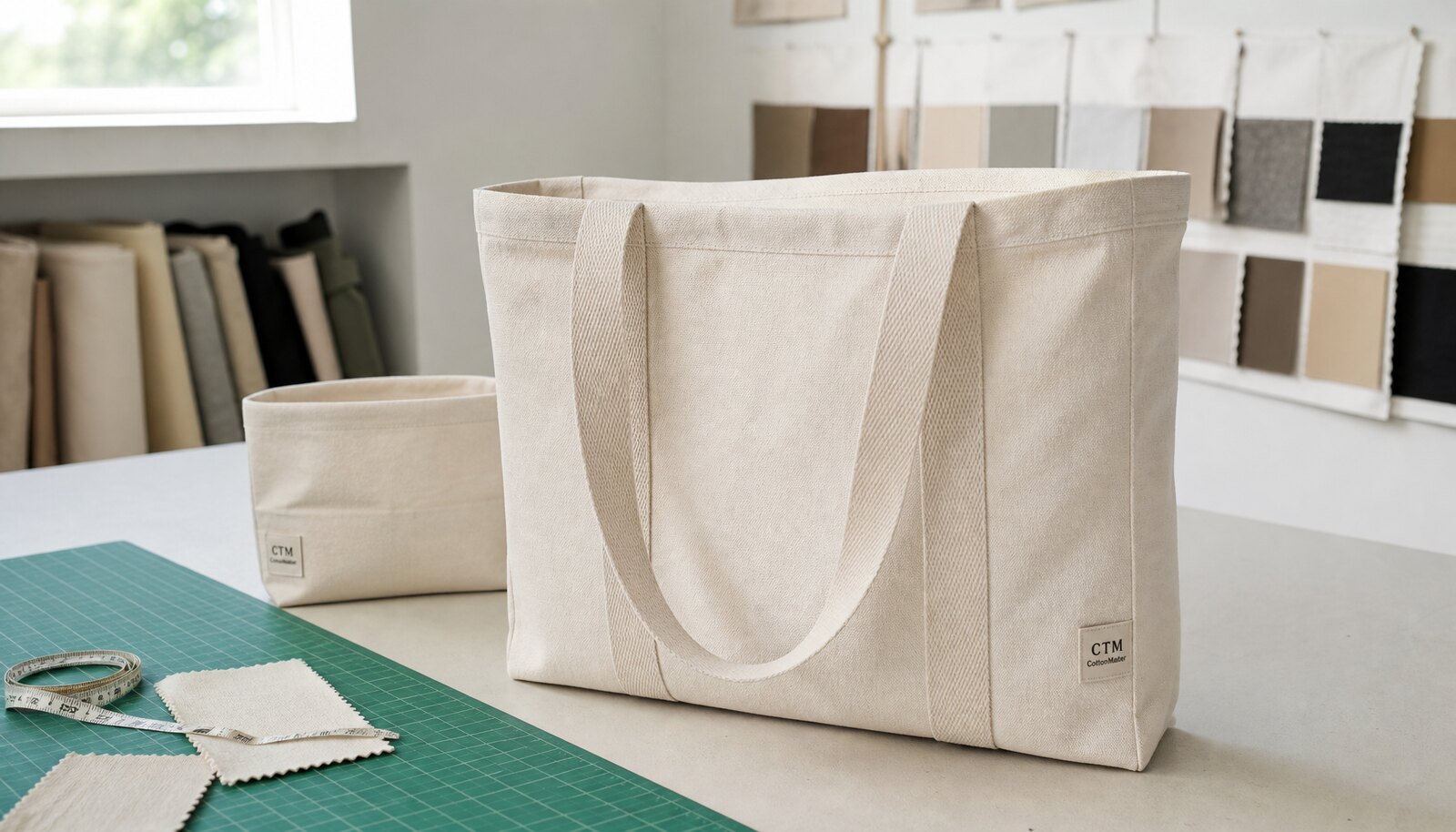
Why the packaging spec matters before you price the bag
For wellness brands, a canvas conference bag is rarely an isolated item. It is usually a carrier for brochures, samples, supplements, event schedules, or retail add-ons, which means the bag is doing both brand presentation and physical protection. If the bag arrives wrinkled, dust-marked, or packed in the wrong format, the buyer often ends up repacking it at the warehouse or event site. That downstream labor belongs in the spec from the start, not after the factory has already quoted a unit price.
The most common procurement error is to request pricing before the packaging stack is defined. One supplier quotes a bare folded tote, another includes tissue, belly band, carton marks, and barcode labeling, and the numbers look comparable when they are not. A clean sourcing process starts by deciding what the unit must do: protect in transit, present on shelf, or support both. Once that is clear, the supplier can price the same build and the buyer can compare actual landed cost instead of mismatched quotes.
Wellness-brand buyers also need to think about tone. A conference bag for a meditation retreat, a nutrition brand, or a clinic event usually calls for a calmer, cleaner finish than a generic promo tote. That does not always mean more decoration. In many cases it means tighter stitching, a controlled logo size, fewer visible pack materials, and carton presentation that arrives neat enough for immediate handout. The spec should express that standard directly.
- Treat packaging as part of the product, not as a finishing afterthought.
- Define presentation, transit protection, and carton handling in the RFQ.
- Use one spec for all suppliers so quotes can be compared cleanly.
Start with the bag build, because packaging has to fit the construction
Packaging should follow the bag, not the other way around. A soft 10 oz canvas tote with a simple one-color logo can usually be packed more lightly than a 14 oz structured bag with a pocket, lining, or board insert. If the base construction is weak, premium packaging will only mask the problem briefly. Buyers should lock the bag architecture first: fabric weight, body dimensions, handle length, handle width, reinforcement, seam type, and whether the bag needs a gusset or base board.
For most wellness conference programs, 10 to 12 oz canvas works when the bag is meant for light handouts, a booklet, and a few sample items. Once the program includes a bottle, a box, or a heavier insert, 12 to 14 oz is the safer range. The buyer should not specify weight in general terms like “thick canvas” or “premium canvas.” Ask for the exact GSM or ounce spec and a minimum tolerance, because one supplier’s 12 oz can be another supplier’s loose interpretation of a medium-weight fabric.
Print method is the second decision that changes the quote. Screen print remains the most practical option for solid logos and one to three flat colors. Heat transfer can support fine detail or gradients, but it introduces another process variable and a different durability profile. Woven labels, sewn side labels, or a small restrained print often fit wellness branding better than a large graphic. If the bag is intended to feel calm and premium, over-printing the face panel is often the wrong direction.
The bag build also affects cartonization. A roomy tote with soft handles may fold flat and stack well, while a structured bag with inserts can create a larger cube and increase freight cost. If the buyer wants the bag to hold its shape, that should be stated as a packaging and transit requirement, because it changes the fold method, the carton count, and potentially the carton dimensions.
- 10 to 12 oz canvas suits lighter event carry and moderate insert loads.
- 12 to 14 oz canvas is safer for heavier kits, bottles, and retail use.
- Ask for exact size, handle drop, and reinforcement details before discussing packout.
Choose the packout by channel, not by habit
A conference handout bag, a retail shelf bag, and a mail-out bag are three different packaging problems. Event handouts usually need a clean fold, a simple band, and efficient carton loading. Retail-ready units usually need a more controlled presentation, plus a barcode or price sticker if they will pass through a retail or distribution network. Mail-out kits need the most protection because the bag has to survive carrier handling, warehouse stacking, and repeated touch points before the customer sees it.
Wellness brands often prefer a natural look, which is understandable, but “natural” should not become a vague instruction. If the bag is going straight from the carton to an event desk, a bare fold may be enough. If it must arrive shelf-ready, the buyer may need tissue wrap or a belly band to keep the presentation consistent. If it must travel farther or sit in storage, a polybag or sleeve can protect the fabric from dust and transit rub. The buyer should define which layer is for appearance and which is for protection so the supplier does not guess.
A useful rule is to match the packout to the distance and handling count. The more times the unit is touched before the end user receives it, the more controlled the packaging should be. That does not always mean more materials; it can mean better folding instructions, a more repeatable band position, or a tighter carton spec. For low-friction event distribution, buyers often save money by simplifying the pack and investing that budget in better sewing or better print registration instead.
The supplier should also be told whether the packed bag must be ready for immediate distribution or can be reworked on arrival. If the warehouse team plans to sort, sticker, or insert printed collateral later, that should be called out in the brief. Otherwise the factory may over-pack or under-pack the order based on its own assumptions.
- Event-ready packout: clean fold, belly band, and efficient carton loading.
- Retail-ready packout: tissue, band, barcode, and sometimes a protective polybag.
- Mail-ready packout: more transit protection, stronger cartons, and clearer carton marking.
Packaging specification choices that change cost, cube, and finish quality
The packout has a direct impact on both cost and warehouse performance. Tissue adds a small materials cost but can make the unit look far more finished when opened. A belly band is usually less expensive than a printed sleeve and is easier to apply quickly. A polybag improves dust protection and can reduce handling marks, but it increases plastic consumption and can change carton cube. A barcode sticker is cheap by itself, yet becomes expensive if the placement rule is unclear and the pack team has to slow down.
The buyer should think in terms of tradeoffs instead of default upgrades. If the conference bags are for a short event cycle and never touch retail shelves, a branded band may be enough. If the bags move through a retail distribution center, the barcode format and sticker location can matter more than a decorative insert. If the team wants the bag to feel premium when handed over at registration, a better fold and tighter tissue placement may deliver more value than another print color. The spec should capture the reason for each packaging layer, because that helps the supplier quote the right process instead of adding unnecessary materials.
This is also where unit economics can be improved without damaging the brand. For example, reducing the pack count per carton may lower carton damage but raise freight cube. Increasing the carton count can cut freight, but it may create crush risk if the bags are too tightly compressed. If the buyer asks for both carton dimensions and pack sequence in the RFQ, the factory can advise where the practical limit sits rather than only giving a bag price.
- Use tissue for presentation, not as a substitute for strong fabric or neat sewing.
- Use a belly band when you need quick branding with low added material cost.
- Use polybag protection only when transit, dust, or distribution handling justify it.
What different supplier routes really change in the quote
A direct factory is usually the cleanest route when the same supplier can control sewing, print, packout, and carton labeling. That reduces handoffs and makes it easier to hold one person accountable for the final result. The tradeoff is that a factory may still outsource some items, such as woven labels, barcode stickers, or cartons, even when it presents the order as fully integrated. Buyers should ask for a production map so they know which steps are actually internal and which depend on third-party vendors.
A trading company can be useful when the program has multiple sub-suppliers or when the buyer does not yet know how to coordinate bag, insert, and carton production. The hidden cost is margin layering and weaker visibility into where variation originates. For procurement teams, the key is not the business model itself but the quote structure. The buyer should receive a line-by-line breakdown: sewn bag, decoration, pack materials, carton, and any setup fees. If those lines are not separated, the quote should not be treated as ready for comparison.
Stock blank plus local print can make sense for urgent launches, but it shifts quality risk into the blank inventory. Shade variation, different canvas lots, or inconsistent fold behavior can become visible when the blanks are printed and packed locally. This route is best when the buyer is comfortable with simpler branding and when the local team can inspect the blanks before decoration. It is not the best route for a carefully controlled wellness launch unless speed matters more than exact uniformity.
For repeat programs, buyers should ask whether the supplier can hold the same material lot, print setup, and pack sequence on reorders. That is often more valuable than a small first-order discount. A slightly higher factory price can still win if it reduces rework, shortens receiving time, or avoids sorting at the buyer’s warehouse.
- Ask who actually handles sewing, printing, packing, and carton labeling.
- Require a component-by-component quote and a named process owner.
- If a supplier says “all in-house,” ask for photos or a brief process map.
The RFQ data factories need to quote cleanly
A useful RFQ for canvas conference bags for wellness brands should read like a production brief, not a marketing blurb. Give the finished size, flat size if relevant, handle length and width, gusset depth, fabric weight, color standard, and decoration area. If the bag includes a pocket, zipper, lining, or board insert, the drawing should show exactly where each element sits. The print file should be provided in vector form, along with a physical reference or strike-off request if color matching matters.
You should also define what the bag is for. A wellness conference tote used to hold handouts has different requirements than a retail tote meant to sit in a clinic shop or boutique. The more the supplier understands the use case, the less likely they are to overbuild or underbuild the order. That can save cost in fabric, reduce freight cube, or prevent a weak bag from being accepted because nobody specified how much load it needed to carry.
Include the destination and shipping term in the RFQ. Carton size, warehouse receiving label, barcode needs, and palletization expectations all affect the final quote. If you only ask for a sewn-bag price, the supplier will not know whether to optimize for compact packing or a more structured presentation. If you need a lower-cost alternative, specify what can change and what cannot. For example: same size, same color, simpler label, no insert card. That gives the supplier a real value-engineering path instead of a guess.
The most common gap in buyer briefs is tolerance. If the buyer wants a handle drop within a tight range, or wants the logo placed a fixed distance from the top edge, that needs to be written down. Without a tolerance band, the factory will quote against its own assumptions and the sample will become a debate instead of a standard.
- List size, GSM, color, handle spec, and logo position with measurements.
- Define the packaging stack, not only the bag body.
- State the destination, shipping term, and target delivery window.
Sample approval: what to inspect before bulk starts
A sample should prove the whole system, not just the bag silhouette. Review the fabric hand feel, seam quality, print clarity, label position, fold behavior, and whether the packout can be repeated without special care. For wellness brands, presentation standards are usually strict: crooked labels, loose threads, visible glue, or a sloppy fold are noticeable even when the bag is otherwise functional. Keep one sealed golden sample at the factory and one at the buyer side so both parties are working from the same physical reference.
Inspection should be done in neutral light, not only under a camera lamp or warm office lighting. Canvas can look cleaner or darker depending on the light source, and that can hide shade shifts or print issues. Measure the finished width, height, gusset, and handle drop. Check the logo placement from a seam or edge rather than by eye. Open and refold the bag to confirm the fold sequence is practical for line workers. A sample that only works when one person handles it carefully is not production-ready.
If the order includes any packaging material, inspect the packed unit as the real deliverable. A bag-only sample is not enough if the final product will be tissue-wrapped, banded, stickered, or inserted into a retail box. Ask the factory to photograph or video the sample being packed step by step. This is not about marketing images; it is about verifying that the chosen pack sequence is actually repeatable on the floor.
If the sample fails, do not approve it with verbal notes only. Ask for a revised sample or a marked-up correction sheet. The sample stage is the cheapest time to fix the order. Once bulk cutting begins, a small error can turn into a line stop, a sorting job, or a carton hold.
- Compare sample color against the approved strike-off under neutral light.
- Measure dimensions, handle drop, and logo position against the spec sheet.
- Reject any sample with visible glue, skewed labels, loose threads, or stain marks.
QC points that prevent rework in bulk production
Bulk quality control should focus on the failures that create rework, chargebacks, or warehouse delays. For canvas conference bags, the recurring risks are shade variation, print misalignment, weak handle stitching, open seams, mixed carton labels, and inconsistent fold or band placement. A buyer does not need an overly complicated QC program, but it does need a written acceptance rule. The factory should know which issues are major, which are minor, and which issues cause the lot to be stopped for sorting.
If the brand presentation is minimal, even a small defect can stand out. A little thread trimming may be acceptable; a crooked woven label often is not. Likewise, a slight print tolerance might be acceptable if the logo is large and centered, but not if the design sits close to the seam. For that reason, QC should be tied to the actual artwork and packing method rather than a generic canvas standard. The buyer should also define whether repairs are allowed on site or whether defects must be replaced outright.
Carton QC matters as much as bag QC once the program is moving in volume. Carton count, barcode accuracy, destination mark, carton strength, and pallet stacking pattern all influence whether the shipment receives cleanly. If a carton is overfilled, the bags may arrive crushed or the carton may split in transit. If cartons are underfilled, freight cube and receiving counts become inefficient. The buyer should ask for a carton specification just like a product specification.
It is also worth defining reject thresholds in practical terms. For example, what level of shade drift is acceptable, how many stray threads can be tolerated, and whether one incorrect label is a full lot rejection or a sort-only issue. Even a basic AQL plan is more useful when it is written into the PO and confirmed before production starts.
- No broken stitches, open seams, or weak handle attachment points.
- No wrong artwork, mixed shades, or visible print bleed on the face panel.
- No carton count errors, mismatched labels, or missing inserts or pack materials.
Carton specs, pack density, and warehouse handling are often the real bottlenecks
Many bag programs slip not because the tote itself is hard to make, but because carton and pack details were treated as an afterthought. A supplier may have the sewing and print under control, then lose time trying to fit the units into a carton size that is too tight or too loose. The buyer should ask for carton dimensions, gross weight, net weight, quantity per carton, and the exact fold orientation before bulk starts. That lets warehouse receiving, freight booking, and pallet planning happen in parallel.
If the bags are shipped flat, pack density can often be improved, but only within a point where the canvas still opens cleanly later. If the bags are too compressed, the first impression at the event desk suffers. If they are too loosely packed, freight cube increases and the carton may crush. The best solution depends on use case: event handout bags can often be packed tighter than retail-ready bags, while retail-ready bags need a cleaner presentation and may need a lighter compression ratio.
The carton itself should match the route. Export cartons need to survive stacking, moisture exposure, and handling from multiple touch points. If the shipment goes to one warehouse, carton marks, destination labels, and pallet pattern are just as important as the product count. Buyers should not accept a finished-goods carton as a generic box. Ask what corrugate grade is being used, whether the carton is single-wall or double-wall, and whether the printed marks are applied before or after final QC. This matters when the shipment is going to a distribution center that scans and receives by label.
One useful procurement habit is to request a packing photo or short packing video before approval. A good supplier can show how the bag folds, how the tissue or band sits, and how the carton closes. That visual evidence is worth more than a general assurance that the packout is standard.
- Ask for carton dimensions, gross weight, net weight, and units per carton.
- Match carton strength and quantity to the route: warehouse, event, or export.
- Request a packing photo or video before approving bulk.
How to compare quotes on the same landed-cost basis
A quote comparison only works if the suppliers are quoting the same build. Normalize the canvas weight, size, print method, packout, and carton count before looking at price. Then split one-time charges from recurring charges. Setup fees, screen fees, label tooling, carton printing, and sample costs should be visible on their own lines. If one supplier buries them inside the unit price and another lists them separately, the apparent difference is not real until you roll the order size forward.
Landed cost should include the labor you will spend after the shipment arrives. A cheaper packed bulk quote can become the expensive option if your warehouse has to add stickers, insert cards, or repack units before the event. Likewise, a slightly higher factory quote may be the better commercial decision if it reduces handling, lowers carton damage, or arrives in a form your team can distribute immediately. For procurement teams, the goal is not simply to save cents on the bag; it is to reduce total cost to ready-to-use inventory.
Use a simple comparison grid internally: bag price, print setup, packaging materials, cartonization, freight, inspection, and receiving labor. That makes it easier to reject a quote that is cheap only because the supplier removed important packing materials. It also helps you choose where to value engineer. In many cases, the easiest savings come from reducing decoration complexity or simplifying the pack sequence rather than changing the canvas quality.
If the buyer expects repeat orders, ask the supplier to quote both first-order and reorder pricing. The reorder number often reveals the real commercial structure more clearly than the opening quote. It also shows whether the supplier is pricing a one-off project or a repeatable program.
- Compare only after normalizing spec, packout, and shipping term.
- Separate setup fees from recurring unit cost.
- Include downstream handling and receiving labor in the decision.
Specification comparison for buyers
| Supplier route | Best use case | Cost impact | Lead-time impact | QC control |
|---|---|---|---|---|
| Direct factory with custom pack-out line | Repeat programs with one bag spec and one packing method | Usually lowest unit cost once setup is amortized; better when carton volume matters | Moderate; efficient if packing components are already approved | Strong if sewing, print, and pack are all documented and traceable |
| Trading company coordinating multiple sub-suppliers | Programs needing one coordinator for bag, insert, carton, and shipping | Often 8 to 20% higher than direct factory pricing, sometimes more for small runs | Can be faster to source multiple components at once, but slower if approvals bounce between vendors | Variable; depends on how tightly they control sub-supplier specs and inspections |
| Stock blank bag plus local print and pack | Rush launches and simple branding with limited customization | Higher per-unit cost than factory-direct, but lower setup spend and fewer delays | Fastest route for short deadlines and small quantities | Moderate; local finishing helps, but blank shade and blank quality can vary by lot |
| Full OEM factory with in-house sewing, print, and packing | Stable, repeatable programs with controlled presentation | Competitive on medium and high volume; setup costs can be spread across reorders | Usually predictable once strike-off and pack-out are approved | Best when line control is documented and inspected at source |
| Domestic decorator or packer | Local events, emergency reorders, and small seasonal runs | Highest unit cost, but may reduce freight and repacking labor | Fast for urgent jobs; good when shipping distance is the bottleneck | Good for small batches if the team has a tight pack SOP |
| Small workshop or low-MOQ supplier | Prototype, pilot launch, or first-market test | Lowest commitment, but usually higher unit cost and more variation | Can be quick for samples; bulk timing becomes less predictable | Weak to moderate unless there is a clear golden sample and inspection plan |
| Exporter with warehouse cartonization | Retail distribution, mixed-SKU shipments, or warehouse consolidation | Can reduce downstream handling cost if cartonization is done correctly | Moderate; helps when export prep is integrated into the schedule | Good for carton marking, barcode application, and mixed shipment control |
| Dual-source model: bag factory plus local fulfillment | Seasonal campaigns, personalization, or changing inserts | Flexible, but coordination costs are real and easy to underestimate | Can be efficient when final assembly happens near destination | QC splits across two parties, so acceptance rules must be explicit |
Buyer checklist before sampling
- Define the use case first: registration desk handout, retail shelf, retreat gift, mail-out pack, or internal staff kit.
- Lock the canvas weight, weave, and finish; for most programs 10 to 12 oz is light-duty and 12 to 14 oz is safer for heavier carry.
- State the exact bag dimensions, handle length, handle drop, gusset depth, and any pocket, zipper, board, or lining requirement.
- Specify the print method, print size, color count, and logo position measured from seams or edges so suppliers quote the same artwork placement.
- Choose the pack format: bulk fold, belly band, tissue wrap, polybag, insert card, barcode sticker, or shelf-ready retail wrap.
- Set the carton pack count, carton dimensions, gross weight target, carton printing requirement, and pallet or warehouse label format.
- Ask for sample photos of the actual pack-out sequence, not just a finished bag shot.
- Request MOQ separately for the bag body, print, labels, tissue, inserts, and cartons because each component can have its own minimum.
- Confirm sample lead time, pre-production approval timing, bulk lead time, and the point at which artwork changes trigger a schedule reset.
- Compare every quote on the same landed-cost basis, including setup fees, packing components, cartonization, and shipping term.
Factory quote questions to send
- What is the unit price at 500, 1,000, 3,000, and 5,000 pcs using the same canvas weight, same size, same print method, and same packaging stack?
- What is the exact canvas GSM or oz weight you are pricing, what weave/finish is used, and what tolerance do you allow on fabric weight?
- Which print method are you quoting, how many colors are included, and what setup fees, plate fees, or screen fees apply?
- What is included in the unit price: sewing only, sewing plus print, or sewing plus print plus packing plus cartonization?
- What packaging items are included or optional, such as tissue, belly band, polybag, insert card, barcode label, hangtag, or dust sleeve?
- What is the MOQ for the bag body and for each packaging component separately, and what happens if one component has a higher MOQ than the bag?
- What is the sample fee, sample lead time, and whether the sample fee is credited back after the order is placed?
- What carton size, carton quantity, carton gross weight, and pallet configuration are planned for the finished packed bags?
- Which steps are done in-house, which are outsourced, and which vendors control labels, prints, cartons, or inserts?
- What is the bulk lead time from artwork approval, and what changes would extend that schedule?
Quality-control points to confirm
- Fabric weight must stay within the agreed GSM or ounce range, with a buyer-defined minimum that cannot be undercut at inspection.
- Canvas shade must match the approved strike-off or golden sample under neutral light; any lot-to-lot shade drift should be defined as acceptable or rejectable before bulk starts.
- Print registration must stay within the agreed tolerance, with no smudge, bleeding, pinholes, ghosting, or broken edges on the logo or artwork.
- Handle attachment should be reinforced with even bartacks or equivalent stitching, with no loose threads, weak ends, or uneven seam tension.
- Seams should be flat and closed, with no skipped stitches, open corners, puckering, or loose internal fibers visible through the opening.
- Bag dimensions, handle drop, gusset depth, and pocket placement must stay within the approved tolerance band, not just visually similar.
- Packaging count must be exact, with each carton carrying the correct quantity, product code, destination mark, and inner pack configuration.
- The fold, tissue placement, band position, barcode position, and sticker placement should be repeatable from one unit to the next.
- No visible contamination, oil marks, needle marks, adhesive residue, or loose trim should appear on the bag, print, or packing materials.
- A golden sample and signed packing standard should be retained by both sides before bulk production starts.