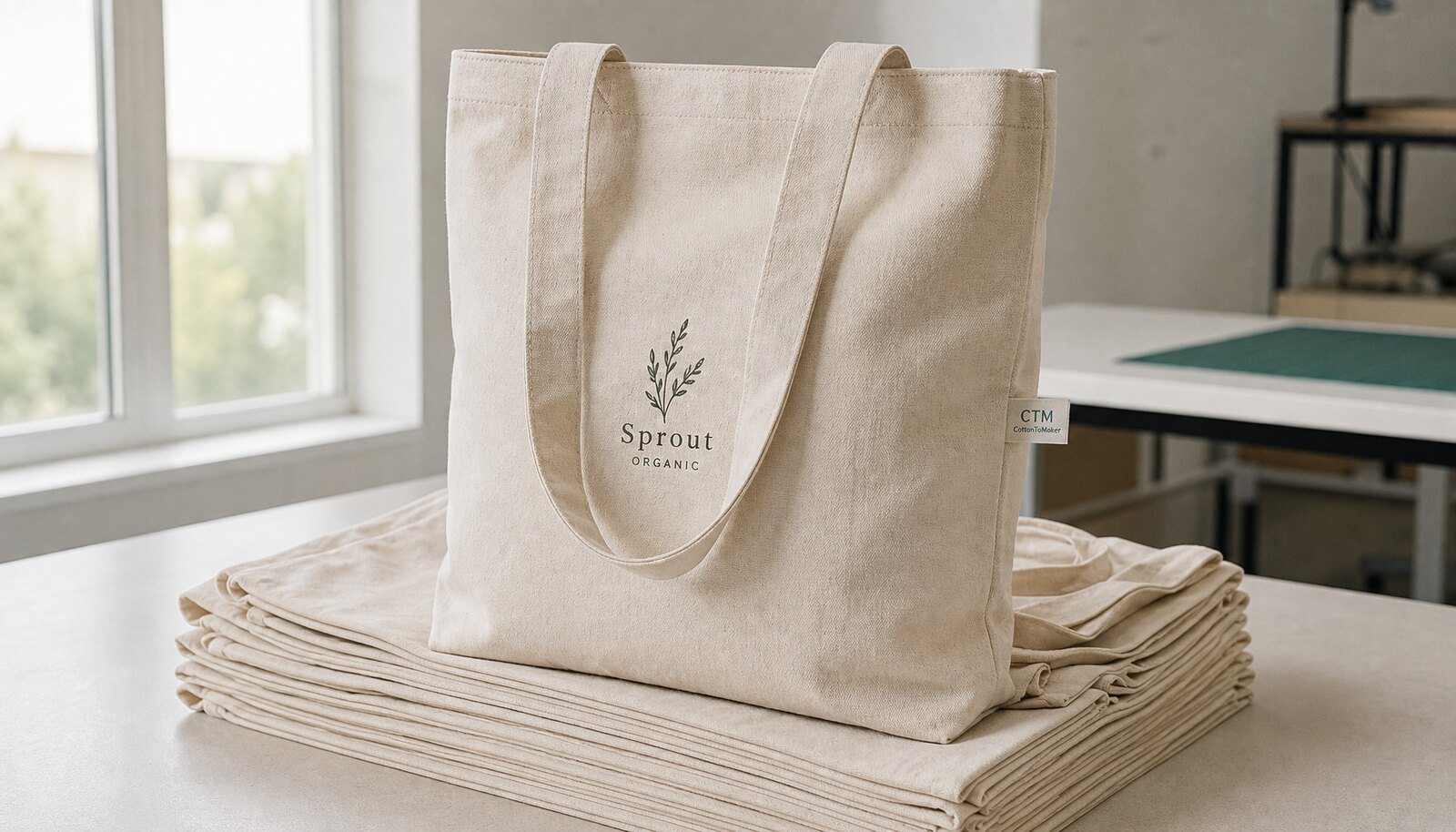
Why trade show buyers keep returning to canvas
For conference programs, the bag is not just a giveaway. It is a distribution tool, a brand surface, and part of the event experience. That changes the buying criteria. A good trade show bag has to hold handouts without sagging, look presentable at the booth, survive transit, and fit the sustainability story the brand is trying to tell. Canvas conference bags do that better than many laminated promo totes because the material feels more durable and less disposable.
The procurement issue is repeatability. Event orders are usually tied to a fixed date, fixed artwork, and a fixed quantity. If the bag spec changes after approval, the consequences are practical: cartons may no longer stack the same way, a brochure may not fit, freight cube may rise, or the print schedule may miss the event window. The right spec avoids those surprises before the PO is released.
- Canvas works best when the bag will be reused after the show, not discarded at the venue.
- The strongest fit is one main logo, one event message, and a clear carry-load target.
- If sustainability is part of the brief, compare the whole pack-out, not only the fabric.
Start with the real load case, not the aesthetic sample
The first decision is what the bag has to carry. A flat literature bag for a keynote session is a different product from a tote that holds catalogs, swag, a water bottle, and a laptop sleeve. That load case should drive size, fabric weight, handle reinforcement, and carton packing. In practice, 12 oz to 14 oz cotton canvas covers most trade show needs. That range is roughly 407-475 GSM, though the exact number depends on weave and finishing.
For lighter distribution, such as a flyer pack, badge holder, and notebook, 10 oz can be workable. The risk is not immediate failure; it is that the bag loses shape, looks tired quickly, and prints less cleanly if the cloth is too loose. For heavier kits or reuse across several events, 14 oz is the safer choice because it holds structure better at the base and reduces the chance of handle distortion over time.
A sample that looks fine when empty can still fail in use. Ask the factory to show the bag flat and loaded. Flat inspection catches size, print placement, and seam quality. Loaded inspection catches handle comfort, top edge flex, and bottom sag. If the kit weight is known, test at the actual filled weight rather than a generic demo load.
- 8-10 oz: acceptable for light handout-only use.
- 12 oz: the common sweet spot for standard conference kits.
- 14 oz: better for reusable bags and heavier inserts.
- Pre-shrunk cloth matters when final fit and print placement must remain stable after handling or humidity exposure.
Compare spec options with price, lead time, and landed-cost tradeoffs
A useful comparison needs benchmarks, not generic descriptions. For typical factory pricing, blank 12 oz canvas bags often fall around $0.90-$1.80 per piece at 1,000-3,000 units. Add a one-color print and the quote may move to roughly $1.15-$2.10. Heavier 14 oz versions, reinforced handles, or label work can push the range higher. Those are not universal prices, but they are practical planning bands that help a buyer spot outliers fast.
Lead time is similar. A straightforward repeat order is often 25-45 days after sample approval. Once custom fabric, new labels, or peak trade show capacity is involved, 40-65+ days is more realistic. In many cases, the sewing line is not the bottleneck; artwork approval, carton artwork, or packing confirmation causes the slip. That is why the cleaner RFQ is the one that removes open decisions early.
Landed cost also moves through the carton. Flat packed bags usually ship more efficiently than loosely stuffed or overpacked bags. A quote that looks slightly cheaper per unit can become more expensive once cube, repacking, and damage risk are included. Procurement teams get the best result when the quote includes the bag, the packing method, the carton count, and the shipment assumptions on the same page.
- One-color screen print is usually the most economical route for conference branding.
- More colors or photographic art increase setup complexity and can raise scrap risk.
- Flat packing often improves freight efficiency, while retail-style polybagging adds cost and plastic.
- A cheap unit price is less meaningful if the carton count or packing method is wrong.
Comparison table: what to specify before you compare suppliers
The table below is the working version of a sourcing brief. It helps compare canvas conference bags for trade shows sustainable packaging comparison purposes without mixing up spec, service, and logistics. The point is to make quotes comparable on the same basis.
Use it as a draft line item list, then lock the final version in the PO and the sample approval. If a supplier cannot quote against these same definitions, the risk is not only price variance; it is a higher chance of rework, missed deadlines, or a bag that does not fit the event kit.
- Keep the same measurement basis across all quotes.
- Ask for sample photos that show the measurement points, not just a finished beauty shot.
- Tie any tolerance to a specific dimension or test, not to a vague quality statement.
How to choose a supplier route without hiding cost or risk
Direct factory sourcing works best when the order is stable and the buyer wants a clear line of sight into fabric, stitching, and packing. That route usually gives better control over repeat orders and makes it easier to hold the same cloth lot for a yearly conference series. It also makes price comparison cleaner because the buyer can ask what is included and what is not.
A trading company or integrated sourcing partner can still be the right answer when the project mixes multiple SKUs, multiple delivery points, or urgent artwork changes. The value is coordination. The tradeoff is visibility. If the partner bundles packaging, labels, freight handling, or inspection into a single number, the quote may be easier to manage but harder to benchmark. The buyer then needs a line-by-line quote to see whether the landed cost is truly competitive.
Regional risk matters too. Fabric sourcing, dye consistency, labor cost, and export congestion can vary by region and season. The practical response is not to assume one geography is always best, but to ask where the fabric is made, where the bags are sewn, where the inspection happens, and where the cartons are handed over to freight. That chain is what drives schedule reliability.
- Direct factory is strongest for repeat, spec-stable orders.
- Intermediaries help when the order has mixed SKUs, multiple destinations, or compressed timelines.
- Request the same spec sheet from every supplier so differences are visible, not hidden in wording.
What to look for in factory evaluation and audit signals
A factory review does not need to be elaborate, but it should be specific. For canvas bags, the most useful signals are practical: whether the supplier can show cutting accuracy, seam consistency, print control, and carton discipline. Ask for photos or video of the actual work-in-process, not just a finished sample room shot. A supplier that can only show beauty samples may be weak on repeatability.
During evaluation, check whether the factory tracks incoming fabric lots, whether it has a defined approval process for print strike-offs, and whether it can show a standard operating method for stitch reinforcement. If the answer is vague, the risk is that quality depends on individual operator habit rather than controlled process. That often works for a very small order and becomes unreliable on a larger run.
Audit signals also matter in the paperwork. A solid supplier usually has a clear record of sample approval, inspection checkpoints, and packing records. If the supplier cannot explain who signs off on bulk release or how carton counts are verified, treat that as a risk signal. The issue is not bureaucracy; it is whether the order can be repeated without mystery.
For procurement teams that need to compare suppliers quickly, a useful checklist is simple: can the supplier name the fabric source, show the stitch standard, explain the print process, and provide a packing plan that matches the freight quote? If those answers are clear, the order is easier to manage.
- Ask for work-in-process photos, not only final product shots.
- Look for lot control on fabric and a clear approval path for print strike-offs.
- A supplier that can explain its own QC steps usually gives fewer surprises later.
Quote the print and artwork like a production job, not a design review
Print details are where many orders drift. The quote should state the number of colors, the size of the print area, the exact placement from the top edge or side seam, and the ink type. A simple one-color logo is generally the safest and most economical choice for canvas. Once multiple colors or tonal gradients enter the spec, setup time rises and the buyer needs to check registration more carefully.
Screen print is usually the best default for conference bags because it is readable, durable, and straightforward to compare across vendors. Heat transfer or other specialty methods can work for short runs or complex artwork, but they need more scrutiny because the surface feel, wash durability, and edge performance can differ. If the bag is meant to be reused, ask for rub-resistance guidance and a clear view of what happens at the seam if the transfer crosses a fold.
Artwork approval should be tied to production reality. A vector file is necessary but not sufficient. The supplier should confirm the final print size, the Pantone reference, the ink coverage, and whether the art loses legibility on natural canvas. Fine lines and small text that look crisp on screen may soften once they hit the weave. That is not a design issue; it is a material issue that should be resolved before the bulk run.
- One or two solid colors are the lowest-risk print approach.
- Ask whether print setup is included or quoted separately.
- Confirm the art’s minimum line weight and smallest readable text size.
- If the design crosses seams, get a revised layout proof, not a verbal promise.
How MOQ really works on canvas conference bags
MOQ is mostly a production logic question. Canvas is cut from rolls, stitched in batches, and packed in carton quantities that affect labor efficiency. That is why practical MOQs often sit around 1,000-3,000 pieces per artwork or colorway. It is possible to go lower, but the unit cost often rises because setup time, fabric handling, and QC effort are spread across fewer pieces.
For event buyers, the better question is not just the MOQ itself. It is whether the MOQ aligns with event demand, overrun allowance, and replacement stock. If 1,200 bags are needed for one show, ordering 1,000 may seem close, but it still leaves a gap if the event count changes or a few cartons are held back for VIP use. Clear planning here reduces last-minute panic buying at a higher price.
MOQ can also change with custom trims. A woven label, special handle color, or nonstandard carton size can push the minimum higher because each of those adds a setup step. If the order is repeating across several events, it may still be worth it. If it is a one-off show, the cheapest route is often the most standard spec the brand can accept.
- MOQ rises with more print colors, more trim variations, and more packaging customization.
- Lower MOQ usually means higher unit cost or less flexibility in color and packing.
- Ask whether MOQ is tied to artwork, bag color, or carton configuration, because those are not the same thing.
Packing and carton planning can change the landed cost more than the bag itself
Canvas bags are bulky compared with film-based packaging products, so packing format matters. If the bags are loosely packed, freight cube rises and the shipment gets expensive faster than expected. If they are over-compressed, the bags arrive with stubborn fold lines, distorted handles, or print scuffing. That means the buyer should state the packing method before production starts, not after the first cartons are built.
Flat packing or neatly controlled folding is usually the best balance for conference use. It keeps the product clean, helps freight efficiency, and makes distribution at the venue faster. Some brands choose a small insert or tissue for presentation, but that should be intentional, not automatic. If the sustainability brief is serious, every extra layer of plastic should be justified with a real protection need.
Carton data should be part of the commercial discussion. Ask for carton dimensions, gross weight, and pieces per carton so the freight quote can be compared properly. A supplier with slightly higher unit price but better carton efficiency can be cheaper on the final landed cost. This is a common place where the cheapest-looking quote stops being the cheapest shipment.
- Flat packing usually reduces cube and makes on-site distribution easier.
- Over-compression creates permanent creases, especially on heavier canvas.
- Carton marks should include product code, color, quantity, and destination clearly.
Sustainability claims need to match the full packaging system
Canvas is often chosen as a more sustainable packaging option because it replaces shorter-life promo bags and supports reuse. That only works if the rest of the specification is aligned. A cotton bag wrapped in heavy plastic, shipped in oversized cartons, and printed with excess ink weakens the message quickly. Sustainability is not a label; it is a set of decisions across material, production, and logistics.
Compared with paper, canvas is stronger, reusable, and better for repeated show use, but it costs more and occupies more freight space. Compared with laminated nonwoven bags, canvas usually looks more premium and avoids the plastic-film feel that many brands want to leave behind. Compared with jute, canvas tends to print more cleanly and feels softer in hand, while jute can be more textured and variable in appearance. The right choice depends on how the bag will be used and how long it needs to stay in circulation.
That is why the most honest sustainability comparison is practical: how many uses are expected, how much protection is needed in transit, how much plastic can be removed from pack-out, and whether the bag is likely to be retained after the event. If the answer is several uses, canvas often makes sense. If the event wants a short-life, ultra-low-cost handout carrier, a different material may fit better.
- Canvas vs paper: canvas is more reusable; paper is lighter and cheaper to ship.
- Canvas vs laminated nonwoven: canvas is usually more premium and easier to position as low-plastic.
- Canvas vs jute: canvas prints cleaner; jute can be rougher and more variable.
- Minimize plastic in inner packing unless moisture or scuff protection truly requires it.
Specification comparison for buyers
| Decision area | Practical benchmark | Typical quote range or tradeoff | Buyer risk to check | What to verify in the RFQ |
|---|---|---|---|---|
| Fabric weight | 12 oz to 14 oz cotton canvas, roughly 407-475 GSM | Blank bag pricing often lands around $0.90-$1.80/pc at 1,000-3,000 pcs; heavier 14 oz fabric usually adds $0.15-$0.50/pc | Too light can sag under catalogs and bottles; too heavy can slow sewing and raise freight weight | Ask whether GSM is measured on finished fabric, and request a finished-cloth tolerance of about +/-5% |
| Bag size and gusset | Common conference sizes like 14x16x4 in or 15x16x4 in | Larger bodies can add $0.10-$0.35/pc and increase carton cube | Oversized bags waste material and inflate air freight; undersized bags force branding inserts to bend | Confirm width, height, gusset, and usable inner volume, not just nominal cut size |
| Handle construction | 25-30 mm cotton webbing or self-fabric handles with bar-tack or X-stitch reinforcement | Reinforced handles usually add $0.05-$0.20/pc | Thin handles create comfort complaints and early failures at stress points | Specify handle length, drop, stitch pattern, and the pull-load target |
| Print method | 1-color or 2-color screen print for most trade show orders | Setup and ink commonly add $0.20-$0.70/pc depending on run size; digital or transfer methods can cost more for short runs | Too many colors increase setup, registration risk, and scrap; transfer films can crack if poorly pressed | Request print area, Pantone targets, ink type, and rub-resistance expectations |
| Branding extras | Woven label, side label, hangtag, or inside care label | Usually +$0.08-$0.25/pc for labels, depending on construction and quantity | Extra branding can complicate packing and create more QC touchpoints | Confirm placement drawings and whether labels are sewn before or after print |
| MOQ logic | Often 1,000-3,000 pcs per artwork or colorway | Lower MOQs are possible but usually raise unit cost by 10-30% or reduce configuration flexibility | A low MOQ may hide higher setup fees or weaker packing efficiency | Ask for MOQ by fabric color, print color, and carton configuration separately |
| Lead time | 25-45 days after sample approval for a straightforward repeat order | 40-65+ days when fabric must be dyed, labels are custom, or production is booked in peak season | Late artwork or packing approval often delays the shipment more than sewing capacity does | Separate sample approval, bulk production, inspection, and transit in the timeline |
| Inspection tolerance | Size tolerance around +/-0.5 to 1.0 cm for critical dimensions; fabric weight tolerance around +/-5% | Tighter tolerances can increase scrap or raise unit cost; loose tolerances can create fit and presentation problems | Without agreed tolerances, suppliers may pass bags that look acceptable but miss your actual use case | Mark critical-to-quality dimensions and the acceptable tolerance for each |
| Packing format | Flat packed or neatly folded in controlled bundles, cartonized by color and size | Flat packing is usually easiest for cube efficiency; retail-style polybagging adds $0.03-$0.12/pc and more plastic | Over-compression creates permanent creases; loose packing increases cube and transit wear | Confirm pieces per carton, gross weight, carton marks, and whether inner plastic is truly needed |
Buyer checklist before sampling
- Lock the final bag size, gusset, handle length, and target load before requesting quotes.
- State whether the bag is for handouts, brochures, retail kits, bottles, or multi-day reuse.
- Specify fabric weight in oz and GSM, plus whether the cloth must be pre-shrunk.
- Send vector artwork with Pantone references, print size, and placement from the top edge or side seam.
- Ask for a production-matched pre-production sample, not only a sales sample.
- Confirm whether the quote includes screen setup, labels, cartons, carton marks, and inner packing.
- Set a written tolerance for size, print position, stitching, and fabric weight before bulk approval.
- Ask for carton dimensions, pieces per carton, gross weight, and estimated shipment cube.
- Define inspection points for seam strength, print rub resistance, stains, and loose threads.
- Keep sample approval, PO, and inspection notes on the same spec version so changes are traceable.
Factory quote questions to send
- What is the quoted fabric weight in finished cloth, and what tolerance do you allow on GSM or oz weight?
- Does the unit price include screen setup, inks, labels, inner packing, cartons, and carton marks?
- Is the sample produced on the same fabric lot and the same production line as the bulk order?
- What is the MOQ per artwork, per bag color, and per carton configuration?
- What handle construction is included, and how many bar-tacks or stitch points are used at the stress zone?
- What is the exact print method, how many colors are included, and what happens if the artwork needs a second pass?
- What are the standard lead time, inspection timing, and shipment cutoff dates during peak trade show season?
- Which packing format is quoted: flat pack, folded bundle, polybagged, or bulk packed?
- What inspection standard do you use for size, print registration, seam quality, and carton count?
- Can you share carton dimensions, pieces per carton, and estimated gross weight for freight comparison?
Quality-control points to confirm
- Finished bag size is within the agreed tolerance for width, height, and gusset depth.
- Fabric weight is within about +/-5% of the approved finished-cloth spec unless the contract states a tighter range.
- Handle length, drop, and reinforcement placement match the approved sample and tech pack.
- Stitching at handle anchors and base corners is dense, even, and free of skipped stitches or loose threads.
- Print registration is centered within the allowed tolerance and does not drift into seam lines or handle anchors.
- Ink coverage is consistent across panels, with no bleeding, tackiness, or obvious rub-off after a simple handling test.
- Natural canvas does not show unexplained shade variation between bag body, handles, and labels beyond the approved tolerance.
- Seam allowance is trimmed cleanly and raw-edge fray is controlled to the agreed standard.
- Carton count, inner pack count, and carton marks match the packing list exactly.
- Bundles and cartons do not show moisture damage, heavy creasing, or crushed handles on arrival.