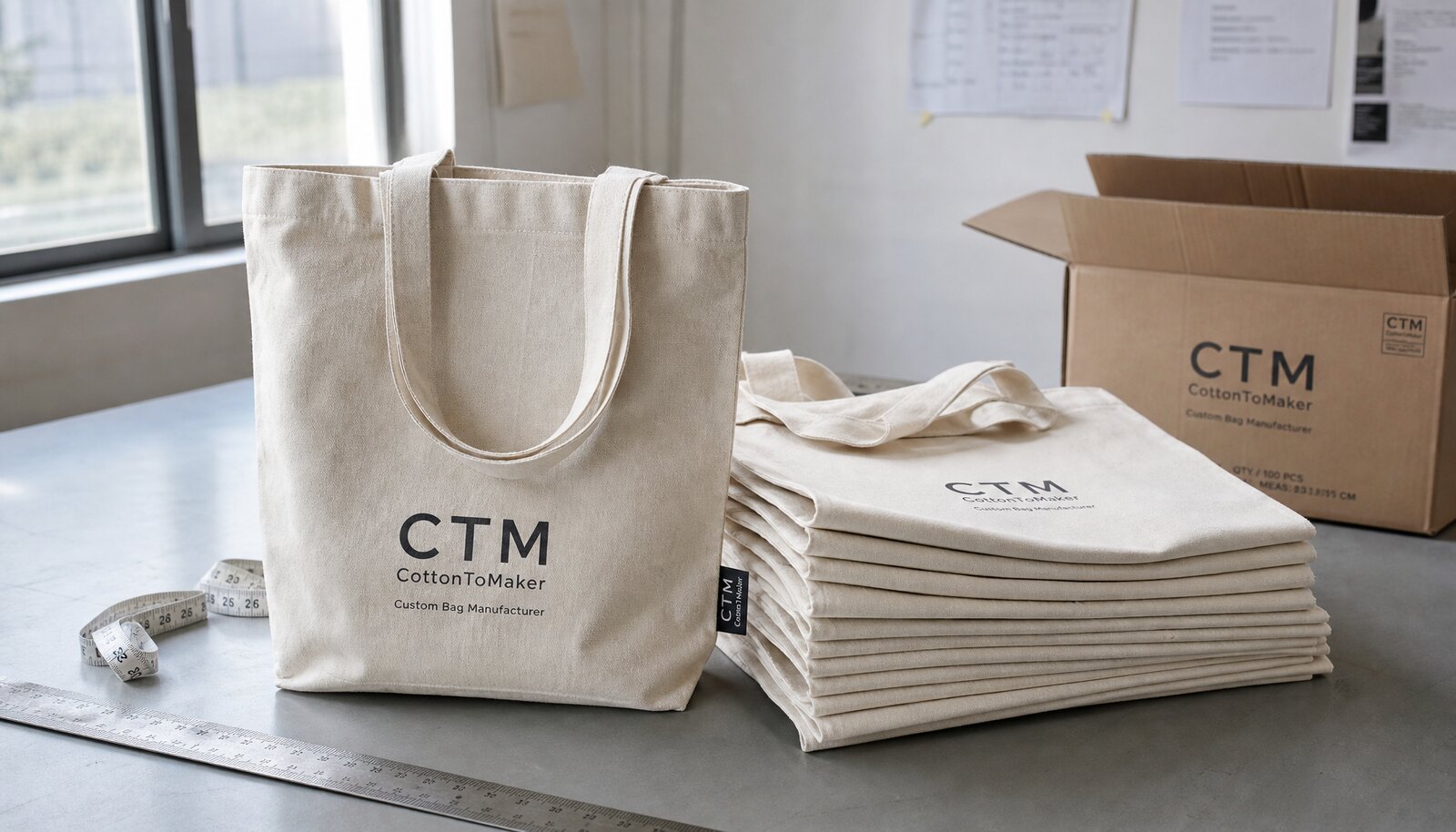
1) Why carton planning belongs in the tote-bag decision, not after it
For canvas conference bags used at trade shows, the bag specification and the shipping carton plan are one buying decision, not two separate tasks. Procurement teams often approve the tote first and think about cartons later, but that sequence is where costs get distorted. A neat sample can still become an expensive shipment if it needs oversized cartons, repacking labor, or protective materials that were never priced into the quote.
The real procurement question is not simply whether the bag looks good. It is whether the bag can be produced, packed, shipped, stored, and handed out with predictable cost and acceptable quality. That means the RFQ has to cover fabric weight, print method, fold style, carton pack count, carton grade, and labeling. If the supplier is quoting one pack-out and you are receiving another, the comparison is already broken.
For trade shows, this matters because timing is unforgiving. Bags usually move from factory to freight forwarder, then to a warehouse, then to an event or regional distribution point. Each handoff increases the chance of crushed corners, scuffed print, or count mismatches. When the carton spec is written early, the bag is easier to receive, stack, and allocate at the venue.
2) Start with the use case: what the bag must hold, how it will travel, and who will carry it
Canvas conference bags are not all the same buying problem. A visitor bag for a one-day expo has very different requirements from a multi-day conference bag that must hold catalogs, product literature, a water bottle, a power bank, and a notebook. The first job in procurement is to define the contents and the travel path. If the bag is only handed out at registration, the carton plan can be more efficient. If the bags must be shipped to multiple venues or stored for months, the carton and packing rules become stricter.
A practical way to brief suppliers is to describe the payload, not just the bag. For example: A4 brochures, a 300-page catalog, a notebook, and two small samples. That tells the supplier more than a generic statement like “conference use.” It informs bag depth, gusset, handle strength, and whether the bag can sit upright in the carton without collapsing. A bag that carries flat paper only can be lighter. A bag that carries heavier inserts needs more body and stronger stitching at the handles.
Buyers should also decide whether the bag is a giveaway, a brand statement, or a reusable carry item. That choice affects fabric weight, the visibility of branding, and the acceptable shipping footprint. A premium event bag that must survive repeat use is worth a firmer 14–16 oz build. A short-life giveaway can often stay at 10–12 oz if the print quality is stable and the carton plan is efficient.
- Define the exact contents the tote must carry, not just the audience profile.
- State whether the bag will be handed out loose, pre-packed, or stored before distribution.
- Tie the bag size to real inserts, especially if A4 or letter-size items must fit without curling.
3) Choosing canvas weight and construction with real trade-offs, not generic rules of thumb
For most procurement programs, 12 oz canvas is the most balanced starting point because it gives the bag enough body to hold shape, print cleanly, and survive event handling without looking flimsy. But the better choice depends on the purpose of the bag. If the tote is part of a premium sponsorship package or must carry heavier collateral, moving to 14 oz or 16 oz can improve perceived value and reduce sagging. The cost increase is not only in fabric; heavier canvas also increases sewing resistance, carton weight, and freight mass.
Below 10 oz, buyers often discover two problems at once: the bag feels too soft and the folded pack becomes less stable in cartons. That does not automatically make lighter fabric wrong, but it raises the bar on print and packaging control. A lightweight tote may be acceptable for a very large giveaway where unit cost is the main concern. It is a weaker choice if the event team expects the bag to stand upright on a registration desk or hold printed materials without wrinkling.
Construction details matter just as much as fabric weight. A bag with a bottom gusset is easier to fill and usually packs more predictably than a flat tote. Reinforced handle stitching, especially an X-box or bar-tack pattern at stress points, matters for conference use because event bags are repeatedly lifted, carried, and set down. If the bag must be distributed in high volume, procurement should ask for the exact stitch reinforcement method and not accept vague language like “strong sewing.”
4) Print method, artwork control, and why the logo affects packing
The print method is not just a branding decision; it affects packing, cure time, rub risk, and reject rates. For canvas conference bags, screen printing is still the most useful default for one- and two-color logos because it is stable, repeatable, and relatively efficient at volume. It works well on heavier canvas and usually gives a cleaner edge than a rushed transfer process. If the artwork has gradients, multiple colors, or fine-line illustration, transfer or digital methods may be needed, but those methods should be evaluated against the full shipping and handling path, not only the visual mockup.
Procurement teams should define logo placement in relation to the seams and handles. A logo that looks centered on a flat artboard can shift awkwardly when the bag is sewn and folded. A print that sits too close to the top edge may collide with the handle stitch or create a visible crease in the carton. The supplier should be asked for a placement drawing or strike-off that shows the print on the actual sewn bag, not just the artwork file.
Rub resistance matters because trade show bags are often stacked closely in cartons and sometimes distributed immediately after packing. If the ink is not fully cured, the print can scuff when two bags face each other. A buyer should ask whether the factory performs a cure check and whether it can show a practical rub result on the sample. For print-critical brands, the approval should include one bag as a visual master and one packed sample that proves the print survives the chosen fold.
- Ask for print setup costs, per-color charges, and repeat-order conditions.
- Approve artwork placement on a sewn sample, not only on a flat image.
- If the logo is large, confirm that it does not conflict with handles, gusset seams, or carton fold lines.
5) Supplier route decisions: direct factory, trading company, or sourcing agent
The supplier route affects not only price but also how much control you have over fabric traceability, packing, and lead time. A direct factory is usually the strongest option when the same tote will be reordered for multiple events. It gives the buyer closer control over fabric sourcing, production scheduling, carton spec, and in-line QC. That matters when the bag must be repeatable and the carton plan must stay consistent across shipments.
A trading company or sourcing agent can be useful when the program includes mixed items, rush consolidation, or multiple destinations. The advantage is coordination, not necessarily the lowest base price. If the order includes notebooks, lanyards, and conference bags, a consolidator may reduce procurement workload. But the buyer should verify whether the quoted bag specification is truly the factory’s own spec or a reseller’s summary. Without that check, the carton details can be vague or inconsistent.
Procurement teams should ask for evidence that the supplier can manage production discipline. That includes sample traceability, a named production site, QC method, packaging photos, and documentation such as company registration, product compliance declarations if relevant to the market, and confirmation of carton markings. For repeat orders, buyers should also ask whether the supplier can hold the same fabric source, print screen, and carton spec for the next event cycle.
- Direct factory usually suits recurring volume and tighter control.
- Trading route can work well for urgency, mixed SKUs, or consolidation.
- Ask who actually makes the bags, who packs them, and who signs off on QC.
6) Side-by-side supplier comparison: what to normalize before you compare quotes
A lot of tote-bag sourcing mistakes come from comparing quotes that are not built on the same assumptions. One supplier quotes bulk pack, another quotes individual polybags. One includes 5-ply cartons; another uses light export cartons. One quotes a standard 12 oz canvas while another uses a lighter fabric that folds more easily but feels less substantial. The result is not a meaningful price comparison.
To compare suppliers properly, normalize the spec first. Use the same finished size, same fabric weight, same print method, same handle type, same packing style, same carton count, and same destination terms. Then compare the unit price, carton cube, gross weight, and lead time. If a supplier cannot quote those numbers clearly, the buyer is not yet holding an apples-to-apples offer.
This is where procurement adds value beyond collecting prices. A buyer who asks for carton dimensions and pack-out logic can immediately see whether a cheaper unit price is being offset by higher freight, more labor, or more repacking at the destination. The strongest quote is usually the one that makes the shipment easiest to receive, not merely the one that prints the lowest number next to the tote price.
7) Carton planning: fold direction, pack count, cube efficiency, and export protection
Carton planning for canvas conference bags should begin with the folded bag size, not with a random warehouse carton. The fold direction determines whether the print face rubs against itself, whether the handles crease, and how efficiently the carton fills. A good packing plan keeps the tote shape stable enough to receive cleanly while still using space efficiently enough to protect freight margins. In practice, many buyers land somewhere between 20 and 50 bags per carton, but the right count depends on bag size, fabric weight, handles, and protective layers.
The carton spec should define more than dimensions. It should state carton grade, gross weight target, stacking limit, and whether the shipment will be palletized. A 5-ply export carton is often a sensible baseline for long-distance or warehouse-handled freight because it gives more resistance to edge crush and stack compression. If the bags are going into a regional event warehouse and may be moved several times, carton strength becomes part of product quality, not just logistics.
Buyers should also be clear about the carton label set: item name, quantity, carton number, PO number, gross/net weight, and any destination-specific marks. This reduces receiving errors when the same style ships in multiple waves. If the program is split across events, carton markings should help the receiving team allocate the right bags to the right venue without opening every carton. That is a real labor saving, especially for large conference kits.
- Ask for one packed-carton photo with the real fold and count, not just a bag sample.
- Set a maximum carton gross weight so warehouse handling stays practical.
- If palletized, confirm the pallet footprint and carton stacking pattern before the order starts.
8) Sample approval: what to approve on the tote, and what to approve on the packed carton
A useful sample approval process has two layers. First, approve the tote itself: fabric feel, size, print placement, handle comfort, seam alignment, and overall appearance. Second, approve the packed carton: fold direction, count, empty space, closure, and label format. Approving only the loose bag is one of the most common reasons buyers are disappointed later. The carton outcome is part of the product outcome.
The pre-production sample should be as close to final production as possible. For repeatable programs, the sample should use the intended fabric weight or an equivalent lot that the supplier can document, the final print method, and the final handle material and stitch pattern. If the supplier shows a blank tote and later switches fabric or packing method, the sample no longer proves the shipment will behave the same way. Buyers should ask for sample traceability: what fabric lot was used, what ink or transfer system was applied, and how the bag was folded for carton packing.
The packed-carton sample is particularly useful when the bags are premium or when freight is expensive. It lets the buyer see whether the carton closes without forcing the bag into a shape that wrinkles the print or compresses the handle. It also helps the buyer decide whether a slight increase in carton size might be worth the freight cost if it reduces damage or repacking later. That trade-off is often more valuable than chasing the smallest possible box.
- Approve the sewn sample and the packed carton separately.
- Ask for sample traceability to final materials, not only a visual match.
- Reject a sample if the carton forces the tote into an unnatural fold that will damage appearance or print.
9) QC standards that are specific enough to be enforceable
QC for canvas conference bags should be written around real defects that the event team would notice. The goal is not luxury-grade perfection; it is consistency, usable strength, and a clean branded appearance. That means the factory should inspect dimensions, stitching, handle symmetry, print cure, odor, and carton condition before shipment. A good QC standard also tells the supplier what happens when a defect is found, so the receiving team is not left to interpret vague language later.
For procurement buyers, it is useful to define a practical inspection framework instead of a generic statement like “good quality.” Many teams use AQL-based inspection with a clear defect classification. Major defects might include torn seams, missing handles, open stitches, severe print misregistration, or cartons that fail to close safely. Minor defects might include light thread trimming issues, slight shade variation within an acceptable band, or small cosmetic marks that do not affect function. The buyer should align the defect list to the event use case rather than copying a retail apparel standard.
Carton quality deserves its own check. Ask for intact corners, secure tape, readable marks, and a packed condition that does not crush the bag body. If the shipment is going overseas or through a warehouse with multiple handoffs, ask about stack performance or at least a simple packed-carton drop or handling test. Moisture protection should also be defined if the transit lane is humid or the bags will sit in storage. If the supplier can show carton photos and a count record before dispatch, receiving disputes drop sharply.
10) Lead time, landed cost, and the final procurement decision
Lead time risk in tote sourcing is often hidden in the steps the buyer does not ask about. A supplier may quote a short delivery time, but the real path still includes fabric reservation, sample approval, print curing, sewing, carton packing, and booking. If the buyer only tracks the final handover date, any delay in an earlier step becomes a surprise. For trade show programs, that surprise can be expensive because event dates do not move. Procurement should ask for a stage-by-stage schedule and build in approval time for artwork, sample, and carton proofing.
The landed cost discussion should also include freight behavior. A cheap tote quote can become costly if the carton count is low, the cartons are oversized, or the pack-out forces extra air into the shipment. Conversely, a slightly higher unit price can still be the better buy if the cartons are efficient, the freight cube is smaller, and the receiving team does not need to rework the shipment. That is why carton math belongs in the purchase decision.
A practical final comparison looks at three numbers together: unit price, total carton cube/gross weight, and the labor required after arrival. If one supplier offers a marginally lower tote price but requires repacking at the warehouse, the real savings may disappear. Buyers should choose the offer that meets the event deadline with the least downstream handling risk, not the one that only looks cheapest in the PO line.
- Request stage-by-stage lead time instead of one total number.
- Compare quotes using unit price plus carton cube plus receiving labor risk.
- Keep the spec version, sample approval, and packing instruction tied to the same PO.
Specification comparison for buyers
| Buying route or spec choice | Typical quote effect | Lead-time impact | Carton-planning consequence | Best fit / buyer risk |
|---|---|---|---|---|
| Direct factory, standard canvas and one-color print | Usually lower unit cost once volume is stable, but setup and sampling are clearer line items | Moderate; often fastest after sample approval if fabric is in stock | Factory can optimize fold, carton count, and export carton strength more consistently | Best for recurring trade-show programs; risk is weak communication if carton spec is not locked in writing |
| Trading company or sourcing agent with factory control | Can look slightly higher per unit, but may consolidate samples, accessories, and documentation | Often faster for mixed programs or urgent replacement orders | May quote a convenient pack-out that is not the most cube-efficient; verify carton math | Best when the buyer wants one contact across multiple SKUs; risk is hidden source changes |
| Standard 12 oz canvas, bulk packed | Lowest freight and packing labor for most event bags | Usually the simplest to produce and pack | Allows efficient carton fill without excessive crushing if the bag is folded consistently | Best starting point for A4 handouts and light catalog programs; risk is a soft look if the event is premium |
| 14–16 oz canvas, bulk or tissue separated | Higher material cost and heavier freight, but stronger hand feel | May add fabric sourcing time if stock is not local | Requires more attention to carton gross weight and stackability | Best for heavier inserts or premium branding; risk is overbuilding if the bags carry only paper collateral |
| Single-color screen print | Lowest print setup cost per design and stable for repeat orders | Usually short once screens are approved | Minimal effect on carton plan if print is fully cured | Best for logos and event marks; risk is poor artwork scaling if the logo is too close to seams |
| Multi-color transfer or digital print | Higher unit cost and more variance between artwork and finish | Can add curing or quality-check time | May need more spacing in cartons to avoid rub or blocking | Best for complex artwork or short runs; risk is scuffing, transfer cracking, or color variation |
| Individual polybag per tote | Raises material and packing labor cost | Often adds time unless automated or pre-stocked | Increases carton volume, lowers pieces per carton, and can push freight up | Best for retail-facing or long-storage programs; risk is unnecessary waste and higher total landed cost |
| Bulk stack with tissue or divider sheet | Usually the lowest packing cost | Fastest to pack if the fold spec is clear | Improves carton cube efficiency, but only if surface finish can tolerate stacking | Best for direct event distribution; risk is surface rub if print or coating is not cured correctly |
| 5-ply export carton | Higher carton cost than a light inner box, but usually lower damage risk | No major lead-time penalty if carton spec is agreed early | Protects weight and stack performance for longer lanes | Best for sea freight, palletized moves, and warehouse handling; risk is under-spec cartons if bursting strength is not confirmed |
Buyer checklist before sampling
- Confirm the end use before quoting: booth giveaway, conference kit bag, distributor handout, or premium visitor pack. The use case determines fabric weight, handle length, and packing style.
- Lock the finished size in writing, including body width, height, gusset depth, and whether the bag must fit A4/letter inserts, catalogs, brochures, or a laptop sleeve.
- Specify the canvas weight in oz or GSM, the fabric finish, and any color requirement for natural, bleached, dyed, or recycled canvas.
- Define the logo file version, Pantone references if applicable, print size, print position, and whether the artwork must avoid seams, bottom folds, or handle stitches.
- State the carton pack count target, maximum gross weight per carton, and acceptable carton size range for pallet or parcel handling.
- Ask for a pre-production sample made from the intended fabric lot or a clearly stated equivalent, with the final print method and final handle construction.
- Request one packed-carton photo showing the actual fold direction, bag count, and empty space left in the carton after closure.
- Require carton marks, item code, gross and net weight, country of origin marking if needed, and any buyer-specific labeling format before bulk packing starts.
- Confirm whether the bags will be bulk packed, tissue separated, or individually polybagged, and ask the supplier to show the cost difference for each option.
- Define acceptance criteria for stitching, print alignment, odor, fabric defects, carton crush resistance, and packed count variance before the order is placed.
Factory quote questions to send
- What is the exact canvas specification you are quoting: oz/GSM, weave type, finish, and whether the number is based on finished fabric or greige fabric?
- Can you confirm the finished bag size after sewing, not only the cut size, and share the tolerance you normally hold on width, height, and gusset depth?
- What print method are you pricing, how many colors are included, and what is the setup cost per color or per transfer plate?
- Where exactly is the logo positioned relative to the seam, handle stitch, and bottom fold, and can you provide a layout diagram before sampling?
- What carton pack count, carton dimensions, and carton gross weight are included in your quote, and what changes if we adjust the pack count?
- What carton grade are you using, and can you share the carton specification such as ply count, burst strength, or edge crush rating if available?
- What type of sample will you send first: blank sample, print strike-off, or pre-production sample from production materials?
- Can you trace the sample lot to the final mass-production lot so we can see whether fabric shade, handle tape, and print behave the same?
- What is your standard QC method before shipment, and do you provide measurements, count photos, or an inspection report?
- What is the production schedule by stage, including fabric reservation, print approval, sewing, packing, and booking, rather than only one final lead-time number?
Quality-control points to confirm
- Use a practical visual inspection plan such as AQL 2.5 for major defects and AQL 4.0 for minor defects unless the buyer’s own standard is stricter. Require the supplier to state the inspection basis in advance rather than assuming it.
- Check finished dimensions after sewing, not only cut dimensions. A useful tolerance for event totes is often around +/- 1 cm on smaller bags and +/- 1.5 cm on larger bags, but the buyer should lock the tolerance to the usable insert size.
- Confirm fabric weight tolerance in the approved spec. For procurement, a working tolerance of about +/- 5% around the approved oz or GSM is common as a starting point, but premium programs may require tighter control.
- Inspect stitch density and reinforcement at the handle attachment, side seam, and bottom seam. The buyer should ask the factory to state stitch count per inch or stitches per 3 cm where relevant, plus the reinforcement pattern used at load points.
- Require handle symmetry within a defined tolerance so one handle does not sit visibly longer than the other. Twisting, uneven spacing, and crooked attachment points should be treated as defects, not as normal variation.
- Inspect print registration, cure quality, and rub resistance. Ask whether the supplier can perform a simple dry rub or wet rub check after curing, and define what level of scuffing is unacceptable.
- Review seam flatness at the gusset and bottom fold. Excess puckering can make the bag look low quality and can also interfere with carton packing consistency.
- Ask the supplier to state whether loose threads are trimmed before packing and whether bags are shaken, folded, and counted in a controlled line before carton closure.
- Check for odor from ink, dye, adhesive, or packing materials. If the bags are going to retail-facing distribution or indoor event spaces, set a clear no-strong-odor acceptance point before shipment.
- Specify carton standards, including intact corners, secure tape closure, readable carton marks, and no crushed panels. If palletized, ask for stack test evidence or a defined stacking limit in kilograms or cartons high.