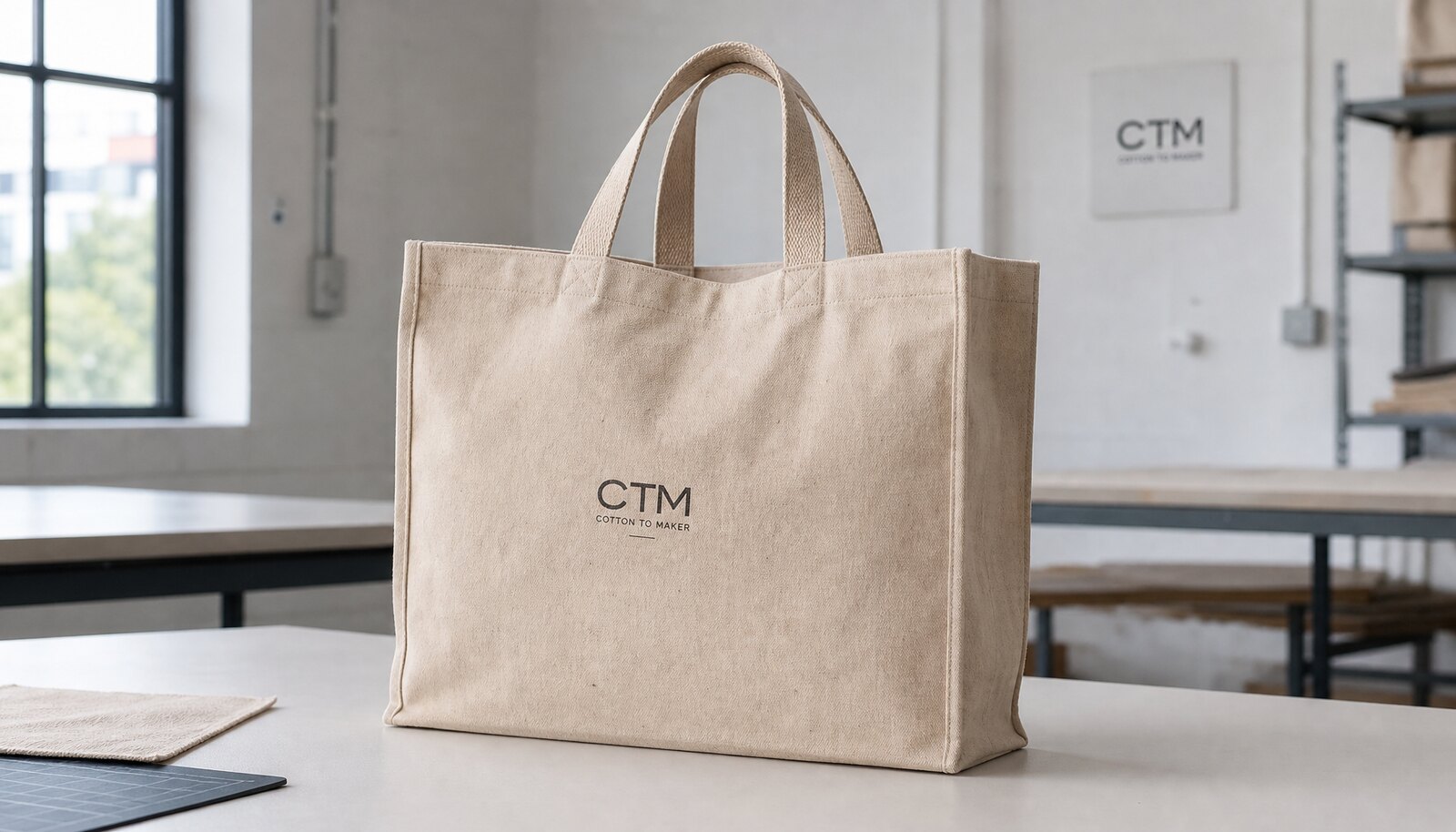
1. Start with the event job-to-be-done, not the logo
For trade shows, a canvas conference bag is usually doing three jobs at once: carrying event materials, acting as a visible brand surface, and surviving a full day of attendee handling without looking cheap in photos. That means the sourcing spec should begin with the actual use case, not the artwork file. A buyer who starts with the logo often under-specs the bag and later discovers the problem is not the print; it is the wrong fabric body, weak handles, or poor carton packing.
A private label program should reflect how the bag will be handed out and what it must carry. A registration desk giveaway that only needs to hold a notebook and brochure stack can be lighter and simpler. A sponsor gift or conference kit bag usually needs better structure, cleaner stitching, and a more premium decoration method because it is seen, photographed, and often reused after the event.
Procurement teams should write the intended use in one sentence before they request pricing. For example: 'bag for 8-10 page brochure stack, notebook, pen, and bottle; 1-day event use with post-event reuse expected.' That line becomes the filter for every later decision, including fabric weight, handle reinforcement, and whether the bag should stand upright in packing.
One practical lesson from these programs is that the bag size should match the handout contents, not the marketing preference. Oversized totes waste freight and look floppy when underfilled. Undersized totes create customer complaints because the contents sit above the top hem or distort the front panel print. The right size should be derived from the actual insert dimensions and the likely carry weight. If the event kit includes a tablet sleeve or a catalog, make that explicit in the spec before RFQ release.
If the bag will be used after the show, buyers should also think about visual durability. Natural canvas with a crisp one-color logo can look solid for a long time if the bag is not over-accessorized. Heavy trims, loose closures, or complicated panel construction can reduce production consistency and raise the defect rate. Keep the design simple unless the marketing value of the extra feature is clear.
2. Build the spec sheet around measurable construction details
The easiest way to create procurement friction is to let each supplier interpret the bag differently. For canvas conference bags, the spec must be written in measurable terms so the factory can quote the same product across multiple rounds. At minimum, the buyer should define the finished size, fabric weight, handle size, handle drop, seam allowance, reinforcement style, print area, and packaging format.
Finished size should be stated after sewing, not as a flat fabric cut dimension. If the approved size is 15 in x 16 in with a 4 in gusset, say that clearly and include a tolerance. The same is true for handles: a 24 in total length may sound enough, but if the handle drop is not controlled, the tote can become awkward to shoulder carry. Buyers should ask for a dimension sketch with labeled reference points so production and inspection teams measure the same way.
Fabric weight is best defined in either oz or GSM, but not left as 'medium canvas' or 'thick cotton.' A usable program often sits around 12 oz to 14 oz canvas, but the right number depends on the load and the desired hand feel. If the buyer wants a cleaner presentation or a premium kit, 14 oz to 16 oz may be worth the extra cost. If the bag is a low-cost handout that will be flat-packed in quantity, a lighter canvas might still be acceptable if the handles and stitch reinforcement are robust.
Private label buyers should also define the cosmetic details that become dispute points later. That includes whether the canvas should be natural, bleached, dyed, or enzyme-washed; whether the top hem is single-fold or double-fold; whether the bottom is boxed or flat; and whether any internal label or care tag is required. If the supplier is expected to attach a branded woven label, the label size, placement, and color count should be on the spec sheet before sampling begins.
A useful rule is to keep the spec short enough for suppliers to quote quickly, but detailed enough that no one can say 'we assumed.' The best RFQs usually combine a written brief, a dimension sketch, a logo placement reference, and a simple packing note. That combination does more to stabilize price than a long email chain of clarifications.
- Write the job-to-be-done in one sentence before requesting quotes.
- Define finished size, handle drop, gusset depth, and seam type with tolerances.
- State fabric weight in GSM or oz and avoid vague terms like 'heavy' or 'premium.'
- Add label, closure, lining, and pocket requirements only if they matter to use or branding.
- Use one dimension sketch for all suppliers so no one quotes a different interpretation.
3. Choose the right supplier route by control, documentation, and order complexity
Not all suppliers are equal for private label sourcing, and the lowest price rarely tells you which route is safest. For canvas conference bags for trade shows, the main question is who owns the construction decisions and who can prove the product they are quoting is actually producible at scale. A buyer should compare supplier routes by control, evidence, and flexibility rather than by unit price alone.
A direct sewing factory is usually the best option when the program needs repeatability, fast feedback on samples, and stable bulk execution. You can ask the factory to show the actual cutting table, sewing line, print station, and packing flow. You should also ask who signs off first-piece approval and who corrects the line if measurements drift. If the factory cannot identify a single responsible QC owner, that is a warning sign even when the quote is attractive.
Trading companies can be practical when the order combines multiple items or when the buyer needs a broader service layer, such as consolidation, labeling, or multi-SKU event packing. The trade-off is that defect decisions may be slower because the trading team must relay changes to the real factory. If you use this route, ask for the factory name, location, and a real production reference from the same bag style. Do not accept a vague promise that the supplier has 'many partner factories.'
Specialized bag workshops are often strong on gussets, handles, pocket construction, and reinforcement details. For conference tote programs that need a very specific shape or repeated reorders, this can be a good fit. The risk is seasonal capacity. If the supplier says yes too quickly to a large event order, ask how many lines will actually run your style and whether any overtime or subcontracting will be used.
General low-price suppliers can still be useful when the bag is truly basic and the buyer is comfortable with narrow tolerances. But if the order needs consistent canvas weight, reliable print placement, and clean retail-ready packing, price-only vendors may create hidden costs through rework, reject rates, or late shipment. The point is not to avoid all low-cost suppliers; the point is to understand where control is weak.
For any route, request evidence, not just claims. Ask for factory registration, recent audit summary if available, sample photos of the same style, material lot traceability, and confirmation of which operations are in-house. A supplier that can answer those questions cleanly is usually much easier to manage during a trade show deadline.
- Direct factory: best for repeatability and sample-to-bulk control.
- Trading company: best when mixed services are needed, but verify the real factory and QC owner.
- Specialized workshop: best for construction-heavy tote details and repeat styles.
- Low-price general supplier: only suitable when the specification is simple and the control risk is acceptable.
- Ask for evidence of actual production, not a sales promise.
4. Compare quotes on landed cost, not factory price alone
A tote bag quote is only useful when every supplier is pricing the same scope. For canvas conference bags, the quoted unit price can hide a lot: screen setup, color change fees, woven label charges, individual polybagging, carton marks, and freight assumptions. If one quote includes a folded inner pack and another excludes it, the comparison is not real. Procurement should normalize the quote before any ranking begins.
The simplest way to compare suppliers is to break the cost into four lines: base bag, decoration, packing, and freight. Base bag cost covers fabric and sewing. Decoration covers screen print, embroidery, or transfer. Packing covers inner pack, labels, and carton work. Freight covers the actual transport cost based on gross weight and carton volume. Once those four lines are visible, a slightly higher factory quote can still be the better commercial decision if it saves labor or reduces carton damage at receiving.
For event programs, carton volume matters as much as weight because storage and air freight can be affected by how the tote is folded. A bulk-packed flat tote may look cheap on the factory invoice but become expensive if the carton cube is inefficient. Ask each supplier for carton dimensions, piece count per carton, and gross weight so your logistics team can calculate landed cost per usable bag. If the supplier cannot provide carton data at the quote stage, they are not giving procurement enough information to compare.
A good RFQ also asks for quantity breaks that match the program, not arbitrary numbers. If the event needs 2,400 bags, there is little value in a quote ladder only for 1,000 and 10,000. Ask for the real target quantity and one or two adjacent price breaks. For repeat annual programs, ask whether the price holds if the same spec is reordered within 6-12 months. This is especially useful when the bag may become a recurring conference item and the buyer wants to know whether the sourcing model can scale.
The most common mistake is comparing a cheap quote against a complete quote. A supplier may omit print setup fees or assume a simpler packing method. Procurement should require every supplier to confirm exclusions in writing. If there are no exclusions, make them state that as well. Clarity at quote stage prevents most post-award disputes.
- Normalize all quotes to the same size, print method, packing, and freight assumptions.
- Separate base bag, decoration, packing, and logistics in the comparison sheet.
- Ask for carton dimensions and gross weight, not just per-piece pricing.
- Request the exact quantity break that matches the event demand.
- Require the supplier to list exclusions in writing.
5. Choose the decoration method by artwork, durability, and reorder strategy
For most private label conference totes, one-color or two-color screen print is still the most dependable route. It sits well on canvas, reproduces solid logos cleanly, and is usually the easiest method to repeat on future orders. If the artwork is simple and the brand wants a crisp promotional look, screen print often delivers the best balance of cost and consistency. On natural canvas, it also gives the buyer a clean visual contrast without overcomplicating production.
Heat transfer can work when the artwork is more detailed or when the order is too small to justify full screen setup economics. It may be the right answer for a short-run conference or for a graphic with fine lines and gradients. The trade-off is that transfer decoration can feel more surface-applied and may age differently if the tote is folded, handled, or packed tightly. If you choose this route, ask for flex testing and a photo of the print after a packing fold, not just a flat sample image.
Embroidery can add a premium feel, but it changes the structure of the front panel and is not always the best choice for large conference giveaways. Dense embroidery on a lighter canvas may pucker or pull the panel out of shape. It also adds unit cost and can slow throughput. Use embroidery only when the brand value is worth the extra effort and the tote design can support it cleanly.
The key procurement point is that the decoration method should match both the artwork and the reorder plan. If you expect to reorder the same bag across multiple events, choose a method that is simple to repeat and easy to inspect. If the program is one-off and highly visual, a more flexible decoration option may be justified. But do not select print technology just because the first sample looks attractive. Ask how the method will behave after packing, shipping, and attendee use.
A practical sample check is to inspect logo edge sharpness, fill consistency, alignment to the seam, and whether the print appears too glossy or too stiff for the canvas body. Buyers should also check the back of the print for strike-through where relevant. A good supplier can explain why a given method fits the bag and can show prior work on a comparable substrate. That explanation is often more useful than the sales pitch itself.
- Screen print: best default for simple logos and repeat programs.
- Heat transfer: useful for detailed art and short runs, but sample the flex and wear.
- Embroidery: premium look, but verify panel distortion and cycle time.
- Check print after folding and handling, not only on a flat sample.
- Choose the method that fits future reorders, not only the first event.
6. Control private label details that typically cause disputes
Private label sourcing succeeds when the buyer controls the details that factories often leave open. For canvas conference bags, the major dispute points are usually not the logo file. They are the exact panel size after sewing, how the handle is attached, where the print starts and ends, whether the bag can stand upright, and whether the same shade of canvas is used throughout the run. These details sound small, but they drive commercial friction when the order reaches mass production.
Handle construction deserves more attention than many RFQs give it. A tote carrying brochures and a notebook will place repeated stress on the shoulder seam or top hem. If the handle is stitched only lightly, the bag may pass a visual check and still fail in use. Buyers should request reinforcement stitching or bar-tacks at load points and ask the factory to show close-up photos. If a reinforcement patch is used, specify the patch size and placement. If the design uses self-fabric handles, confirm whether the fold and stitch path are consistent across both sides.
The top hem is another common source of variation. A single-fold hem may be acceptable for a lower-cost promo bag, but a double-fold hem usually gives a cleaner finish and better edge stability. The buyer should state which one is required, because the cost and appearance differ. The same is true for the side gusset and bottom construction. A boxed bottom can improve shape and carry comfort, but it changes sewing time and carton profile.
Private label programs also need a clear label strategy. If the bag will carry a woven brand label, printed care label, or country-of-origin statement, these should be defined before sampling. Buyers should confirm label size, placement, and thread color. If the supplier says labeling will be 'no issue,' ask for a sample photo of the same type of label on a similar bag. That is better than discovering at bulk stage that the label placement conflicts with the handle or inner seam.
Finally, keep color language practical. Natural canvas is not one exact shade; it varies by cotton lot and finishing. Instead of asking for a vague perfect beige, define whether the bag should be bleached, unbleached, warm natural, or visually clean enough for retail presentation. The same is true for printed ink color. The approved sample should be the benchmark, not an abstract color description. This avoids the familiar problem where every supplier hears the spec differently.
- State finished size after sewing, not just cut size.
- Define handle reinforcement, bar-tacks, and stitch path clearly.
- Specify hem type, gusset structure, and bottom construction if they matter to appearance or load.
- Approve label placement and content before the bulk run.
- Use the approved sample as the color benchmark, especially for natural canvas shades.
7. Make sample approval a performance check, not a visual handshake
A pre-production sample should prove the bag works in the real event environment. A clean-looking empty tote is not enough. The sample needs to be handled, loaded, folded, and checked for the same issues that will matter on the show floor: whether the handles feel secure, whether the bag twists when weight shifts, whether the print holds its place on the front panel, and whether the top edge looks neat after use.
The approval process should start with measurement control. Buyers should measure finished width, height, and gusset after the sample is sewn and lightly pressed, using the same reference points the factory will later use. Tolerances should be written into the approval note. For standard promotional totes, a size tolerance around ±0.5 in / ±1.3 cm is commonly workable, though tighter limits may be needed for retail-style bags or rigid kit inserts. Handle length and drop should also be measured, not assumed.
Then test the carry function. Load the sample with the actual intended contents or a realistic equivalent, such as brochure stack, notebook, water bottle, and any high-density insert the event kit will use. Carry it by hand and on the shoulder if the bag is designed for both. Check whether the handles dig in, whether the seam line strains, and whether the side panel remains square. If the bag is going into kit fulfillment, also test how it folds back after being packed because some canvas styles wrinkle badly and lose presentation value.
The print check should be equally concrete. Inspect the logo centering against the top hem and side seam, verify color density and edge crispness, and check whether the artwork sits too close to a seam or fold line. If the artwork has fine type, check readability at the expected viewing distance on the show floor, not just in a close photo. For multi-color decoration, inspect registration carefully because a tiny shift may be tolerable on paper but obvious on canvas.
Most importantly, tie bulk production to the approved sample by reference. The supplier should keep a signed sample or golden sample reference and confirm that the bulk run will follow that same material lot, print setup, and construction method unless a change is approved in writing. That one control step prevents a lot of 'sample looked better than bulk' disputes.
- Measure the sample after sewing and pressing, not before.
- Load-test the tote with the actual event contents or a realistic equivalent.
- Check handle comfort, seam strain, and bag stability while carrying.
- Inspect print centering, color density, and readability at use distance.
- Keep a signed golden sample and require written approval for any bulk deviation.
8. Define QC acceptance thresholds before production starts
General quality language is not enough for a procurement order. If the buyer wants fewer disputes, the order should carry measurable QC thresholds that the factory and inspector can both use. For canvas conference bags, the most useful checks are fabric weight, dimensions, seam construction, print quality, load behavior, carton count, and packing accuracy. A supplier can only be held to a standard if the standard exists in writing before mass production.
A practical QC plan often starts with fabric verification. Ask the supplier to confirm the lot weight and construction method against the approved spec. For standard canvas promotional bags, buyers commonly allow a modest lot variation, but the lot should still feel visually and structurally consistent. If the fabric is too light, the bag loses body and the front panel print can look wavy. If it is too heavy, freight and sewing cost can creep up. The point is not just to hit a number; it is to keep the bag usable and consistent.
Next, inspect the construction details under load. Stitch density on major seams should be consistent, with no skipped stitches or loose thread ends on load-bearing points. Bar-tacks or reinforcement should be present where handles meet the body. If a seam opens when the bag is moderately loaded or when the handle is pulled, the bag should fail inspection. A buyer should define those failure conditions in advance so the factory knows what will be rejected.
Print quality deserves its own standard. The logo should be centered using fixed measurements from the top hem and side seam. The print should have even ink coverage, no obvious pinholes, no flaking, and no visible ghosting. For simple one-color logos, buyers can also set a visual tolerance for edge sharpness and overspray. If the decoration method is transfer-based, check the surface after a flex test so the buyer knows how the print behaves when the tote is folded into cartons and later reopened.
Carton verification is the last piece and is often ignored until the warehouse receives the goods. The carton should show style, quantity, lot code, and purchase order reference. The count should match the order, and the carton dimensions should match the freight booking. If the packing includes polybags, the buyer should confirm bag count per inner pack and whether the outer carton is overpacked or underpacked. For event shipments, a carton count mismatch can become a serious distribution delay even when the bags themselves are acceptable.
If the project uses a third-party inspection service or an internal QC team, ask for photo evidence of all these points: front and back views, measurement shots, handle attachment close-up, print close-up, carton label, and stack count. That evidence should be archived with the PO so future reorders can be judged against the same standard.
- Set written tolerances for size, handle length, print position, and carton count.
- Require visible reinforcement at load points and reject open stitching or skipped stitches on those seams.
- Test print opacity, edge sharpness, and flex durability.
- Verify carton marks, lot code, and PO reference before shipment.
- Archive inspection photos with the order for future reorder comparison.
9. Verify supplier claims with documents, not sales language
Procurement buyers should not rely on verbal claims about capacity, compliance, or quality systems. For canvas conference bags, supplier validation needs documents or verifiable evidence because the production steps look simple but still vary widely in practice. A factory can say it makes 'export-quality bags' and still have weak process control, inconsistent fabric sourcing, or no clear traceability when a defect appears.
At a minimum, ask for business registration or factory license details, a recent audit summary if available, and proof of the actual facility that will run the order. If the supplier claims in-house printing, ask for a photo of the print station and a recent sample from the same method. If they claim in-house cutting, ask for cutting layout photos or a short process video. If they claim a quality system, ask who signs first-piece approval and what inspection records they keep by lot.
For compliance-sensitive programs, ask for the specific documents that matter to your channel. That could include material composition statements, country-of-origin labeling support, restricted substance declarations, or lab testing from an accredited third-party lab where required by the destination market or customer policy. Do not ask for every possible certificate; ask for the one or two documents that actually map to your distribution channel. That keeps the validation process useful rather than ceremonial.
A good supplier should also be able to explain traceability. Which fabric lot was used? Which ink batch? Which packer handled the cartons? Which line produced the order? Even if the supplier does not have a sophisticated enterprise system, they should be able to answer those questions on a practical level. If they cannot, repeatability will be difficult on future runs.
One more validation point is capacity realism. Ask how many orders of similar size they ran in the last peak season, what the actual line allocation would be for your order, and whether they can commit to a production slot before you award business. A supplier with strong documents but weak capacity planning can still miss your ship date. Documentation and capacity need to be checked together.
- Request factory registration or license details and confirm the real production address.
- Ask who owns first-piece approval and what lot-level records are kept.
- Match compliance documents to the actual channel requirements instead of asking for generic certificates.
- Confirm traceability for fabric, print ink, packing, and production line.
- Verify that the production slot exists before issuing the PO.
10. Plan MOQ, lead time, and freight around the event calendar
MOQ and lead time are where many conference bag programs lose margin. Canvas totes look simple, but the order can still be tied up by fabric color availability, print setup, packing rules, or peak-season sewing capacity. Buyers should treat MOQ as a function of configuration rather than a single number. Stock natural canvas with one-color print may have a workable low MOQ, while custom-dyed fabric, multiple print colors, or branded inner packs can push the order higher.
The right lead time depends on how much of the order is already standard. If the supplier uses stock fabric and a simple decoration method, production after sample approval may be relatively fast. If the order requires custom dyeing, additional label approvals, or special carton packing, the timeline should widen. Trade show buyers should never count only the factory production days; they need a schedule that includes sample sign-off, production slot, inspection, export handling, and freight booking. If the event date is fixed, back-plan from the receiving deadline, not the ship date.
Freight planning matters more than many buyers expect. Canvas bags can be deceptively bulky even when they are lightweight. A tote that folds flat may still generate a large carton cube if the packing is inefficient. Ask each supplier for carton dimensions and gross weight early enough that logistics can quote both sea and air scenarios if needed. The cheapest ex-works quote can become the most expensive landed result if the carton profile is poor.
For repeat conference programs, it is worth asking the supplier what can be held stable across reorders. Can they reserve the same fabric style? Can they keep the same print screens or artwork files? Can they repeat the carton pack? Reorder stability is valuable because the best event programs are often repeated with only minor content changes. If a supplier cannot maintain the same construction or packing approach, you may spend as much time re-approving the bag as you did the first time.
A practical timeline model is to separate the project into four gates: spec lock, sample approval, production release, and shipment confirmation. If one gate slips, the risk should be visible immediately. That structure keeps the program from drifting until the freight deadline is already inside the danger zone.
- Treat MOQ as configuration-specific: fabric, print count, label, and pack all affect it.
- Back-plan from the event receiving deadline, not from factory production days alone.
- Get carton dimensions and gross weight early for freight quoting.
- Ask which elements can stay stable on a reorder to reduce reapproval work.
- Use four gates: spec lock, sample approval, production release, shipment confirmation.
Specification comparison for buyers
| Supplier option | What to verify | Commercial advantage | Buyer risk to control |
|---|---|---|---|
| Direct sewing factory | fabric swatch, approved sample, seam close-ups, logo test photos, packing pilot, and final inspection evidence | Better sample-to-bulk control and faster production feedback | May be weaker on export paperwork or branded packing unless checked early |
| Trading company | Factory name, production photos, trim-source proof, and who owns QC decisions | Can coordinate small mixed orders and extra services | Markup can hide real factory capability and slow defect decisions |
| Specialized bag workshop | bag size, gusset, handle drop, seam allowance, stitch density, reinforcement patch, and loading expectation | More practical for detailed construction, trims, and repeat programs | Capacity may be limited during peak seasons |
| Low-price general supplier | 8-12 oz cotton canvas, 120-220 gsm cotton, recycled cotton, or blended fabric selected by use case and target price | Useful for simple promotional runs with loose specs | Material downgrades, weak packing, and vague inspection scope can erase savings |
| Retail-ready supplier | fold method, inner bundle, carton count, carton mark, moisture protection, SKU separation, and warehouse receiving needs | Can handle labels, SKU separation, carton marks, and receiving rules | Higher unit cost must be compared against reduced warehouse work |
| Compliance-focused supplier | Fabric records, labeling review, test plan, and production traceability | Safer for retail programs and repeat brand orders | Documentation claims need evidence, not only sales language |
| Local sample room plus bulk factory | Signed sample, bulk factory handoff, first-piece photos, and deviation owner | Good for complex branding before large production | Sample room quality may not match bulk line unless handoff is controlled |
Buyer checklist before sampling
- Define the real use case first: attendee giveaway, speaker kit, press kit, premium sponsor gift, or staff utility bag, because the load and perceived value change the spec.
- Lock the target fabric in GSM or oz, and state whether the canvas should be natural, bleached, dyed, washed, or recycled-content canvas.
- Approve the decoration method against artwork complexity, reorder frequency, and acceptable hand-feel on the front panel.
- Specify finished size, gusset depth, handle width, handle drop, seam reinforcement, and any pocket, closure, or lining requirement.
- State carton pack, inner pack, barcode label, and master carton count before RFQ release so freight and warehouse handling can be compared fairly.
- Set measurable sample approval criteria for size tolerance, print placement, color consistency, load performance, and stitching quality.
- Ask for supplier validation evidence before price negotiations: factory registration, recent audit summary, process photos, and names of subcontracted steps if any.
- Confirm inspection method, AQL target if used, and which defects are automatic rejects for the bulk order.
- Align lead time with event dates, freight booking, and a fallback plan if the first production slot slips.
- Create one controlled spec sheet and use it for all quotes so the landed cost comparison stays clean.
Factory quote questions to send
- What fabric weight do you recommend for this size and expected insert load, and is that fabric available from stock or does it require weaving/dyeing first?
- Is cutting, sewing, printing, embroidery, labeling, and packing done in-house, or will any step be outsourced? Please name the subcontractor step if applicable.
- What is your MOQ by fabric color, print color count, and order type: stock canvas, custom dyed canvas, or private label retail pack?
- Please quote unit price at 1 color, 2 color, and no-print options, and show setup fees, plate fees, or screen fees separately.
- What finished size tolerance, handle length tolerance, stitch density target, and print shift allowance do you recommend for this bag?
- Can you provide carton dimensions, gross weight, carton count, and packing method so we can calculate freight and warehouse receiving cost?
- What inspection report or photo set do you provide before shipment, and which defects are treated as rejectable versus acceptable?
- What documents can you provide to verify factory claims: business license, social compliance audit, quality system summary, and material traceability records?
- If the order is repeat business, what changes can you keep stable from one batch to the next: fabric lot, print ink, handle tape, and carton pack?
- What is your standard lead time after sample approval, and what events or material shortages would extend it?
Quality-control points to confirm
- Fabric weight must match the approved spec within a practical tolerance of about ±5% on the approved lot, unless the buyer and factory agree otherwise in writing.
- Finished bag dimensions should be measured after sewing and pressing, not on cut fabric; a common procurement tolerance is ±0.5 in / ±1.3 cm on height and width for standard tote styles, unless the project requires tighter control.
- Handle length and handle drop should stay within ±0.25 in / ±0.6 cm to prevent asymmetry and inconsistent carry feel.
- Seam quality should be checked for skipped stitches, loose thread tails, broken bar-tacks, needle damage, and open stitching at stress points; load-bearing seams should not show obvious distortion during handling.
- Stitch density should be consistent across the sample and bulk order; buyers commonly request a minimum visible density target such as 7-10 stitches per inch on key seams, adjusted to construction type and fabric weight.
- Load test a representative bag with the intended use case weight; for conference programs, a practical in-house check is 5-7 kg / 11-15 lb for a short carry trial, or the actual packed kit weight if higher.
- Print registration should stay within a defined shift window; for simple front-panel logos, many buyers set a maximum visible misalignment of 1/8 in / 3 mm relative to the approved reference points.
- Print durability should be checked by light flexing, rub testing with a clean dry cloth, and visual inspection for cracking, flaking, ghosting, or pinholes after handling.
- Color consistency should be checked against the approved sample under daylight-equivalent lighting; natural canvas variation is acceptable within the agreed lot, but visible shade jumps between panels are not.
- Carton verification should confirm style code, quantity, carton count, gross weight, and lot number; carton over/short tolerance should be agreed in advance, often 0% or very tight for event shipments.