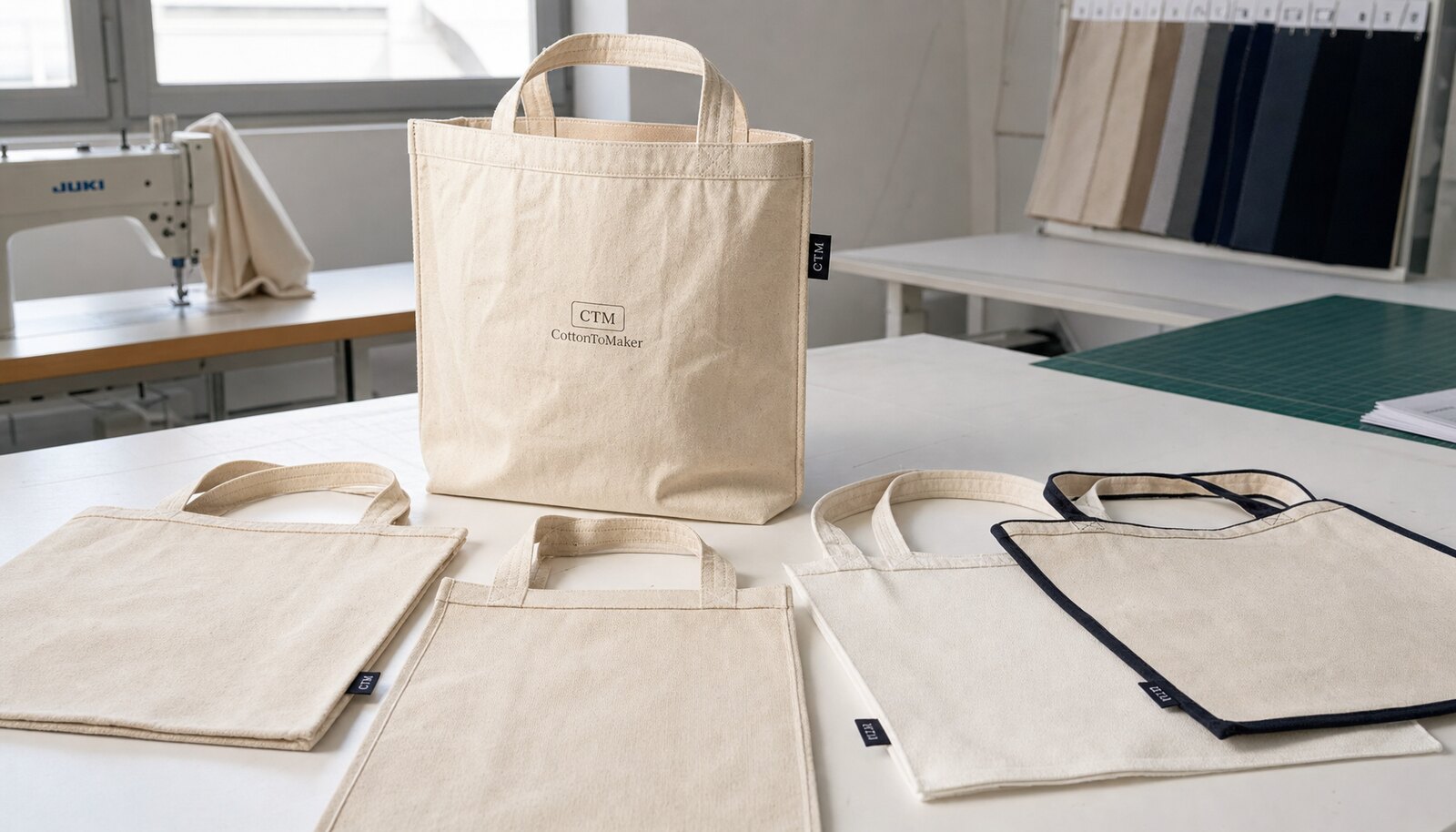
Why material selection matters more than artwork in conference bag sourcing
When procurement teams source canvas conference bags for trade shows, the fabric decision determines far more than appearance. The material controls how the bag holds shape on a booth table, how the print sits on the surface, how the handle carries load, and how the product survives packing, shipping, and repeated event-day use. Artwork is visible, but construction is what decides whether the bag feels dependable in hand or flimsy after the first use.
That is why a common buying mistake is to start with the logo and only later ask about canvas weight, weave density, shrinkage, or reinforcement. A supplier can show a clean mock-up and still quote a fabric that is too soft, too open, or too inconsistent for a trade show program. If the buyer wants a bag that can carry brochures, notebooks, water bottles, or sponsor samples, the fabric and construction need to be defined before the design is frozen.
There is also a commercial reason to treat material selection as a sourcing issue rather than a styling issue. Different canvas grades change sewing time, print yield, rejection risk, and freight weight. A move from 8 oz to 12 oz can alter unit cost, carton count, and the bag’s in-hand impression. For B2B procurement, the objective is not simply ‘nice canvas’; it is a bag spec that can be ordered, repeated, inspected, and delivered without avoidable variance.
For that reason, this guide is written around decision criteria that matter in procurement: measurable fabric data, construction choices, supplier traceability, sample validation, and QC thresholds. Those are the points that determine whether the bags you approve are the same bags you receive.
The best trade show bag is not the heaviest one or the cheapest one. It is the one whose material choice matches the contents, the event duration, the required brand presentation, and the supplier’s real process capability.
- Write the event use case into the RFQ so the factory understands the load and finish expectations.
- Treat body construction and decoration as separate decisions until the production sample is approved.
- Use measurable terms—oz, GSM, dimensions, stitch count, and tolerance—rather than broad marketing language.
Choose a canvas grade that matches the bag’s workload and brand tier
For most trade show programs, 10 oz to 12 oz cotton canvas is the most workable range, but the right answer depends on the bag’s job. If the bag is only meant for brochures and paper handouts, 8 oz can be acceptable, especially when the buyer wants lower freight weight or a softer fold for bulk packing. The tradeoff is less structure, more wrinkling, and a weaker premium feel once the bag is filled.
If the bag is part of a premium delegate kit, 12 oz or 14 oz can make better commercial sense. The extra weight improves body stability, reduces collapse at the base, and helps the bag look deliberate when photographed on a registration desk or carried around the venue. But weight alone does not guarantee performance. A heavy, loosely woven canvas can still print unevenly or distort under a concentrated load, while a slightly lighter but tighter weave may perform better in real use.
In buyer terms, the correct question is not ‘What is the best canvas weight?’ It is ‘What fabric weight and weave support the contents, expected use life, and desired brand impression?’ A reusable tote for a conference sponsor should be spec’d differently from a one-time handout bag. Likewise, a resale-style conference tote needs more attention to stitch quality, surface finish, and seam reinforcement than a single-use event give-away.
Ask the supplier to define the fabric in both weight and construction terms. ‘Cotton canvas’ is not enough. Request whether the cloth is plain weave, how tight the weave is, whether it is washed or pre-shrunk, and whether it comes from a bag-grade mill roll or a general textile roll. Those details influence dimensional stability, print clarity, and lot-to-lot consistency.
If your programs repeat every season, confirm whether the same canvas spec can be held across reorders. A supplier can often match a description, but not always a hidden fabric habit. Buyers should ask for the original mill source or production standard so the next order does not drift in hand feel or shade.
- 8 oz: suitable for lightweight handouts or short-duration promotional distribution.
- 10 oz: a solid baseline for standard conference use with moderate load and reasonable cost.
- 12 oz to 14 oz: better for premium perception, firmer shape, and heavier contents.
- If the bag carries samples or catalogs, test the fabric under load instead of approving on appearance alone.
Compare weave density, surface finish, and lot consistency before you compare price
Canvas weight is only part of the specification. Weave density changes how the surface prints, how the bag drapes, and how consistent the fabric will look from one lot to the next. A tighter weave usually gives better ink edge control, less show-through, and a cleaner surface for logos with small text or thin strokes. A looser weave may still be acceptable for simple artwork, but it can make solid color areas look patchy and can reveal more texture variation between panels.
Surface finish is equally important. Some conference bags are left raw and natural, which gives a casual, organic appearance but also exposes yarn variation, flecks, and shade differences. Others are washed, brushed, calendered, dyed, or lightly coated to create a smoother surface or a more polished hand feel. None of these finishes is inherently better; the right one depends on the brand position and the expected print method. What matters is that the finish is specified clearly in the RFQ and sample approval process.
Lot consistency is where many buyers lose control. A supplier may offer an attractive price on first sample approval, but if the bag body is made from mixed rolls or mixed lots, the final shipment may show shade or surface inconsistency. That is particularly visible on natural cotton, where subtle fiber or weave differences can be amplified under trade show lighting. For repeat orders, ask whether all units will be cut from one lot or whether lot mixing is permitted within a shipment.
You do not need laboratory-level detail for every order, but you do need verifiable evidence. Ask whether the supplier can share a mill specification, incoming roll ticket, or test report for fabric weight and finish. If they cannot, they should at least state how incoming fabric is checked and what deviation is acceptable before it is rejected or downgraded. That turns a generic ‘premium’ claim into a supplier-controlled process.
If your artwork includes thin linework or small text, give weave density extra attention. A rougher fabric can make the design appear soft or fuzzy even when the print process is correct. In those cases, it is usually better to pay for a cleaner weave and simpler finish than to try to rescue poor surface quality with a more expensive print method.
- Ask for woven density or mill specification when suppliers claim premium fabric quality.
- Confirm whether the canvas is raw, pre-shrunk, washed, dyed, brushed, or lightly coated.
- For repeat programs, ask how the supplier controls roll-to-roll and lot-to-lot shade variation.
Construction details that justify the price: handles, seams, gussets, and edge finish
A canvas conference bag can look similar at first glance while being built very differently. The handles are the first place to look because they determine load performance and day-to-day comfort. Self-fabric handles create a cleaner visual style and often suit lighter or medium-load bags. Cotton webbing handles are usually more robust and can feel better on shoulder-carry styles. Either can work, but only if the attachment method is strong enough for the intended load.
Do not accept a vague answer such as ‘reinforced handles’. Ask the supplier to specify the reinforcement pattern at each stress point. In practice, you want the factory to name the stitch pattern, such as bartacks, box-X stitching, double-row lockstitching, or another defined method. Then ask for the number of reinforcement points per handle and the seam allowance used at the join. If the bag will be carried with catalogs or samples, the load distribution matters as much as the visible finish.
The same logic applies to seams and edges. Top hems can be turned over, double-folded, bound, or topstitched. Gussets can be left simple or reinforced. If the bag includes a lining, zipper, inner pocket, or woven label, those features add seam intersections that need careful control. A poorly planned gusset or an over-ambitious pocket can create wrinkling, misalignment, or a weak point where the stitching changes direction.
Edge finish is often overlooked because it does not show in the product photo unless the bag is turned inside out. Yet edge consistency influences how the bag ages. Loose thread ends, uneven overlock, or poor trimming can create a low-quality impression even when the main structure is acceptable. Buyers should ask for a sample of the inside finish or at least ask the factory to describe how raw edges are secured.
For premium conference programs, pay attention to handle drop and opening width as well. A handle that is too short can be neat on a table but awkward on the shoulder. An opening that is too narrow may make the bag difficult to load with brochures or branded items. Those are practical details, not style details, and they should be included in the spec.
- Self-fabric handles suit simpler promotional bags and a cleaner visual style.
- Webbing handles are usually better for load support and repeated carry use.
- Require the stitch pattern and reinforcement count at each handle attachment point.
- Check top hems, gusset transitions, and corner seams for stress concentration.
Pick the print method only after the fabric and durability target are fixed
Artwork should not drive the whole bag specification. The decoration method has to match the fabric surface, order size, color count, and expected life of the product. Screen printing remains the most practical option for many conference tote programs because it is efficient on simple logos, gives strong coverage, and is typically repeatable when the shop controls curing and registration well. On a suitable canvas surface, it is often the most balanced option for cost and durability.
For bags with complex graphics, many colors, or short-run event variations, transfer or digital methods can be appropriate. The tradeoff is that these methods can be more sensitive to folding, abrasion, and process variation. A transfer that looks excellent in the sample room can crack if the bag is tightly folded in shipping or used as an everyday carry item. Digital print can deliver detail, but only if the fabric surface, curing profile, and artwork limits are all understood.
A buyer should therefore ask what the bag is supposed to do after the event. If the product is intended as a useful giveaway that will be reused, prioritize print durability and consistent batch output. If it is a short-lived campaign piece with a highly detailed graphic, a more flexible decoration method may be acceptable. That tradeoff should be explicit in the RFQ so the supplier quotes the right process instead of the one that is easiest for them to sell.
Print approval should happen on the actual production fabric, not on a substitute swatch or a generic proof sheet. This is especially important on natural cotton, where texture can change edge sharpness and color density. If the artwork includes fine lines or small text, ask the printer to tell you the smallest line thickness and smallest text height they can hold in production. That gives you a technical boundary before a shipment becomes a dispute.
For one- to three-color sponsor logos, screen print remains the default comparison point. For high-detail artwork, buyers should ask for a print sample on the intended fabric, not just a digital rendering. The file may be correct while the chosen method is not.
- Use screen print for most logo-led conference bags with one to three spot colors.
- Use transfer or digital methods only when the artwork complexity justifies the durability tradeoff.
- Approve print on the actual production fabric, not on a substitute swatch or proof sheet.
- Ask the supplier for minimum line width, minimum text size, and cure method before artwork lock.
Handle reinforcement standards that force suppliers to disclose real construction
Handle failures create some of the most visible complaints in tote bag sourcing because the issue is immediately obvious to end users. A conference bag can pass appearance review and still fail in use if the handles twist, pull, or begin separating after loading. That is why procurement teams should not ask only ‘Are the handles reinforced?’ They should ask how, where, and with what stitch count or stitch pattern.
A useful supplier answer should describe the exact reinforcement approach, such as bartacks at the upper and lower handle joins, a box-X pattern on the load point, or double-row stitching around the attachment area. Ask for the number of stitches per bartack, the number of bartacks per handle, and the seam allowance used to attach the handle. If the bag is intended for shoulder carrying, ask for the handle drop and finished handle width as well because comfort becomes part of performance.
The best QC check is simple and relevant: load the sample with realistic contents and lift it repeatedly. Use brochures, a notebook, a water bottle, or other event items that match the intended use. Watch whether the handle stitching opens, whether the body deforms, whether the top edge collapses, or whether the handle seam distorts under the weight. A sample that fails here is not ready for bulk approval, regardless of how good the logo looks.
Reject criteria should be written before the sample arrives. For example, reject if the handle join shows loose thread ends after trimming, if the reinforcement pattern is off-position, if the handle twists enough to change the carry line, or if the bag tears at the corner seam during repeated lift testing. When those standards are written down, the factory knows what it must hit and the buyer can compare suppliers on a technical basis instead of a subjective one.
If your order includes a heavier body spec, larger format, or a premium retail-style look, ask whether the factory can widen the handle and extend the attachment area. More fabric at the stress point usually costs more sewing time, but it is often cheaper than a complaint after the event.
- Ask for the stitch pattern by name, not just ‘reinforced handles’.
- Check handle width, attachment length, and handle drop in the spec sheet.
- Reject samples that show thread loosening, handle twisting, or visible strain at the join after loading.
Use sourcing-route comparison to judge risk, not only unit price
Many buyers compare only the bag specification and ignore the route behind the quote. A direct factory, a trading company, and a print-focused supplier can all offer canvas conference bags, but the process control behind each quote is different. One supplier may own sewing and decoration. Another may be coordinating several subcontractors. A third may be strong on print but weak on stitching. If you compare only the unit price, you may miss the reason one quote is lower.
A useful sourcing-route comparison asks a simple question: who is responsible for each step from fabric sourcing to final packing? If the answer is clear, the quote is easier to trust. If the answer is vague, the buyer should treat the price as provisional until the actual production chain is disclosed. That chain matters because each handoff adds the possibility of a tolerance shift, a shade difference, or a packing error.
For brand-critical conference programs, direct factory control often gives the clearest accountability. For mixed-category sourcing, a trading route may be acceptable if the supplier can identify the real maker and provide traceability. Print-focused suppliers can work well when the bag structure is simple and decoration quality is the main concern. But none of these routes should be accepted on trust alone. Ask for the process map, the fabric source, the print location, and the inspection owner before comparing the number.
This is also where a buyer should separate what is being bought from who is selling it. The right supplier for a rush job may not be the right supplier for a repeat program. A quote that includes packing and carton build-out may look expensive until the buyer adds the hidden labor elsewhere. Procurement teams should compare the total supply route and documentation set, not just the item line.
The commercial objective is not to choose the lowest quote. It is to choose the route that can reproduce the bag spec with the lowest risk of hidden variance.
- Direct factory offers the best chance of clear accountability when construction details matter.
- Trading routes can work, but traceability to the actual maker is essential.
- Print-only suppliers need extra scrutiny on stitching, reinforcement, and final packing.
What a production-intent sample should prove before bulk approval
A sample is not approved because it looks good on a desk. It is approved because it proves the bag can be produced at scale with the same materials, methods, and tolerances. The most useful sample is a production-intent sample: same canvas, same thread, same handles, same print process, same finishing, and ideally the same packing method planned for the order. A blank mock-up can help with dimensions and visual balance, but it cannot validate the real production risk.
Review the sample as an event attendee would. Open and close it several times. Load it with actual brochures or notebooks. Carry it by hand and on the shoulder if the style allows. Check whether the top opening stays flat, whether the gusset collapses, whether the print cracks where the bag folds, and whether the handle join puckers under load. Those observations matter more than a polished sample-room photo.
It helps to define reject thresholds before the sample is submitted. For example: handle distortion that changes the carry position, visible misalignment at the top seam, print placement outside the allowed zone, or loose threads that suggest poor trimming control. If you want the factory to repeat the result, the factory needs to know what result is unacceptable.
Keep a signed physical sample or a locked photo reference with measured dimensions. If the order changes later, this becomes the baseline for comparison. Without a reference, a buyer can end up debating memory instead of evidence. For larger programs, it is also worth noting which elements are allowed to vary, such as natural cotton shade, as long as the agreed tolerance is respected.
If the sample includes optional features such as a pocket, zipper, lining, or label, check those parts separately. Optional features are where small alignment errors often show up first, and they can be the reason a bag looks cheap even when the main body is acceptable.
- Approve a production-intent printed sample, not only a blank body sample.
- Test the bag under realistic load and repeated handling, not just for appearance.
- Keep a signed physical sample or locked photo reference for bulk comparison.
- Set explicit reject criteria for handle distortion, print placement, seam alignment, and loose trimming.
How to write an RFQ that helps factories quote the same bag the same way
A strong RFQ reduces both price noise and quality surprises. For canvas conference bags, the RFQ should use production language: finished size, target fabric weight, weave or finish preference, handle width and length, print method, decoration area, packaging method, and quantity. If the bag has a purpose beyond a standard giveaway—such as retail resale, delegate gifting, or sponsor distribution—that should be stated because it changes the expected finish level.
The most useful RFQs separate the quote into component lines whenever possible. One line for the bag body. One for decoration. One for labels or woven tags. One for packing, if the factory is doing it. That makes it easier to compare a direct factory quote against a bundled sourcing quote and to see where price differences actually come from. It also helps procurement teams manage landed cost because packing labor, carton size, and freight efficiency can materially affect the final number.
Ask the supplier to state the acceptable tolerance on the critical dimensions. That includes finished width, height, gusset depth, and handle placement. A supplier that cannot quote tolerance is usually quoting a general product rather than a controlled specification. For more complex programs, include artwork placement zones and the acceptable distance from top seam or side seam so the supplier does not improvise.
For multi-event programs, state whether the body remains the same while the print changes. That is especially useful when one conference season requires several versions of the same bag. If the factory knows the core construction will repeat, they can price the base bag more accurately and focus the variation on print setup. This keeps quotes cleaner and avoids repeated re-quoting for the same body spec.
If your organization uses approval gates, make the RFQ mirror those gates: sample approval, print proof approval, pre-production review, and shipment inspection. The more the RFQ resembles the actual approval process, the less room there is for ambiguity later.
- Include finished dimensions and an acceptable tolerance band.
- State whether artwork setup, screen charges, or plate costs are included.
- Ask for sample lead time and bulk lead time as separate numbers.
- Request gross weight and carton dimensions for freight planning.
MOQ, lead time, and freight should be evaluated together with material choice
Minimum order quantity is often treated as a supplier policy, but in tote sourcing it is usually a material and process issue. The order size needed for a simple open-top bag with one print color is not the same as the order size needed for a bag with lining, zipper, inner pocket, woven label, or multiple decoration locations. Extra features add sewing operations, setup time, and inspection points, which raises the economically sensible batch size.
Lead time follows the same pattern. If the canvas is stock-held and the print is simple, the factory may move quickly. If the fabric must be purchased, dyed to a custom tone, or matched with custom webbing and labels, the schedule becomes longer and less flexible. Buyers should ask which dates are under factory control and which depend on outside material delivery. A single promised ship date is not enough if the risk sits in the fabric purchase stage.
Freight is the third variable. A heavier canvas may improve the bag’s feel, but it also increases gross weight. A deeper gusset or more structured bag can improve usefulness but reduce carton efficiency. Ask for the carton pack count, folded size, outer carton dimensions, and estimated gross weight so you can see the full landed impact before you approve the spec. In some programs, a small change in fabric weight can alter container utilization enough to matter.
For this reason, buyers should not compare material, MOQ, and freight as separate conversations. They are one sourcing equation. The best quote is the one that balances those factors rather than maximizing only one. A slightly higher fabric price may still be the better commercial decision if it reduces rework, lowers carton waste, and improves on-site presentation.
If the event schedule is fixed, ask the supplier to identify the longest-risk item in the chain. It may be fabric arrival, print approval, or final inspection rather than sewing capacity. That answer is usually more valuable than a generic promise that the order can be completed on time.
- Simpler construction generally lowers MOQ more reliably than small artwork changes do.
- Zippers, lining, pockets, and special labels usually raise MOQ and extend lead time.
- Ask suppliers to explain which dates depend on materials, not only on sewing capacity.
- Request carton dimensions and gross weight before release so freight is not a late surprise.
Specification comparison for buyers
| Sourcing route | What you usually get | Best fit for buyer need | Main risk to control |
|---|---|---|---|
| Direct factory with in-house sewing and print | One production owner for cutting, stitching, decoration, inspection, and packing | Best when the bag spec is fixed, traceability matters, and you want fewer handoffs between sample and bulk | Verify that the factory actually controls fabric incoming inspection, print curing, and final pack-out rather than subcontracting them |
| Trading company or sourcing agent | A commercial quote that may bundle multiple factories or subcontractors behind one response | Useful when you need broader supplier access, local communication support, or multi-category coordination | Demand the actual factory name, process map, and material source or the quote is hard to compare on a true like-for-like basis |
| Print-focused supplier with sewing outsourced | Strong decoration capability, with bag assembly handled elsewhere | Works when artwork accuracy is the main priority and the bag structure is simple | Check stitch quality, handle reinforcement, and final inspection responsibility because those are often weaker than the print |
| Bag factory using stock canvas | Faster sampling and sometimes lower MOQ if approved fabric is already in inventory | Good for urgent event calendars or recurring conference programs using the same body spec | Confirm the real stock fabric weight, shade, shrinkage behavior, and roll-to-roll consistency; stock fabric is not automatically stable |
| Custom fabric order through mill plus factory production | Most control over weave, shade, finish, and repeatability | Best for brand-critical programs, premium delegate kits, or large repeat orders | Lead time rises and the buyer must manage both mill and factory approvals, including test reports, strike-offs, and lot control |
| Blank body sample only | A simple unprinted sample for size, shape, and handle layout review | Useful as an early geometry check before artwork or final decoration approval | Do not use it as final approval because it does not validate print method, fabric lot, seam finish, or actual production risk |
| Printed production-intent sample | A sample made with the intended fabric, thread, print method, and finishing route | Best for final sign-off before mass production | Require a signed reference sample and check that the sample is truly production-intent, not a hand-finished special |
| Inspection route through buyer or third party QA | An agreed inspection plan using AQL, measurement checks, and visual standards | Best when the order is large enough that defect cost outweighs extra inspection time | Make sure the acceptance criteria, not just the inspection date, are written before goods are shipped |
Buyer checklist before sampling
- Define the event use case first: brochure handout, delegate kit, sponsor gift, retail-style tote, or reusable conference carry bag.
- Write fabric in measurable terms: weight in oz or GSM, weave type, finished width, and an acceptable tolerance band.
- Specify the canvas finish you want: raw, pre-shrunk, washed, dyed, brushed, calendered, or lightly coated.
- State handle length, width, stitch pattern, and reinforcement method rather than using only the phrase ‘strong handles’.
- Decide whether the bag needs a gusset, lining, zipper, snap, pocket, woven label, or card window before requesting quotes.
- Request a production-intent sample made from actual bulk materials, not only a blank mock-up.
- Ask for proof of the fabric claim: mill spec, roll ticket, incoming inspection record, GSM measurement, or test report where available.
- Separate bag body, decoration, packing, accessories, and carton costs so supplier quotes can be compared line by line.
- Confirm carton pack count, folding method, outer carton dimensions, and gross weight before order release.
- Write seam, handle, print, and packing acceptance criteria into the PO or quality agreement, not just into email notes.
Factory quote questions to send
- Who is the actual bag manufacturer, and where do cutting, sewing, printing, inspection, and packing take place?
- What exact fabric weight, weave density, and surface finish are included in the quote? Please state the unit in oz and GSM if available.
- Can you share how you verify fabric weight on incoming rolls, and what tolerance you accept from the mill or fabric house?
- Please state the fabric origin or mill source, and whether the same mill and lot will be used for bulk production if the sample is approved.
- Are the handles self-fabric or webbing, and what reinforcement is used at each attachment point?
- How many bartacks, backstitches, or box stitches are used per handle, and what stitch length or stitch density is applied?
- Which thread type is used for the seams, and is the seam allowance the same on the sample and bulk order?
- Which print method is included, what is the ink or transfer system, and what is the maximum usable print area?
- If the artwork has fine lines or small text, what minimum line thickness and minimum text height do you recommend for production?
- Will the sample be made with the same fabric lot, thread, stitch pattern, print process, and packing method as mass production?
Quality-control points to confirm
- Check fabric weight on a representative roll or cut panel, not by touch alone. Record the measured GSM or oz and compare it with the approved tolerance in the spec sheet. For procurement use, a common control band is to set a target and require the supplier to state an agreed tolerance rather than accept a vague ‘about’ weight.
- Inspect weave consistency for uneven pick density, slubs, loose weaving, broken yarns, or thin streaks that could affect print clarity or bag shape. If the bag is meant to stand upright on a registration table, a weak weave can be a functional problem even if it passes a visual glance.
- Confirm pre-shrink or wash treatment if dimensional stability matters. If the fabric is untreated, the bag may change size after steam, folding, or customer use. Buyers should ask whether the fabric was pre-shrunk before cutting or whether the finished bag is expected to tolerate natural shrinkage.
- Measure cut panel dimensions before sewing and again on the finished bag, especially bag width, gusset depth, top opening, and handle placement. Ask the factory to state the allowed measurement tolerance on each critical dimension rather than only the final size.
- Check seam quality for skipped stitches, puckering, broken thread, loose thread ends, and uneven stitch length. The top hem, gusset transitions, and handle joins deserve extra attention because these are the areas where a bag often fails first under real load.
- Verify handle reinforcement by stitch count and stitch type, not just by appearance. Require the supplier to state whether the join uses bartacks, box-X stitching, double-row lockstitching, or a similar method, and inspect that the pattern is placed consistently on all units.
- Define a practical pull or load test before production starts. For example, load the bag with realistic contents and inspect for stitch opening, handle distortion, seam separation, or body tearing after repeated lifts. If the bag is used for heavy delegate kits, ask the factory what load they can test internally and how they document the result.
- Check print quality for registration, opacity, edge sharpness, and cure resistance. Rub a printed sample after curing and inspect for ink transfer or cracking at fold lines. If the design includes fine text, define the smallest acceptable line width and character height in the artwork approval stage.
- If the design includes a second print location, pocket, zipper, lining, or label, inspect alignment between features so the bag does not look skewed in use. Small alignment errors become more visible once the bag is folded, packed, or carried.
- Check color consistency against the approved strike-off or approved print sample, not against memory. Natural cotton varies by lot and dye bath, so define what shade variation is acceptable, what constitutes a reject, and whether all bundles must match the same lot or may mix within a shipment.