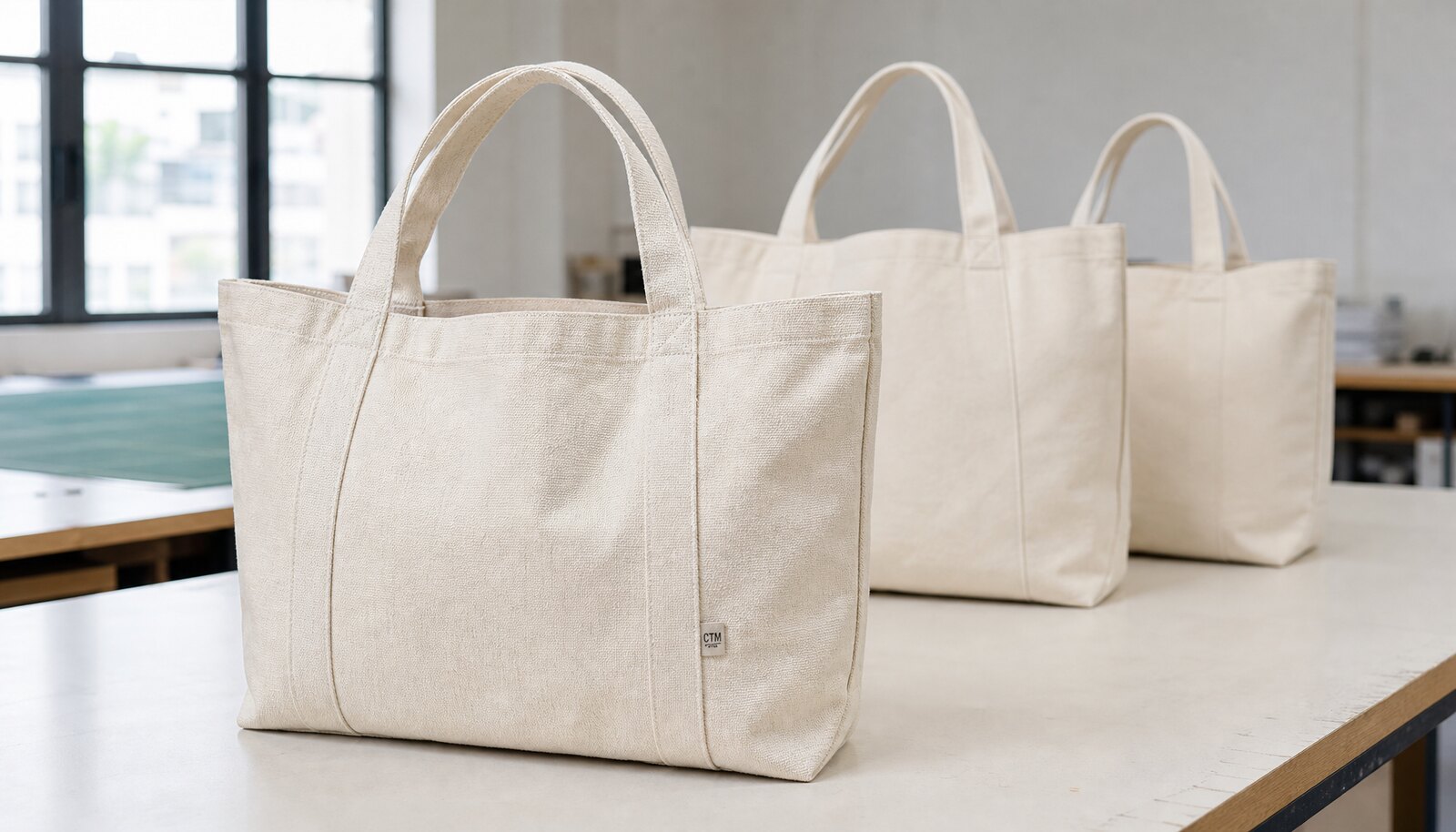
1. Start With the Buying Job, Not the Tote Bag
Canvas conference bags for trade shows are often priced as if they were all the same item. They are not. A visitor giveaway bag, a staff document bag, a speaker kit, and a VIP conference bag can share the same logo and still require different fabric weight, reinforcement, packing, and delivery timing. If procurement starts with artwork instead of use case, suppliers will fill in the missing details for you, and those assumptions will make the bulk pricing plan impossible to compare cleanly.
Start by defining the job the bag has to do on event day. Is it meant to carry brochures and a notebook for a few hours, or should it hold a tablet, samples, a water bottle, and several documents across a full trade-show schedule? That answer drives the canvas weight, seam reinforcement, gusset depth, and handle construction. It also tells you whether the price should be optimized for lowest unit cost, lower freight volume, a more premium feel, or a reusable bag that will survive multiple events.
The most useful procurement brief is short but specific: who receives the bag, what goes inside it, how long it must last, where it ships, and what it must look like when handed out. Once those five points are fixed, the supplier can quote a real product rather than a vague tote concept.
- Separate giveaway bags from staff-use bags before asking for price.
- State the expected contents so the bag can be sized for real load, not assumptions.
- Define whether the bag must survive one event or multiple reuses.
2. Lock the Specification Before You Compare Pricing
The fastest way to create quote noise is to let every supplier define its own version of the bag. For a canvas conference bag, the core spec should include fabric weight, finished size, gusset depth, handle length, handle width, print method, print area, and packing format. If one supplier quotes 10 oz canvas, another quotes 12 oz, and a third quotes a heavier weave without saying so clearly, the unit prices are not comparable. The same problem appears when one supplier includes individual polybags and another quotes bulk packing only.
For many trade show programs, 12 oz canvas is a practical starting point because it balances hand feel, print clarity, and sewing cost. Ten oz can work for lighter brochure bags or short-use giveaway programs. Fourteen to 16 oz is more appropriate when the bag needs a firmer structure or is expected to carry heavier items. The point is not that one weight is always best; the point is that a stable weight lets procurement hold the quote steady across suppliers and volume tiers.
Dimensions need equal attention. A bag that is too shallow can look flimsy, while a bag that is too deep can be bulky, awkward in a crowded hall, and inefficient to pack. Handle construction also changes cost and performance. Self-fabric handles are usually more economical, while webbing handles may improve comfort and durability. If you need a zipper, inner pocket, or lining, those should be part of the first quote, not an afterthought.
- Use one reference size for all quotes.
- Specify fabric weight in oz or GSM, not just “heavy” or “premium.”
- Treat zipper, lining, and pocket as separate cost drivers, not minor add-ons.
3. Build a Bulk Pricing Framework, Not a Single Unit Price
A useful bulk pricing plan for canvas conference bags needs tiered logic. Procurement should ask for at least three or four volume bands using the same spec, such as 500, 1,000, 3,000, and 5,000 units. The value of the tiers is not only to identify the cheapest bracket; it is to show where the price curve flattens and which cost items stop changing after setup is absorbed. Screen setup, cutting efficiency, sewing line utilization, and carton packing all behave differently as volume rises.
A good supplier quote should separate the bag cost from the decoration cost and the packing cost. If the quote hides those lines in one number, the buyer cannot tell whether a discount is coming from a lighter fabric, a simplified print process, or a change in packing. When comparing tiers, keep the fabric weight, artwork, and packaging identical. Otherwise, the “bulk discount” is just a different product disguised as a lower price.
The volume break is usually driven by setup recovery. At lower quantities, the factory needs to recover pattern making, screen making, sampling, and line changeover. As volume rises, those costs spread out and the unit price drops. But the discount is not infinite. If the price falls sharply between two tiers and then barely moves afterward, that is useful information: the factory has already absorbed most of the setup burden by the second breakpoint. Procurement can use that to choose the most economical order quantity, not merely the largest one.
- Request the same spec at each tier so the curve is real.
- Ask which costs are one-time setup and which are per-piece.
- Treat unexplained price gaps as spec differences until proven otherwise.
4. Know the Cost Drivers Behind the Quote
Canvas conference bag pricing is usually shaped by five buckets: fabric, labor, decoration, packing, and logistics. Fabric cost changes with weight, weave, and finishing. Labor changes with the number of seams, gussets, reinforcements, pockets, and closures. Decoration changes with print size, number of colors, registration accuracy, embroidery digitizing, or applique work. Packing changes with whether the bags are bulk-packed, individually polybagged, labeled, or palletized. Logistics changes with carton dimensions, gross weight, destination, and incoterm.
This is why the cheapest quoted unit price is rarely the cheapest landed cost. A bag with lower ex-works pricing can be more expensive once it is packed in a way that raises freight volume or requires rework at the destination. If one supplier quotes a very clean bag price but the carton is oversized, the freight bill may erase the savings. If another supplier includes better packing and tighter carton dimensions, the total delivered cost can be better even if the factory price is higher.
When comparing suppliers, ask them to show what is included in the quote line and what is excluded. Use the same payment term, the same ship basis, and the same packing standard if possible. If those are different, separate the pricing from the commercial terms before making a decision. Procurement should be comparing actual delivered value, not only the factory line number.
- Separate unit price, packing, and freight before comparing.
- Ask for carton dimensions and gross weight because freight follows volume as much as weight.
- Do not award on ex-works price alone if the event date is fixed.
5. Match the Sourcing Route to the Risk Level
The route you choose matters as much as the product spec. A direct factory usually gives the best control over sewing, print, and packing, especially for repeat programs where the buyer wants the same result again next season. A trading company can help when the order includes several products, multiple ship-to locations, or a need for one commercial contact point. A stock-bag supplier or local decorator can be useful when the event is close and the priority is speed rather than tight spec control.
Each route carries different trade-offs. Direct factory sourcing is often strongest on traceability and cost transparency, but only if the factory truly controls the process. A trading company may add coordination value, but it also adds a layer that can make problem-solving slower if the quote is not fully itemized. Stock plus local print can save time, but buyers must watch for shade variation, size variation, or mismatched decoration quality across replenishments. Nearshore supply can reduce transit time and simplify communication, but it does not automatically mean lower total cost once packing and freight are counted.
For procurement, the real question is not “which route is cheapest?” It is “which route can hit the event date with the least risk of quality drift and the clearest cost breakdown?” That is the better way to choose a route for canvas conference bags for trade shows bulk pricing plan work.
- Use a direct factory for repeatability and clearer cost tracing.
- Use a trader only when the coordination benefit is obvious and priced transparently.
- Use stock plus local decoration only for urgent jobs or simple reorders.
6. Use MOQ Logic to Your Advantage
MOQ is usually rooted in production efficiency, not an arbitrary supplier preference. For canvas bags, the minimum can be influenced by fabric width utilization, cut waste, print screen setup, sewing line changeover, and accessory sourcing. A simple one-color logo may have a lower MOQ than a multicolor print, a zipper bag, or a bag with a pocket. That is why two suppliers can state similar minimums even though one is more efficient on the bag body and the other is protecting decoration setup.
The best procurement move is to ask for MOQ by element: fabric color, decoration method, and packing style. That tells you which feature is really forcing the minimum. If you need to stay under the factory’s ideal volume, ask for the cost of simplifying the spec rather than asking the factory to force a lower minimum. For example, keeping the base bag fixed and changing only the print artwork or side label can sometimes be more economical than asking for a completely different construction.
A practical rule is to compare the extra cost of reaching the next volume band against the operational benefit of having reserve bags for future events. In some programs, ordering a little more at the first run is cheaper than placing a small rush reorder later. That logic matters only if the bags can actually be used again, so procurement should test storage space, program cadence, and future event timing before approving a larger tier.
- Ask for MOQ by color, artwork, and carton style.
- Compare one SKU versus multiple SKUs on the same base bag.
- Do not force a factory to break an efficient production method without checking the cost impact.
7. Choose the Print Method Before the Price Becomes a Guess
Print method is one of the largest hidden drivers in canvas tote pricing. Screen printing is usually the best choice for large runs with one or two solid colors because it is durable, repeatable, and economical once setup is done. Transfer print is more flexible for smaller quantities or multicolor graphics, but it can change the look and wear behavior of the bag. Embroidery can add a premium touch, but it increases labor, may require digitizing, and can distort thin fabric if the backing and stitch density are not right.
The right method depends on the event objective. A hall giveaway bag does not need the same finish as a VIP speaker kit. If the bag will be handled heavily and packed with literature, durability and fast production are more important than a complex decoration. If the bag is meant to signal a premium brand presence, the visual finish matters more and buyers may accept a higher cost per piece. What matters is that the decoration method is chosen intentionally rather than left to the factory’s default.
To avoid late quote drift, supply vector artwork, a fixed print area, and a clear color requirement. If Pantone matching matters, say so. If a visual match is enough, say that too. The quote should also state whether the logo is on one side or both sides and whether a woven label, side label, or patch is part of the design. Every one of those details changes either the setup cost or the labor time.
- Use screen print for simple, high-volume logos.
- Use transfer print when artwork is more complex or the order is smaller.
- Use embroidery only when the fabric weight and panel support can handle it cleanly.
8. Make Sample Approval Operational, Not Decorative
A sample should prove more than logo placement. For a procurement buyer, the sample needs to confirm finished size, gusset shape, handle attachment, stitch density, print position, label placement, closure function, and overall bag balance. If the sample only checks the artwork, the bulk order can still fail on structure or packing. The approval process should also distinguish between the material swatch, the print strike-off, the pre-production sample, and the sealed golden sample so no one confuses one approval point with another.
A better approval standard is measurable. Record the target dimensions, the acceptable tolerance, the approved print window, and the expected seam finish. For example, the handle attachment should be symmetrical, the bag should stand or fold as expected, and the print should sit within the approved placement area without drift. If the bag includes a CTM or other woven side label, that should be checked in the sample stage and locked before mass production. If the factory changes fabric lot, thread, or label source after approval, it should notify the buyer first rather than quietly substituting material.
For repeat trade show programs, keep one signed reference sample in procurement records. That sample becomes the basis for later reorders and reduces the chance that a second order drifts from the first. It also makes dispute handling easier because the buyer has a physical reference instead of only an email thread.
- Approve the full build, not only the printed front panel.
- Keep one signed reference sample for future reorders.
- Require the factory to confirm any material or label change before bulk sewing starts.
9. Packing, Cartons, and Landed Cost Can Make or Break the Program
Packing is not a back-office detail on trade show orders. If the bags arrive wrinkled, crushed, or hard to count, receiving time goes up and the event team pays the cost. Decide early whether the order will be bulk-packed, individually polybagged, or boxed with an insert card. Bulk pack is usually the leanest option when the bags go straight to a booth or event warehouse. Individual polybags are more useful when the bags will be stored, reshipped, or distributed in smaller lots. Insert cards or barcode labels can help when the bags must fit into a broader SKU or logistics system.
Carton planning should be tied to the destination. Venue warehouses often care about carton size, label clarity, and receiving efficiency. If cartons are too large or too heavy, the delivery process becomes slower and more expensive. If the order is split across cities, carton marks need to be precise, because a good unit price is not useful if cartons are sent to the wrong site. Buyers should ask for carton dimensions, gross weight, cartons per pallet if needed, and the expected packing count per carton before they compare quotes.
This is also where landed cost becomes real. The landed cost is not only the tote price; it is the bag, decoration, packing, freight, duty if applicable, delivery, and any warehouse or handling charge. A supplier with a lower unit price can still be more expensive overall if the cartons are inefficient or if the quote leaves out required packing materials. For procurement, every quote should be normalized to the same incoterm and same packing basis before the award decision is made.
- Choose bulk pack for speed and lower handling cost.
- Choose individual packing if the bags must stay clean, sorted, or resale-ready.
- Check carton size against the venue’s receiving rules, not just against freight cost.
10. Compare Quotes on a Single Decision Sheet
The cleanest way to make a buying decision is to put every supplier on one comparison sheet and force the quotes into the same structure. Line up fabric weight, finished size, handle construction, decoration method, print area, packing, MOQ, unit price by volume tier, lead time, and delivery basis. If one supplier is quoting FOB and another DDP, normalize them before judgment. If one supplier includes polybags and another does not, add that cost so the comparison is fair. The point is to compare the same product at the same commercial basis.
A strong procurement sheet usually highlights three numbers: the first viable volume tier, the break where price drops materially, and the landed cost at the event destination. From there, the buyer can weigh quality risk, speed, and control. It is often better to pay a modest premium for a supplier that can provide tighter QC, better carton labeling, and a safer delivery window than to save a small amount and take the risk of a late or nonconforming shipment.
The table below is not just for reference; it is the decision tool. If a quote cannot fill in the columns, the supplier does not yet have a comparable offer. That is a useful signal in itself.
- Normalize all quotes to the same fabric, packing, and delivery basis.
- Compare the first viable tier, the next price break, and the landed cost.
- Use missing data as a procurement risk flag, not a reason to guess.
Specification comparison for buyers
| Procurement route | Typical price position | Typical lead time profile | Compliance / QC fit | Best use case |
|---|---|---|---|---|
| Direct factory, in-house sewing and print | Usually the lowest clean quote at repeatable volumes | Moderate; faster after first order, slower if sampling is not controlled | Strongest traceability if the factory truly controls fabric, sewing, decoration, and packing | Repeat trade shows, stable artwork, medium to high volume |
| Factory plus trading layer | Often 5-15% higher depending on complexity and consolidation service | Can be competitive if the trader manages multiple SKUs, but handoff time may add variance | Traceability depends on the trader’s documentation discipline | Mixed-product programs, multi-destination shipments, buyers who need one PO interface |
| Stock blank bags plus local decoration | Can be low on unit bag cost but higher on total landed cost | Fastest for urgent events or short reorders | Quality depends on matching stock availability and local print consistency | Rush programs, short campaigns, event replacements |
| Nearshore / regional source | Not always the cheapest, but freight and transit can offset the unit price | Usually shorter transit time; useful when event dates are tight | Good for fast response if the supplier has stable QC discipline | Replenishment orders and late-stage conference needs |
| Screen-print specialist factory | Very competitive for one- or two-color artwork at scale | Efficient once screens and artwork are approved | Good repeatability if registration and ink cure are controlled | Large bulk runs with simple logos |
| Embroidery / patch-focused supplier | Higher unit cost due to labor and setup | Can slow production if digitizing or applique is involved | Acceptable only if backing, stitch density, and panel support are managed | Premium speaker kits, VIP bags, higher-value conference sets |
| Recycled-canvas specialist | Usually priced above standard natural canvas | Lead time depends on recycled yarn availability and shade consistency | Better fit when documentation on content and finishing is required | Sustainability-led events and branded programs |
| Supplier offering split shipments and carton labeling service | Adds handling cost but may reduce receiving issues | Useful for staged deliveries and multi-city events | Strong if carton marks, SKU labels, and destination lists are controlled | Roadshows, traveling conferences, regional distribution |
Buyer checklist before sampling
- Freeze bag size, gusset depth, handle length, and handle width before requesting quotes.
- State the fabric target in GSM or ounces and say whether a tolerance band is acceptable.
- Specify decoration method, print area, number of colors, and whether Pantone matching is required or only a visual match.
- Define packing exactly: bulk pack, individual polybag, insert card, barcode label, or pallet build.
- Ask for tiered quotes at the same spec for 500, 1,000, 3,000, and 5,000 units so you can see the price curve.
- Request sample timing, sample fee, and what changes are included if the sample misses the approved spec.
- Confirm carton size, gross weight target, and whether cartons must fit a venue warehouse or shelving rule.
- Lock the incoterm, delivery address, and any split-shipment requirement before comparing suppliers.
- Ask for production photos or a short video if the supplier is not already approved.
- Keep one signed reference sample or gold seal for size, color, print placement, and stitch quality.
Factory quote questions to send
- Is this quote based on the same fabric weight, bag size, handle construction, and print area as the other suppliers’ quotes?
- What is the MOQ by fabric color, by artwork version, and by carton style, and which element is driving the highest minimum?
- Does the unit price include screens, plates, embroidery digitizing, or strike-off charges, or are those separate?
- What packing is included by default, and what is the added cost for polybagging, insert cards, barcode labels, or palletizing?
- What is the lead time after sample approval, and what changes it if artwork, carton marks, or labels are revised?
- Which quality checks are included before shipment, and what is your acceptance standard for size, stitching, and print alignment?
- What is the quote basis: EXW, FOB, CIF, or DDP, and which freight, duty, or clearance charges are excluded?
- What documents will ship with the order, such as carton list, packing list, and production or inspection photos?
- Can you confirm whether sewing, printing, and packing are all in-house or whether any step is subcontracted?
- What is your rework policy if the bulk production misses the approved sample on size, print placement, or packing count?
Quality-control points to confirm
- Fabric weight should match the approved target range, and random carton checks should not show obvious shade jumps between lots.
- Bag size, gusset depth, and handle drop should stay within agreed tolerance; the body should be symmetrical side to side.
- Stitching should be even with reinforced stress points; no skipped stitches, loose threads, or seam gaps on handles and corners.
- Print placement should sit within the approved artwork window, with acceptable color density and no smearing, pinholes, or misregistration.
- If zippers, pockets, snaps, or lining are included, they should operate smoothly and not twist the bag body.
- Trim, labels, and side marks should be secure, readable, and placed exactly where the approved sample shows them.
- Carton count should match the packing plan, cartons should be sturdy, and outer marks should match the ship-to and SKU plan.
- No oil stains, fabric holes, needle damage, strong odor, or visible contamination should appear during random carton inspection.
- Carton gross weight should stay within the agreed limit for the receiving site or venue warehouse to handle safely.
- If recycled canvas is specified, the batch should be checked for acceptable visual variance before bulk approval.