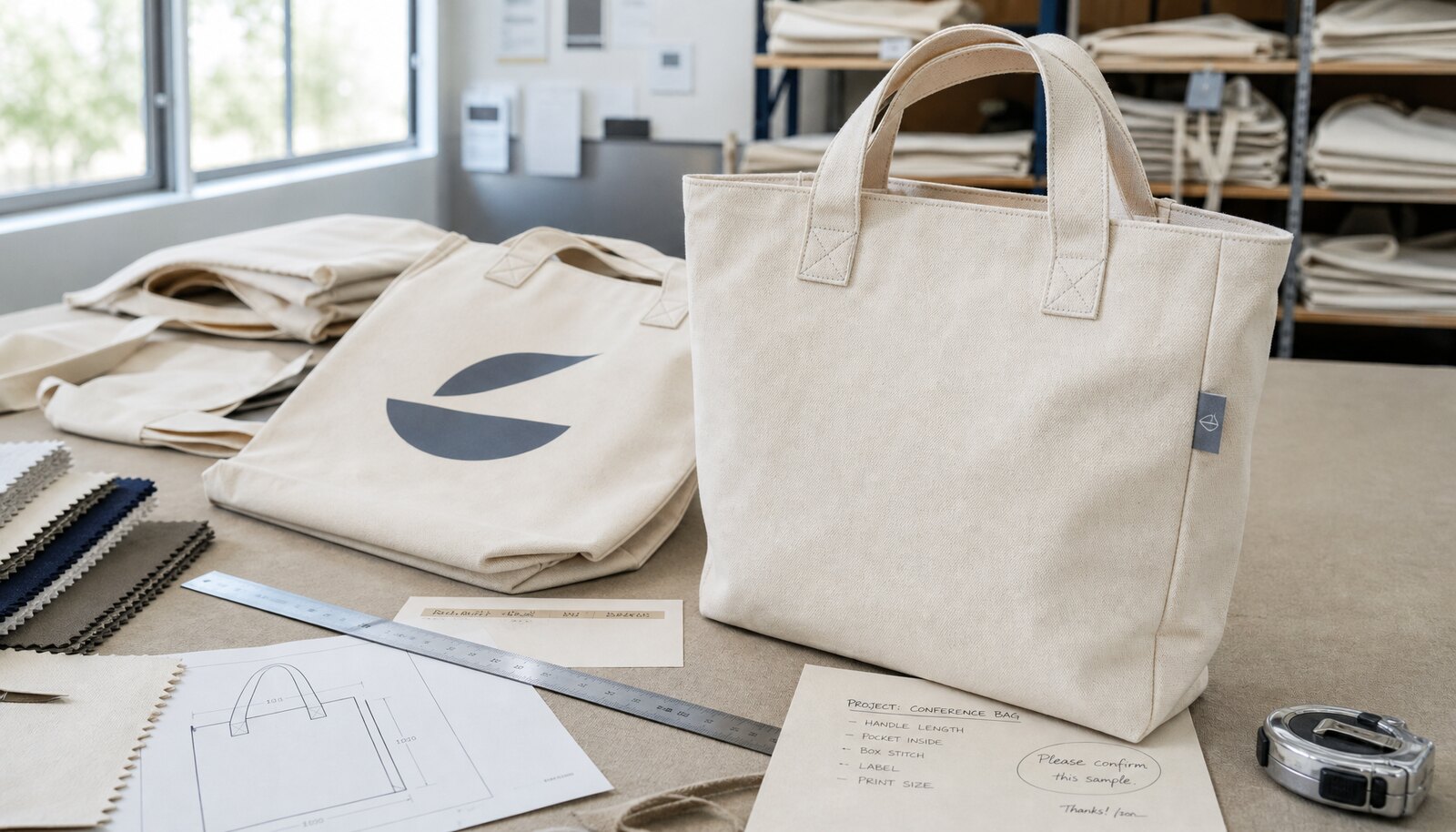
Why canvas conference bags matter more than they look
Canvas conference bags often sit in the same budget bucket as other promo items, but procurement teams quickly learn they are not a trivial purchase. At a trade show, the bag becomes part of the event workflow: it carries brochures, samples, notebooks, chargers, and any inserts that the booth team needs to hand out quickly. At retail launch level, the same bag may be placed on a shelf, bundled with a product, or used as a premium gift item. Those two channels create different requirements for structure, print quality, packing, and cost control.
The mistake many buyers make is to treat the product name as the specification. ‘Canvas tote’ can mean a thin giveaway bag, a structured retail bag, a lined launch kit, or a reinforced carrier for product samples. The bag’s real value is in how it behaves after packing, during transport, and at first customer touch. If it sags, prints poorly, or arrives with carton damage, the bag does not save money just because the factory unit price was low.
For procurement, the key question is not whether the tote looks good in a mockup. It is whether the same bag can be produced repeatedly, inspected consistently, and delivered in the pack format the warehouse or event team actually needs. That means buying decisions should start with load, channel, and presentation—not with the logo alone.
Useful framing for buyers: a trade show bag is judged by utility and speed; a retail launch bag is judged by utility, appearance, and shelf readiness; a hybrid program needs enough structure to look intentional while still staying within event economics. Once you define the channel, the rest of the spec gets much easier to write.
- Trade show bags need fast distribution, strong handles, and predictable packing.
- Retail launch bags need better structure, cleaner decoration, and repeatable presentation.
- Hybrid programs should avoid overbuilding every feature; specify only the elements the channel will actually pay for.
Start by deciding how the bag will be used in the workflow
Before requesting quotes, map the bag into the actual workflow. Will event staff preload the bag with inserts before the show opens? Will visitors receive the bag empty and fill it themselves? Will retail staff hang it, stack it, or place it in a gift set? Will the bag need to fit a boxed product, a catalog, or a standard welcome kit? These questions determine whether you need a flat tote, gusseted tote, lined tote, or a reinforced base.
Trade show workflow often prioritizes speed and carry capacity. Bags are usually packed in bulk, moved from cartons to a booth, and handed over quickly. In that setting, the bag does not need luxury finishes, but it does need stable handle construction, enough body to avoid collapsing, and a print that stays legible under fluorescent event lighting. Retail launch workflow is different: the bag may need to look clean on a shelf or in e-commerce imagery, so the buyer should care about fold presentation, seam cleanliness, and how well the bag keeps its shape when empty.
A useful procurement practice is to write a one-paragraph use-case brief before sending the RFQ. Include the destination channel, average contents, target loading weight, and whether the bag must support shelf display or only transport. That one paragraph often prevents a lot of later confusion about weight, build, and cost.
If the bag will be used as a handout plus a packaging element, consider insert cards, barcode stickers, or a pre-packed set. Those items affect carton count, labor, and warehouse time, so they should be specified early rather than added after the quote arrives.
- Write the use case in one paragraph and attach it to the RFQ.
- State the expected contents, approximate weight, and presentation requirement.
- Decide early whether the bag is a distribution item, a display item, or both.
Choose fabric composition and weight with the final load in mind
For canvas conference bags, buyers often start with ounces or GSM, but the fabric composition matters just as much. Cotton canvas is common, but the practical results vary depending on weave density, yarn quality, finishing, and whether the canvas is pre-washed or treated. In many buyer discussions, the useful working range is around 10–12 oz, which is roughly 340–410 GSM, but that should be treated as a conditional guide, not a universal rule. The right number depends on the load, print style, and desired structure.
At the lower end of that range, the bag is easier to sew, slightly cheaper, and more flexible for bulk handouts. The tradeoff is less body and more visible distortion after print or loading. At the higher end, the bag holds shape better and usually looks more premium, but the fabric cost rises and sewing can become slower, especially if the factory is reinforcing seams or adding lining. If the bag is for a retail launch, a buyer may prefer the stronger visual structure of heavier canvas even when the raw material cost is not the biggest difference.
A second decision is whether the canvas is pre-shrunk or washed. This matters when finished dimensions must stay consistent after storage, packing, or customer use. If the program requires exact sizing for inserts or shelf facings, ask the factory whether shrinkage is controlled in finishing and what tolerance they can commit to. Unwashed canvas can move more after first laundering, so the bag may arrive within spec but later drift if the end user washes it.
Also ask how the supplier measures fabric weight. Some factories quote fabric weight before finishing, while others quote after washing or after treatment. Those numbers are not always directly comparable. If you do not clarify this point, two quotes that both say ‘12 oz’ may not be equivalent in hand feel or performance.
- Ask whether the quoted fabric weight is before or after finishing.
- Use pre-washed or pre-shrunk canvas when size stability matters.
- Do not compare supplier weights unless the measurement basis is the same.
Decide how much structure the bag needs
The simplest canvas conference bag is a single-layer tote with self-fabric handles and reinforced seams. That build is enough for many event programs, but it is not the only option. If the bag has to look polished for a retail launch, a lining can hide loose threads, improve the inside feel, and reduce show-through from inserts or seams. A partial lining in the body or base is often enough for many programs and may be more cost-effective than a fully lined bag.
Base reinforcement is another important decision. A flat base is simpler and cheaper, and it works well for brochures or flat handouts. A boxed or gusseted base makes the tote stand upright more reliably and helps with heavier or irregularly shaped contents. If the bag must hold a boxed product, sample kit, or several hard items, a reinforced base insert can significantly improve stability. Buyers should ask the supplier whether the insert is sewn in, loose, or simply added during packing, because each method changes cost and usability.
Handle construction should be specified rather than assumed. The most common issue in field use is not the handle material itself but the attachment point. A self-fabric handle can be perfectly adequate if the factory uses the right width and reinforcement, but a narrow handle with weak end stitching can fail under a normal event load. Ask for the handle drop in the final approved size so you know how the bag will sit on the shoulder or arm.
For high-visibility retail work, buyers may also want to control the bag’s empty stance. Some canvas totes collapse flat, which is fine for shipment but less ideal for shelf presentation. If standing upright matters, ask the factory whether a heavier base, gusset, or board insert is required. That small build change can make the difference between a tote that looks like a commodity and one that looks like part of the brand experience.
- Choose single-layer, lined, or partial lining based on the channel—not on habit.
- Use gussets or base inserts if the bag must stand up with contents or on a shelf.
- Ask for handle width, handle drop, and reinforcement method in writing.
Compare sourcing routes before you compare unit prices
Procurement teams often compare quotes as if every supplier were selling the same thing, but the sourcing route changes what the quote means. A direct factory quote usually gives the best visibility into fabric, sewing, print, and packing decisions. It is often the best route for repeat orders and stable specifications because you can control the build and tighten quality expectations over time. The tradeoff is that factories are usually less flexible when you want multiple variants or very small test quantities.
A trading company or sourcing agent can help when the program has mixed requirements: different bag sizes, multiple print versions, or shipments to several destinations. The value is coordination. The downside is that the buyer may see fewer details about the real production factory, the exact fabric source, or the point at which lead time can slip. That does not make the route wrong, but it does mean the quote needs more scrutiny. Ask who the actual manufacturer is and whether the sample you approve will be made in the same facility as production.
A local converter or domestic printer can be useful for urgent reprints, small replenishment orders, or last-minute event replacements. In those cases, the buyer may pay more per unit but gain speed and easier communication. For a launch that cannot miss the event date, that may be the right tradeoff. For a large planned buy, however, the same route may be too expensive to scale.
The main procurement lesson is simple: do not compare factory, trader, and local converter quotes as if they were identical offers. Compare them by control level, flexibility, transparency, and delivery risk. A slightly higher quote with better visibility can be the cheaper option if it prevents rework, missed dates, or carton disputes.
- Direct factories are usually best for repeatable specs and stronger process control.
- Trading routes can be useful for complex, mixed, or small-batch programs.
- Local converters are often about speed and responsiveness, not lowest landed cost.
Build the RFQ so the supplier has to quote the real product
A useful RFQ for canvas conference bags should force the supplier to quote the same product you plan to buy. That means more than sending a logo file and asking for a price. The RFQ should include finished size, gusset depth, fabric type, target weight, handle dimensions, print position, number of colors, pack count, carton requirements, and whether you need retail folding or bulk packing. Without these details, the supplier will fill in the blanks with whatever is easiest to produce.
If you want to compare suppliers on equal terms, ask for a line-item quote. At minimum, the quote should separate fabric, cutting and sewing, decoration, labels, packing, cartons, and sample charges. For larger programs, ask for options. For example, request one price for natural canvas and one for pre-washed canvas; one price for single-layer construction and one for lined construction; one price for bulk packing and one for retail folding. This creates a more useful comparison than a single all-in number.
For buyers managing a launch budget, landed cost matters more than ex-works price alone. Freight can change materially if the carton size grows, if the bag is folded differently, or if retail packaging reduces carton density. Even a small change in cube can alter shipment economics. Ask the supplier to provide carton dimensions and gross weight before you approve the order, then compare that data across suppliers. If a quote looks cheaper but uses a larger carton, you may pay for the difference in freight.
A strong RFQ also protects against ‘silent substitutions.’ If the supplier swaps to a different canvas source, a thinner label, or a lower-cost print process, the quote should not be allowed to stand without written approval. Put the no-substitution rule in the RFQ or PO if the bag is tied to a retail launch or a brand-sensitive program.
- Ask for line-item pricing, not just one unit price.
- Request carton dimensions and gross weight before comparing offers.
- Write a no-substitution rule for fabric, trim, print, and packing.
Use sample approval to lock the production path, not just the look
A sample is only useful if it reflects the exact build you want in bulk. For a canvas conference bag, that means final fabric weight, final print method, final handle construction, final label position, and final packing method if possible. A blank or digitally mocked sample may help with artwork, but it does not tell you how the bag will behave in production. The approved sample should become the benchmark for the PO, inspection, and dispute handling.
When you receive the sample, inspect it like a buyer, not like a designer. Measure the finished dimensions after the bag is fully made, not only when it is cut open. Check whether the handles sit evenly, whether the gusset folds cleanly, and whether the bag stands as expected. Examine print sharpness in daylight because the natural texture of canvas can soften fine details. If the design includes small text, ask the supplier to confirm the minimum readable size before the sample is made. Otherwise, you may discover too late that the artwork is not production-friendly.
For launch programs, sample sign-off should be documented. Record who approved the sample, the date, the sample reference number, and any deviations that are accepted only for the sample. If the supplier must make changes after sample approval, require a revised sample or written confirmation before moving into bulk production. This avoids the common problem where the “approved” sample and the mass-produced bag no longer match.
One practical control is to ask for photos of the sealed production sample against a ruler or measurement sheet. This gives you a second check before mass production starts, especially when the program is moving quickly or the supplier is in another time zone. It does not replace a physical sample, but it helps you catch obvious mismatches early.
- Approve a full production-style sample, not only a mockup.
- Measure the finished bag, not just the cut parts.
- Document sample sign-off and any accepted deviations in writing.
Printing and decoration choices should follow the canvas, not the artwork file
Screen printing is still the most practical decoration method for many canvas conference bags. It is usually the strongest choice for bold logos, simple type, and repeat orders where cost stability matters. The advantage is consistency: once the screen and ink system are set, the supplier can reproduce the same result over a larger run. The tradeoff is that screen print does not handle ultra-fine detail, gradients, or very small reverse text as gracefully as a digital image on paper would suggest.
Heat transfer can be useful when the artwork is more complex, but the buyer should treat it as a different product experience. It may sit on top of the fabric rather than sinking into the weave, which can affect feel and long-term wear. Embroidery, woven patches, or sewn labels can add a premium impression, especially on heavier canvas, but these options bring extra labor and can distort lighter fabric if the stitch density is too high. A bag with too much embroidery on a light body can pucker or twist after sewing.
A good supplier should tell you not only which decoration method is possible, but which one is appropriate for the chosen fabric. Ask for minimum line thickness, smallest readable text size, print area limits, and curing or wash parameters when relevant. For natural canvas, some ink sink is expected, so the practical question is whether the logo still reads cleanly and holds its edge. If you want very precise branding, the fabric may need to be denser, the print simplified, or the decoration moved to a patch or label.
If your retail launch includes both tote bags and matching product packaging, consider how the decoration will photograph. A good-looking bag in person can look flat in e-commerce if the print lacks contrast or if the fabric weight is too soft to stand naturally. Ask the supplier to show a sample in daylight before final approval if visual merchandising is important.
- Use screen print for bold logos and repeat volume.
- Use embroidery, patches, or woven labels only when the fabric can support the extra stitch load.
- Confirm minimum line thickness and text size before approving detailed art.
Plan MOQ and variant strategy around inventory risk, not just unit cost
MOQ for canvas conference bags is often driven by the number of variables you introduce. Natural canvas usually allows lower entry quantities than custom-dyed canvas. One print version is simpler than two. A plain body is easier than a lined body. A bulk pack is easier than retail folding with inserts and labels. Procurement teams should think in terms of SKU complexity, because each added variable can push the supplier’s minimum upward or make the per-unit price less attractive.
The smartest MOQ decision is not always the smallest number. If you split an order into too many variants, you may pay multiple setup charges and end up with leftovers that are hard to redeploy. For example, if one tote design can work for both the event booth and the retail launch by changing only the insert card or hangtag, that is often more efficient than creating two nearly identical bag SKUs. The same logic applies to print positions and colors: a small cost to simplify the variant structure may reduce a much bigger inventory problem later.
Buyers should also ask the factory how MOQ changes by component. The bag body may have one minimum, while woven labels, custom zippers, dyed fabric, or special packaging each have their own minimum. That is why the quote should separate the core tote from add-ons. Otherwise, the program appears to meet MOQ until the extra components are added. If the supplier cannot break out the minimum by component, the buyer is taking on hidden risk.
For retail launch planning, it is worth checking whether the same base bag can support a later replenishment order. If you expect follow-on demand, ask the factory to reserve or document the fabric source, color, and print setup so reorders can be matched more closely. That is especially important when the bag is used as part of a seasonal promotion or a campaign that may expand after launch.
- Reduce SKU variants before you ask for MOQ concessions.
- Ask for MOQ by component: body, label, print, and packing.
- Design the first order so it can be replenished without redesigning the bag.
Packing, insert strategy, and shelf presentation affect both cost and the buyer experience
Packing is not an afterthought for these bags; it is part of the product. For a trade show, bags are often distributed from cartons, so the priority is efficient bulk packing and easy counting. For a retail launch, the bag may need to be folded neatly, protected from dust, and paired with an insert card, barcode, or hangtag. Those presentation choices influence labor and freight, so the supplier should quote them separately.
If the bags will be packed alongside product samples or welcome materials, ask whether the factory can pre-pack inserts. Some programs save time by having the supplier assemble the bag with a brochure, card, or promotional item already inside. Other programs should not do that because the inserts are destination-specific or packed by a third-party fulfillment center. Either way, the workflow should be explicit before production begins.
Carton data matters for warehouse planning. Ask for carton dimensions, the number of bags per carton, the gross weight, and whether the cartons can withstand multiple touches before arrival. A bulky but light tote may create more freight cost than expected if it is folded inefficiently. Conversely, over-compressing the bag can create wrinkles, print rub, or presentation problems when it is unpacked. The answer is usually not to pack it as tightly as possible, but to pack it in the way that best matches the intended receiving process.
For retail distribution, also consider moisture and odor control. Canvas can absorb humidity and warehouse smells. If the route involves sea freight or humid storage, ask what packaging the supplier uses to protect against dampness, yellowing, or mildew risk. In some lanes, a simple polybag or moisture-control measure is worth the cost because it reduces rejection at receiving.
- Quote bulk packing and retail-ready packing separately.
- Get carton dimensions and gross weight before you book freight.
- Protect against moisture and odor if the lane includes humid storage or sea transit.
Specification comparison for buyers
| Spec decision | Common buyer choice | Where it fits best | Cost / risk tradeoff to evaluate | Supplier questions to ask |
|---|---|---|---|---|
| Fabric weight | 10 oz natural canvas | Lighter trade show handouts, brochure kits, or welcome bags where cost is the main driver | Lower cost and easier sewing, but less body and more visible distortion after printing; fabric may feel softer under load | Is this GSM measured before or after finishing? Can you provide fabric swatches and a cut-size spec? |
| Fabric weight | 12 oz canvas | Retail launches, premium event kits, or bags that must stand up on a shelf | Better structure and perceived value, but higher fabric cost and slightly more sewing resistance | What is the finished GSM/oz range on bulk fabric, and how much does the bag weight increase versus 10 oz? |
| Fabric construction | Single-layer body with reinforced seams | Most standard conference tote programs | Lowest complexity and usually the fastest to produce, but interior appearance is basic and load recovery is limited | Which seams are double-stitched, and do you use bar-tacks or X-box reinforcement at handle ends? |
| Fabric construction | Lined body or partial lining | Retail-facing launches, premium gifts, or bags that will hold delicate inserts | Improves appearance and reduces print rub-through, but adds material, labor, and inspection points | Is the lining full, partial, or only in the base? What is the added cost and lead time? |
| Base build | Flat base | Flat brochures, light catalogs, and low-cost event handouts | Simpler and cheaper, but contents can slump and shelf presentation is weaker | Can you quote with and without base reinforcement for comparison? |
| Base build | Boxed or gusseted base with reinforcement insert | Product samples, heavier kits, and retail launch bags | Improves load stability and upright shape, but increases cutting and sewing complexity | What is the gusset depth, and is there a board insert or extra base layer? |
| Handle construction | Self-fabric handles with reinforcement | General trade show and retail tote use | Good cost-to-strength balance if attachment points are reinforced; weak if only topstitched once | What handle width, drop length, and stitch pattern are included in the quote? |
| Decoration method | Screen print | Simple logos, repeat events, and volume runs | Usually the best price-to-durability option for bold graphics; less ideal for fine detail or gradients | How many colors are included, what is the setup charge, and what print adhesion test do you perform? |
| Decoration method | Embroidery or woven patch | Premium retail launches or small logo placements on thicker canvas | Better perceived value, but higher cost and possible puckering on lighter fabric | What fabric weight is required to avoid puckering, and can you show a stitch count sample? |
Buyer checklist before sampling
- Define the end use first: trade show handout, VIP kit, retail shelf bag, or distributor pack, because the spec changes with the channel.
- Lock finished dimensions, gusset depth, handle drop, and realistic load target before asking for quotes.
- Specify fabric composition, canvas weight, whether the fabric is pre-washed/pre-shrunk, and acceptable shade variation for natural canvas.
- Choose the construction level: single-layer, lined, reinforced base, or board insert, and ask the supplier to quote each option separately if unsure.
- Send vector artwork, Pantone references, logo placement, print size, and minimum line thickness; if the design is detailed, ask the supplier to confirm the print method before sampling.
- Request a full production-style sample, not only a blank or digital proof, and require that the sample use the final fabric, print method, handle build, and label/pack format.
- Set sample sign-off terms in writing: who approves, what can still change after approval, and whether late artwork changes reset lead time or incur retooling charges.
- Ask for document copies before PO release: fabric spec sheet, size sheet, sample photos, carton spec, QC checklist, and if relevant, test reports for colorfastness or print adhesion.
- Agree on packing details before production: polybag use, insert cards, barcode labels, carton count, carton marks, and whether the goods are bulk-packed or retail-folded.
- Define post-order change control: any change to artwork, fabric color, print size, label position, or carton count should trigger written approval, revised pricing if needed, and schedule confirmation.
Factory quote questions to send
- Please state the exact fabric composition, canvas weight, and whether the weight is measured before washing, after washing, or after finishing.
- Can you quote the bag in at least two build levels—for example, single-layer and reinforced base or lined version—so we can compare cost and appearance tradeoffs?
- What handle width, handle length, handle drop, and reinforcement method are included in the quoted price? Please confirm stitch pattern at the stress point.
- Which print method is included in the quote, how many colors are covered, and what is the setup charge per design, size, or print position?
- Can you share the minimum readable line thickness and smallest text size you recommend for this fabric and print method?
- What is the MOQ by fabric color, print version, label type, and packing style? Please separate the MOQ for the bag body from the MOQ for decoration.
- What sample charges apply, how long do samples take, and can the sample be made from the same production fabric and trim as the bulk order?
- Please send a sample approval process note: what is considered final approval, who signs off, and whether any post-approval changes restart the schedule.
- What is the production lead time after approval, and what part of the timeline is most likely to slip: fabric sourcing, printing, sewing, or packing? Please answer by stage.
- How are the bags packed per inner polybag, master carton, and pallet if relevant? Please share carton dimensions, gross weight, and carton count per style.
Quality-control points to confirm
- Fabric verification: confirm the fabric spec against the approved swatch or technical sheet. For procurement use, a practical tolerance should be written into the PO—for example, agreed GSM range, shade tolerance for natural canvas, and whether slubs or seed specks are acceptable.
- Finished dimensions: measure width, height, and gusset on a flat bag after finishing. Buyers should define tolerances in millimeters or inches rather than saying ‘close enough.’ If the bag must fit inserts, brochures, or retail shelving, test fit with the actual insert or carton.
- Handle checks: inspect handle width, handle symmetry, stitch count, and attachment strength. Look for bar-tacks or X-box reinforcement at the handle ends, no skipped stitches, and no twist that makes the tote hang unevenly.
- Seam quality: check topstitching straightness, seam allowance consistency, and loose-thread control. A practical reject threshold is any seam that opens under normal handling, obvious puckering at the gusset, or visible needle damage outside the seam line.
- Print quality: confirm position, registration, opacity, and edge sharpness. Buyers should set allowable misalignment before production—for example, a maximum offset from centerline—and define whether minor ink specking or light background show-through is acceptable on natural canvas.
- Print adhesion test: use a simple rub test on the approved sample and first bulk units. Rub the print with dry and lightly damp cloths to confirm it does not smudge, transfer, or crack excessively. If the order uses heat transfer or specialty inks, ask for the supplier’s adhesion method and any curing parameters.
- Load test: pack the bag with a realistic event or retail load and carry it by the handles. Watch for handle stretch, seam creep, base sag, and body distortion. The test does not need to be laboratory-grade to be useful; it just has to reflect the intended use case.
- Carton integrity: check count accuracy, carton labeling, corner crush resistance, and moisture protection. For shipping, carton drop or handling checks should be defined in the packing spec, especially if the bags travel long distances or move through multiple warehouses.
- Moisture and odor check: canvas can absorb warehouse odors and humidity. Inspect cartons for dampness, mildew smell, wet spots, or mold risk if goods are stored near sea freight or in humid climates.
- AQL and inspection approach: for retail launches or high-visibility programs, use a written AQL plan rather than a casual visual check. Define critical, major, and minor defects, who performs the inspection, how many units are sampled, and what happens if the lot fails. If the supplier does not normally work with AQL terminology, translate your standards into a simple defect list with clear pass/fail rules.