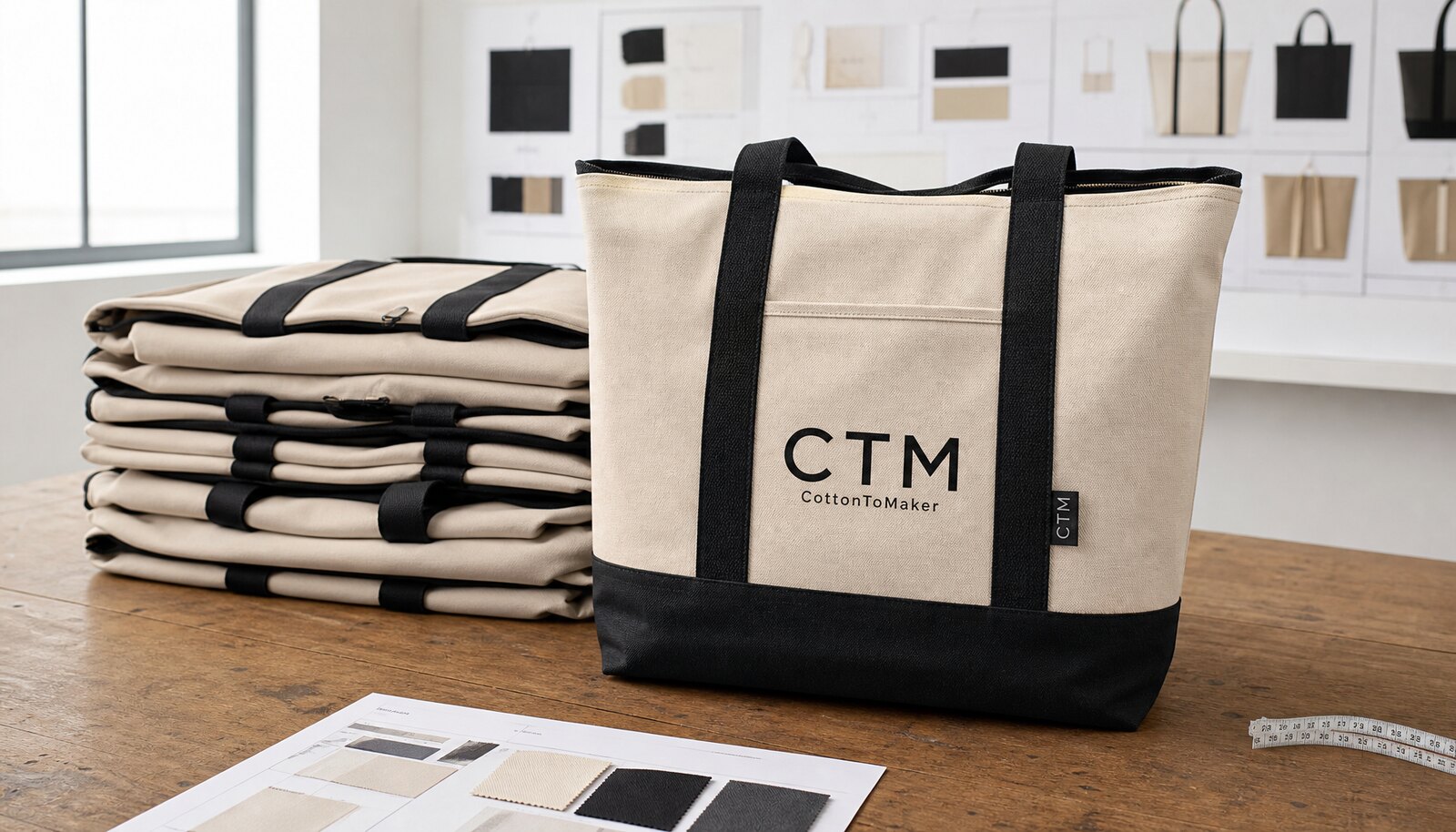
Why subscription-box conference bags need a tighter spec than a standard tote
A canvas conference bag for a subscription box is not just a printed carryall. It has to survive box packing, courier handling, retail presentation, and a customer who may reuse it for travel or work. That means the bag spec must balance structure, print quality, weight, and pack efficiency. Buyers often start with a logo idea and stop there; the result is a quote that looks cheap on paper but fails once the first full carton is packed.
The right sourcing plan starts with use case. If the bag is meant to hold a notebook, brochure set, sample kit, and one or two small products, the bag needs enough body to stand up in packing and enough seam strength to avoid distortion. For premium subscription boxes, the bag is part of the unboxing experience, so print sharpness, handle feel, and finishing details matter as much as the raw fabric cost.
- Define the load: document what goes inside the bag and estimate total packed weight.
- Separate the marketing brief from the manufacturing spec: they are not the same document.
- Choose a bag style that matches the box format, not just the brand mood board.
Fabric weight, structure, and finishing choices that affect quote accuracy
For most conference and subscription-box programs, 12 oz canvas is the practical baseline. It gives enough body for a premium feel without becoming overly heavy or expensive to ship. If the bag is expected to carry a tablet or thicker inserts, 14 oz canvas is usually the safer option because it holds shape better and reduces the chance of limp side panels. Lightweight 8 oz canvas can work for low-cost inserts, but it is easier to wrinkle, shows structure problems faster, and often looks weaker than the brand expects.
The finish matters as much as the base fabric. A bleached or enzyme-washed canvas can soften the hand feel, while a coated or densely woven cloth can improve structure and print clarity. If the design includes a zipper, gusset, or lining, each of those adds cost and may change the feel of the bag more than a buyer expects. Quote requests should state fabric weight, weave preference, lining requirement, and whether a stiffener or board insert is part of the design or only part of the sample photo.
- Use 12 oz as a common comparison point, then move up or down only if the load or brand position requires it.
- State whether the bag should stand upright on its own or simply carry flat inserts.
- If you need a premium hand feel, ask for fabric finish options rather than accepting a default canvas.
Choosing the right decoration method for a private-label program
Decoration choice drives both cost and repeatability. For simple logos, 1-2 color screen printing is usually the most economical route and gives consistent results on canvas when the artwork is clean. It also tends to be easier to compare across suppliers because the production variables are narrower. If the logo has fine details or multiple colors, digital printing or transfer may solve the artwork problem, but the buyer should understand the tradeoff in feel, durability, and unit price.
If the bag is going into a subscription box, decoration has to survive friction from folding, inserts, and warehouse handling. A print that looks sharp on a flat sample can crack or distort if applied to a soft fabric or placed too close to a seam. Side labels, woven tags, and embossed patches are useful for private-label programs because they create a stronger branded signal without forcing a complex print setup. In many cases, the best quote comparison is not one decoration method versus another, but a clean screen print plus a woven label versus a more expensive all-over decoration approach.
- Keep artwork to one or two colors unless the brand value justifies a more complex process.
- Place the logo on a flat panel with enough clearance from the seam and handle stitch line.
- Specify whether the branding must stay visible after the bag is folded into the subscription box.
How to compare supplier routes without comparing bad quotes
A low quote means little unless you know what supplier route produced it. A direct factory can be the best fit when you need a stable private-label program, strict control over materials, and better unit economics at volume. The tradeoff is that the buyer must manage technical clarity: sample stages, artwork approval, and packing details need to be explicit. A trading company can be useful if you need access to multiple factories or smaller order flexibility, but you should verify who owns the technical spec and who is responsible when something changes between sample and shipment.
For urgent launches, a domestic converter or local source may make sense even if the unit cost is higher. That route can reduce risk when the box calendar is fixed and missing the ship date would damage the entire campaign. What matters is not simply the origin of the bag, but whether the supplier route aligns with your control needs, budget, and replenishment pattern. For a private-label subscription program, repeatability is usually more important than shaving a few cents off the first order.
- Direct factory: best for stable repeat orders and tighter material control.
- Trading company: useful for smaller starts or when you need sourcing flexibility.
- Domestic converter: practical for pilot runs or launch deadlines that cannot move.
A practical landed-cost comparison for subscription-box buyers
Buyers often compare only ex-factory price and miss the full landed-cost picture. For a subscription box, the bag may need packaging inserts, individual polybags, barcodes, carton labels, and sometimes pre-shipment folding instructions so it fits the fulfillment workflow. Those small items can change the real unit cost enough to make a cheaper supplier route more expensive once freight, packing labor, and receiving time are included.
The cleanest way to compare quotes is to normalize them against the same service scope. Ask each supplier to quote the same fabric weight, same decoration method, same packing format, and same Incoterm. Then build a comparison that includes freight estimate, duties, local handling, and any warehouse labor caused by poor packing. If one supplier offers a lower ex-factory price but ships loose-packed bags that require repacking, the apparent savings can disappear quickly.
- Compare total landed cost, not just factory unit price.
- Include packaging labor if the bag must be folded a specific way for the box line.
- Separate one-time sample or tooling cost from recurring production cost.
MOQ logic, sample stages, and how to avoid expensive redesigns
MOQ should be matched to both material risk and demand confidence. A private-label buyer with a seasonal subscription box may want a smaller pilot order to test fulfillment behavior, while a stable recurring program can justify a higher MOQ in exchange for better pricing. The important point is that MOQ should be tied to the whole production setup, not just the bag body. Custom zippers, labels, dye lots, and print screens can each carry their own thresholds, so the quote must state whether the MOQ applies to the full order or only to the decoration run.
Sample stages should be treated as decision gates, not courtesy shipments. A blank sample shows material and construction, but it does not prove the final look. A pre-production sample using final fabric, final print, and final packing is the one that should trigger bulk approval. If the supplier skips that stage, the risk moves into mass production where the cost of fixing the error is much higher. The fastest way to save money is to stop redesign at the sample stage instead of correcting 2,000 units later.
- Ask whether the MOQ is per color, per print design, or per PO.
- Require a pre-production sample with final fabric and final trim.
- Do not approve bulk on a blank sample if the decoration or packing is still uncertain.
Quality control points that matter before shipment
For canvas bags, most failures are visible if you know where to look. Stitch tension around the handle joins, seam alignment at the gusset, print registration, and the quality of the folded top edge are all easy to inspect and directly affect how the buyer or end customer perceives the product. If the bag includes a zipper, the slider action and tape alignment should be tested, not just visually accepted. The best QC process is simple, repeatable, and tied to the approved sample rather than subjective judgment at final inspection.
Acceptance criteria should be set before production, not negotiated after a defect appears. Define the dimensional tolerance, allowed stitch flaws, print shift limits, and carton count accuracy. If a supplier cannot work to those thresholds, that is a sourcing issue, not just an inspection issue. For subscription-box programs, consistency matters because the bag may be packed alongside other branded items where mismatch is immediately visible to the customer.
- Inspect handle reinforcement first; it is one of the highest-stress failure points.
- Compare print registration and color against the signed sample, not the artwork file.
- Open a carton sample and verify folding consistency, barcode placement, and count accuracy.
Packing instructions that protect the bag and the box workflow
Packing is part of the product. A poorly folded canvas bag can create bulk inside the subscription box, warp the insert layout, or increase packing labor at the fulfillment center. The quote should specify whether each bag is folded flat, inserted into a polybag, grouped by dozen, or packed loose with tissue or card support. If the bag has a zipper, strap, or structured insert, the folding method can change how the final box closes and whether the lid bulges.
A good packing spec also reduces receiving disputes. State the carton count, outer carton dimensions, net and gross weight, and any carton marks required by your warehouse or 3PL. If the buyer plans to ship to multiple fulfillment nodes, the supplier should know whether the cartons need scannable labels, country-of-origin marks, or carton IDs for lot tracking. These details sound minor until a warehouse rejects a shipment because the cartons are inconsistent or unlabelled.
- Choose a fold pattern that fits the box cavity, not just the factory’s standard method.
- Specify whether bags need individual polybags for cleanliness or moisture protection.
- Require carton counts and carton dimensions in the quote for freight planning.
Lead time, freight risk, and launch planning
Standard lead time for a repeat-order canvas program is often 28 to 45 days after sample approval, but that only works when the spec is already stable. Artwork revisions, fabric sourcing changes, and packaging edits are the common reasons a schedule slips. Buyers should treat every change after sample approval as a time risk and track it separately. If the program is tied to a subscription launch, the production schedule should include margin for inspection, export booking, transit, and inbound receiving.
Freight risk also changes the sourcing decision. A bag that seems cheap at factory level can become less attractive if it takes more cubic space because it was overbuilt or packed inefficiently. For bulky items like canvas bags, dimensional weight matters. A slightly tighter fold, a better carton pack plan, or a lighter but still suitable fabric weight can produce a better landed cost than a simple unit-price reduction. That is why sourcing should always look at the bag, the carton, and the shipping plan together.
- Build schedule buffer for sample approval, inspection, and freight booking.
- Track carton size and packed density because they affect transportation cost.
- Freeze artwork and packing instructions before bulk release.
The RFQ structure that gets comparable quotes
A useful RFQ is not long, but it is precise. It should give the supplier enough detail to quote the same product without guessing, and enough room to show optional pricing where the buyer may want to trade up or down. For canvas conference bags in subscription boxes, the best RFQ usually includes size, fabric weight, decoration method, handle spec, closure type, packing method, target quantity, destination term, and sample requirements. If any of those are missing, the factory will fill the gap with assumptions, and the quotes will not be comparable.
The most important discipline is to distinguish mandatory requirements from optional upgrades. For example, a buyer may require 12 oz canvas, one-color screen print, woven label, and flat folding, while asking for alternate pricing on 14 oz canvas or a zipper closure. That gives procurement a real comparison without forcing suppliers to guess the preferred base spec. It also helps merchandising teams understand where the price jumps are coming from, which is essential when the budget is tied to a subscription box margin model.
- State one base spec and one optional upgrade path, not five loosely defined ideas.
- Request separate prices for sample, tooling, and production.
- Ask for the same quote format from every supplier so comparisons stay clean.
Specification comparison for buyers
| Supplier option | What to verify | Commercial advantage | Buyer risk to control |
|---|---|---|---|
| Direct sewing factory | fabric swatch, approved sample, seam close-ups, logo test photos, packing pilot, and final inspection evidence | Better sample-to-bulk control and faster production feedback | May be weaker on export paperwork or branded packing unless checked early |
| Trading company | Factory name, production photos, trim-source proof, and who owns QC decisions | Can coordinate small mixed orders and extra services | Markup can hide real factory capability and slow defect decisions |
| Specialized bag workshop | bag size, gusset, handle drop, seam allowance, stitch density, reinforcement patch, and loading expectation | More practical for detailed construction, trims, and repeat programs | Capacity may be limited during peak seasons |
| Low-price general supplier | 8-12 oz cotton canvas, 120-220 gsm cotton, recycled cotton, or blended fabric selected by use case and target price | Useful for simple promotional runs with loose specs | Material downgrades, weak packing, and vague inspection scope can erase savings |
| Retail-ready supplier | fold method, inner bundle, carton count, carton mark, moisture protection, SKU separation, and warehouse receiving needs | Can handle labels, SKU separation, carton marks, and receiving rules | Higher unit cost must be compared against reduced warehouse work |
| Compliance-focused supplier | Fabric records, labeling review, test plan, and production traceability | Safer for retail programs and repeat brand orders | Documentation claims need evidence, not only sales language |
| Local sample room plus bulk factory | Signed sample, bulk factory handoff, first-piece photos, and deviation owner | Good for complex branding before large production | Sample room quality may not match bulk line unless handoff is controlled |
Buyer checklist before sampling
- Specify finished size, fabric weight, handle length, closure type, and decoration area before requesting quotes.
- Send one approved artwork file with color references, logo placement, and the exact print method you want quoted.
- Ask for a pre-production sample based on the final structure, not only a blank fabric swatch.
- Require carton quantity, inner pack format, and outer carton dimensions in the quote.
- Set pass/fail limits for stitching, print registration, and dimension tolerance before mass production starts.
- Confirm whether the supplier is quoting FOB, EXW, or DDP so landed cost comparisons are valid.
Factory quote questions to send
- What is the exact fabric weight in oz or GSM, and does it include coating, lining, or washing that changes the hand feel?
- What decoration methods are quoted separately, and what is the unit price break by color count and print area?
- What is the MOQ for the bag body, the print version, and any custom trim such as zipper pullers or labels?
- What sample stages are included, and do you provide a pre-production sample with final materials before bulk approval?
- What are the standard carton pack quantities, carton sizes, and gross weight for freight planning?
- What lead time applies after sample approval, and what items can extend it such as special dyeing or custom hardware?
- What QC documents can you share, such as measurement sheet, AQL standard, in-line photo report, or final inspection checklist?
- What Incoterm is quoted, and which costs are excluded, such as local charges, testing, labels, or export documents?
Quality-control points to confirm
- Finished dimensions: set an acceptable tolerance before production; for most tote-style bags, a practical starting point is +/- 0.5 to 1.0 cm on key panels.
- Fabric verification: confirm the actual fabric weight against the approved spec and reject substitution that makes the bag too thin or overly stiff.
- Print placement: define a centered logo zone and allowable shift so the mark does not drift toward seams or handles.
- Stitch density and reinforcement: inspect bar-tacks, handle joins, and stress points for skipped stitches, loose threads, or uneven back-tacking.
- Zipper or closure function: run every sample through repeated open-close cycles and reject any catch, wave, or rough slide feel.
- Color consistency: compare bulk production against the approved lab dip or Pantone target under daylight and warehouse lighting.
- Packing accuracy: verify that inner packs, barcode labels, carton marks, and carton counts match the purchase order before shipment.