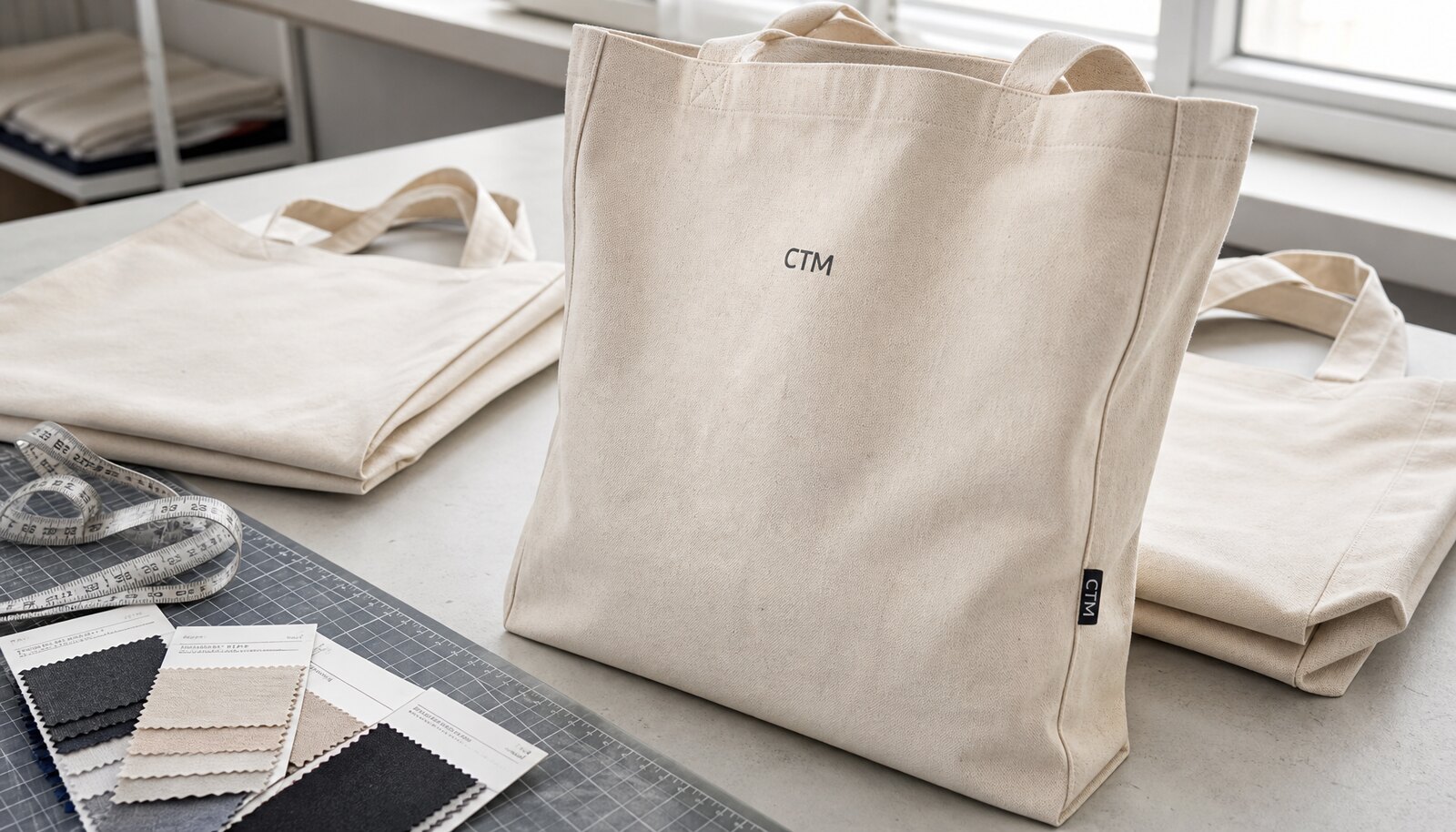
Why subscription box buyers need a tighter canvas spec
Canvas conference bags for subscription boxes are packaging components first and promotional items second. That distinction matters because the bag has to fit the insert plan, pack quickly, protect the logo, and arrive in a repeatable condition. A tote that looks attractive on a table can still fail the program if it is too bulky to fold, too thin to keep its shape, or too inconsistent for a co-packer to insert at speed.
The buyer’s job is to define the finished size, flat size, handle drop, fold method, and pack format before price shopping begins. If those items are left open, suppliers will quote different assumptions and the comparison becomes meaningless. One factory may quote a looser bag with lower sewing time; another may quote a more structured bag that fits the box properly but costs more. Without a shared spec, lower price can simply mean weaker performance.
Subscription programs also expose drift across reorders. Shade changes in natural canvas, small shifts in print placement, and small dimensional changes are all tolerable in retail promotional handouts but can become unacceptable in a controlled box program. When the bag is part of a launch sequence, the buyer needs the same bag to arrive every time, not just a similar-looking tote.
The practical rule is simple: write the bag as if it were a packaging insert. State the box or tray size, the folded footprint, the logo zone, the acceptable seam finish, and the carton receiving format. That is what allows factories to quote against the actual use case instead of against a generic tote sample.
If the bag will later be reused outside the box, then durability matters more. In that case, the spec should explicitly raise the bar on canvas weight, reinforcement, and print durability. Buyers often under-spec reusable bags because they are focused on first-pass insert cost, then discover the customer experience problem later. The correct tradeoff depends on how long the bag needs to stay in service after unboxing.
- Treat the bag as a packaging component, not a standalone promo item.
- Set the finished size and fold footprint before asking for price.
- Use one approved sample as the reference for size, print position, and fold method.
- Decide whether the bag is a short-life insert item or a reusable brand asset before choosing GSM and finish level.
Fabric weight, weave, and finishing choices that change cost
Fabric weight is the first major commercial lever. For lighter subscription insert programs, canvas around 200 to 240 GSM can work, but the body will feel softer and may collapse during packing. The common middle ground is roughly 280 to 340 GSM: enough structure for a cleaner silhouette, better print definition, and less risk that the bag looks flimsy when the customer opens the box. Heavier fabric can feel more premium, but it raises material cost, sewing effort, and freight weight.
Weave quality matters almost as much as GSM. A tighter plain weave usually prints cleaner and shows less fuzzing at the logo edges. A looser weave can give a rustic look, but it also makes ink spread, seam puckering, and thread slubs more visible. If the supplier can identify the yarn type, ask for it. A smoother yarn and more consistent weave usually help the print look sharper and reduce the need for heavy ink laydown.
Natural unbleached canvas is usually the safest procurement choice for subscription programs because it reduces dye-risk and is easier to repeat on reorders. Dyed fabric is fine when the brand needs a specific color, but buyers should ask whether the fabric is pre-dyed in rolls or dyed after weaving. Pre-dyed rolls are often more stable for production planning, while dyed-after-weaving approaches can add variability and delay. If the supplier says the reorder will be “same as sample,” ask for the exact lot reference or color standard used on the sample.
Finishing changes both appearance and cost. Basic hems and standard topstitching are inexpensive and fast. Reinforced handles, boxed corners, gussets, lining, or more elaborate pressing improve structure but increase sewing minutes and create more defect points. A factory can quote a bag that looks similar at first glance while quietly changing one of these items. Buyers should therefore request a line-by-line build description, not a one-line photo quote.
As a rough buying guide, light canvas is best for launch tests and low-cost insert programs, midweight canvas is the safest general-purpose range, and heavy canvas should be reserved for higher-touch brand items or long-use bags. The right answer is not “the heaviest bag you can afford.” It is the lightest build that still passes the kitting, presentation, and reuse standard you actually need.
- 200 to 240 GSM: lower cost, softer structure, suitable for light inserts or pilot runs.
- 280 to 340 GSM: balanced option for most subscription box and brand programs.
- Above 340 GSM: premium hand feel, but higher freight and packing cost.
- Tight plain weave usually prints cleaner than a looser rustic weave.
- Ask whether dyed canvas is pre-dyed in roll form or changed after weaving; the answer affects repeatability.
Pick the sourcing route before you ask for price
A direct factory, a trading company, and a local decorator all solve different problems, and they should not be compared as if they were the same source. A direct factory is usually the best route when you need one supplier to own fabric purchase, cutting, sewing, print, and carton packing. That structure is the cleanest fit for a repeat subscription SKU because there is one accountable party if the bag misses spec.
A trading company can be helpful when the program includes more than the bag itself, such as inserts, labels, printed cards, or mixed packaging items. The benefit is convenience: one RFQ, one shipment coordination point, one commercial contact. The tradeoff is less visibility into who actually makes what. If the margin is buried across multiple line items, the lowest headline price may not be the best procurement outcome.
A local decorator or converter can be a good pilot option when time is tight or the order is small. The risk is that the blank bag source, shade, and size may change from batch to batch unless the supplier has a locked blank program. That is acceptable for a test run but less acceptable for a recurring box where consistency matters more than speed.
The first question should be about process ownership, not price. Who buys the fabric? Who cuts it? Who prints it? Who packs it? Who checks it? If the supplier cannot answer that clearly, the quote is too early for a serious comparison. The second question is about repeat order stability. Can the same build be repeated next season without reworking the spec? If the answer is unclear, the risk sits with your fulfillment team later.
For subscription box buyers, the safest route is usually the one that reduces change control. More vendors can create more flexibility, but it also creates more points where a small variation becomes a launch problem. Single-source control often wins when the bag must be exactly the same across monthly or quarterly shipments.
- Direct factory: best control for repeat orders and cleaner accountability if defects appear.
- Trading company: useful for bundled sourcing, but verify process ownership and hidden markups.
- Local decoration route: fast for pilots, weaker for long-term consistency unless blank supply is locked.
- Ask who owns fabric purchase, cutting, sewing, print, packing, and final inspection.
Decoration method should follow artwork and volume
The logo method should be chosen from artwork complexity, order volume, and how the bag will be handled in the box. Screen print is usually the default for simple one- to three-color logos on canvas because it gives stable coverage and a lower per-unit cost once setup is absorbed. It is the easiest method to quote cleanly, and it usually fits repeat orders well.
Transfers are useful when the artwork has fine detail, small text, gradients, or a run that is too small to justify screen setup. The tradeoff is durability and hand feel. Some transfer finishes hold up well; others can feel more plasticky or show stress when the bag is folded tightly. If the canvas is textured, the transfer also needs to bridge the surface without looking patchy.
Embroidery can create a premium feel, but it is not automatically better. On lighter canvas, dense stitching can pucker the fabric or create distortion around the logo. It also adds digitizing and setup time. Woven labels and sewn patches are good alternatives when the brand wants visible identity without heavy ink coverage or when the artwork is too simple to justify a full print run.
The procurement mistake is asking which method is best in theory. The better question is which method survives the actual use case. Will the bag be folded into a box, opened by a customer, and then reused? If yes, the fold line becomes part of the decoration environment and the logo needs to look good after compression. If the bag is only a low-cost insert, then the cheapest method that passes the visual standard may be enough.
For seasonal campaigns, a low-MOQ decoration route can be worth the higher per-unit cost because it gives flexibility. That is especially true if the design changes frequently or if several versions will run in the same year. Buyers should compare not just the sample appearance but the long-term cost of setup, repeatability, and rejected units.
As a rule, screen print is the best starting point for most simple logo orders. Transfer works when detail or short-run flexibility matters. Embroidery and sewn branding are more about presentation and perception than raw cost efficiency. The right choice is the one that fits the artwork, the box format, and the order volume without creating downstream pack-out problems.
- Screen print: best for simple logos and volume pricing.
- Transfer: better for detail or short runs, but test for fold durability.
- Embroidery: premium appearance, higher cost, and potential fabric distortion.
- Woven or sewn label: strong for branding without heavy ink coverage.
- Test the logo at the final fold line if the bag ships compressed in a box.
How to compare quotes without missing hidden cost
A usable quote must separate the bag body, decoration, packaging, and freight assumptions. If those are blended into one number, you cannot tell whether one supplier is cheaper or just leaving items out. Ask for the canvas weight, handle material, logo method, inner pack format, and master carton assumptions on the same sheet. The goal is not just a lower price; the goal is a comparable price.
Quantity breaks deserve close attention. A quote at 500 units is useful for launch planning, but it should not be treated as the real commercial answer if the forecast is 3,000 pieces per quarter. Ask for pricing at multiple volumes and for each meaningful variant: one color, multiple colors, one logo version, multiple logo versions, and any special pack format. A supplier who only quotes one quantity is often not giving enough information to support procurement.
Sample charges and revision fees are another common blind spot. Some factories quote an attractive production price but charge repeatedly for proof rounds. Others include one sample and then charge for remake shipping, extra revisions, or artwork adjustment. Ask what is included in the development sample, what changes are free, and what changes trigger a new setup fee. If those points are not written down, the buyer is comparing incomplete offers.
Subscription box programs also need to account for downstream labor. A bag that is cheaper at the factory but awkward to fold, count, or insert can cost more at the co-packer or 3PL. That cost rarely shows up on the supplier quote, yet it affects the real landed cost. If your fulfillment team spends more time handling one supplier’s pack format, the lowest factory number is not the lowest total cost.
The cleanest buying worksheet has one column for the factory unit price and separate columns for decoration, packaging, freight, duty if relevant, sample cost, and estimated receiving labor. That format makes hidden cost visible and prevents a low headline price from winning by omission.
In other words, compare the product, not just the invoice line. The best quote is the one that tells you exactly what is included, what is excluded, and what changes the price if the program scales or the design changes.
- Require separate pricing for fabric, sewing, decoration, packaging, and freight assumptions.
- Ask for price breaks at multiple quantities, not just one MOQ number.
- Treat omitted packaging as a hidden labor cost, not a free saving.
- Include sample charges, revision fees, remake policy, and receiving labor in the quote comparison.
Use a decision matrix before you send the RFQ
Procurement teams move faster when the sourcing route, decoration method, and pack format are chosen before the RFQ goes out. A simple decision matrix helps avoid quote drift. If the order is under roughly 500 units, with changing artwork and no long-term SKU commitment, a stock blank bag with local decoration or a low-MOQ transfer route is usually the least risky starting point. If the order is 500 to 3,000 units and the logo is simple, screen print on a controlled canvas spec is often the best balance of cost and consistency. If the bag is part of the brand experience and must look retail-ready, a fully custom build with tighter tolerances is usually worth the extra cost.
The same logic applies to packing. If the bags are only being handed out at an event, loose or simple pack formats may be fine. If they are going into a subscription box, the pack must support fast receipt, predictable folding, and minimal damage in transit. In that setting, a counted bundle or individual polybag can be the smarter choice depending on how the 3PL receives inventory. Ask the warehouse team what format they want before you decide the spec.
Here is the practical decision rule: start with volume, then artwork, then pack-out. Low volume and changing designs favor flexible decoration methods. Stable volume and simple logos favor screen print. Premium positioning favors a stronger build and stricter QC. If a supplier pushes a build that does not match those basics, they are selling their preferred process, not solving your sourcing problem.
This matrix is also a useful internal approval tool. Finance wants to know why one quote is higher. Operations wants to know whether the bag will slow kitting. Marketing wants to know whether the logo looks premium enough to support the box experience. A decision matrix makes the tradeoff visible instead of burying it in email threads.
- Under 500 units with changing artwork: consider stock blank plus local decoration or a low-MOQ transfer route.
- 500 to 3,000 units with simple artwork: screen print on controlled canvas is often the cleanest fit.
- Premium brand use: choose a more structured build and stricter QC, even if unit cost rises.
- Ask the warehouse how it wants the bag packed before finalizing the RFQ.
Sample approval should lock the production standard, not just the look
A sample that only looks good is not enough. For canvas conference bags used in subscription boxes, the sample has to prove the measured size, the decoration method, the fold behavior, and the packing format. The sample should be tested exactly the way bulk goods will be handled. If the final order will be folded into a specific box or tray, test that configuration, not just a flat display shot.
The most useful sample process usually has two stages. A development sample checks style, dimensions, and basic structure. A pre-production sample should use the intended bulk fabric, final print method, and final packing approach. Some buyers also retain a sealed reference sample or top-of-production sample as the future comparison point. That is especially useful for reorders, because it reduces arguments over what “same as approved” actually means.
The sample needs measurable acceptance criteria. Do not approve by eye alone. Measure width, height, gusset, and handle drop. Confirm the distance from the print to the edge or seam. Check whether the bag closes and folds as expected. If the factory proposes a substitute fabric lot for the sample, ask whether that lot is representative of the bulk. A prettier sample made from better material is not a valid approval for a weaker production run.
It also helps to perform a real box-fit test. Put the folded bag into the actual insert space and open it the way a customer will open it. This reveals whether the logo survives compression, whether the fabric rebounds too much, and whether the pack format slows kitting. This is one of the few checks that saves time later and can be done before production begins.
If the supplier offers a pre-production sample, ask whether the same sewing line and print setup will be used for bulk. If not, the sample is only directional. Keep that distinction clear in the file so the approval does not become a false promise later.
- Measure body width, height, gusset depth, and handle drop on the approved sample.
- Check logo placement against a fixed seam or edge reference, not by eye alone.
- Test the folded bag in the real box or carton format before releasing bulk production.
- Keep the PPS or sealed sample as the reference for future reorders.
QC thresholds that prevent avoidable claims
Quality control should focus on the defects that actually break the program. For these bags, that usually means handle strength, seam quality, print placement, and packing accuracy. A bag can survive a cosmetic flaw, but it cannot survive an unreliable handle or a badly packed carton. Start with the parts that create claims, not with generic inspection language.
Define pass-fail thresholds before the order starts. For example, state the measurement tolerance you will accept, the maximum allowed print shift, and the defect categories you will treat as major versus minor. Natural canvas often shows slight shade variation, so set the acceptable range in writing. If the buyer and supplier have different defect standards, the shipment can be technically complete and still be unusable for the subscription workflow.
Ask for at least one first-article check against the approved sample and, for larger runs, a mid-production inspection. That helps catch stitch drift, print misregistration, or packing changes before the entire order is finished. For recurring programs, carton-level inspection is worth specifying because packing mistakes often create the most expensive receiving disputes. The carton may be right in quantity but wrong in count, fold, or label placement.
The practical QC question is always the same: what is measurable, and what failure would cost the most? For most canvas conference bag programs, the answer is measured dimensions, handle reinforcement, logo quality, odor, loose threads, and carton accuracy. Those should be in the QC checklist before bulk begins, not after a problem surfaces.
If the supplier gives you only a general promise of “good quality,” that is not enough. Good quality must be described as a measured standard with a written acceptance range and a clear remake policy if the lot misses it.
- Check handle anchors and top hems first because they carry the load.
- Judge logo alignment and opacity under normal warehouse lighting, not only under bright inspection lamps.
- Pre-approve natural canvas shade variation within a defined tolerance band.
- Define major/minor defect thresholds and carton count tolerances before production begins.
Packing for subscription boxes is a separate engineering step
Packing is where good bags become bad logistics if the format is not planned. Subscription box teams need a fold that is repeatable, a count that is easy to verify, and carton dimensions that support the receiving process. If the bag is too loosely folded, it wastes carton space and can complicate insertion. If it is over-compressed, wrinkles and logo distortion can show up when the customer opens the box. The packing spec should therefore be treated as part of the product spec.
Ask the factory to state the exact fold sequence, bundle count, polybag use, and carton count per outer carton. Then confirm whether the carton dimensions fit the receiving floor plan or the co-packer’s shelving. If you use barcodes or SKU labels, the carton art should include those requirements now rather than later. That saves receiving friction and reduces the chance of rework at the dock.
Packing format also affects freight. Heavier canvas increases gross weight quickly, and small changes in carton size can change freight efficiency enough to matter on a recurring program. A slightly better fold can lower cube and reduce shipping cost; a slightly worse fold can do the opposite. This is why a bag that looks only marginally different on a quote can produce a different landed cost once the pack format is added.
If the bags are going into a mixed subscription kit, coordinate the bag pack with the rest of the components. The best format is the one your warehouse can receive, count, and insert without extra handling. Do not let the factory choose the pack format solely because it is easiest for their line. The correct format is the one that best fits the buyer’s downstream process.
For some programs, an individual polybag is worth the extra material because it preserves cleanliness and makes counts easier. For others, a counted bundle is more efficient because the fulfillment team can process it faster. Ask the warehouse team which one supports the real workflow before the PO is issued.
- Lock the fold width to the box insert plan before PO release.
- Specify whether each bag goes in an individual polybag or a counted bundle.
- Require carton markings that match warehouse receiving and SKU control needs.
- Include carton dimensions, net weight, gross weight, and barcode needs in the packing spec.
Lead time risk is usually in sampling, not sewing
Many buyers focus on the quoted production lead time and underestimate the sample loop. In practice, the largest delay is often artwork correction, sample revision, or packing confirmation. A factory may quote 20 to 30 days for bulk production, but if the print proof changes twice or the carton specification is still open, the calendar slips before fabric is even cut. For a subscription launch, front-end approval time is the real schedule risk.
It is better to break the project into stages: RFQ and supplier selection, artwork submission, sample development, pre-production sample approval, material booking, production, final inspection, and dispatch. Each stage can move the ship date if no one owns it. Procurement teams should ask the supplier which stage usually causes the longest delay for this exact bag, not just what the overall lead time is.
Capacity risk is often in print scheduling rather than sewing. Canvas bag lines are common, which can make them look easy to secure, but multiple colors or multiple SKU versions can compete for print time and setup time. Ask whether the order will run on one line or several and whether the fabric or packaging can be reserved in advance. A supplier that can explain the sequence from booking to carton loading is usually more reliable than one that only quotes a ship date.
For repeat orders, ask whether the same fabric specification is available for reorders or whether a substitute is likely. That question matters because many programs assume repeatability that was never explicitly promised. If your subscription schedule is fixed, the supplier needs to know that the reorder window is part of the commercial requirement.
The safest lead-time plan is the one that includes sample approval and material booking from day one. If those steps are left outside the schedule, the buyer is not planning a launch; they are hoping for one.
- Include sample approval time in the launch schedule, not only bulk production time.
- Confirm whether print setup or sewing is the bottleneck for your artwork.
- Reserve fabric and packaging early if the program is tied to a fixed subscription ship date.
- Map the order into stages so delays are visible before the PO is issued.
Specification comparison for buyers
| Spec decision | Recommended option | When it fits | Buyer risk to check |
|---|---|---|---|
| Direct factory with in-house print | Best for repeat orders when one supplier controls fabric, sewing, print, carton packing, and final inspection | You need a stable subscription SKU and want one accountable source for spec control | Confirm whether the factory owns the canvas purchase, cutting, sewing, decoration, and carton packing or is only coordinating outside vendors |
| Trading company bundling multiple plants | Useful when the program needs mixed trims, multiple pack items, or a fast RFQ start | You are still validating the program and want one quote that includes the bag, inserts, and ship-ready packing | Check process ownership, defect handling between suppliers, and whether margin is hidden in the line items |
| Stock blank bag plus local logo application | Good for urgent pilots or very low launch volume | You need to test market response before committing to a full custom build | Verify stock depth, blank-bag shade variation, print placement limits, and whether local decoration changes landed cost more than expected |
| Fully custom bag from a woven bag specialist | Best when the bag is part of the brand experience and must match a strict spec | You want fixed dimensions, controlled GSM, cleaner finishing, and a retail-grade presentation | Insist on measured tolerances, shrinkage allowance, seam construction photos, and an approved pre-production sample |
| Low-MOQ digitizing or transfer route | Appropriate for small subscription runs or frequent design changes | Artwork changes often or you need several seasonal versions in one year | Check setup fees, color limits, hand feel, and whether the decoration survives folding and shelf storage |
| Screen print on medium-heavy canvas | Strong choice for simple logos and good unit cost at scale | Artwork is one to three solid colors and the run is large enough to absorb screen setup | Verify ink opacity, cure quality, rub resistance where relevant, and registration on textured canvas |
| Woven label or sewn patch branding | Best for a premium, understated look with less ink coverage | You want the bag to feel more retail than promotional | Check label edge finish, sew-down consistency, thread color, and extra labor added to the sewing line |
| Standard carton pack to subscription-ready bundle pack | Preferred when bags ship directly into kit assembly or fulfillment | Your 3PL or co-packer needs counted cartons and a fixed folding method | Confirm polybag use, bundle count, carton dimensions, and whether the pack format changes labor or freight cost |
Buyer checklist before sampling
- Confirm the bag’s finished dimensions against the actual subscription box insert space, then allow for a realistic folding tolerance.
- Decide the fabric weight, weave, and finish before comparing quotes; do not let suppliers quote different build standards as if they were equivalent.
- Send vector artwork with Pantone targets or at least a controlled color reference, and state whether the logo will be screen printed, transferred, embroidered, or added as a label.
- Match the decoration method to the artwork complexity and annual volume, not just to the appearance of the sample.
- Approve a sample only after measuring the bag, checking print placement, reviewing seam quality, odor, and fold behavior, and packing it in the real box or carton format.
- Write the fold style, bundle count, polybag spec, and carton count into the PO so the warehouse receives the same format it was quoted.
- Make the lead time include fabric booking, sample approval, production, packing, and export or domestic freight booking.
- Require a quote breakdown for bag body, decoration, packaging, and freight assumptions so landed cost can be compared on the same basis.
Factory quote questions to send
- What exact canvas weight, weave type, and shrinkage allowance are you quoting for this bag, and what tolerance do you guarantee after sewing and pressing?
- Is the logo price included in the bag price, or is there a separate setup fee, screen fee, digitizing fee, plate fee, or color-change fee?
- What is your MOQ by color, by artwork version, and by pack format, and how does unit price change at 500, 1,000, and 3,000 pieces?
- What folding method, inner bundle count, polybag specification, and master carton count do you recommend for subscription box fulfillment?
- What are your sample stages, sample charges, and revision rules, and what changes trigger a new setup fee?
- What lead time do you give after artwork approval, and which step most often delays shipment for this exact bag?
- What are your standard measurement tolerances, stitching tolerances, and acceptable print placement variance?
- Can you provide carton dimensions, net weight, gross weight, barcode placement, and carton label data before order confirmation for freight planning and warehouse receiving?
- What is your remake policy if the bulk bags miss the approved sample on size, print placement, or packing count?
- If I order multiple SKUs or seasonal colorways, how do you price each SKU variation and how do you separate the cost by print, trim, and pack changes?
Quality-control points to confirm
- Canvas GSM must match the approved spec before bulk cutting starts, with no unapproved fabric substitution.
- Finished width, height, gusset depth, and handle drop should stay within the agreed tolerance band after sewing and final pressing.
- Handle length, handle reinforcement, seam stitch density, and top hem width should be consistent across the lot.
- Print placement should be within the approved edge reference points; ink should be opaque enough that the logo reads clearly under normal warehouse lighting.
- Natural canvas shade variation must stay within the buyer’s pre-approved range; do not accept a meaningfully darker or lighter lot without sign-off.
- Seam strength at the handle anchors, side seams, and base corners should pass a pull test without tearing, twisting, or visible distortion.
- Folding, polybag count, bundle count, and carton quantity must match the packing list exactly.
- Finished bags should be clean, odor-free, and free from oil marks, loose threads, broken stitches, needle damage, and visible press marks.
- Carton markings, SKU labels, and barcode placement should be correct and readable at receiving.
- For recurring programs, keep a sealed approved sample or top-of-production sample to compare reorder lots against.