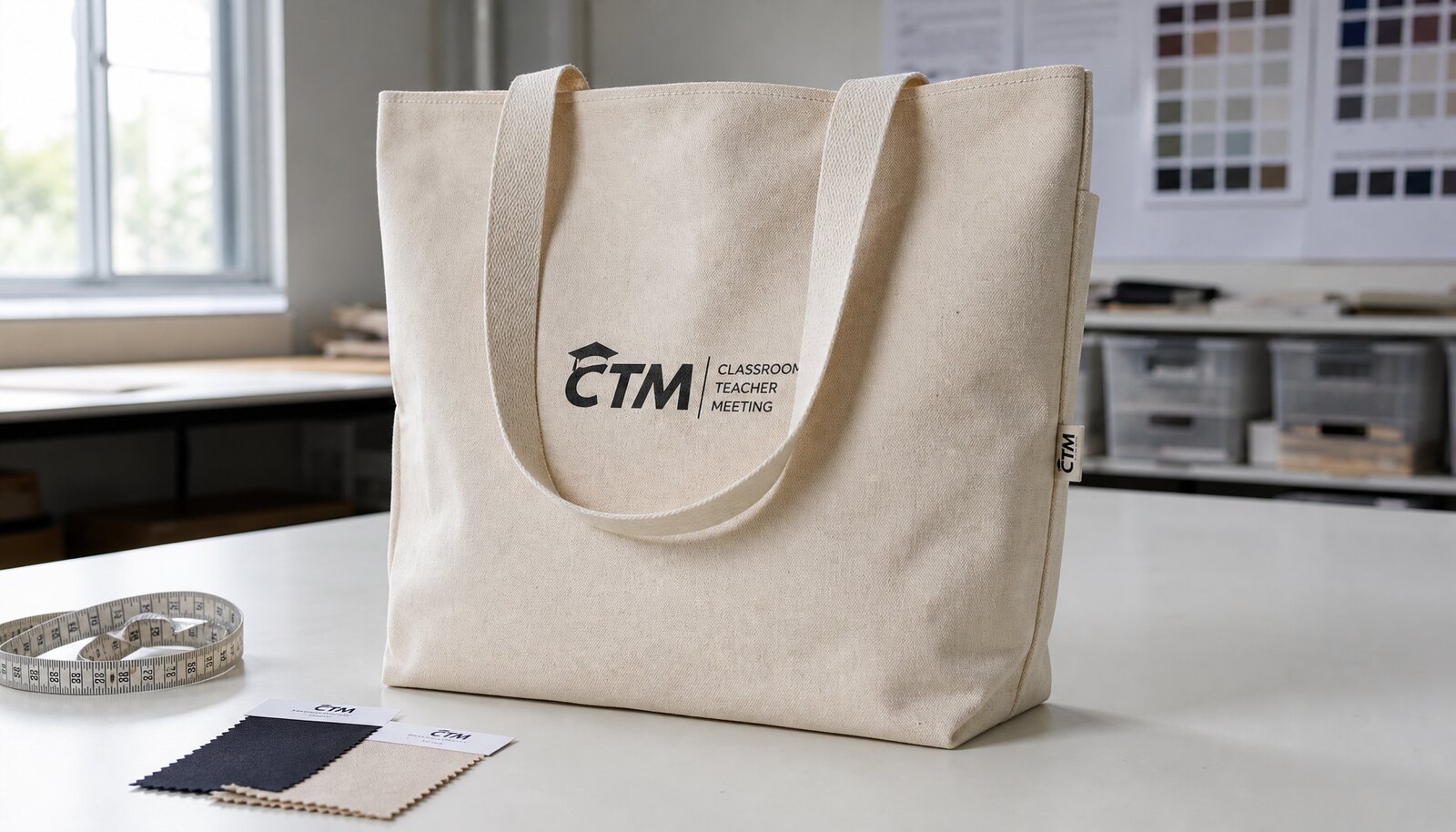
Start With The Reorder Question, Not The Product Label
Most repeat-order problems with canvas conference bags for schools start before production, not on the sewing line. The buyer asks for the same bag again, but the earlier file is incomplete, the sample was never measured properly, and the packing note lives in someone’s inbox. The factory can still quote, but it is quoting from memory. That is where drift begins: a slightly lighter canvas, a weaker handle tape, a logo that sits a few millimeters off center, or a carton pack that no longer matches the distribution plan. A reorder memo should stop that drift before price conversations start.
The first question is not what the bag is called. It is what must stay identical and what can change without causing a complaint. For school buyers, that usually means the carrying performance, decoration position, and packing format need to stay fixed, while the year mark, campus name, or insert card can change. If the first order worked, the reorder should protect that working spec and keep the approval chain short. Reorders fail when the buyer treats them as a new concept order instead of a controlled production repeat.
- Use the approved sample as the reference point before asking for new pricing.
- Write down which items are fixed and which items are allowed to change.
- Treat the reorder as a production control exercise, not only a purchasing event.
Lock The Spec Before You Compare Numbers
A useful spec for canvas conference bags for schools needs to be measurable. State the fabric in GSM or ounces, not with words like thick, strong, or premium. For a simple conference or handout bag, buyers often sit in the 8 oz to 12 oz range, but the right point depends on the load, the expected life of the bag, and whether the school wants a softer hand feel or a more structured shape. If the previous run sagged under brochures or notebooks, the spec should move up in weight or add reinforcement instead of hoping the next factory will interpret the problem correctly.
The rest of the build needs the same discipline. Finished dimensions should include width, height, gusset, and handle drop. Decoration needs placement and size, not only a logo file. If there is a pocket, lining, zipper top, or bottom board, those details belong in the RFQ and the tech pack. A supplier can only price what it can measure. When the brief is loose, the quote becomes a guess, and a guess is useless in a repeat-order comparison because it hides the real product differences behind a single unit price.
- State finished size, not only pattern size or a general bag concept.
- Fix the handle width, handle drop, and reinforcement details in writing.
- Record the decoration method and exact print or embroidery placement.
Choose The Sourcing Route That Matches The Calendar
The cheapest quote is not always the best reorder route. If the original factory still holds the pattern, screen, and packing record, repeating there is usually the fastest and least risky option. The approval cycle is shorter because the supplier already understands the bag. That matters for school deadlines, where a missed delivery can affect orientation packs, open-day handouts, or term-start materials. A new factory can still win, but only if the current source is too slow, too expensive, or too limited in capacity.
Lead-time tradeoffs also depend on geography. A coastal factory in China can be very competitive on repeat production, but a school buyer should still add sea transit, destination clearance, and inland delivery when the schedule is fixed. Vietnam can be strong for cut-and-sew programs where the buyer wants broader sourcing diversification, though freight routing and factory slot availability still matter. India can work well for buyers who need regional trade coverage or want to reduce exposure to long ocean transit, but the local supply chain depth for certain trims and print methods varies by supplier cluster. A nearshore supplier or domestic converter can cost more at the factory gate, yet still win on landed timing if the school calendar cannot absorb a delay.
- Same factory: best for speed, repeatability, and lower approval risk.
- New factory: best when the current source misses timing or capacity.
- Nearshore or local conversion: best when transit risk matters more than unit price.
Read The Quote Like A Cost Build, Not A Single Number
A buyer-friendly quote should separate fabric, sewing, print, packing, and any service charges. Many reorder quotes look cheaper only because they omit something the first supplier included: screen fees, color matching, carton labels, inspection support, or insert packing. If the line items do not match, the unit price comparison is misleading. The correct approach is to normalize the quote first: same fabric, same decoration method, same carton count, same incoterm, same currency, and same delivery point. Anything else is a comparison of different products wearing the same product name.
The cost drivers in canvas conference bags are predictable. Heavier fabric increases material cost and can reduce yield. More print colors increase setup time and the chance of registration drift. Pockets, piping, binding, and interior labels all add labor. A quote that is far below the others usually means one of those details has been simplified, not that the factory found a miracle efficiency. The buyer’s job is not to force every supplier to the same number. It is to see which supplier is pricing the real spec and which one is quietly changing the bag to protect margin.
- Compare only after fabric weight, decoration, and packing method are identical.
- Ask whether setup, plates, screens, and sampling are included or separate.
- Check whether the price assumes polybagging, bulk folding, or carton inserts.
Use MOQ Logic That Fits School Demand Patterns
School demand does not behave like retail demand. Even when the total volume is large, the bags may be needed in waves: first for staff kits, then for student distribution, then for late enrollments or replacement units. That means MOQ needs to be discussed by color, by artwork version, and by pack format, not only by the grand total. A supplier may accept the order size overall and still require a minimum per print version or per colorway. If that detail is hidden until after approval, the production plan can break when the school needs multiple campuses or multiple year groups in one purchase order.
For annual programs, a better approach is often a base run plus a reserve. The base run covers confirmed headcount, and a small buffer covers replacement requests and last-minute enrollment changes. That buffer is cheaper than a second emergency order because it avoids rush freight, urgent sampling, and the risk of shipping a substitute bag just to meet the date. Good reorder planning does not always mean buying more. It means buying the right amount in the right release pattern so the school can keep distribution simple and the factory can run efficiently.
- Negotiate MOQ by artwork version when multiple campus logos are involved.
- Ask whether the factory can reserve fabric for a later top-up batch.
- Separate confirmed quantity from reserve quantity in the planning sheet.
Approve The Sample As A Production Reference
A reorder sample should prove that the factory can make the actual bulk bag, not a polished one-off display piece. If the sample is too perfect, it may hide the fact that the bulk line cannot repeat that finish at volume. The approval sample should be made from the same construction logic that will be used in production: same canvas weight, same handle tape, same stitch path, same decoration method, and the same packing format if packing affects the shape. Otherwise the sample says little about what the buyer will receive in the shipment.
The sample review should be practical and measurable. Measure the finished bag, check the handle drop, verify print position against the artwork file, and inspect the reinforcement at the handle ends and side seams. If the first order had a complaint, write that issue into the sample sign-off. For example, if folders caused the bag to sag, that is not a styling issue; it is a load issue and should be handled with a heavier canvas or a reinforced base. The right sample process pushes the defect out of bulk production and into the approval stage, where it is cheaper to fix.
- Keep one sealed golden sample and one working production reference.
- Mark the approval date, artwork version, and measured dimensions on the sign-off sheet.
- Do not approve bulk if the sample is missing the final label, insert, or packing method.
Set The Inspection Standard Before Sewing Starts
If the buyer wants fewer disputes, the inspection standard has to be defined before production begins. For canvas conference bags, the key points are size, stitch quality, handle reinforcement, print placement, and packing accuracy. A bag may look acceptable on a table and still fail in use if the handle stitch is too close to the edge or the bottom seam opens when loaded with books. Buyers should ask the factory how it checks stitch consistency and what sampling method it uses for in-process and final inspection. The answer should be specific, not general language about good quality.
A practical control standard is ISO 2859-1 sampling with named AQL limits, often with zero tolerance for critical defects, an agreed AQL for major defects, and a separate AQL for minor defects. For example, a buyer may classify open seams, missing handles, wrong color, or missing artwork as critical or major, depending on the program. The exact thresholds should be written into the PO or the quality appendix. If the shipment is going to multiple schools or districts, carton-level SKU checks become important because the cost of mixing campus variants rises fast once the cartons are sealed.
- Set tolerance for size, print shift, and handle length before bulk cutting.
- Require bartacks or equivalent reinforcement at load points.
- Use a named sampling method, such as ISO 2859-1, instead of a vague factory standard.
Plan Packing For Distribution, Not Just For Shipping
School buyers often focus on the bag itself and under-plan the distribution step. That causes avoidable problems. If the bags go directly into classrooms or event kits, the packing format affects labor, print appearance, and freight cost. A bag folded too tightly can crease the logo. A bag packed too loosely can increase carton size and raise shipping cost. If the school needs individual handouts, name cards, or sponsor inserts, the factory needs that instruction before production scheduling starts, because late packing changes often create both delay and rework.
The quotation should include carton configuration, not only the piece price. Ask for pieces per inner pack, inner packs per carton, carton dimensions, and gross weight. Those numbers affect warehouse handling, pallet fit, and truck loading. If the buyer expects mixed destinations or staggered delivery by campus, barcode labeling and carton marking need to be set now, not after the goods are packed. The cheapest packing is not always the cheapest solution. The right packing is the one that avoids damage, speeds receiving, and lets the school team count the shipment without opening every carton twice.
- Specify whether the bags are to be flat folded, loosely folded, or individually polybagged.
- Confirm carton size against pallet and truck loading constraints.
- Provide exact insert size and insertion point if handouts or cards are required.
Use Region-Specific Lead-Time Thinking
Lead time should be planned by route, not by wishful thinking. A repeat order from an established factory in a coastal Chinese manufacturing cluster can move quickly if the materials are already familiar, but the buyer still needs to account for fabric booking, print setup, sewing, inspection, and transit. A Vietnam or India supplier may offer a different balance of material availability, labor scheduling, and freight routing. Those differences matter because a school reorder is usually tied to a date, not to a flexible retail window. A slower but more predictable route can be better than a faster route that depends on overtime or air freight to stay alive.
The choice becomes clearer when you compare landed timing, not just factory production time. If a school needs bags for a specific event, a nearby regional converter or domestic printer may be the safer route even when the quote looks higher. If the order is planned months ahead, an offshore factory with efficient bulk production may win on total cost. The buyer should decide whether the priority is lowest unit price, shortest transit, or lowest schedule risk. Only one of those can be the dominant goal. If all three are treated as equal, the reorder plan usually becomes vague and the shipment arrives under pressure.
- Map the schedule from fabric booking to in-dock delivery, not only sewing time.
- Add transit, clearance, and inland delivery before choosing the supplier route.
- Use nearshore or local conversion when the school date cannot move.
Write The Reorder Memo So The Next Buyer Can Run It
The strongest reorder file is short, explicit, and hard to misread. It should bring together the approved sample photo, the final spec sheet, the artwork file, the packing instructions, the quote, and the quality appendix in one place. If the information lives across email threads and chat messages, the repeat order will drift even when everyone has good intentions. A school buyer who wants stable reorders should create a single source of truth and reference that version in the purchase order. That is how the next run stays close to the first one, even if the person placing the order changes.
A useful memo also records what was accepted the first time. Did the canvas weight feel right? Did the bag hold notebooks without sagging? Did the logo stay crisp after packing and transit? Those notes become the benchmark for the next cycle. They also prevent a new team from treating the reorder like an entirely new product. Good procurement in this category is not about filling pages with generic instructions. It is about capturing the few details that determine whether the school gets a bag it can keep using, not a shipment it has to sort out after arrival.
- Store the golden sample reference, artwork file, and PO together.
- Record any deviations that were accepted on the first order.
- Use the same file structure on every repeat run so quotes stay comparable.
Specification comparison for buyers
| Spec decision | Recommended option | When it fits | Buyer risk to check |
|---|---|---|---|
| Repeat with the same factory | Use the approved bag spec, artwork, and packing record without changing construction | Best when the prior run was delivered on time, passed inspection, and sold through without handling complaints | Check for silent substitutions in fabric weight, handle tape width, stitch density, or ink coverage that keep the carton count unchanged but alter the bag |
| Move artwork only | Keep size, fabric, and construction fixed while updating school name, year, or campaign copy | Useful for annual conferences, campus events, or graduation-related reorders | Confirm file versioning so the old and new artwork do not mix in the same bulk lot or carton labels |
| Shift to a new factory | Quote against the approved sample and require a like-for-like comparison sheet | Fits when the original supplier misses timing, capacity, or commercial terms | A new plant may accept the order on paper and then adjust seam allowance, pocket size, or reinforcement unless the tech pack is explicit |
| Use a trading company or sourcing agent | Let an intermediary coordinate factory selection and consolidation | Useful for buyers covering multiple bag styles or multiple campuses with limited internal sourcing bandwidth | Ask for the actual factory name, service split, and margin structure so the quote is not hiding upstream cost changes |
| Buy stock blanks and print locally | Source plain canvas bags and apply decoration near the delivery point | Good for urgent events, small reorders, or simple logos with limited color complexity | Stock shade, handle quality, and print adhesion can differ from the original approved sample, especially if the blank fabric lot changes |
| Use a nearer regional supplier | Shift the reorder to a closer factory or converter to reduce transit risk | Useful when the school calendar is tight and freight volatility matters more than the last unit of price | A cheaper factory gate number can disappear once you add delivery lead time, inland freight, and rework exposure |
| Split volume across two suppliers | Keep one main source and qualify a backup against the same sample | Works when enrollment is uncertain or the order has phased release dates | Dual sourcing only works if both factories are held to the same construction, inspection method, and artwork placement standard |
| Upgrade the spec on reorder | Move to heavier canvas, stronger handle reinforcement, or better packing protection | Appropriate when the first run revealed sagging, stress marks, or early wear in school handling | Treat the upgrade as a new quote, because it changes fabric yield, labor time, carton loading, and sometimes transit cost |
Buyer checklist before sampling
- The approved sample, golden sample, and bulk reference sample all match the same spec sheet and artwork file
- Fabric weight is written in GSM or oz, with a tolerance the factory can actually hold in bulk
- Finished dimensions, handle length, handle drop, and gusset depth are stated as final measurements, not only pattern dimensions
- The decoration method is fixed by artwork complexity and durability needs, not left open as a supplier choice
- MOQ is clear by color, artwork version, and pack format, not only by total quantity
- Packing instructions cover fold method, polybag use, inner pack count, carton count, barcode, and any inserts
- Lead time includes fabric booking, print setup, sewing, in-line inspection, packing, and freight if the date is school-critical
- Quote comparison uses the same incoterm, currency, sample charge, and carton specification across every supplier
- Quality terms name the inspection standard, such as ISO 2859-1 with an AQL target for major and minor defects
- A reserve quantity is planned if the school calendar cannot absorb a late replacement order
Factory quote questions to send
- What exact fabric weight are you quoting, and what tolerance will you hold during bulk production?
- Is the price based on the same canvas construction as the approved sample, including handle tape, reinforcement, and pocket size if applicable?
- What is included in the decoration cost: screens, plates, embroidery setup, strike-offs, or color matching?
- What is the MOQ by color and by artwork version, and can the order be packed into mixed cartons if the school needs multiple campuses?
- Can you quote the job as a repeat order from the signed-off sample, with no change to fabric source, handle width, or stitch construction?
- What is the pre-production sample timeline, and will that sample be made from the same material lot as bulk production or a similar substitute?
- Which packing method is included in the unit price: bulk fold, polybag, insert card, barcode label, or master carton only?
- What inspection standard do you use for size, seam quality, print placement, and carton count, and do you follow ISO 2859-1 or your own AQL table?
- What tests can you support if needed, such as stitch pull, dimensional check, color fastness, or carton drop testing?
- What is excluded from the quote, such as freight, destination duty, local testing, rework, or third-party inspection?
Quality-control points to confirm
- Fabric weight matches the agreed GSM or oz specification within the factory tolerance named in the PO
- Finished dimensions stay within the agreed tolerance for width, height, gusset depth, and handle drop
- Handle attachment uses bartacks or equivalent reinforcement at both load points with no loose thread at stress areas
- Seams are straight, evenly sewn, and free from skipped stitches, puckering, or open edges at stress points
- Print placement matches the approved artwork layout, with no visible drift that changes the design balance
- Ink coverage, embroidery density, or woven label alignment is consistent across the full lot, not only on the sample
- Carton count, inner pack count, and barcode or SKU labeling match the shipper list and purchase order
- Incoming or final inspection follows a named sampling method, preferably ISO 2859-1 with AQL targets for major and minor defects
- Critical defects are defined in advance, such as open seams, missing handles, missing artwork, or the wrong colorway
- If the order is school-critical, a pre-shipment pull test and carton count audit are completed before release