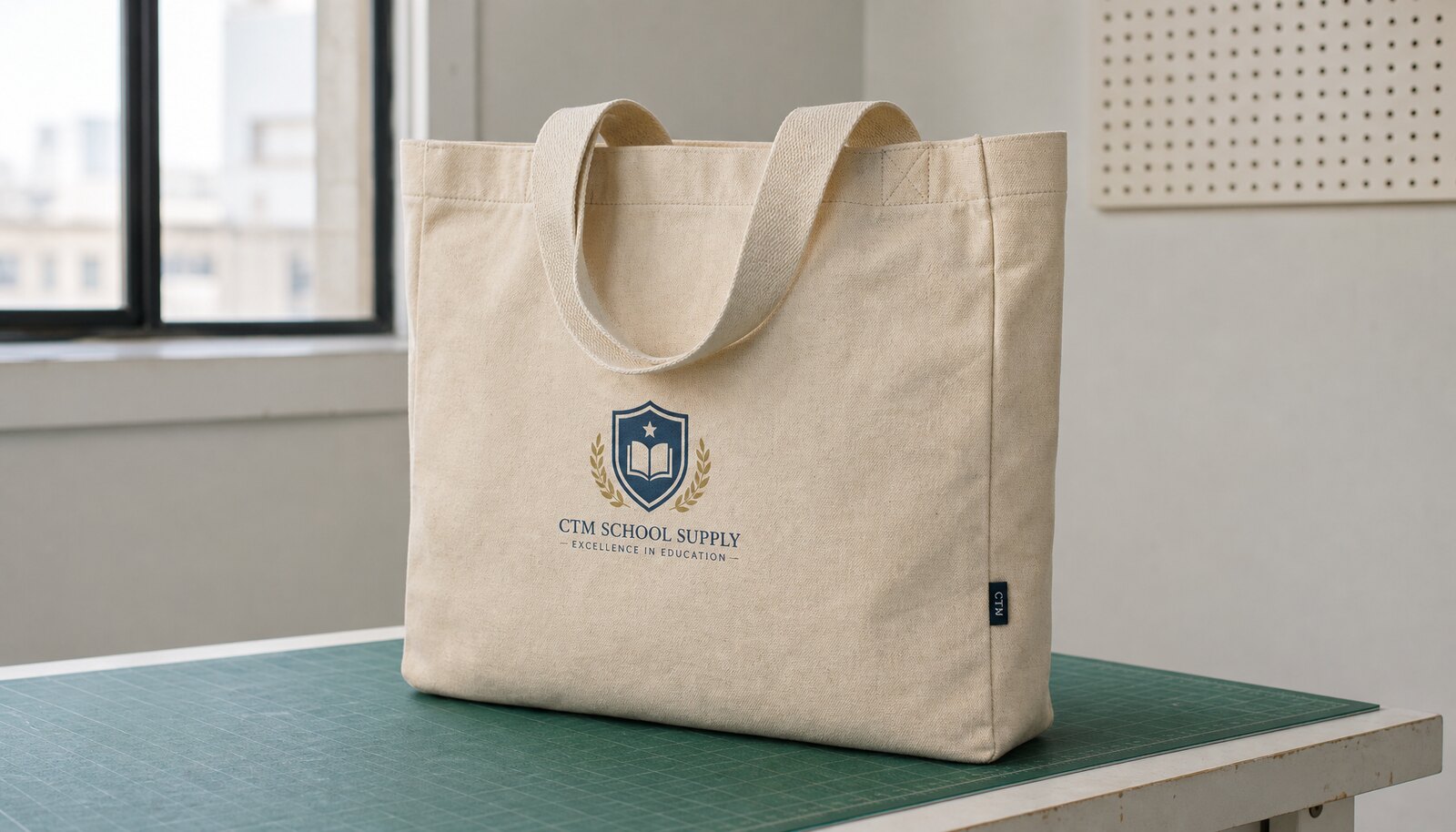
Anchor the Order to the Use Case
Canvas conference bags for schools should be treated as a functional carry item, not a generic tote. The right spec depends on what the bag has to hold, how often it will be handled, and whether the bag is a free event handout, a staff conference pack, or a private-label retail item sold through the school store. A bag for brochures and stationery can be lighter and simpler. A bag that will carry notebooks, folders, and a bottle needs a more durable build, more disciplined handle attachment, and tighter control on the finished size.
The use case should drive the quote, not the other way around. Procurement teams often get pulled into price comparisons before the bag's purpose is defined, which is how a light promotional body gets mistaken for a school-ready product. Write one sentence that describes the actual user and the actual load. If the bag is for orientation week, say so. If it is for alumni merchandise, say so. That one line should determine fabric weight, branding method, packing format, and inspection focus.
- State the maximum practical load, such as notebooks, brochures, a laptop sleeve, or a water bottle.
- Say whether the bag must stand upright, fold flat, or ship inside a mailer carton.
- Decide whether the bag is a one-off event item or a repeat private label program before you ask for quotes.
- Identify the receiving point: warehouse, campus mailroom, retail stockroom, or event venue.
Build a Specification a Factory Can Quote Cleanly
Fabric weight is the first commercial decision. For many school conference uses, 10 oz canvas, roughly 340 gsm, is the workable midpoint because it balances handle feel, unit cost, and freight weight. 8 oz canvas can be acceptable for lightweight handouts, but it becomes less convincing when the bag is expected to carry books or heavier kits. 12 oz canvas pushes the product toward a more retail-ready feel and usually improves structure, but it also raises sewing effort and landed cost. The point is not to pick the heaviest fabric. The point is to match fabric to load and expected perception.
Do not stop at gsm. State whether the canvas should be natural, bleached, dyed, pre-shrunk, or washed, because those choices affect both appearance and dimensional stability. Handle construction matters just as much. Self-fabric handles are economical, while cotton webbing often feels better under load and usually looks more polished for private label use. Lock the handle width, handle drop, gusset depth, top hem finish, and any bottom reinforcement before you ask a supplier to price the job. If the factory has to guess those details, the quote will be less meaningful and the sample will be less reliable.
- Use around 8 oz or 270 gsm only when the bag is carrying light paper goods.
- Use around 10 oz or 340 gsm for the broad middle of school conference use.
- Use around 12 oz or 400 gsm when the bag needs more structure or retail presence.
- Specify handle width, handle drop, and reinforcement at the anchor points.
- Fix gusset depth and top hem construction so the bag packs and folds consistently.
Choose the Sourcing Route and Region Deliberately
There is no universal best sourcing route. Direct factory sourcing is strongest when you need one party responsible for sewing, printing, label attachment, packing, and repeatability. That is usually the cleanest option for a school program that will reorder next season. A trading company can be useful when you need mixed products in one shipment, language support, or sourcing flexibility across several factories. The tradeoff is that you need more evidence to understand who is actually making the bag and who is making the decisions when a defect appears.
Regional supply context matters, but it should be treated as a capability check rather than a shortcut. China still tends to offer the broadest accessory capacity and decoration options. India is often a strong fit for cotton canvas and labor-intensive sewing. Vietnam and Bangladesh can be viable for certain bag programs, but factory capability varies and should be verified item by item. If the bag needs fast local turnaround, a domestic decorator or stock-body program can work, but you should compare that route on landed cost, not just unit price. Faster does not mean cheaper once packing, freight, and rework are counted.
- Ask for photos of cutting, sewing, printing, and packing if the supplier says it is a direct factory.
- Treat any sample that looks good but cannot be repeated in bulk as a warning sign.
- If you expect future reorders, keep one technical spec sheet that every supplier must follow.
- Use the same evaluation criteria for overseas and domestic routes so speed does not distort the comparison.
Match Branding Method to Artwork, Volume, and Durability
For simple school logos, one-color screen print usually gives the cleanest result on canvas. It is economical, readable, and easier to repeat across multiple runs. If the artwork is a crest with fine lines, multiple colors, or shaded detail, heat transfer or DTF can preserve the graphic, but the buyer should treat those methods as a tradeoff: better artwork fidelity, less confidence in long-term wear than a well-executed screen print on a heavy canvas body. If durability matters, ask the supplier to show the actual print process used on the production line, not a generic sales claim.
Private label identity is not limited to the front panel. A woven side label, sewn-in brand tab, or inside label can make the bag feel like a controlled product rather than a temporary giveaway. Keep the front logo size realistic for the print area and the canvas texture. A logo that reads clearly on a PDF can disappear on fabric if the line work is too fine or the contrast is too weak. For school programs, the most common mistake is trying to fit too much brand detail into too little print space. The cleaner option usually performs better and is easier to approve.
- Approve a strike-off on the actual canvas before bulk printing starts.
- Keep the first production design simple if the order is large or the schedule is tight.
- Use a woven side label when you want private-label identity without crowding the front print.
- Test small text, thin rules, and crests at production size, not only on screen.
- Define print placement from seam references so the logo does not drift from bag to bag.
Vet the Supplier Before You Discuss Price
A solid supplier review should look beyond the quote itself. Ask for the factory license, a current production site address, named contact for quality decisions, and evidence that the supplier can actually produce the type of bag you want. If the supplier claims compliance, ask what standard was audited, who issued the audit, when it was last updated, and whether the report covers the actual production site. If the supplier uses subcontractors, that is not automatically a problem, but it becomes a problem when the buyer only learns about them after a defect or delivery delay.
For school procurement, audit evidence should be practical rather than decorative. A social audit report, a quality system certificate such as ISO 9001, or a current third-party inspection history can be useful, but only if it ties back to the product you are buying. Ask for recent in-line or final inspection records, material traceability, and photos of the actual packing line. If the factory cannot show how it controls fabric shade, label placement, or print cure consistency, the sales presentation is ahead of the operation. Procurement should price that risk in from the start.
- Request the production site name, not only the sales office name.
- Ask who signs off on deviations when the sample and bulk line disagree.
- Check whether subcontracting is allowed and, if so, which steps are external.
- Ask for recent inspection records or traceability examples instead of relying on marketing language.
Read the Quote as a Landed-Cost Model
The right comparison is landed cost per acceptable bag, not the lowest line item. A useful quote should separate fabric, cutting, sewing, decoration, labels, packing, cartons, inland transport if applicable, and any testing or setup charges. If one supplier gives a single number and another breaks the costs out, the first quote is not necessarily better. It may simply hide differences in fabric weight, packing method, or shipping assumptions. A bag that looks inexpensive on paper can become expensive when it arrives with loose cartons, damaged prints, or a batch that must be sorted by hand.
To compare suppliers properly, normalize the terms. Use the same incoterm, the same carton count, the same printed area, the same overrun policy, and the same delivery window. Then compare the result against MOQ and sample cost. A lower MOQ can be attractive for a pilot school program, but the sample fee and unit price may be higher. A bigger order may have a better unit price but more freight risk and more cash tied up in inventory. The better commercial choice is the one that fits the school calendar, the reorder plan, and the cost of holding stock.
- Ask for a line-by-line price split instead of accepting a flat unit number.
- Compare like-for-like terms: same incoterm, same packing, same artwork, same carton plan.
- Include sample cost and freight in the decision, not only the ex-factory price.
- Judge the quote against the reorder plan, because a lower first order price can become a higher next-season cost.
Approve Samples So Bulk Production Does Not Drift
A digital mockup is not an approval for bulk production. For private-label school bags, the buyer should approve a pre-production sample made from the actual fabric, the actual print method, and the actual label construction. The sample should arrive after key materials are booked, otherwise you are approving a one-off hand build that may not be repeatable at scale. The sample exists to lock the things that are hard to correct later: fabric hand, color tone, handle feel, logo placement, fold shape, and seam appearance.
Treat the sample like a production control point, not a presentation piece. Put books, folders, and a bottle into the bag. Lift it repeatedly by the handles. Fold it flat, re-open it, and check whether the side seams twist or the print cracks. Measure the width, height, gusset, and handle drop against the spec sheet. Photograph the approved sample from front, back, side, and top, then attach those photos to the PO. If the factory later changes the fabric lot, label position, or print method, the approved sample becomes the reference for rejection, rework, or price adjustment.
- Approve the physical sample, not only a render or artwork file.
- Measure the sample against the written dimensions before releasing bulk.
- Load test the handles and seam anchors before confirming production.
- Keep the approved sample and photos with the order file for reorder comparison.
- If a change is unavoidable, require written deviation approval before the line runs.
Write Compliance and Documentation Into the PO
Compliance should be written as a document requirement, not assumed from the product type. For school programs that may be sold, resold, or distributed across regions, the buyer may need country-of-origin marking, fiber composition disclosure if relevant, and chemical documentation for prints, dyes, or trims. If the bag will go to the U.S. retail market, buyers often ask for CPSIA-related evidence when the product setup requires it; if it will go into the EU or UK market, ask for the relevant chemical and labeling documentation the route requires. The exact standard depends on the market, but the principle is the same: ask for evidence tied to the materials and decoration method, not a vague compliance statement.
The best time to ask for documents is before the order is released. Ask which materials are covered by certificates or test reports, who supplied the report, and whether the report applies to the same ink, fabric, and label source being used for your order. If a supplier uses recycled cotton, special dyes, or a branded woven label, those details can change the documentation burden. Keep the paperwork practical: factory license, current audit evidence if needed, product test reports where relevant, and carton marking instructions. A clean document pack reduces customs friction and makes internal sign-off easier for procurement and legal reviewers.
- Ask for the exact documents that match the target market, not a generic compliance promise.
- Tie test reports to the actual fabric, ink, and label materials used on your order.
- If the bag will be sold retail, verify label and origin-marking requirements before bulk starts.
- Keep certificate dates, issue numbers, and scope coverage in the order file.
Lock Packing, Cartons, and Freight Handling
Packing is a commercial decision, not an afterthought. For school distribution, flat-packed bags in counted cartons are usually the simplest option because receiving teams can move cartons directly into staging. For retail or resale, you may need a cleaner fold, a barcode sticker, or a polybag to protect the print and improve shelf presentation. Each choice affects labor, carton fill, and freight density. If the factory is not given a fold spec, it will usually pack by habit, and that habit may not match your warehouse process.
Carton planning should be tied to handling weight and receiving workflow. A carton that is too heavy slows warehouse work and increases damage risk. A carton that is too loose allows bags to shift, wrinkle, or lose shape. The packing instruction should state carton count, folded size, outer marks, mixed-color policy, and whether any protective insert is required. If you are shipping to multiple campuses or event sites, carton marks should also support route sorting. The more predictable the packing standard, the lower the receiving cost and the lower the chance of an avoidable discrepancy claim.
- Specify flat fold, retail fold, or no fold before production starts.
- Set carton weight and count to match the receiving team's handling limits.
- Require outer marks that show style, color, quantity, and purchase order number.
- State whether mixed-color cartons are allowed, and if not, require single-SKU packing.
- If the order is retail-facing, define barcode or sticker placement before packing begins.
Set QC, AQL, and Defect Remedies Before Shipment
A useful QC plan distinguishes cosmetic variation from functional failure. For school conference bags, common critical issues include wrong size beyond tolerance, handle failure, open seams, wrong logo, missing labels, stain, odor, or print that is too faint to read. A common buying mistake is to treat all defects as equally minor. They are not. A bag with a cosmetic thread tail is not the same as a bag that cannot carry the intended load. Put that distinction into the inspection instructions before goods are packed.
Many buyers use an AQL framework, often around AQL 2.5 for major defects and 4.0 for minor defects, but the exact plan should match the school's tolerance for risk and brand damage. More important than the number is the remedy. State what happens if the factory misses on size, print, or seam strength: rework, replacement, partial credit, or shipment hold. Ask for lot traceability so the supplier can isolate a bad fabric lot or print run instead of sending the buyer back into a full-scale dispute. For repeat school programs, the best suppliers are the ones that can explain a defect root cause and show the corrective action they used on the next run.
- Classify defects as critical, major, and minor before inspection starts.
- Use a written acceptance plan such as AQL, but tie it to your actual product risk.
- Require photo evidence for any rejected carton, defect cluster, or print issue.
- Define the remedy in advance: rework, replacement, partial credit, or shipment hold.
- Ask for lot traceability so repeat defects can be isolated to fabric, print, or packing.
Specification comparison for buyers
| Supplier option | What to verify | Commercial advantage | Buyer risk to control |
|---|---|---|---|
| Direct sewing factory | fabric swatch, approved sample, seam close-ups, logo test photos, packing pilot, and final inspection evidence | Better sample-to-bulk control and faster production feedback | May be weaker on export paperwork or branded packing unless checked early |
| Trading company | Factory name, production photos, trim-source proof, and who owns QC decisions | Can coordinate small mixed orders and extra services | Markup can hide real factory capability and slow defect decisions |
| Specialized bag workshop | bag size, gusset, handle drop, seam allowance, stitch density, reinforcement patch, and loading expectation | More practical for detailed construction, trims, and repeat programs | Capacity may be limited during peak seasons |
| Low-price general supplier | 8-12 oz cotton canvas, 120-220 gsm cotton, recycled cotton, or blended fabric selected by use case and target price | Useful for simple promotional runs with loose specs | Material downgrades, weak packing, and vague inspection scope can erase savings |
| Retail-ready supplier | fold method, inner bundle, carton count, carton mark, moisture protection, SKU separation, and warehouse receiving needs | Can handle labels, SKU separation, carton marks, and receiving rules | Higher unit cost must be compared against reduced warehouse work |
| Compliance-focused supplier | Fabric records, labeling review, test plan, and production traceability | Safer for retail programs and repeat brand orders | Documentation claims need evidence, not only sales language |
| Local sample room plus bulk factory | Signed sample, bulk factory handoff, first-piece photos, and deviation owner | Good for complex branding before large production | Sample room quality may not match bulk line unless handoff is controlled |
Buyer checklist before sampling
- Write the use case in one line: event handout, student welcome kit, alumni retail item, or staff conference pack.
- Freeze finished size, gusset depth, handle length, and target load before collecting quotes.
- Specify canvas weight in gsm and state whether the fabric should be natural, bleached, dyed, pre-shrunk, or washed.
- Name the branding method, logo dimensions, color count, and label type in the RFQ.
- Define the packing standard: flat fold, retail fold, polybag or no polybag, carton count, and outer marks.
- Ask for a pre-production sample made from the actual fabric and the actual decoration method, not just a digital proof.
- Compare quotes on the same incoterm, the same carton plan, and the same overrun policy.
- Put shade, stitch, print, and dimension tolerances into the purchase order before bulk release.
Factory quote questions to send
- What finished gsm are you quoting, and is it measured before or after printing, washing, or any fabric finish?
- Which processes are done in-house, and which ones are subcontracted for cutting, printing, label attachment, or packing?
- What is the MOQ for this exact size, fabric weight, print method, and label construction?
- Can you break the price into fabric, cutting, sewing, printing, labels, packing, cartons, and any testing or setup charges?
- What sample stages can you provide before bulk production starts, and is the sample fee refundable against a purchase order?
- What dimensional tolerance do you hold for width, height, gusset, and handle drop?
- Can you provide fabric swatches, print strike-offs, and seam close-up photos from the actual production route?
- What is your overrun or underrun policy by SKU and by color, and how do you handle short-shipped cartons?
- Which compliance documents can you provide for the fabric, print inks, label materials, and factory audit status?
- Which incoterms can you quote, and what inland charges, export documentation, or destination handling fees are excluded?
Quality-control points to confirm
- Confirm whether gsm is measured on raw fabric, finished fabric, or after any wash or print process, and record that method in the spec.
- Check bag width, height, gusset, and handle drop against the approved sample, using a written tolerance instead of a verbal estimate.
- Inspect handle reinforcement, bar-tack quality, stitch density, seam opening, and thread trimming at the attachment points.
- Set a print acceptance rule for opacity, registration, rub resistance, and placement relative to fixed seam references.
- Review label attachment for flatness, straight alignment, seam interference, and any curling or puckering after folding.
- Set carton count, carton marks, and carton dimension limits so warehouse receiving does not have to re-count or rework every shipment.
- Use a defect classification system that separates critical, major, and minor defects, then tie it to the agreed AQL or inspection plan.
- Require lot traceability for fabric, print run, and carton pack so a repeat defect can be isolated instead of reworked blindly.