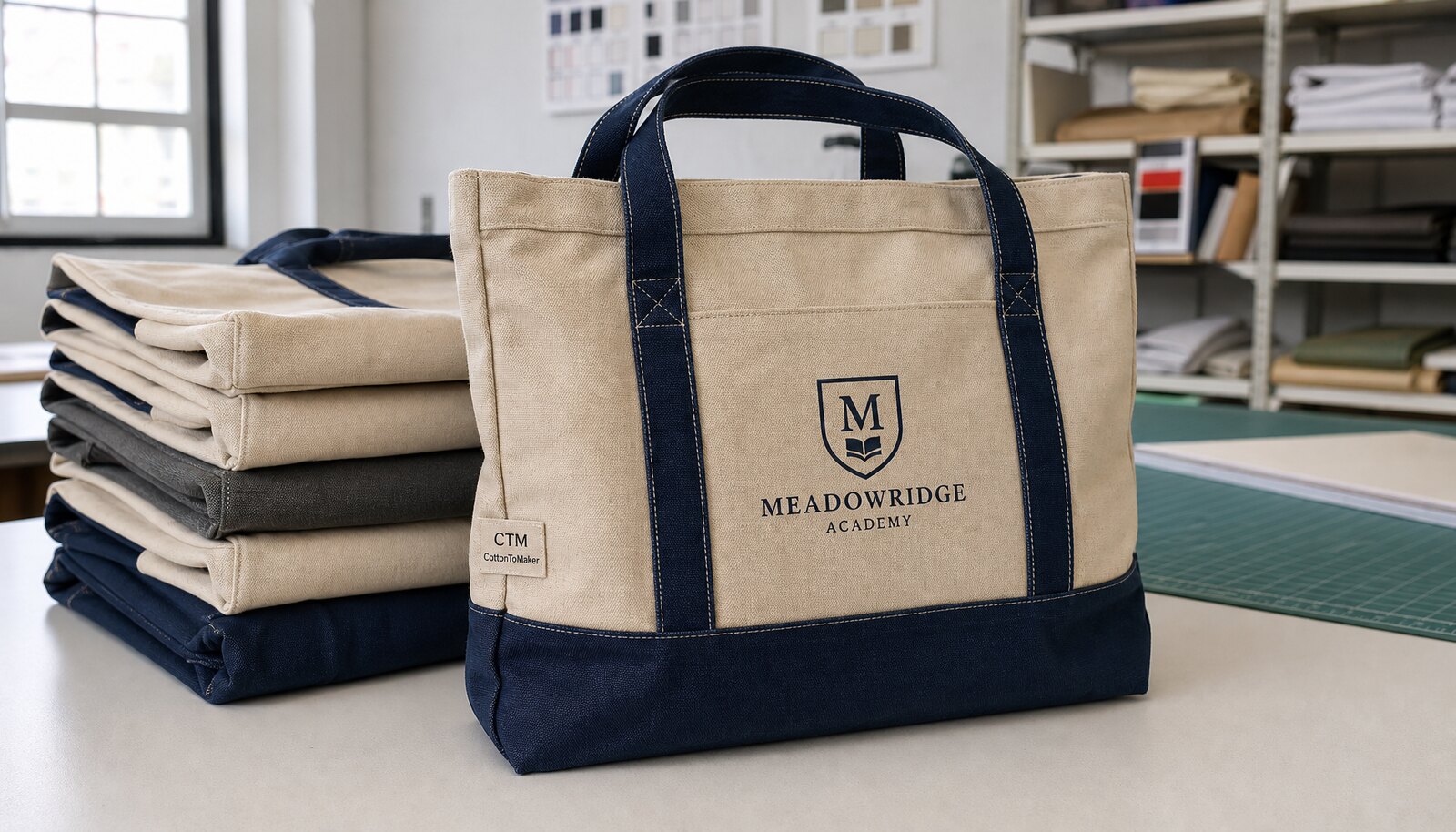
Why school conference bags need a tighter material spec than a generic tote
A school conference bag looks simple, but the use case is not simple. It may be handed out at admissions events, parent conferences, staff training days, open houses, academic fairs, or student leadership programs. The bag has to handle papers, notebooks, brochures, a pen set, and sometimes a bottle or small gift. That is not a heavy industrial load, yet it is a daily procurement issue because the bag is visible, handled quickly, and judged immediately. When the material feels flimsy or the print looks misaligned, the complaint is not just about the bag. It reflects on the school event itself.
That is why a material selection guide for school conference bags should not start with artwork. It should start with structure, surface, and repeatability. Procurement teams usually want three things at once: a bag that looks neat in the hand, a bag that holds its shape enough to pack well, and a bag that can be reordered without constant spec drift. Those goals are easier to achieve when the fabric, weave, finishing, and decoration method are defined before quotes are collected.
The more varied the audience, the more important the material decision becomes. A bag for students handing out admissions packs can be lighter and simpler. A staff welcome kit or leadership conference bag may need a more structured feel, a better closure, or a cleaner interior. The same base concept can work across all of these, but only if the material and construction match the job rather than the brochure mockup.
Set the fabric weight first, because GSM drives most of the finished feel
For most canvas conference bags for schools, the practical starting point is 10 oz to 12 oz canvas, which roughly translates to about 280 to 340 GSM depending on the supplier’s conversion and fabric basis. That range is common because it balances cost, body, and print performance. Around 10 oz is usually enough for lighter event packs and high-volume distribution. Around 12 oz gives a firmer handfeel, better drape control, and a more substantial look in photos and at reception tables. Beyond that, the cost per bag rises, sewing becomes a little slower, and the benefit is only worth paying for if the order is meant to feel premium or carry heavier contents.
Procurement teams should not accept a quote that says only 'canvas' or 'heavy canvas.' Ask for the finished GSM, not just the raw fabric GSM if finishing changes the handfeel. Also ask whether the supplier quotes by square meter weight or by finished goods weight after washing or coating. Two bags can both be called canvas, but if one is a loosely woven 280 GSM fabric and the other is a tighter 340 GSM fabric, they will behave very differently in packing, printing, and handle stress. If the bag will hold folders or boxed inserts, the extra body from the higher range usually pays off in lower complaint risk.
The tradeoff is straightforward. Lighter fabric reduces cost and may fold more neatly into cartons. Heavier fabric holds shape better and often looks more premium, but it can make simple school packs unnecessarily expensive. A good procurement spec should name a target GSM and an acceptable range, for example 300 to 330 GSM, instead of leaving the supplier room to substitute something materially different.
Understand weave, yarn type, and finishing before you approve the quote
The term 'canvas' tells you almost nothing on its own. For procurement work, weave and yarn type matter because they affect appearance, print sharpness, shrinkage behavior, and wear. A plain weave is the most common and easiest to source. Within that, ring-spun cotton usually gives a smoother, more even surface than carded cotton, which can make the fabric look cleaner and accept print better. Carded yarn may still be fine for low-cost programs, but if the school wants crisp branding or a more refined look, yarn quality matters.
Weave density also matters. A tighter weave helps reduce show-through and can improve the way a printed logo sits on the surface. It may also make the bag feel more structured, which is useful when the contents are not completely soft. However, tighter weave can raise cost and may require more careful stitching so the needle does not distort the fabric. Buyers do not need to specify textile engineering jargon, but they do need to ask the supplier to identify weave type, yarn type, and any finishing treatment that changes the surface.
Finishing is often under-described in quotes, yet it affects the whole order. Pre-washing or pre-shrinking reduces the chance that a sample looks good but the bulk order shrinks after finishing. Calendering or light surface smoothing can improve print clarity, especially for logos with small text or thin lines. If a supplier uses a coating or heavy finishing to make the surface smoother, the buyer should confirm whether that changes handfeel, odor, or print adhesion. For school orders, the best answer is usually the simplest one: a stable, pre-shrunk canvas with enough surface consistency to print cleanly, but not so much coating that the bag feels synthetic.
Compare the real material options: body, lining, closure, handle, and print compatibility
A procurement spec is stronger when it compares material components rather than only sourcing routes. A school conference bag can be built several ways, and the right choice depends on how the bag will be used after it is handed out. A single-layer unlined bag is often enough for brochures and notebooks. Add a gusset if the bag needs to hold folders, thick programs, or a bottle. Add a lining if the school wants a cleaner interior or a more premium structure. Add a closure only when contents need to be secured, because every added feature introduces sewing tolerance and another inspection point.
The most common mistake is to overbuild a simple handout bag. A zipper, inner pocket, and heavy lining can make sense for staff kits or donor gifts, but they can be overkill for admissions events where speed, count control, and budget matter more. The better question is not 'What can we add?' but 'What does this bag actually need to do without creating avoidable factory complexity?' The table below is more useful than a sourcing-route comparison because it shows the material and construction decisions that change price, print quality, and durability.
If the bag must be printed with a school crest, a simple one- or two-color screen print is usually the most reliable choice. That does not mean every logo must be screen printed. Fine seals, gradients, or multi-color artwork may need transfer decoration or a woven label if the logo is too detailed for clean ink coverage on textured canvas. The point is to match the artwork to the fabric rather than forcing the logo to fit a low-cost method that was never designed for it.
Print method should be chosen after the fabric, not before it
Many buyers start with the logo file and ask the factory to build the bag around it. That often leads to weak material choices or print methods that look acceptable in a digital proof but fail on textured canvas. A better sequence is fabric first, construction second, decoration third. When the canvas is chosen correctly, print options narrow in a useful way. When the wrong fabric is chosen, even a good print method can look muddy or distorted.
For school conference bags, screen print is usually the most efficient option when the logo is bold, the artwork is simple, and the order size is large enough to justify setup. It gives good opacity on canvas and handles repeated production well. It also allows the buyer to define ink color, print size, and placement clearly. The limits are worth remembering: very fine text, tiny linework, and detailed seals are harder to keep crisp, especially on rougher weaves. If the bag is for a small event or the artwork has multiple colors and fine detail, a transfer method can be safer, as long as the supplier can show how it performs on the selected canvas.
Embroidery can look premium, but it is usually better reserved for smaller quantities, staff gifts, or special recognition items. On a plain tote used for mass distribution, embroidery often adds cost faster than it adds value. A woven label can also be useful when the school wants branding without heavy print coverage, particularly on natural-colored canvas. The real procurement question is not which decoration is fanciest; it is which method gives clean reproduction, acceptable durability, and the right total landed cost for the event type.
Quote questions that expose weak specs before the order is placed
Good quotes are not built from generic requests. They are built from questions that force the supplier to reveal the actual material spec, the production path, and the risk points. If a supplier cannot answer clearly, that usually means the quote is too broad to compare fairly. A useful inquiry should ask for the exact canvas GSM, the yarn and weave type, whether the fabric is pre-washed or pre-shrunk, and whether the quoted color is stock-dyed, piece-dyed, or custom-dyed. Those details matter because they change both price and consistency.
It also helps to ask how the factory handles printing in relation to sewing. Some suppliers print before cutting, which can help alignment on repeated artwork. Others print after assembly, which can work well for larger logos but may expose seam-position variation. Neither approach is automatically wrong, but the buyer should know which one is being used. Ask about in-house capability as well. If printing, sewing, and packing are split across different subcontractors, the quote may look simple but the accountability chain becomes longer.
Another area to pin down is ownership of rework. If the bulk goods miss the approved sample, who pays for correction, replacement shipping, and re-inspection? For school orders with fixed event dates, this question is not theoretical. It determines whether the supplier is standing behind the product or only standing behind the invoice. A strong quote should answer not just what the bag costs, but what happens if the bag does not meet the agreed spec.
A real procurement comparison table should compare the bag specs, not just the sourcing route
The table below is the kind of comparison that helps procurement teams make a true material decision. It shows how one material or construction choice affects durability, appearance, print compatibility, and risk. Use it when deciding which version should go into an RFQ or when comparing a supplier’s 'similar' alternative against the original brief.
A useful rule here is to compare what changes the physical product. Source-route comparisons may matter later, but they do not tell you whether the bag will stand up, print well, or survive distribution. Material selection does.
- Write decisions in measurable language, not only descriptive wording.
- Ask for sample photos plus one physical approval sample for important orders.
- Keep quotation, sample approval, and inspection notes tied to the same spec version.
Sampling should prove fit, print behavior, and finishing—not just color
A sample is only useful if it answers the right questions. For canvas conference bags for schools, the sample should show the actual fabric, the final print method, the final handle construction, and the final packing method. A photo sample or mockup can help with the design direction, but it cannot show weave texture, print soak-in, seam puckering, or how the bag sits when loaded. That is why the best practice is to approve a physical pre-production sample before bulk production starts.
The sample should be tested with real contents, not just held up by hand. Put in the brochures, notebook stack, folders, and any bottle or insert the school intends to distribute. Check whether the bag can sit flat without rolling over, whether the handle drop is comfortable, and whether the bag remains easy to open if it has a closure. If the bag includes a pocket, check whether the pocket pulls the front panel out of shape or causes the print to warp. It is much cheaper to discover these issues at sample stage than to find them in a carton of 5,000 pieces.
When approving the sample, write down what is accepted and what is not. For example, note the exact print position, the acceptable shade range, and whether slight natural variation in canvas texture is normal. If the school wants the bag reused for multiple years, ask the supplier to keep a master sample or control sample on file. That makes repeat orders easier to match and reduces arguments about whether a later lot is 'the same' as the original.
QC needs measurable acceptance criteria, not just a visual yes or no
Quality control for canvas bags is stronger when it includes clear thresholds. A visual inspection alone is too subjective. The buyer should define acceptable tolerance for size, shrinkage, color, print placement, and stitch consistency before mass production starts. That way the factory knows exactly what will pass and what will trigger rework. This is especially important when school orders are split by campus or event, because packaging errors can create receiving problems even when the bag itself is fine.
A practical QC plan can start with the approved sample and then add simple test methods. Measure finished dimensions on a sample of production pieces. Compare the canvas weight or fabric handfeel to the approved reference. Do a dry rub check on the print with a white cloth to see whether ink transfers. Look closely at handle attachments, corner reinforcement, seam ends, and any label or pocket attachment. If the bag will be used in a setting where appearance matters immediately, shade consistency across the lot should also be checked under daylight or a standard inspection light.
It is also worth setting rejection triggers in advance. For example, open seams, missing bar-tacks, broken stitches at load points, print misregistration beyond the approved tolerance, or large shade variation should all be reasons for correction or replacement. For high-volume school distribution, a small number of loose threads may be cleanable, but structural defects should not be normalized. Clear acceptance criteria make inspections faster and protect both sides from arguments after shipment.
Packing, carton marking, and distribution details can change the landed cost more than expected
Packing is easy to overlook because it does not change the bag shape on the website, but it changes the landed cost, receiving speed, and damage rate. If a school needs bags sorted by campus, department, or event day, the factory has to follow a pack matrix. If each bag requires an individual polybag, a printed insert, and a carton mark, those tasks add labor and materials. The base unit price may still look attractive, but the final landed cost can move significantly once packaging is made realistic.
The cleanest way to control this is to write packing instructions in the RFQ itself. State whether the bag should be flat-packed or lightly folded, whether each piece goes into a polybag, how many pieces belong in each inner or outer carton, and how the cartons should be marked. Include any moisture protection if the shipment is traveling through humid or rainy conditions. These details are not just logistics preferences; they reduce rework at the warehouse and make distribution faster at the school side.
If the order is split across multiple locations, ask the supplier to label cartons by SKU, campus, or event code before shipment. It is much easier to separate cartons at the factory than to sort mixed boxes later in a school warehouse or campus office. Good packing instructions also help with inspection because the buyer can check whether the quantity, labeling, and carton count match the purchase order before goods move to internal distribution.
Specification comparison for buyers
| Spec item | Option A | Option B | Option C | Procurement note |
|---|---|---|---|---|
| Canvas weight | 10 oz / approx. 280 GSM | 12 oz / approx. 340 GSM | 14 oz+ / approx. 390 GSM+ | Heavier fabric improves structure but increases cost, sewing effort, and sometimes print ink consumption. Ask suppliers to quote the same finished GSM, not a broad fabric description. |
| Weave and yarn type | Plain weave, ring-spun cotton | Plain weave, carded cotton | Tight plain weave or heavier twill-like canvas | Ring-spun yarn usually feels smoother and prints more cleanly; a tighter weave can reduce show-through and improve durability, but may cost more. Ask for yarn type and weave count if consistency matters. |
| Pre-wash / finishing | Unwashed natural canvas | Pre-shrunk or pre-washed canvas | Calendered or lightly coated finish | Pre-washing lowers shrinkage risk; calendering can improve surface smoothness for printing. Confirm whether finishing changes final size or handfeel. |
| Body construction | Single-layer body | Lined body | Lined body with gusset | Single-layer is usually enough for brochure packs. Lining and gussets improve form and internal organization, but they add sewing time and can affect MOQ. |
| Closure | Open top | Magnetic snap or button | Zipper closure | Open top is simplest and lowest cost. A closure helps with mixed contents but adds hardware risk, more sewing steps, and extra QC points. |
| Interior features | No pocket | One slip pocket | One zipped pocket plus pen loop | Useful when schools want event kits or staff packs, but every extra feature can create another sewing tolerance and rework point. |
| Handle build | Self-fabric handles | Webbing-reinforced handles | Padded or extended-drop handles | Reinforced handles are better for heavier kits and repeated hand carry. Check handle width, drop length, and bar-tack placement, not just total length. |
| Print compatibility | One-color screen print | Multi-color screen print or heat transfer | Embroidery or woven label branding | Simple screen print is usually the most durable and cost-efficient on canvas. Complex artwork should be matched to the decoration method, not forced into the cheapest option. |
Buyer checklist before sampling
- Define the real load: brochures only, brochures plus notebook, or a mixed kit with bottle, folder, and gift item.
- Lock fabric weight in GSM and state whether you want 100% cotton canvas, recycled cotton blend, or a blend with polyester for dimensional stability.
- Ask for weave and yarn details: plain weave or twill-like canvas, ring-spun or carded yarn, and whether the fabric is pre-shrunk or pre-washed.
- Choose the closure and interior features only after confirming what the bag must carry and how it will be distributed.
- Match the decoration method to the artwork: one-color screen print for simple logos, transfer for detail or short runs, embroidery only if the budget and look justify it.
- Specify handle width, drop, reinforcement, and whether the handle is self-fabric or webbing-backed.
- Request a physical pre-production sample using the final fabric, final color, final logo placement, final label, and final packing method.
- Ask for acceptance criteria in writing: size tolerance, shrinkage tolerance, color tolerance, print alignment tolerance, and packaging rules.
- Compare quotes on the same spec sheet so setup fees, packing, and testing are visible instead of buried in the unit price.
- Confirm who owns rework, replacement shipping, and corrections if the bulk order misses the approved sample or agreed tolerances.
Factory quote questions to send
- What exact canvas specification are you quoting: GSM, yarn type, weave type, and whether the fabric is pre-washed or pre-shrunk?
- Is the canvas 100% cotton or a blend, and what tolerance do you allow on composition?
- What is the finished shrinkage range after washing or steam finishing, if any?
- Can you provide the print method limits for this artwork, including color count, minimum line thickness, and recommended print area?
- Will printing, sewing, labeling, and packing all be done in-house, or is any step outsourced?
- What are the exact MOQ levels by color, fabric, and artwork version?
- Can you quote line items separately for fabric, printing, label, sample, individual polybag, carton, and special packing?
- What size tolerance do you hold on finished width, height, gusset depth, and handle drop?
- What colorfastness, rub resistance, and seam strength tests can you support, and what standard do you use?
- What happens if the bulk shipment does not match the approved sample: rework, replacement, credit, or partial rejection?
Quality-control points to confirm
- Fabric matches the approved GSM range, and the lot does not show thin areas, broken yarn lines, or visible weave inconsistency across the body panels.
- Finished size is within the agreed tolerance after sewing and finishing; buyers should specify exact allowable deviation rather than relying on 'close enough.'
- Shrinkage stays within the agreed range after the required test cycle; if no wash cycle is expected, verify steam or humidity stability instead.
- Color matches the approved sample under daylight or a standard light source, with no obvious panel-to-panel shade jump between front, back, handles, and gusset.
- Print registration is aligned to the approved position and does not drift toward seams, edges, or folds.
- Print adhesion passes a simple rub check on the sample and on random production pieces; ink should not crack, flake, or smear under light dry rubbing.
- Handle reinforcement is consistent, with bar-tacks or seam locking placed in the same position on every piece and no skipped stitches at stress points.
- Stitch density is even on load-bearing seams, and there are no loose threads, seam puckering, open seams, or needle damage on the canvas.
- Closures, pockets, labels, and any metal or plastic parts function correctly and are attached securely without sharp edges or weak fixing points.
- Carton pack count, inner packing, and carton marks match the approved packing instruction, and the cartons are intact, dry, and properly sealed.