What Schools Actually Need From A Conference Bag
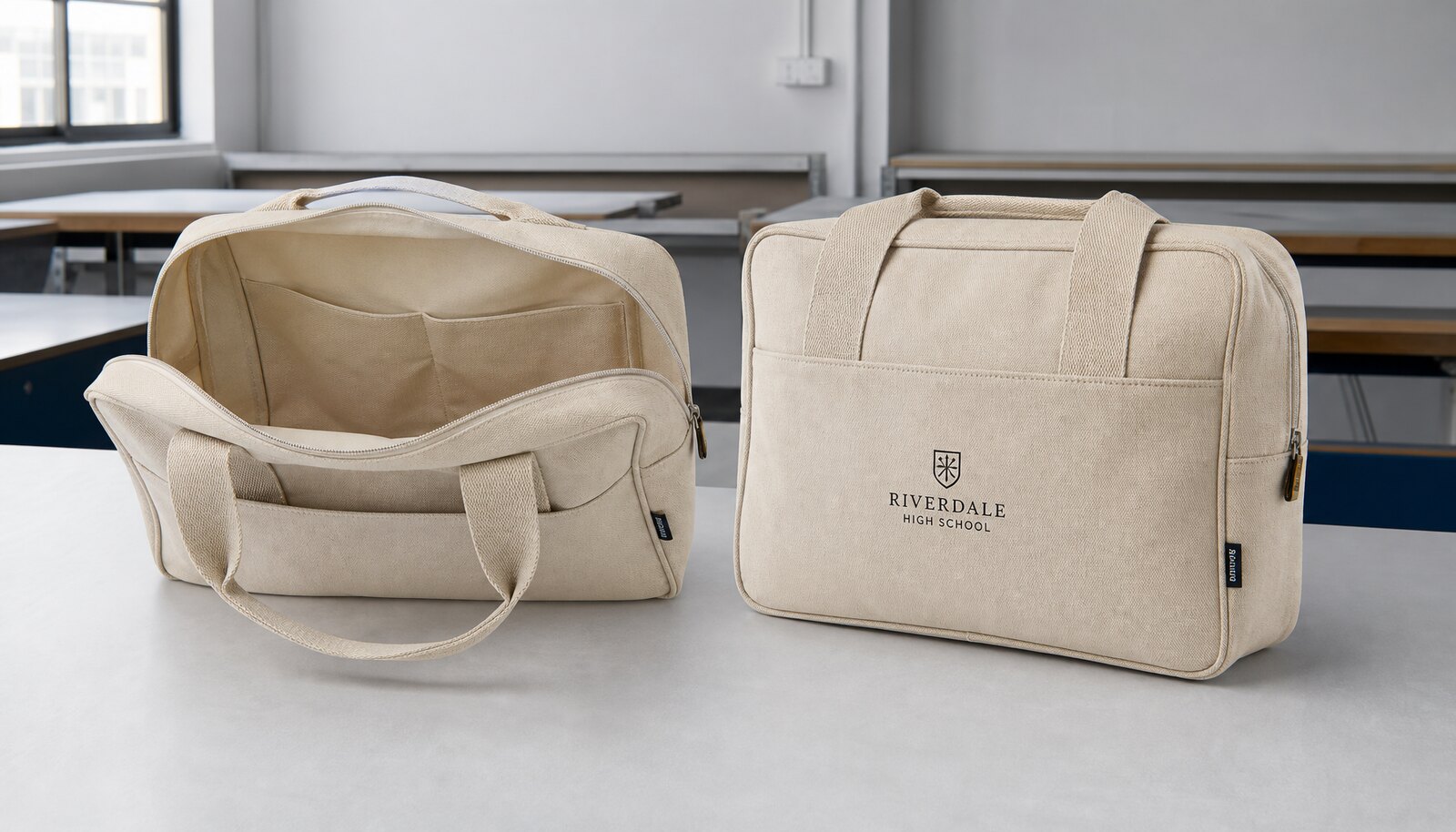
For schools, a canvas conference bag is not a fashion tote. It is a working item for orientation packs, staff development days, parent events, admissions briefings, and student leadership programs. That means the buyer should define the bag by the load it must carry and the way it will be handed out, not by a vague idea of a nice-looking cotton bag. If the bag is supposed to hold folders, a notebook, a pen set, a brochure stack, and a thin device sleeve, the spec has to support that load without turning the bag into a weak, floppy pouch.
The practical question is not whether the bag looks simple. It is whether the logo is legible, the handles survive repeated use, and the bag still looks acceptable after being filled and carried through a full event day. School orders are often judged by receiving teams and event staff in the first minute after unpacking, so the bag should arrive flat, clean, consistent in shade, and ready to distribute without extra handwork.
- Define the actual contents: handouts, notebook, folder, device sleeve, bottle, or swag item.
- Set the use horizon: one-day event carry, semester use, or repeat staff distribution.
- Decide whether the bag is a branded giveaway or a working conference accessory.
Choose The Canvas Spec Around Use, Not Just Price
Canvas weight should be selected from the load and the budget together. For many school conference bags, 12 oz canvas is a sensible starting point because it balances body structure, print quality, and price. Ten oz can work for light handout kits and low-cost programs, but it starts to feel soft if the bag is expected to hold books or a laptop sleeve. Fourteen oz gives a more substantial hand feel and better shape retention, but it raises material cost and can make the bag less flexible if the pattern is not adjusted.
Ask for the finished fabric weight in both oz and GSM if the factory can provide it. That helps you compare quotes across suppliers that use different measuring habits. If the program needs a more premium appearance, consider a modest gusset, self-fabric handles with reinforcement, and a cleaner top edge finish. If the school wants the bag to sit flat on a desk during an event, keep the body simple and avoid overspecifying pockets that complicate cutting and sewing.
- 10 oz: workable for light collateral and short-term distribution.
- 12 oz: the most practical middle ground for most school conference use.
- 14 oz: better for heavier loads, but cost and stiffness rise fast.
- A 2 to 3 cm gusset is often enough for documents without adding unnecessary bulk.
Compare Supplier Routes Before You Compare Unit Price
The cheapest unit price is not always the best buying route. A direct factory usually gives better control over fabric, stitching, and print placement, which matters when the school wants consistent bags across multiple campuses or annual reorders. A trading company can be useful if the buyer wants bundled service and does not have time to manage every production detail, but the quote needs to show what is actually being made in house versus moved through subcontractors. A local decorator or print shop can work for urgent small runs, though the bag body often comes from stock inventory rather than a purpose-built spec.
When you review quotes, compare route against risk. A stock blank bag with local printing can be fast, but fabric shade and seam quality may vary from batch to batch. A direct custom factory run takes longer, but it gives better control over logo placement, handle stitching, and carton packing. For school programs that repeat every year, the long-term value usually comes from consistent production records, not from the first low quote.
- Direct factory: best for repeat orders, spec control, and stable quality.
- Trading company: useful when you need managed sourcing, but verify the real production source.
- Local decorator: useful for urgent or very small orders, but not always the best route for consistency.
- Stock blank plus logo: fastest option, but less control over fabric shade and bag structure.
Use The Right Logo Method For School Branding
For a canvas conference bag, the logo method should match the artwork and the order size. Screen print is usually the first method to price because it handles solid shapes, school names, and simple one-color marks well. It is also easy to repeat on larger orders. If the logo has a premium look requirement, a sewn woven patch or side label can be stronger visually than a direct print, especially when the design includes small type that would fill in on rough canvas. Embroidery works, but it can look too raised or heavy on some tote styles and may not be the best choice for large flat graphics.
The key is to define what is acceptable before bulk production starts. Make the supplier show the final print size on the actual bag, not just a layout file. For schools, a clean one- or two-color logo with clear line spacing usually gives the best balance of cost and durability. If the design includes gradients, tiny text, or very thin strokes, push back early because those details may disappear once the ink sits on textured canvas.
- Screen print: best for simple school logos, large quantity, and controlled cost.
- Woven patch or sewn label: good for a cleaner premium presentation and small typography.
- Embroidery: useful when the brand wants texture, but it adds cost and can distort fine detail.
- If the logo uses multiple colors, define Pantone targets and print order before sampling.
Build The Quote Around MOQ, Setup, And Repeatability
MOQ is rarely just a fabric number. It is usually driven by cutting efficiency, print setup, carton planning, and how much material the factory must allocate to one style. That is why a buyer should ask for a price ladder at several quantities, not a single quote. A school distributor that plans to reorder can sometimes justify a higher initial MOQ if the factory holds the same spec and print setup for future runs. If the order is a one-time event kit, the buyer should resist overcommitting to features that increase minimum quantity without adding value on the receiving side.
Good quote structure separates the base bag from the decoration and the packing step. If the factory gives only one number, it becomes hard to see where the cost jumps come from. Ask for the cost impact of changing the size, adding a pocket, switching from self-fabric handles to webbing, or changing from one-color print to two-color print. That is the fastest way to identify which design choices are real value and which are just quote noise.
- Request pricing at 300, 500, 1,000, and 3,000 pieces if possible.
- Separate bag body cost, print setup cost, sample cost, and packing cost.
- Keep the body spec fixed if you want better repeat-order pricing.
- If you need a lower MOQ, expect a higher piece price or fewer customization options.
Approve The Sample Like A Production Buyer, Not A Designer
A sample should be judged against the use case, not just appearance. When the factory sends a pre-production sample, inspect the finished size, the canvas feel, the logo placement, and the way the handles sit on the shoulder or in hand. If the school wants the bag to carry documents neatly, fill the sample with the same load it will carry in use. That reveals whether the gusset is enough, whether the bottom panel twists, and whether the print area looks correct when the bag is loaded rather than empty.
The sample approval should become the reference for bulk production. Lock the fabric shade, logo size, print position, handle length, and any pocket or zipper detail. If a supplier says a change is minor, still treat it as a change if it affects the front panel layout or the way the bag is folded for packing. The most common rework problem on school orders is not a major failure; it is a small alignment drift that turns into a visible mismatch across a large delivery.
- Use a physical sample as the gold standard for bulk approval.
- Test the bag with real inserts, not an empty hand carry.
- Freeze logo position, fabric color, and handle reinforcement before bulk starts.
- Do not approve by photo alone if the order is above a small trial quantity.
Set QC Thresholds That Prevent Rework At Packing
School buyers should define quality control in measurable terms. The factory needs to know what counts as acceptable variance in size, logo placement, and stitch quality. If the canvas bag is too loose, the print can skew when the bag is folded. If the stitching is uneven, the handles may pull one way under load. The review should include the raw bag, the printed bag, and the packed carton because errors often appear in the handover between sewing and packing, not only in the print room.
The best threshold is simple: no open seams, no missing bar tacks, no obvious print smear, and no carton count mismatch. If a school project needs higher presentation value, add a stricter visual check for thread ends, corner sharpness, and panel symmetry. Do not make the inspection so complicated that the receiving team cannot execute it. A clear pass-fail sheet with a few critical points is more useful than a long list nobody can apply consistently.
- Check finished dimensions and handle length against the signed sample.
- Reject open stitches, skipped stitches, loose threads, and weak bar tacks.
- Confirm logo alignment, color, and edge clarity on random production units.
- Count packed units per carton and verify outer label accuracy before shipment.
Plan Packing For Distribution, Not For A Product Photo
Packing affects both freight cost and how easily the school team can receive the order. For most conference bag programs, bulk packing in polybags and cartons is more practical than individual retail packaging. It keeps labor lower and reduces unnecessary insert materials. If the bags are going straight to a school warehouse or event organizer, outer carton labels, carton counts, and clear folding direction matter more than retail display. The buyer should tell the factory whether the bags are being distributed by campus, by department, or by event kit so the carton plan matches the receiving flow.
If the route is humid or the shipment is long, add basic moisture protection and make sure the canvas is fully dry before packing. For printed bags, the fold direction should protect the logo from abrasion inside the carton. The carton size should be practical for manual handling, not just optimized for cubic freight efficiency. A carton that is too heavy slows unloading and increases the chance of damage in the final mile.
- Use bulk packing unless retail presentation is a hard requirement.
- Specify carton count, carton markings, and any campus sorting needs.
- Protect printed faces from rub marks during folding and transport.
- Keep carton weight manageable for warehouse staff and school delivery teams.
Treat Lead Time As A Sequence Of Risks
Lead time is not one number. It is a chain of steps: artwork approval, material allocation, sample sign-off, cutting, printing, sewing, packing, and shipping booking. School orders often get squeezed because the buyer leaves artwork approvals too late, then discovers that a small logo revision forces a new sample. The safer approach is to finish the spec before the seasonal rush starts. If the bags are for back-to-school, orientation, or a conference calendar, the order should be moving toward production before the final event schedule is fully locked.
The biggest schedule risks are fabric availability, print approval delays, and carton packing changes near the end of production. If the buyer wants custom dyed canvas or a special lining, the lead time can extend quickly. The factory should tell you where the bottleneck is, not just quote a total number of days. That allows procurement to build a realistic buffer for internal approvals, freight booking, and receiving at the destination.
- Separate artwork approval time from production time in the project calendar.
- Assume the first sample is part of the schedule, not an extra step.
- Keep a buffer for peak-season freight and carton rework.
- If the order is tied to a fixed school event, lock the spec early and avoid late artwork changes.
Review Landed Cost Like A Procurement Buyer
A useful quote review goes beyond the factory unit price. It should show the cost stack from bag body and print setup through packing, export, freight, duty, and destination handling if the buyer is comparing landed cost. This matters because a low FOB number can become an expensive delivered order once destination fees are added. The same is true when comparing a direct factory quote with a local decorator quote: the local option may look easy on paper, but the bag construction and decoration limits may not match the school's actual need.
For a clean comparison, ask each supplier to quote the same bag spec, the same logo method, and the same packing plan. Then compare apples to apples: total landed cost, expected quality consistency, and how much effort it takes to reorder. If the school wants one bag style for multiple events, repeatability may be worth more than shaving a small amount off the unit price on the first order.
- Compare unit price, setup cost, packing cost, and destination cost together.
- Hold the spec constant across suppliers so the quote is actually comparable.
- Value repeat-order stability if the school program will be used again next year.
- Do not let a cheap quote hide weak fabric, poor print, or costly destination handling.
Specification comparison for buyers
| Spec decision | Recommended option | When it fits | Buyer risk to check |
|---|---|---|---|
| Supplier route | Direct factory with canvas bag experience and in-house print control | Repeat school programs, multiple campuses, or buyers who need stable quality across reorders | Confirm who cuts, prints, and packs the bag; if those steps are split across subcontractors, color and stitching consistency can drift |
| Fabric weight | 12 oz canvas as the default starting point, with 10 oz for light loads and 14 oz for heavier use | Folder packs, notebooks, orientation kits, and staff events where the bag must hold shape without becoming too expensive | Do not compare only ounce weight on paper; ask for finished GSM and whether the cloth has been pre-shrunk or washed |
| Bag structure | Flat body with a modest gusset and reinforced base | School conference kits that carry paper files, handouts, pens, and a thin laptop or tablet sleeve | If the gusset is too small, the bag looks neat but loses useful volume; if too large, the logo area can distort when filled |
| Print method | Screen print for 1 to 2 solid colors, woven patch or sewn label for premium branding | Large school orders with simple logos, repeated distribution, or when the buyer wants a durable mark at controlled cost | Fine text, gradients, and small details can fail on canvas; approve actual artwork size and Pantone tolerance before production |
| Handle spec | Self-fabric handles with bar-tack or X-box reinforcement at the stress points | Standard school use where the bag is carried by hand or over the shoulder, not loaded like a travel tote | Check handle drop, stitch density, and whether the handle seam pulls the front panel out of shape under load |
| Sample path | Pre-production sample after fabric, print, and size approval | First order, new supplier, or any project where the logo position and color must match a brand standard | A digital proof is not enough; lock the physical sample as the gold standard for bulk production |
| Packing route | Bulk polybag packing with clear carton counts and outer labels | Institutional deliveries, warehouse receiving, and school distribution teams that repack on site | Avoid retail-style packing unless it is required; extra folding and inserts add labor, carton size, and freight cost |
| Trade term | FOB for buyers with their own freight forwarder, DDP only if landed cost is the priority and the route is simple | Importers and distributors who can compare freight, duty, and destination fees separately | A low factory price can hide expensive destination charges; compare landed cost, not just unit price |
Buyer checklist before sampling
- Final bag size with tolerance, plus the content load the bag must carry
- Finished fabric weight in oz or GSM, and whether the canvas is bleached, dyed, or natural
- Logo file in vector format, approved colors, and exact print placement with measurements
- Handle length, handle drop, reinforcement method, and any shoulder-carry requirement
- Closure, lining, pocket, zipper, or gusset requirement if the school use case needs them
- Sample approval owner, approval deadline, and what changes still require re-sampling
- Packing method, carton count, outer label text, and whether individual polybags are needed
- Target MOQ and the acceptable price jump if the order moves below the factory threshold
- Delivery window, ship-to location, trade term, and whether the freight is booked by the buyer or supplier
- QC tolerance for size, print position, color variation, stitching defects, and carton count
Factory quote questions to send
- Is the bag body, cutting, printing, and packing done in-house or split across subcontractors?
- What is the finished fabric weight after finishing, not just the raw cloth weight?
- What is the MOQ for this exact size, fabric, handle spec, and print method?
- What setup charges apply for screens, plates, embroidery, woven labels, or artwork correction?
- Can you quote the same bag at 300, 500, 1,000, and 3,000 pieces so we can see the price curve?
- What sample is included before bulk production, and how many revisions are allowed?
- What stitch standard do you use for handles, side seams, and load points?
- How will the bags be folded, packed, carton-labeled, and counted at shipment?
- What is the production lead time after sample approval, and what can delay it?
- Can you share photos of a similar school or conference bag you have produced recently?
Quality-control points to confirm
- Measure the finished size, gusset, and handle length against the approved sample before packing starts
- Confirm the canvas weight, weave consistency, and color shade from the same bulk lot across the order
- Check logo placement, logo size, and print sharpness against the approved physical sample, not only the artwork file
- Inspect handle attachment points, bar tacks, and side seams for open stitches, skipped stitches, and thread breaks
- Test the bag under realistic school load to see whether the base sags, seams twist, or handles pull unevenly
- Verify zipper action, pocket alignment, and lining finish if those features are included in the spec
- Check for stains, odor, loose threads, folded marks, and ink transfer before cartons are sealed
- Confirm carton count, carton labels, and pallet stack pattern so receiving teams can unload and count quickly