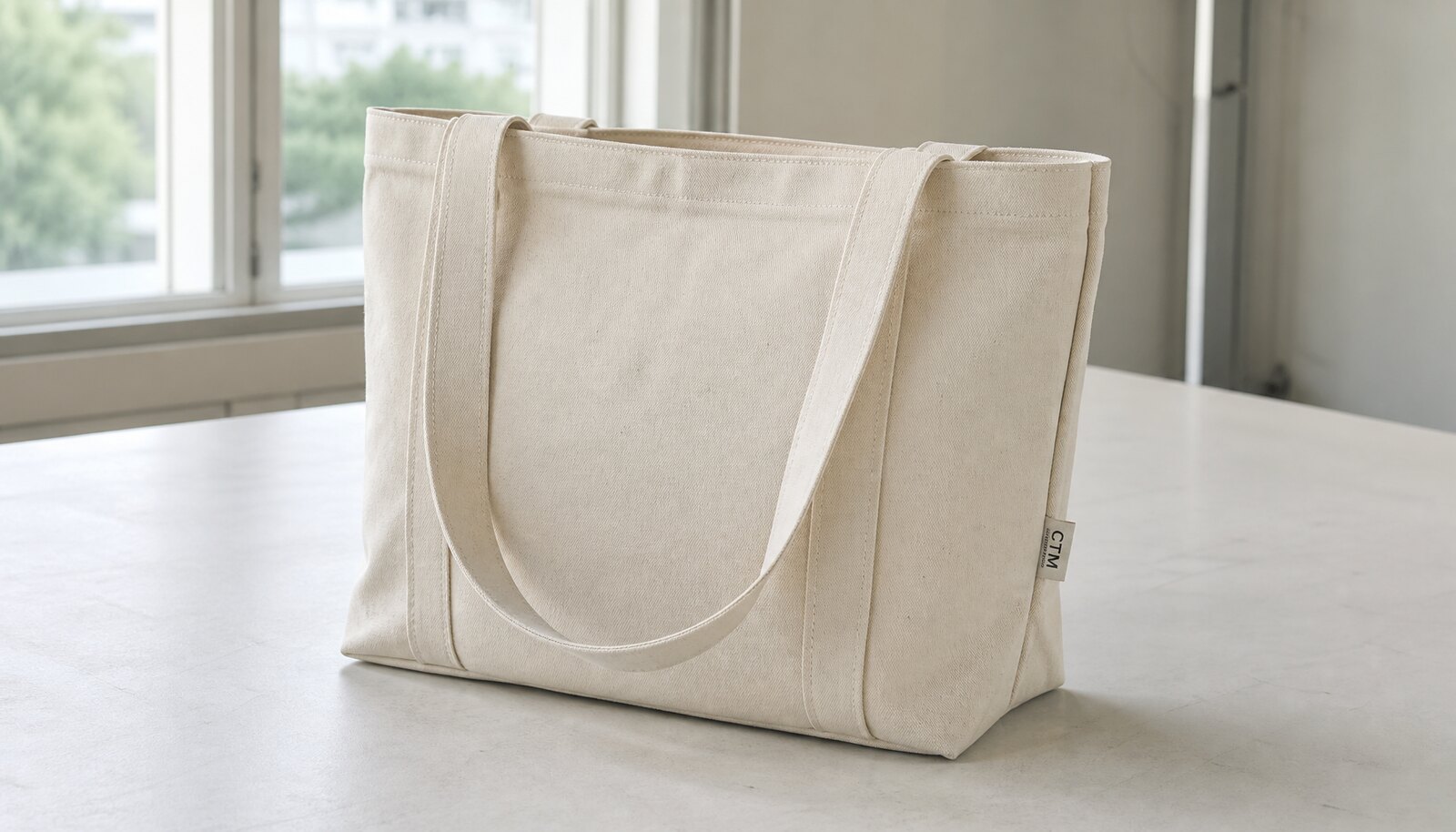
What a retail launch bag has to do
A canvas conference bag for a retail chain launch is not just a giveaway. It has to carry merchandise, look consistent on shelf, survive handling in the distribution center, and still fit the price point your buyer set for the program. That means the bag spec needs to be defined around use, not around a vague idea of a "nice tote." If the chain plans to place the bag at checkout, near a seasonal display, or inside a launch kit, the size, print area, and pack format all affect sell-through and store handling.
The fastest way to lose margin is to let the factory decide the spec from a rough logo file. A bag that is too light feels cheap. A bag that is too stiff turns into excess freight. A bag with a weak handle or poor print opacity creates rejects before the launch ever reaches stores. Start with the use case: what the bag carries, how it is displayed, how it is shipped, and what the chain expects the customer to do with it after purchase.
- Define the use case first: carry bag, event bag, welcome kit, or resale tote.
- Set a target load before sourcing so the factory can size the handle and seam reinforcement correctly.
- Make shelf presentation part of the spec if the bag will be merchandised, not just distributed.
Start with the right canvas spec
For most retail launch programs, the main choice is between 8 oz, 10 oz, and 12 oz canvas. In practical terms, 8 oz or around 280 gsm works for low-cost promotional use, but it can feel thin once printed and folded. 10 oz or around 340 gsm is the safer default for a retail chain launch because it balances cost, structure, and print performance. 12 oz or around 400 gsm gives a stronger, more premium hand feel, but it also adds weight, freight cost, and sometimes stiffness that is unnecessary for a simple branded bag.
The wrong fabric choice creates quiet problems. A light canvas can shrink too much, distort print placement, or show through the weave after ink is applied. An oversized canvas spec can make the bag too bulky for shelf packs and too expensive to move through a chain's supply system. Ask for the actual finished fabric weight, not a vague description like "good quality canvas," and make sure the supplier states whether the fabric is natural, bleached, dyed, or washed after sewing.
- 10 oz / 340 gsm is usually the safest launch spec for a reusable retail tote.
- 12 oz / 400 gsm fits premium resale programs or heavier carry loads.
- Lock the fabric color standard early if the bag must match a seasonal brand palette.
Pick the sourcing route that matches your launch risk
Retail buyers often compare suppliers on unit price and miss the bigger issue: who actually controls the bag from fabric cutting through final packing. A direct factory with in-house sewing and printing usually gives the best control over tolerances, sample approval, and repeat order stability. A trading company can be useful if your program will expand into several bag styles or needs backup capacity, but only if the accountability is clear. A stock blank bag plus local print route is best when speed matters more than exact spec control.
For a launch, the right route depends on risk. If your chain is rolling out hundreds of stores and the bag will be replenished, direct factory control usually wins. If you are testing the concept in a limited geography, a stock base bag with local decoration may be acceptable even if the unit cost is higher. The key is to compare suppliers on what they can prove, not on what they claim. Ask for real production photos, sample provenance, and the name of the plant that will execute the order.
- Direct factory: best for stable QC and repeatability.
- Trading company: useful for range management, but the factory link must be visible.
- Stock blank plus local print: fastest, but usually weakest on consistency and brand control.
Print method changes the whole quote
For canvas conference bags, screen print is still the most practical method for most retail launches. It handles simple logos well, holds color on natural canvas, and keeps the quote readable when the artwork is one or two colors. If the logo is small, detailed, or built with gradients, the production team may simplify it or change the print method to something more forgiving, but that usually adds cost or visual compromise. Woven labels and side labels are useful when the brand wants a cleaner premium cue without covering the whole front panel.
Do not approve artwork before the factory confirms the print window, seam clearance, and registration limits. A logo that looks fine on a monitor can fail on canvas if lines are too fine or if the print area crosses a seam. For screen printing, ask for the ink type, cure method, and rub resistance. For woven labels, confirm stitch density, edge finish, and how the label is attached so it does not fray in transit. The best quote is the one that shows how the artwork will be made, not just what it will look like.
- One-color screen print is usually the lowest-risk option.
- Two-color print increases setup and registration risk, so simplify artwork if possible.
- A woven side label can add brand value without forcing a more expensive main-panel print.
MOQ, sampling, and approval gates
MOQ on canvas bags is rarely a single number pulled from nowhere. It is shaped by fabric roll usage, cutting efficiency, print setup, and how many colorways you want in the same order. A natural canvas bag with one print color can often support a lower MOQ than a dyed canvas bag with multiple artwork placements and retail packaging. If you split quantity across too many colors, the factory loses efficiency and the quote rises quickly. That is why the most useful RFQs state the quantity per color and per design, not just a total order volume.
Sampling needs its own approval path. A size sample confirms dimensions and handle geometry. A pre-production sample confirms the fabric, print, and packing sequence that bulk production will follow. If the launch is sensitive, treat one sealed golden sample as the reference for future disputes. Do not move bulk into production until the supplier has confirmed the exact fabric lot, print screens, trim materials, and packing method. Most preventable mistakes in tote sourcing happen because a sample was approved but never converted into a locked production standard.
- Lower MOQ usually follows simpler fabric, simpler artwork, and simpler packing.
- Approve a pre-production sample before bulk, not just a photo or a rough hand sample.
- If color accuracy matters, retain a sealed golden sample for reference.
Write QC thresholds into the order
A clean tote quote is not enough. You need acceptance criteria that the factory can actually test before shipment. That starts with size tolerance, stitch quality, print position, and handle strength. For retail launch bags, the tolerances do not need to be extreme, but they should be written down. If the bag is intended for resell, set a clear expectation for seam finish, thread cleanup, and print consistency. If it is for a launch kit, be stricter on presentation, because a messy seam or sloppy print will be visible the moment the bag is opened.
Buyers often ask for a load test, but the important part is defining the use case behind it. A promo tote does not need the same strength as a heavy grocery bag, yet the seam and handle still need to survive normal customer use. Write the target in business terms: what the bag must carry, how many units can fail, and which defects are automatic rejects. That is more useful than a generic request to "make the quality good."
- Use size, stitch, print, and load criteria as separate acceptance points.
- Set a defect rule for stains, holes, broken stitches, and label errors.
- Require pre-shipment inspection photos or a third-party report for larger programs.
Packing can make or break retail handling
Packing is part of the product, especially for a retail chain. If the bag arrives wrinkled, over-compressed, or packed with labels in the wrong place, the store team pays for it later. Decide early whether the bag ships bulk folded in a master carton or individually packed for store-ready handling. Bulk pack lowers cost and is fine if the distribution center will rework the units. Individual polybag packing is cleaner for scan-based receiving and direct-to-store flow, but it adds plastic, labor, and carton volume.
Barcode and carton marking details need the same attention as the bag spec. If the retail chain uses UPCs or internal item codes, the supplier should know where the sticker goes, what size it must be, and how it should scan at receiving. Carton count matters too, because an odd pack size can slow down distribution and force manual repacking. Put the packing instruction in the RFQ, not in a side email, so the quote reflects the real handling cost.
- Bulk pack is cheaper, but only if the DC can handle repacking.
- Individual polybag packing is better for store-ready flow and barcode control.
- Confirm whether the chain has a plastic reduction policy before choosing polybag format.
Plan lead time around approval, not hope
Retail launches fail when lead time is treated like a single number instead of a sequence of gates. The factory needs time for fabric sourcing, cutting, printing, sewing, packing, and inspection. The buyer needs time for artwork sign-off, sample review, and internal purchase approval. If the launch date is fixed, the only safe method is to count backward from the ship date and freeze the approval stages early. Do not let artwork drift after sampling, because every late change restarts setup time and can disturb the print screens or label run.
A realistic plan also leaves room for shipping and customs. If the chain wants a domestic store drop, build in transit and DC receiving time. If the bags are imported, leave enough margin for inspection hold, document corrections, and potential carton rework. The launch calendar should include a buffer for one problem: a sample revision, a print correction, or a carton count mismatch. A bag program that depends on a perfect first pass is fragile by design.
- Count lead time from pre-production sample approval, not from first contact.
- Freeze artwork, carton copy, and barcode placement before bulk starts.
- Keep a schedule buffer for inspection, transit, and receiving issues.
Compare quotes on a landed-cost basis
The easiest way to compare supplier quotes is to force them into the same structure. Ask for fabric GSM, bag size, print colors, packing format, carton spec, sample fee, tooling, and incoterm in separate lines. A quote that gives only one unit price is not comparable, because it may hide screen charges, label fees, carton upgrades, or a different fabric weight. This is where many retail teams lose margin: the lowest unit price is often the most incomplete quote.
For landed-cost planning, compare the bag at the point where your chain receives it ready for sale or distribution. That means material, labor, print setup, packing, inland handling, and shipping all belong in the analysis. If two suppliers offer similar FOB numbers, the better one is usually the one with fewer hidden variables and cleaner proof of production. The quote should read like a production plan, not a sales brochure.
- Require separate pricing for sample, tooling, bulk unit, packing, and freight assumptions.
- Compare finished bag specs, not just quoted fabric descriptions.
- Choose the quote that exposes the fewest hidden rework or packing costs.
Specification comparison for buyers
| Spec decision | Recommended option | When it fits | Buyer risk to check |
|---|---|---|---|
| Supplier route: direct factory with in-house sewing and print | Best control over fabric, stitching, and print approval | Launches that need repeat orders and stable QC | Verify the factory actually cuts, sews, and prints on site, not through silent subcontracting |
| Supplier route: trading company with a fixed factory pool | Useful when you need multiple bag styles or backup capacity | Programs with wider SKU range or shifting volume | Confirm who owns sample approval, defect claims, and delivery accountability |
| Supplier route: blank stock bag plus local decoration | Fastest route for small test launches | Urgent rollouts or pilot programs | Expect higher unit cost, shade variation, and weaker control on bag consistency |
| Fabric weight: 10 oz / 340 gsm canvas | Balanced retail launch spec with a solid hand feel | Most standard reusable retail bag programs | Check finished GSM after washing and whether the fabric is tightly woven enough for print detail |
| Fabric weight: 12 oz / 400 gsm canvas | Heavier, more premium feel with better structure | Higher-ticket retail bags or heavier carry loads | Watch freight weight, carton count, and whether the bag becomes too stiff for the intended use |
| Print method: one-color screen print | Lowest risk for clean logos and good opacity | Large volume and simple artwork | Ask for cure test results and how the ink behaves on natural canvas texture |
| Print method: two-color screen print or print plus woven label | Better branding when the logo needs more than a single flat mark | Retail chains that want a more polished presentation | Confirm registration tolerance, plate charges, and whether the artwork is simplified for production |
| Packing route: bulk folded in master carton | Lowest packing cost and easiest for DC repack | When the retail chain handles final store prep | Make sure fold marks are acceptable and the cartons protect the canvas from compression |
| Packing route: individual polybag with barcode and shelf-ready carton | Best for direct-to-store or barcode-controlled receiving | Retail programs that need store-ready handling | Check plastic policy, label placement, and whether the carton pack matches the store flow |
Buyer checklist before sampling
- Final bag size, gusset, handle length, and handle drop are written in the RFQ and matched to the merchandiser's shelf and carry requirements.
- Canvas weight is stated as finished GSM or oz, with the color standard noted as natural, bleached, dyed, or dyed plus washed.
- Artwork is supplied as vector art with Pantone references, print area dimensions, and any no-print zones around seams and handles.
- The required print method is named, including the number of colors, ink type, and whether side labels, woven labels, or embroidery are allowed.
- The pre-production sample stage is defined, with one sealed reference sample approved by procurement, brand, and quality if needed.
- Packing instructions cover fold method, polybag yes/no, barcode location, inner pack, master carton count, and carton marking language.
- The quote states MOQ per color, per artwork, and per order repeat, plus any surcharge for mixed colors or mixed destinations.
- The RFQ names the destination incoterm, target ship date, and whether the supplier must quote carton dimensions and gross weight.
- QC expectations are written into the PO, including size tolerance, stitch quality, print adhesion, load test, and carton drop protection.
- A reserve plan exists for overrun, shortage, and replacement units so the launch does not depend on a single perfect shipment.
Factory quote questions to send
- Is the bag quoted from finished GSM or from raw fabric weight, and what tolerance do you allow after cutting and sewing?
- Do you cut, sew, print, and pack in the same factory, or is any step subcontracted?
- What is the MOQ per color, per print artwork, and per packing format?
- What sample stages are included in the quote, and which sample type should be treated as the approved golden sample?
- What are the extra charges for print plates, screen setup, woven labels, hangtags, barcode stickers, and carton markings?
- What is the lead time from artwork approval and deposit, not just from the first inquiry date?
- What packing standard is included: bulk pack, individual polybag, inner carton, or shelf-ready retail pack?
- What QC tests do you perform before shipment, and can you share the acceptable load test or stitch standard?
- What carton size, carton count, and gross weight do you quote for export planning?
- Can you combine multiple colors or store allocations in one order, and if so, what is the cost impact?
Quality-control points to confirm
- Finished bag size should stay within the agreed tolerance, especially width, height, and gusset depth.
- Handle length and handle drop must match the approved sample so the bag hangs correctly on a shoulder or retail hook.
- Stitching should be even, secure at stress points, and free of skipped stitches, loose thread knots, or seam puckering.
- Canvas weight should be close to the agreed spec, and the shade should be consistent across the batch.
- Print placement must stay inside the approved area with no major registration drift, ghosting, or broken edges.
- Ink cure should pass a rub test that does not smear easily during packing or first use.
- Seams and handle attachment points should survive the agreed load test without tearing or opening.
- Fabric should be clean, with no oil marks, holes, broken yarns, staple contamination, or strong odor.
- Labels, barcodes, and carton marks must be in the correct position and scannable at receiving.
- Cartons should hold shape after stacking and basic transit handling, with no crushed corners or burst seams.