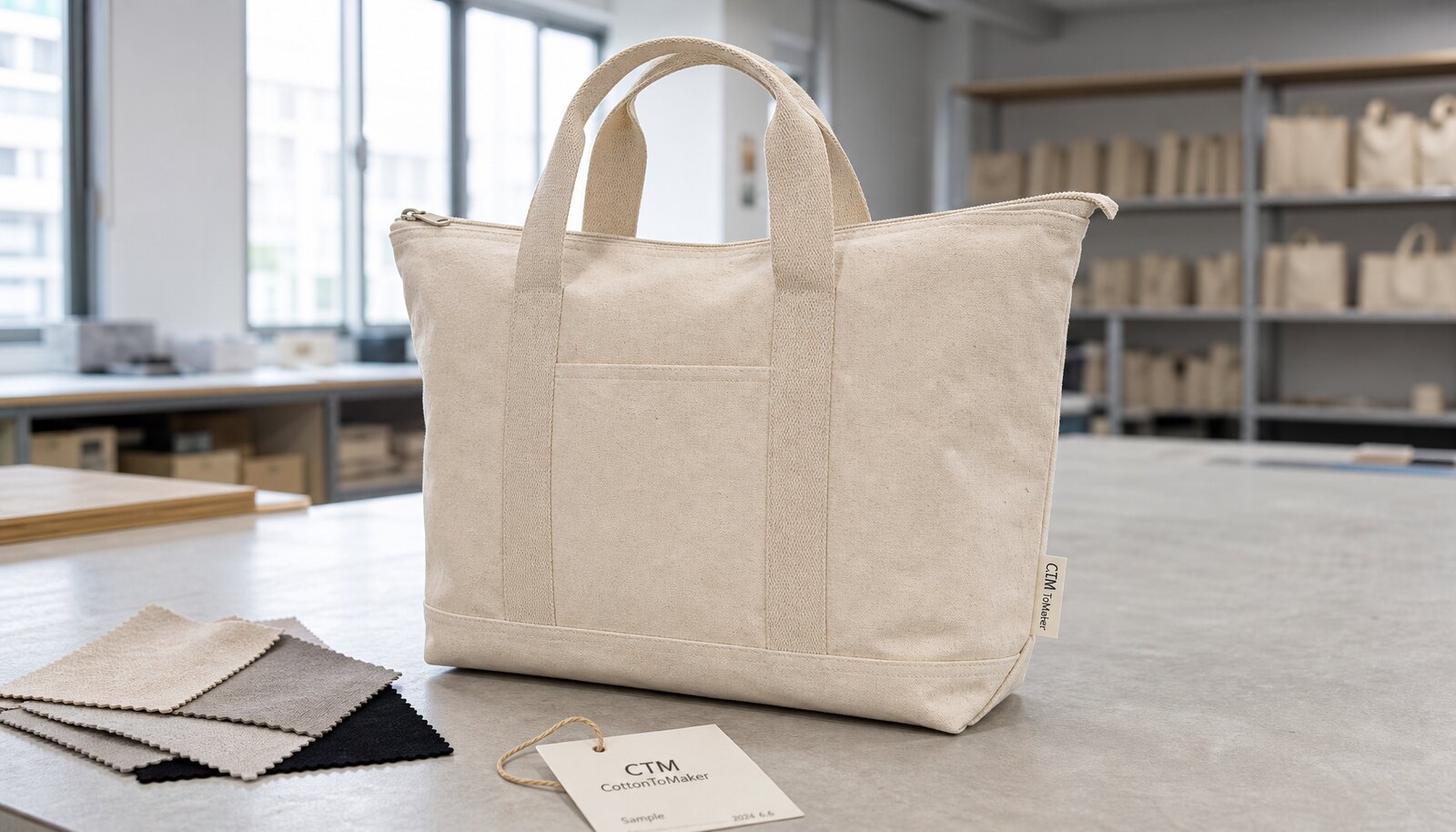
Start With The Hotel Use Case
A hotel conference bag is not just a tote with a logo. It has to work as a small operating container for the property team and as part of the guest experience. In practice, that means carrying printed agendas, notebooks, pens, badges, a charger, and sometimes a tablet, water bottle, or retail brochure without collapsing into a soft pile. If the bag is too floppy, the contents telegraph through the fabric and the handoff looks cheap. If the opening is too tight, the event team wastes time forcing kits into the bag and the bag starts to wrinkle or tear before it reaches the guest.
The first buying decision is therefore the use case, not the artwork. A one-day conference pack, a multi-day seminar kit, a VIP welcome bag, and a reusable guest takeaway bag all need different structure, load tolerance, and decoration choices. A bag that will stay on property can be lighter and simpler. A bag that leaves with the guest or is reused across events needs better seam strength, a more durable print, and a finish that still looks clean after handling. If the hotel group wants a bag that can also work as retail packaging, the spec has to reflect that from the beginning.
- Write down the real contents and estimated total weight before you ask for quotes.
- Decide whether the bag is hand-carry only, shoulder-carry, or expected to do both.
- State the expected life of the bag: one event, repeated hotel use, or guest takeaway.
Turn The Brief Into A Real Spec Sheet
A usable spec sheet is more than a size and a logo file. It should define finished dimensions, gusset depth, handle length, handle width, closure type, pocket layout, lining, and any hanging tag or woven label. For many hotel programs, a useful starting size is around 38 x 42 cm with an 8 to 12 cm gusset, but the right dimensions depend on what actually goes inside the bag. If the contents include a bottle or document folder, a taller body or wider gusset may be more important than a wider front panel.
The spec should also contain tolerances. Buyers often leave this out and then argue about a bag that is technically close but not acceptable in the hand. For wholesale hotel buys, a practical starting point is plus or minus 1 cm on overall dimensions and plus or minus 0.5 cm on handle length, with logo placement held to plus or minus 5 mm from the approved artwork position. If the supplier cannot work to a written tolerance, they will treat every sample as a loose target and your bulk order will drift.
To make the brief usable across multiple bidders, add a simple sketch or tech pack. The drawing should mark the front panel, back panel, side gussets, bottom seam, handle base, print zone, pocket location, zipper line if present, and any label placement. That avoids the common problem where one supplier quotes an open-top tote, another quotes a zip-top version, and a third assumes a pocketed promo bag. A one-page visual spec prevents that drift faster than a long email thread ever will.
- Specify finished dimensions, not just nominal catalog size.
- State handle drop in addition to handle length if the bag needs shoulder-carry clearance.
- Add a sketch or tech pack that marks logo placement, pocket size, zipper line, seam direction, and label position.
- Define whether the bag should stand upright when empty or only when filled.
Set Build Standards For Canvas, Seams, And Handles
Canvas weight matters, but it is not the whole build. For many hotel conference bags, 12 oz canvas around 400 GSM is a practical middle ground because it holds shape, prints well, and avoids unnecessary freight or sewing difficulty. Ten oz canvas around 340 GSM can work when the contents are light and the budget is tight. Sixteen oz canvas around 450 to 480 GSM is better when the bag needs a more structured retail feel or repeated reuse, but the extra fabric weight raises sewing effort and can expose weak production methods if the factory is not used to heavier cloth.
The real durability comes from reinforcement. Ask for a double-fold top hem, load-bearing seams sewn at a consistent stitch density, and a named reinforcement method at the handle base such as box-x stitching with bar tacks. A 25 to 30 mm webbing handle is usually more comfortable than a narrow tape and spreads the load better across the seam. If the bag has a gusset, the lower corners should be reinforced so the bag does not split when staff load it with hard inserts or a full set of literature. Buyers often focus on canvas thickness and overlook these seam details, even though that is where failure usually starts.
Do not accept a quote that treats canvas weight as the only durability measure. Ask the supplier to identify the full build: top hem width, handle tape width, handle attachment method, seam allowance, corner reinforcement, and whether there is any lining or interfacing. If the supplier says the bag has been 'tested' or 'strong enough,' ask what test, what load, and for how long. A useful procurement rule is simple: if the factory cannot describe the build in production terms, the quote is not yet ready for comparison.
- Require the supplier to state whether the canvas weight is finished fabric weight or raw cloth weight.
- Ask for box-x plus bar tack reinforcement at the handle base and gusset corners.
- Set a load target in the RFQ, with the actual test method described in writing.
- Ask for a close-up photo of the inside seam finish, not just the outside view.
Choose Decoration Based On Brand Risk
Decoration method changes cost, lead time, and rejection risk. Screen print is still the most practical choice for many canvas conference bags for hotels wholesale programs because it handles one or two solid colors cleanly and keeps unit cost manageable at volume. The buyer still has to control the artwork tightly. On textured canvas, a large logo can lose detail if the ink is too thin, the print area is too wide, or the cure is not stable. Ask for the exact logo width, print placement, and color reference before the first strike-off is made.
Embroidery and woven patches feel more premium, but they are not free of risk. Embroidery can pucker on soft canvas if backing, thread density, and stitch direction are not controlled. Patches need clean edge finishing or they start to curl after handling. If the hotel wants the bag to be reused, photographed, or treated like a small retail product, the premium methods may be worth the added setup cost. If the order is a large, simple event run with a fixed deadline, a well-controlled screen print usually offers the best balance of speed and cost.
The main procurement mistake is to compare decoration methods only on the decoration line item. A cheap print may look attractive until you add extra sampling, higher rejection risk, or a longer approval cycle. For that reason, ask each supplier to quote the same art size, the same number of colors, and the same decoration position. If the supplier proposes an alternative placement, treat it as a separate option rather than a hidden substitute. That keeps the quote clean and stops an unexpected print move from changing the look of the entire bag.
- Lock the Pantone target and agree the substrate before the supplier prices the job.
- Set a written color tolerance if the supplier can measure it consistently.
- Treat the decorated sample as a production test, not a creative mockup.
- Check the logo at actual size on the actual canvas, not only on a digital proof.
Compare Supplier Routes On More Than Price
The supplier route shapes the whole order. A direct factory is usually the best fit when the hotel needs custom dimensions, a specific canvas weight, and a repeatable build. You generally get better control over reinforcement, carton packing, and revision history, and the price structure is easier to interrogate. The tradeoff is that the buyer has to manage more detail directly and verify that the seller is truly the factory, not a broker with a catalog image and a middleman margin.
A trading company or sourcing agent can simplify communication when the order mixes multiple products or the buyer wants one contact for sampling, freight, and documents. The downside is less transparency on the factory, the real source of the sample, and where changes get lost during handoff. A domestic stock decorator can be useful for urgent programs, but the buyer usually gives up fabric control and ends up paying more per unit for speed. For hotel procurement, the lowest quote is rarely the lowest risk unless the supplier route matches the schedule and the spec.
Geography and order size also change the economics. A supplier close to the final destination may offer lower freight or faster delivery, while an offshore factory may win on piece price but add longer transit, more communication steps, and more variation in packing. Small orders usually carry more setup and handling overhead per unit. Larger runs can absorb setup more efficiently, but only if the spec is stable. That is why buyers should ask each bidder to explain what in the quote is affected by location, what is affected by volume, and what is fixed regardless of order size.
- Ask who physically makes the bag and who owns production quality if a defect appears.
- Request production photos from the actual line, not generic catalog imagery.
- Check whether the sample came from stock or from the same line that will make the bulk order.
- Confirm the person managing the order can explain both the build and the logistics.
Write An RFQ That Actually Compares Like With Like
Most weak quotes come from weak briefs. If the buyer sends only a logo and a target price, every supplier fills in the missing details differently, which makes comparison almost meaningless. The RFQ should include the finished size, canvas weight, color target, handle spec, reinforcement method, closure, pocket layout, decoration method, packing style, destination term, and target quantity breaks. The supplier should not have to guess whether the bag is open top or zipper top, whether the print is one color or two, or whether the carton must be retail-ready or just bulk packed.
The quote should also separate base bag cost from setup and add-ons. Screen charges, digitizing, patch tooling, sample fees, carton cost, polybagging, and freight should all be visible. Ask each supplier to quote the same breakpoints, such as 500, 1,000, 3,000, and 5,000 pieces, using the same spec sheet. That exposes whether the low first-tier price is real or whether the supplier is recovering margin through hidden setup costs. If you want a supplier to quote an alternative, ask for it explicitly, such as a lower-cost open-top version or a higher-end zipper version, so the comparison does not get muddied.
A good RFQ should also define what the supplier must assume and what they must not change. For example, if the hotel needs a front pocket for a brochure insert, that pocket size and position should be fixed in the bid. If the buyer allows alternates, each alternate should be labeled clearly as a separate option. That small discipline matters because procurement teams often receive one quote for a zipper tote, another for an open-top tote, and a third for a lower-GSM bag, then spend time comparing products that are not actually equivalent.
- Send one spec sheet, one artwork package, and one packing instruction sheet to every bidder.
- Ask for line-item pricing for the bag body, decoration, setup, packing, and freight term.
- Quote quantity tiers on the same basis so each supplier is compared against the same volume assumptions.
- Request an alternate price only when you actually want a second build option.
Approve Samples Against Measurable Criteria
A sample is not approved because it looks acceptable in a photo. It has to pass a simple physical test. Measure the width, height, gusset depth, and handle length on the actual sample. Check the stitch line on the inside and outside. Open and close any zipper several times. If the sample includes a pocket, verify that it sits flat and does not pull the front panel out of shape. If the decoration is off by more than the approved tolerance, or the fabric weight feels lighter than the quote, the sample is not ready.
The cleanest path is a two-step sample process. First approve a plain sample for structure, dimensions, seam quality, and handle build. Then approve a decorated pre-production sample on the same fabric and with the same packing method that will be used in bulk. This keeps construction issues separate from print issues and makes it easier to know who owns the correction. For hotel programs with a fixed event date, the sample signoff should be written and final. If the supplier wants to change the handle length, print size, or reinforcement after signoff, the buyer should treat that as a schedule reset.
For higher-value or reusable programs, ask one additional question during sample review: how will the bag age in use? This is especially useful if the hotel intends to reuse the bag across multiple events or offer it to guests as a takeaway item. Look at seam puckering after handling, print surface coverage on the weave, and whether the bag still sits square after being filled. A sample that looks fine flat on the table can still feel cheap once the bag has weight in it.
- Approve the plain sample first, then the decorated pre-production sample.
- Use a pass or fail checklist with measurements, not just comments.
- Reject any sample that changes handle length, pocket size, logo placement, or closure type without written approval.
- Keep one approved sample as the reference for the bulk lot and future reorders.
Normalize The Quote Into Landed Cost
A cheap factory price is not the same as a cheap landed bag. The real comparison has to include sample cost, setup, packaging, carton cost, export documentation, freight, duty, customs handling, and any repacking labor at destination. A quote that leaves out cartons or assumes a smaller finished size can look lower on paper while delivering less usable volume and more work for the hotel receiving team. The same is true for freight. If the bags are bulky, volumetric weight can outweigh small unit price differences very quickly.
The easiest way to compare bids is to normalize them to the same spec and the same delivery term. If one supplier quotes a 10 oz bag with a thin handle and another quotes 12 oz canvas with proper reinforcement, the lower quote is not a real saving. The stronger build may reduce replacements, event-day damage, and guest complaints. For wholesale hotel buying, the target should be landed cost per usable bag, not factory cost per piece. That means the buyer has to price the whole chain, from sample approval to delivery at the property or consolidation point.
When the order is small, setup costs and shipping minimums can matter more than the bag body itself. When the order is large, small differences in fabric weight, packing density, and carton size can have a bigger impact. That is why the procurement team should normalize each quote with the same assumptions: same finished size, same decoration position, same packaging, same cartons, and same destination term. Without that normalization, the lowest price can simply be the most incomplete quote.
- Compare all quotes against the same finished size, fabric weight, decoration method, and packing format.
- Amortize setup and sample cost across the full order quantity before comparing totals.
- Check carton dimensions because cubic freight can matter more than the unit price difference.
- Treat very low prices as a prompt for a detailed cost breakdown, not as an automatic win.
Control Packing, Compliance, And Handover
Packing determines how much labor the hotel team spends after the shipment arrives. If the bags are going directly to the property for event distribution, bulk packing may be the cleanest option. If the hotel group wants the bags sorted by event, room block, or property code, the carton labeling has to match that plan exactly. The buyer should confirm units per carton, carton size, net and gross weight, outer mark format, and whether single polybags are required. A nice-looking tote can still create a receiving problem if the carton labels are vague or inconsistent.
This is also the point to ask for material declarations if the hotel group has a restricted substances policy or if the order uses coated fabric, specialty inks, or plated hardware. The goal is not to overcomplicate a simple bag order. The goal is to make sure the supplier can support the basic documentation the hotel needs for internal review, customs, or sustainability tracking. If any recycled content, coating, or special finish is claimed, ask for it in writing and keep the wording exact. Unclear claims create more trouble later than a plain, well-documented bag.
For international orders, packing discipline matters beyond appearance. The carton should protect corners and reduce compression damage, and the outer marks should align with the packing list and final delivery instructions. If the goods are moving through a third-party warehouse or a consolidation service, confirm whether they want master cartons, carton sequence numbers, or pallet instructions. This is not decorative paperwork. It is what prevents event inventory from being split, mislabeled, or delayed at the exact point where the hotel team needs it most.
- Define the packing method: bulk, single polybag, or kit-packed by property or event.
- Require carton marks that match the delivery schedule and destination naming convention.
- Confirm carton strength and moisture protection if the shipment will move through humid ports or warehouses.
- Ask for any material declarations needed by the hotel group's internal procurement or compliance policy.
Lock The First Order And Future Reorders
The first order should create a repeatable record, not just a shipment. Once the sample is approved and the PO is issued, save the final tech pack, the approved artwork, the strike-off or decorated sample photo, the carton data, and the supplier's written lead time. If a future hotel event needs the same bag, that record saves time and prevents spec drift. It also gives the buyer a clear benchmark if a new merchandiser or assistant buyer steps into the program later.
For repeat buys, the most useful discipline is to keep the bag exactly as approved unless the business case for change is real. Small changes such as a different handle length, a wider gusset, or a new print position can sound harmless but often create fresh sampling, new lead time, and different freight behavior. If the hotel wants a seasonal variation, treat it as a new version with its own record. That approach keeps the supplier accountable and makes the next wholesale order faster, cleaner, and easier to price.
A good reorder file should also note what did not work. If the first shipment had carton damage, slight shade drift, a slower than expected approval cycle, or print cleanup issues, save that information alongside the approved spec. Buyers often remember the finished bag and forget the process problems. Procurement teams that keep both usually negotiate better on the next run because they know exactly which detail caused the delay or cost overrun.
- Store the final approved sample image, spec sheet, and artwork as the master reference.
- Keep the supplier's load test result, carton data, and packing configuration with the PO record.
- Treat any change to size, closure, or decoration as a new version, not as a casual revision.
- Use the first order to build a stable supplier file for future hotel conference bag programs.
Specification comparison for buyers
| Decision area | What typically changes by supplier route / geography / order size | Quote items to isolate | Buyer risk to check |
|---|---|---|---|
| Direct factory | Lowest unit cost is more likely on stable specs and larger orders; response quality depends on the factory's export experience and line capacity | Bag body, reinforcement, decoration, packing, cartons, export documents, freight term | Confirm the seller is the actual maker, not a broker, and verify who owns QC and revisions |
| Trading company or sourcing agent | Often easier for mixed-product programs or smaller orders; price may include coordination margin and less direct production control | Factory source, margin or service fee, sample origin, lead time, packing, freight support | Ask for factory name, actual production location, and clear responsibility if a defect appears |
| Domestic stock decorator | Fastest for urgent programs; price is usually higher and fabric / build options are limited by what is already in stock | Blank stock price, decoration, rush handling, shipping, any stock-matching fee | Check that the blank stock really matches color, size, handle spec, and closure before approval |
| 10 oz / about 340 GSM canvas | Useful for lighter content kits or event giveaways; easier to sew and ship, but less structured | Finished GSM, weave, handle reinforcement, load target | Do not assume it will hold the same payload as a heavier build |
| 12 oz / about 400 GSM canvas | Common balance point for hotel conference bags; usually enough structure without excessive freight or sewing difficulty | Finished GSM, seam reinforcement, panel size, packaging | Confirm the supplier is quoting finished fabric weight, not a raw fabric estimate |
| 16 oz / about 450 to 480 GSM canvas | Better for premium reusable bags or heavier inserts; more labor and freight, and some factories handle it better than others | Finished GSM, reinforcement method, load test, carton weight | Ask whether the line has experience sewing heavier canvas before committing |
| Screen print | Best value usually appears at mid to higher volume and when the artwork is simple and flat color | Screens, setup, color count, print size, placement, cure method | Lock artwork size and placement or supplier comparisons will not be meaningful |
| Embroidery or woven patch | More premium look, but setup and labor depend on stitch count, patch size, and edge finish | Digitizing, patch tooling, stitch count, backing, sew-on labor | Check for puckering, legibility, and edge quality at actual size |
| Zipper, pocket, lining, or extra hardware | Each add-on can change sewing time, packing dimensions, and defect risk | Separate line-item pricing for each add-on | Do not compare quotes that bundle different constructions without noticing |
Buyer checklist before sampling
- Define the hotel use case first: conference kit, VIP welcome bag, event giveaway, or reusable guest takeaway.
- List the actual contents and approximate filled weight before requesting quotes.
- Lock the finished size, gusset depth, and handle drop before asking for pricing.
- Specify canvas weight in finished GSM or oz and state whether the number is pre- or post-finishing.
- State the handle spec in writing, including webbing width, handle length, and whether it must support shoulder carry.
- Require reinforcement details in the quote, such as box-x stitching, bar tacks, top hem width, and stitch density on load-bearing seams.
- Set the decoration method, logo size, logo placement, and Pantone reference on the same spec sheet.
- Ask for a plain sample first, then a decorated pre-production sample before bulk approval.
- Set measurable sample acceptance criteria for dimensions, color, print position, seam quality, and load performance.
- Request carton dimensions, units per carton, gross weight, and master carton details so freight can be compared properly.
Factory quote questions to send
- Is the quoted GSM or oz measured on finished canvas after washing or coating, or on raw fabric before finishing?
- What exact stitch construction do you use on the handles, top hem, and gusset corners?
- What reinforcement method do you use at the handle base, and can you show a close-up photo of it?
- What is your measurable tolerance for finished dimensions, handle length, and print placement?
- What load test do you use for this bag, and how is the load held during testing?
- Can you quote the same spec with and without zipper, pocket, or inner lining so we can see each cost driver separately?
- What is included in setup cost for each decoration method, including screens, digitizing, patch tooling, and strike-off samples?
- Which fabric lot or color reference will you use for production, and how do you control shade drift between runs?
- What are the carton dimensions, net weight, gross weight, and units per carton for the proposed packing method?
- Can you provide the factory name, production-line photos, and a recent QC report for a similar canvas bag order?
Quality-control points to confirm
- Finished dimensions stay within plus or minus 1 cm for width, height, and gusset depth unless your specification calls for tighter control.
- Handle length stays within plus or minus 0.5 cm and both handles match within 0.3 cm of each other.
- Load-bearing seams use the agreed reinforcement method, such as box-x plus bar tacks, with no skipped stitches, open corners, or weak backtacks.
- Stitch density on load seams is consistent and visually even across the bag body and handle joins.
- For a standard hotel conference bag, the sample should hold at least 8 kg for 1 hour without seam failure, handle separation, or visible distortion beyond 10 mm, unless your design calls for a different test target.
- For a heavier premium reusable build, a higher load target may be appropriate if the supplier can show the construction supports it.
- Logo placement stays within plus or minus 5 mm of the approved location and does not drift across front panels.
- Color match is checked against the approved strike-off or lab dip under daylight-equivalent lighting, with a written tolerance if the supplier can measure it.
- Print quality shows no pinholes, smudging, cracking, or incomplete ink coverage on the textured canvas surface.
- Zippers, snaps, or other closures open and close cleanly through multiple cycles without snagging, broken teeth, or twisted tape.