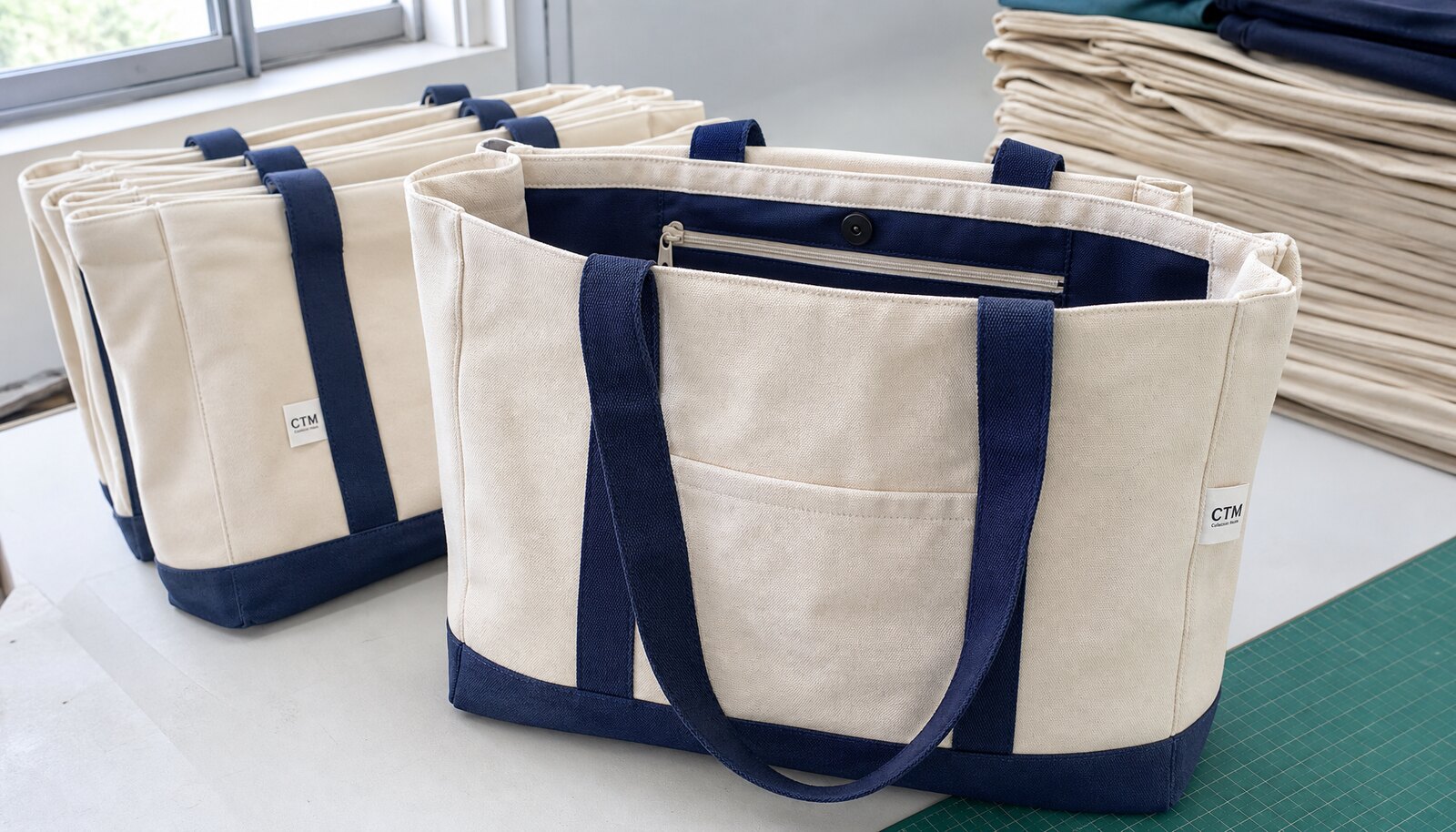
Why hotel conference bags create carton problems
Hotel conference bags look simple on a spec sheet, but they are one of the easiest textile items to overpack or underpack. Buyers usually start with logo placement and fabric weight, then discover late that the chosen bag size changes the carton count, freight class, and warehouse receiving speed. A flat canvas bag can seem compact in sample form and still ship poorly if the handle bulk, print thickness, or folding method creates excess head space in the carton. For hotel programs, that matters because the bags are often delivered to a single property, a convention center, or a regional distributor under a fixed window.
The core buying problem is not only the bag itself. It is how the bag arrives, counts, and stacks. A hotel chain may need the bags delivered by property, by event date, or by campaign wave, and each route changes the carton plan. If the carton count is too low, freight cost per unit rises. If the carton is too tight, the fabric wrinkles and the handles deform. If the labels are vague, the receiving team spends time opening cartons to identify style and quantity. The buyer who controls carton planning early usually avoids the most expensive production mistakes.
- Treat carton planning as part of the spec, not a warehouse afterthought.
- Use the final use case, not the artwork, to decide pack count and carton size.
- Ask for a packed sample carton photo before bulk production starts.
Set the bag spec before you size the carton
For hotel conference bags, the bag dimensions drive everything else. A flat tote with a 38 cm by 40 cm body and a modest gusset packs very differently from a deeper tote that can carry catalogs, a water bottle, and a notebook. Start with the actual contents. If the bag only needs to hold brochures and a pen set, 10 oz canvas can be enough. If the bag may carry a laptop sleeve or heavier gift items, move toward 12 oz canvas or add a reinforced base. The right fabric is the one that meets the load requirement without inflating freight cost needlessly.
Handle style also changes both perceived quality and carton efficiency. Self-fabric handles sit flatter and are usually easier to pack, while cotton webbing handles feel stronger and can justify a higher price point. Long handles that twist or fold irregularly can take up more volume inside the carton, especially when a bag is folded around them. Keep the finish simple if the order is meant for scale. For a large hotel roll-out, the best spec is often the one that is easy to repeat, easy to inspect, and easy to stack.
- 10 oz to 12 oz canvas is the usual range for conference bags.
- Choose gusset depth based on contents, not on visual preference alone.
- State handle drop and reinforcement method in the RFQ.
Print and trim choices that change packability
Printing is not only a branding decision. It affects carton thickness, curing time, scuff resistance, and the way the folded bag sits in a master carton. A one-color screen print is still the most practical option for many hotel conference bags because it is durable, easy to match, and usually cheaper than more complex decoration. If the logo includes small text, multiple colors, or fine lines, confirm the minimum line thickness and font size that the factory can hold on canvas. A design that looks clean on screen can blur once it is printed on natural cotton fabric.
Embroidery, woven labels, and side labels are useful when the buyer wants a more premium look without covering a large surface area. They can also reduce the risk of print rubbing during carton compression. But they are not automatically better. Embroidery adds thickness and can create a harder fold point. Woven labels are efficient, but they do not replace a strong primary logo when the bag is meant for brand visibility in a conference setting. The practical rule is simple: use the lowest-complexity decoration that still meets the brand standard and the event deadline.
- For most orders, one or two print colors are the cleanest sourcing choice.
- Ask for print placement tolerance in millimeters, not only in general terms.
- If the artwork is small or detailed, request a strike-off before bulk.
Compare sourcing routes before you request quotes
The same bag can land at very different costs depending on how you source it. A direct factory quote usually gives the best control over carton count, print process, and packing labor because the same team can manage sewing, printing, and packing. A trading company can be useful if the order combines multiple products or if the buyer needs a single contact for mixed SKUs, but the carton plan may need extra verification because the actual packing line sits one step removed from the sales contact. A local decorator or print house can work for rush programs, yet the base bag often comes from elsewhere, which can complicate final carton consistency.
For hotel conference bags, sourcing route matters because the shipment may be split by property, event, or region. If you are building a long-term program, a direct factory with stable carton standards is usually the least risky route. If the order is small and urgent, a domestic finishing house may shorten lead time but raise unit cost. The right choice depends on whether the buyer values cost, speed, or control most. The table below is useful because it keeps sourcing route tied to the packing outcome, not just the bag spec.
- Direct factory is usually strongest on cost and carton control.
- Trading companies add coordination value when the SKU list is mixed.
- Local print houses help with speed but can weaken carton consistency if the base bag comes from a separate source.
Build the carton plan around counts, weight, and destination
The carton plan should be designed from the destination backward. Start by deciding whether the bags will move by sea, air, courier, or a mixed route. A carton that is acceptable for local truck delivery may still be too heavy or too large for efficient ocean loading. For hotel conference bags, the best carton is rarely the biggest carton. It is the carton that balances labor, stacking strength, and freight cost. In many cases, a pack count that keeps gross weight in a manageable range is more important than squeezing in one or two extra bags.
Ask the factory to propose carton dimensions, not just accept a default count. A good carton plan has a clear target on gross weight, a reasonable void ratio, and a simple packing layout that warehouse staff can repeat without special training. If the bags are folded with handles inside, the stack height changes. If a tissue sheet or polybag is added, the carton may need more head room. Put these choices into the RFQ so the factory can quote the real shipping carton, not a theoretical one.
- Set a target gross weight per carton before production begins.
- Avoid extra void space that invites shifting and corner damage.
- Ask for carton dimensions with the packed bag count, not separate from it.
Use quote data that lets you compare suppliers fairly
A useful factory quote should tell you more than unit price. It should show the base bag spec, the decoration method, the carton pack count, and the packing materials that are included or excluded. Without that data, one supplier can look cheaper simply because the quote assumes a lighter fabric, a larger carton count, or no individual packaging. That is how procurement teams end up comparing unequal offers. For hotel conference bags, the quote must make the carton plan visible because the shipping cost can be a meaningful part of the landed cost.
The best comparison sheet separates cost drivers from assumptions. For example, note the difference between 10 oz and 12 oz canvas, screen print and woven label, and 20 pcs per carton versus 40 pcs per carton. Include whether the supplier quotes FOB, EXW, or delivered to port, and whether sample charges are credited back after order. If the factory can break out setup charges, print charges, and carton charges, you can see where the price increases are coming from and decide whether they are justified by the program.
- Compare like for like: same fabric, same decoration, same pack count, same Incoterm.
- Separate setup charges from unit price so the real order size is visible.
- Request a quote line for carton and packing materials if those items are not included.
Sample approval should include a packed carton, not only a loose bag
A loose approved sample is not enough for a hotel program. The sample bag must be reviewed in the same fold and pack method that will be used in bulk. That means checking the print placement, handle alignment, stitch balance, and the way the bag sits inside the carton. A bag that looks acceptable on a table can become a problem when it is packed with thirty or forty others. In bulk, small variations in fold direction or handle stiffness can create a carton that bulges on one side and collapses on the other.
Build approval around acceptance criteria. Decide the tolerable variation on size, print position, and stitch appearance. Then seal one approved loose sample and one approved packed carton sample. If the order is repeated later, those two references help the next production run stay consistent. For a buyer, that is worth more than an attractive one-off sample because it reduces argument at final inspection and gives the factory a clear target during packing.
- Approve both the loose bag and the packed carton configuration.
- Define the tolerance for size, print placement, and stitch appearance in advance.
- Keep a sealed reference sample for reorders and dispute resolution.
Packing and labeling details that save receiving time
Receiving problems often start with vague carton labels. If the buyer only specifies a carton count, the warehouse may still receive the shipment slowly because the cartons do not clearly show style, color, quantity, and carton number. For hotel conference bags, where distribution may be done property by property, clear labels reduce mistakes. A clean master carton label should show the product code, color, size, quantity per carton, total cartons, and country of origin. If the shipment is palletized, the pallet label should match the carton count and the delivery note exactly.
Polybags, tissue, and inserts should be treated as functional choices, not cosmetic ones. Polybags protect against dust and moisture but can trap humidity if the bags are not fully dry before packing. Tissue can reduce scuffing, but too much wrapping adds labor and volume. For most hotel conference bag programs, the simplest packing that protects the print and keeps the carton count stable is the best answer. If the destination warehouse requires barcode labels or a specific carton format, that needs to be in the order sheet before the factory starts packing.
- Use labels that help the receiving team identify style and quantity without opening cartons.
- Do not add unnecessary packing materials that increase volume or trap moisture.
- Match carton labels to the packing list and the pallet plan.
Lead time risk is usually hidden in packing and approvals
Most schedule slips happen after the bag spec is already approved. The first risk is sample delay. The second is print approval delay. The third is packed carton change control when the buyer asks for a count adjustment after production starts. For a hotel conference bag order, even a small change in print size or fold method can force the factory to rework the line and reset the carton plan. That is why the buyer should lock the carton count before bulk sewing begins, not after decoration is complete.
Lead time should be reviewed in stages. Ask the supplier to separate material arrival, sewing, printing, sample approval, bulk production, packing, and dispatch. If the order is going by sea, also include booking and port cut-off time. A factory that gives only one total lead time number may be hiding bottlenecks. A better quote shows where the schedule can slip and which steps depend on buyer approval. That makes it possible to manage the calendar instead of reacting to it.
- Split lead time into material, production, packing, and shipping stages.
- Do not change carton count after bulk production starts unless you accept delay risk.
- Keep print approval and packed sample approval on a fixed calendar.
Landed cost is often decided by carton efficiency, not fabric cost
Many buyers focus on the bag unit price and miss the carton effect on landed cost. A slightly cheaper bag can cost more overall if it requires a larger carton, a lower pack count, or more freight volume. That is especially true for hotel conference bags, where the bag is large enough to matter for dimensional weight but still flexible enough that small changes in fold method can change the shipment profile. A well-optimized carton plan can reduce freight spend and receiving labor at the same time.
When comparing quotes, look at the full route: material, decoration, packing, carton size, pallet load, ocean or air freight, and destination handling. If two suppliers are close on unit price, the one with the cleaner carton plan can be the better commercial choice. If one quote assumes a 40-piece carton and another assumes 25 pieces, the apparent unit difference is not meaningful until you compare the freight result. Procurement teams get the best outcome when they rank suppliers by landed cost and receiving risk, not just ex-factory price.
- A lower unit price can disappear once freight volume is included.
- Compare carton count and carton dimensions before deciding which quote is cheaper.
- Rank offers by landed cost, not just factory price.
Specification comparison for buyers
| Spec decision | Recommended option | When it fits | Buyer risk to check |
|---|---|---|---|
| Source route | Direct factory with carton-pack control and one accountable spec sheet | Best for repeat hotel programs, 5,000 pcs and up, or any order where carton count must stay stable across replenishment | Risk of mixed packing if the factory outsources printing or uses multiple sewing lines without one packing standard |
| Fabric weight | 10 oz to 12 oz canvas for most hotel conference bags | Works for laptops, brochures, notebooks, and water bottles without looking too soft or too bulky | Too light can wrinkle and collapse in cartons; too heavy increases carton weight and freight cost |
| Print method | 1 to 2 color screen print for large front logos; woven label or small side label for premium branding | Best when the artwork is simple and the order needs durable branding with controlled cost | Fine gradients, tiny text, or full-bleed art may need digital or heat transfer and can change carton thickness |
| Handle construction | Self-fabric handles with bar-tack reinforcement or cotton webbing handles for heavier loads | Use self-fabric for a cleaner conference look and webbing when the bag will carry heavy gifts or catalogs | Weak handle stitches fail after compression in cartons and can create claims before the event |
| Bag profile | Flat tote with controlled gusset depth, often 8 cm to 12 cm | Best when the buyer wants efficient carton packing and a bag that stands up on tables but still stacks well | A deep gusset improves capacity but can reduce carton count and raise dimensional weight |
| Carton pack count | Pack to a target by carton size, not by a fixed number copied from another style | Use a carton count that balances labor, carton strength, and ship rate on the chosen route | Overstuffed cartons crush seams; underfilled cartons waste freight and warehouse space |
| Carton build | 5-ply export cartons with clear gross weight control and no loose head space | Preferred for ocean freight, mixed warehouse handling, and any route with transshipment | Weak cartons or excess void space create edge crush, stacking failure, and wet damage risk |
| Labeling and pallet plan | Unit polybag only if required, then master carton label with style, color, qty, and carton number | Best for DC receiving, hotel distribution, and multi-SKU programs with tight inbound control | Missing carton numbers or vague labels slow receiving and can trigger chargebacks or rework |
Buyer checklist before sampling
- Confirm finished bag size, gusset depth, handle drop, and whether the bag must fit a laptop sleeve or only conference papers.
- Lock the fabric weight in oz or GSM and state whether the cloth must be pre-shrunk, bio-washed, or left natural.
- Specify print method, print area, pantone target, and whether the logo must survive carton compression without scuffing.
- Set the carton pack count, target carton dimensions, and maximum gross weight per carton before sampling starts.
- Define whether polybags, inserts, silica gel, or hang tags are needed for hotel distribution.
- Ask for one packed sample carton photo with carton labels visible before bulk packing starts.
- Require a pre-production sample that matches the final stitch count, print placement, and carton count.
- State the destination country, delivery term, and whether the shipment will move by sea, air, or mixed mode.
- Ask for carton quantity by SKU and a pallet plan if the destination warehouse uses strict receiving rules.
- Keep one approved sealed sample and one approved packed carton reference for final inspection.
Factory quote questions to send
- What is the exact finished bag size, fabric weight, and cut method you are quoting?
- Which print method is included, how many colors, and what is the setup or screen charge?
- How many bags per carton do you recommend, and what are the carton dimensions and gross weight?
- Do you quote unit price with or without polybag, silica gel, hang tag, and carton labeling?
- What MOQ applies for the blank bag, the printed bag, and any color or size change?
- What sample types are available before bulk production, and are sample charges refundable at order?
- What is the standard production lead time after sample approval, and what changes the schedule?
- Can you share packing photos or a carton plan from a previous similar order, with private data removed?
Quality-control points to confirm
- Finished size must stay within the agreed tolerance on width, height, and gusset depth.
- Handle stitch count, bar-tack length, and stitch balance must be uniform across the lot.
- Print placement must stay centered or within the agreed offset, with no visible smearing or color shift.
- Fabric must be free from major slubs, oil marks, broken yarns, and obvious shade variation within the same carton.
- Carton count must match the packing list exactly, with no mixed counts unless approved in writing.
- Carton strength must hold stack pressure without corner collapse or seam opening.
- Polybag or tissue wrapping, if used, must not trap moisture or distort the bag shape.
- One packed master carton should be opened and counted against the approved sample before final dispatch.