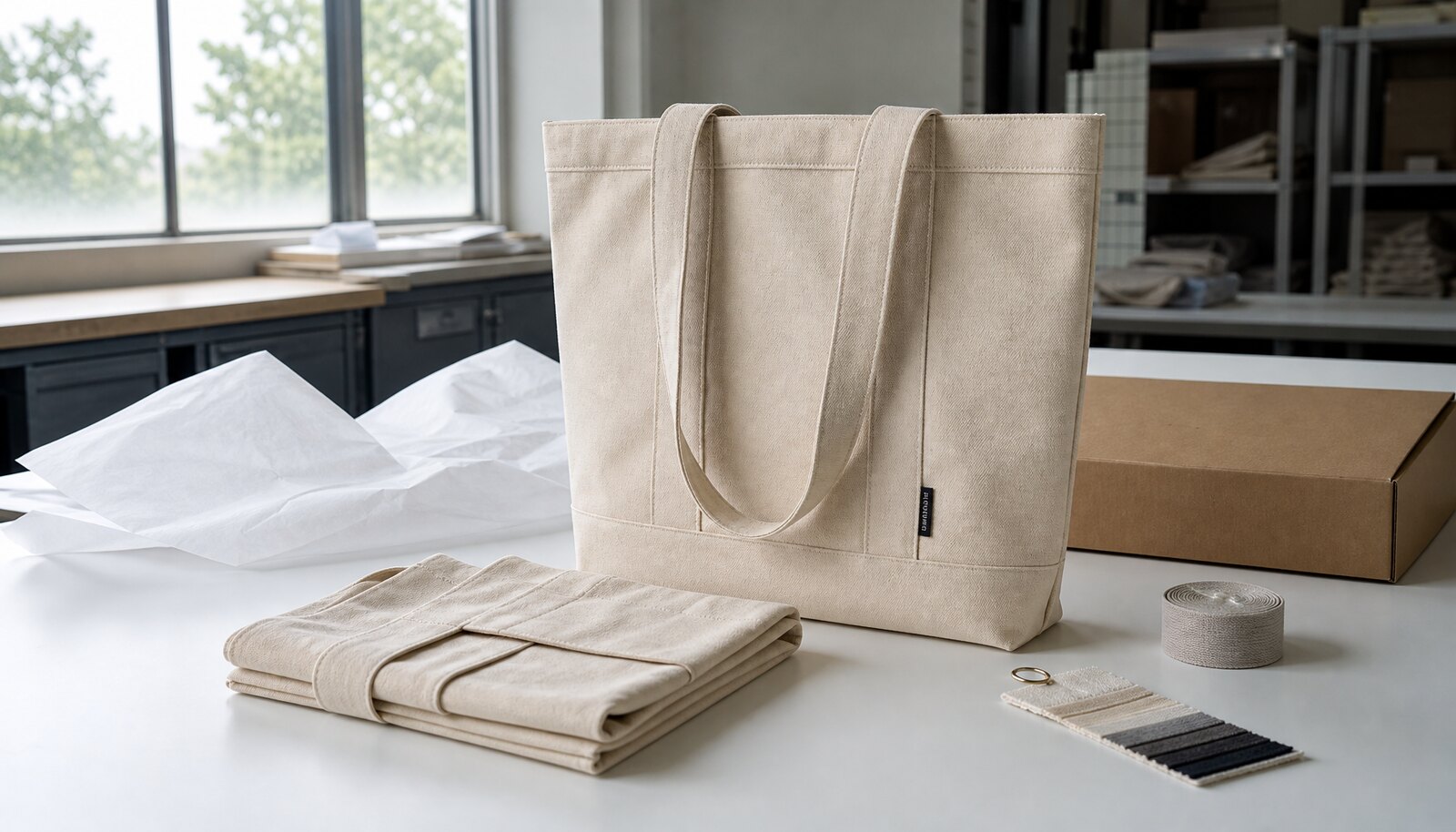
Define the hotel use case before you pick a bag
Canvas conference bags for hotels are not generic promotional totes. They have to carry a clear hotel message, survive handling at registration, and still look orderly when a guest opens the room drop or welcome kit. The first spec decision is not the logo or even the fabric weight. It is how the bag will be used: handed out at a conference desk, placed in guest rooms, sold in a hotel shop, or packed with printed materials and a water bottle. Each route changes the bag size, handle type, packing method, and the level of finish the buyer should demand.
If the event team expects the bag to be seen in front of other guests, the visual standard matters as much as strength. A badly folded bag, a crooked label, or a carton that crushes the shape can turn a low-cost item into a poor brand impression. In the RFQ, define the final use, the expected contents, and the required presentation standard. That gives the supplier a way to quote the right construction instead of guessing from a logo file alone.
- Registration bags need fast packing and clear count control.
- Room-drop bags need cleaner folding and better dust protection.
- Retail or gift shop bags need stronger hand feel and consistent presentation.
- A bag that only carries paper collateral can be lighter than one that holds bottles or gifts.
Canvas weight and finish change the whole quote
For most hotel conference programs, 10 oz to 12 oz canvas is the practical range. Eight-ounce canvas, about 272 GSM, can work for short events or low-cost giveaways, but it may feel soft and show wrinkles quickly. Ten-ounce canvas, about 340 GSM, is usually the best balance between body, print quality, and freight cost. Twelve-ounce canvas, about 408 GSM, is the better choice when the bag needs to feel premium, hold weight repeatedly, or survive reuse across a longer stay. If you need a washed or pre-shrunk hand feel, state that early, because it affects both cost and lead time.
The finish matters as much as the weight. Natural canvas with visible slub can look authentic, but it also changes how the print sits and how the bag looks from one piece to the next. A bleached or dyed canvas gives more uniform print results but can add a dye-lot control issue. If the logo has fine type or a full-coverage block, ask for a print trial on the actual fabric. A quote based on a generic fabric assumption is not useful when the final bag needs to sit cleanly in a hotel room or conference ballroom.
- Use 8 oz only when cost and light weight matter more than body.
- Use 10 oz for most hotel conference packs and reusable welcome bags.
- Use 12 oz when the bag is part of a premium guest experience or carry-heavy program.
- Ask whether the quote is for greige, bleached, dyed, or washed canvas.
Size, gusset, and handle build decide real usability
A hotel conference bag needs enough volume for documents, a notebook, a brochure set, and sometimes a bottle or amenity pack. Common working sizes are around 14 by 16 by 4 inches or 15 by 16 by 4 inches, but the right size depends on the contents, not on what is common in the market. A narrow bag saves material but can look cramped when filled. A wide bag can be more useful but will increase fabric consumption, carton size, and freight. The same logic applies to gusset depth: too shallow and the bag loses shape; too deep and it becomes bulky in packing.
Handle design is a cost and usability decision, not a cosmetic one. Self-fabric handles look neat and keep a consistent brand language, while webbing handles can carry load better and often reduce stretching. For a bag that will be carried on the shoulder, the handle drop needs to be long enough to sit naturally over clothing, not just in a product sketch. Reinforcement at the handle base is non-negotiable for a hotel order because staff and guests will handle these bags repeatedly and often load them faster than the bag was designed for.
- Specify finished dimensions and not only the artboard size.
- Define handle drop, total handle length, and handle width in the RFQ.
- Use reinforced X-box or bar-tack stitching at stress points.
- State whether the bag must stand upright when filled or only carry flat materials.
Branding method should follow artwork and volume
For most hotel conference bags, screen printing is the default because it is durable, easy to read, and cost-effective for simple logos. It works well when the art uses one to three spot colors and the logo area is flat enough to hold a clean print. If the artwork has fine lines, gradients, or small text, screen printing can still work, but it needs a careful strike-off on the actual fabric. For a cleaner premium look, a woven label sewn into the side seam or a small embroidered mark can be better, but both add cost and may create stiffness if the bag is made from lighter canvas.
The print method should be matched to order size. Heat transfer can be useful for short runs or more detailed art, but it adds a process risk if the buyer expects long-term durability without testing rub resistance. Embroidery is visually strong but can distort the bag panel if the canvas is too thin. A good RFQ should state artwork size, placement, color count, and whether the buyer will approve a pre-production strike-off or a sewn sample. Without that, quote comparison becomes misleading because each supplier may assume a different branding process.
- Use screen print for simple, high-readability hotel logos.
- Use woven labels when the brand wants a subtle premium finish.
- Use embroidery only when the fabric weight can support it without puckering.
- Keep the logo away from thick seams, gussets, and handle reinforcements.
Packaging spec is part of the product
For hotel buyers, packaging is not a logistics afterthought. It decides how the bag looks when it reaches the guest or the conference desk. If the bags are delivered directly into rooms, each bag usually needs a clean fold, dust protection, and a stable carton count so housekeeping or banqueting staff can move them quickly. If the bags are distributed at registration, the packing can be simpler, but the count and label control still need to be exact. A paper wrap or tissue can improve presentation, but it should be written into the quote because it changes labor time and carton volume.
The packing format also affects damage risk. A flat-fold bag packed too tightly can pick up hard creases and distort the logo. A carton that is too big can let the bags shift and wrinkle during transit. A carton that is too small can crush handles and edges. Ask the supplier for the fold sequence, unit pack, inner pack, outer carton count, and master carton dimensions before approval. Once the hotel chain or event agency has standardized the packaging, keeping the same spec on reorder is one of the easiest ways to control quality drift.
- Use individual polybags when the bags go into guest rooms or premium welcome kits.
- Use tissue or paper wrap when the hotel wants a softer unboxing presentation.
- Specify carton count, carton size, and carton marking exactly in the RFQ.
- Ask for a sample fold so the bulk pack matches the approved presentation.
Build the RFQ around real cost drivers
A useful quote is one that lets you compare the same product line by line. The supplier should separate the bag price from setup charges, packaging charges, sampling costs, and freight-related charges. That matters because a low unit price can hide a high screen charge, a costly inner pack, or an expensive carton spec. For canvas conference bags, the main cost drivers are fabric weight, print method, number of colors, handle construction, pack style, and carton configuration. The order can also move from one cost bracket to another if the buyer changes the hotel color, adds a label, or asks for individual packing late in the process.
MOQ logic should be understood before the buyer requests final pricing. Many suppliers set MOQ based on fabric purchase, print screen setup, and carton production rather than on the bag itself. That means one style in one color can be economical, while the same style in three colors creates three separate setup paths. When comparing quotes, ask each supplier to price the identical spec, then compare the same Incoterm and the same packing count. Otherwise the lowest number usually reflects the loosest assumption, not the best value.
- Ask for separate lines for fabric, cutting, printing, stitching, packing, and cartons.
- Compare FOB to FOB or CIF to CIF, not a mix of shipping terms.
- Confirm whether sample charges are credited back on bulk order.
- Request a clear MOQ by style, color, and print version.
Compare supplier routes before you compare unit price
The table above is useful because not every supplier route fits this type of order. A direct factory gives the best control over fabric, print, and packing, but the buyer needs a stronger spec and a tighter approval process. A trading company can be useful when the order includes other hotel items, but it can hide the actual production source and make defect resolution slower. A stock wholesaler works only when the schedule is urgent and the artwork is simple, because the customization options are limited and the bag may not match the hotel standard closely enough. For a repeat hotel program, the best structure is often direct factory production with a stable packaging or labeling process.
Ask each supplier for evidence that matches the route they claim. A real factory should be able to show a sample room, cut-and-sew flow, and a clear explanation of how print and packing are handled. A trading company should be transparent about the actual factory and the responsibilities on both sides. If the seller cannot explain how fabric is sourced, how a print screen is approved, or how a packing change affects lead time, the quote is too thin to rely on. For a hotel order, transparency is part of the commercial value.
- Direct factory is usually best for custom dimensions and repeat programs.
- Trading company is useful when the buyer wants one contact for a mixed order.
- Stock route is only suitable when speed matters more than exact spec control.
- Evidence beats promises: ask for sample photos, production flow, and packing references.
Sample approval needs measurable tolerances
A sample is not approved because it looks close. It is approved because it matches the agreed spec in the places that matter. For a hotel bag, that means the dimensions, handle placement, fabric feel, print clarity, and pack presentation must all be close enough to the approved reference. A pre-production sample should reflect the final construction, not just the artwork. If the supplier sends a blank fabric sample or a print-only swatch, that is not enough for a purchase order on a conference program. The buyer needs to see how the bag folds, where the seams sit, and how the logo looks on the actual panel size.
Set clear tolerances before bulk production starts. Many buyers accept small variation in natural canvas, but variation should be documented so it does not become an argument later. A sensible spec file will note what can move and what cannot: perhaps the fabric shade can vary slightly, but the logo placement cannot drift; perhaps the handle drop can move within a narrow band, but the carton count must be exact. When the supplier knows where the line is, bulk quality becomes easier to manage and final inspection becomes much less painful.
- Approve a sample that uses the final fabric, final print method, and final packing method.
- Record acceptable tolerance for size, color shade, and logo placement.
- Keep one sealed reference sample for future reorder comparison.
- Test opening, folding, and re-packing so the hotel team can use the bag easily.
Lead time and reorder planning need hotel calendars
Conference bags are date-sensitive. If the delivery misses the event by even a few days, the bag has no value for the original order. The buyer should work backward from the hotel handover date, not from the ship date. Sample approval, material booking, screen making, cutting, printing, stitching, packing, inspection, and freight each need space in the schedule. A short production lead time is only useful if the buyer can approve artwork quickly and if the supplier already has the fabric available. Otherwise the order can move fast on paper and still miss the deadline in real life.
For repeat hotel programs, the goal is to make the reorder boring. That means locking the fabric code, logo placement, carton size, and pack count so the next order can reuse the same approved reference. If the supplier needs to switch fabric lots, ask how color and shrinkage will be controlled. If the hotel expects multiple properties to receive the same bag, keep one master spec and one approved sample file rather than letting each property make small changes. Small changes are how stable programs become expensive.
- Work backward from delivery to sample approval, not from production start.
- Build buffer time for printing, inspection, and freight delays.
- Lock the spec after first approval so reorders stay consistent.
- Ask what happens if the fabric mill changes lot or timing slips.
Use landed cost, not unit price, to make the final call
A low bag price can still be the wrong purchase if the packing, freight, and duties are not consistent with the rest of the quote. For hotel procurement, landed cost is the true comparison point. It includes the bag price, decoration, inner packing, cartons, inland moves, international freight, import duty, and inspection if you use it. When one supplier quotes FOB and another quotes EXW, the numbers are not comparable. When one supplier includes individual polybags and another does not, the quote is also not comparable. The buyer should build one comparison sheet and force every supplier into the same assumptions.
The best RFQ pack is small but complete. Include a dimensioned sketch, artwork file, target fabric weight, pack format, destination, and delivery window. Add the hotel use case so the supplier understands whether presentation or load-bearing matters more. Once the quote comes back, separate price differences into real drivers: fabric, print, packaging, freight, and lead time. That is the only reliable way to defend the purchase internally and avoid a late change that damages both margin and service quality.
- Compare landed cost, not only unit price.
- Keep Incoterms and pack counts identical across quotes.
- Capture freight, duty, and local delivery before choosing the supplier.
- Use one RFQ pack for all suppliers so assumptions stay aligned.
Specification comparison for buyers
| Spec decision | Recommended option | When it fits | Buyer risk to check |
|---|---|---|---|
| Supplier route | Direct factory with bag specialization | Custom size, print, and hotel packaging need real control | Check the actual production line, not only the sales office |
| Supplier route | Trading company with verified factory disclosure | You need multiple product categories in one shipment or one contact point | Confirm who owns the tooling, who buys fabric, and who handles defects |
| Supplier route | Stock wholesaler or blank-bag distributor | The schedule is tight and artwork is simple | Customization is limited and carton pack quality can vary by lot |
| Fabric weight | 10 oz to 12 oz canvas, ideally pre-shrunk or washed if the bag will be reused | Most hotel conference programs, welcome kits, and premium room drops | Light canvas can look limp; heavier canvas increases freight and material cost |
| Branding method | 1 to 3 color screen print or woven side label | Most hotel logos and repeat orders where durability matters | Fine gradients, small text, or seam-crossing art can lose clarity |
| Packaging route | Individual polybag with barcode or paper wrap for eco programs | Direct guest distribution, conference registration, or retail-ready presentation | Packing style changes labor cost and can slow production if not agreed early |
| MOQ strategy | Style-based MOQ with one print version first | New hotel launch or pilot property | Multiple colors, handle styles, or pack formats can multiply setup charges |
| Inspection route | Factory in-line check plus pre-shipment inspection on first orders | Large orders or first-time supplier approval | Sample approval alone will not catch bulk stitching drift or carton count errors |
Buyer checklist before sampling
- Bag use case: conference registration, room drop, VIP welcome, or gift shop resale
- Finished size, gusset depth, handle length, and target load weight
- Canvas weight in oz or GSM, plus whether the fabric is washed, bleached, or natural
- Logo artwork file, print colors, placement, and any required PMS match tolerance
- Packaging method: folded flat, tissue wrapped, polybagged, or paper wrapped
- Carton pack count, inner pack count, barcode label need, and master carton mark format
- Required Incoterm, destination port or door address, and delivery date
- Sample approval gate, inspection requirement, and reorder continuity requirements
Factory quote questions to send
- What canvas weight, weave, and fabric finish will you use, and can you show a reference swatch?
- Is the canvas pre-shrunk or washed, and what size change should I expect after handling?
- Which print method are you quoting, how many setup charges apply, and what is the color limit per price?
- What is the MOQ by style, by color, and by print version?
- Can you quote the same bag with and without individual polybags, and what is the labor difference?
- What carton pack count, carton size, and gross weight will you use for export packing?
- What sample options do you offer, what do they cost, and how long do they take?
- What is the production lead time after artwork and sample approval, and what can extend it?
- Which Incoterms can you quote, and can you separate product cost, packing cost, and freight-related charges?
- What QC method do you use on first orders, and what defect levels trigger rework or replacement?
Quality-control points to confirm
- Fabric weight matches the approved spec and the weave looks even across the full panel
- Finished size, handle drop, and gusset depth stay within the agreed tolerance band
- Handle reinforcement, side seams, and bottom seams are aligned and free of skipped stitches
- Print placement, color density, and logo registration match the approved strike-off or sample
- No obvious shade variation, staining, oil marks, loose threads, or needle damage on visible surfaces
- Individual packing count, barcode label, and carton count match the packing list exactly
- Master cartons are closed securely, stack well, and protect the bag shape during transit
- Retention sample is kept on file so future reorders can be compared against the approved standard