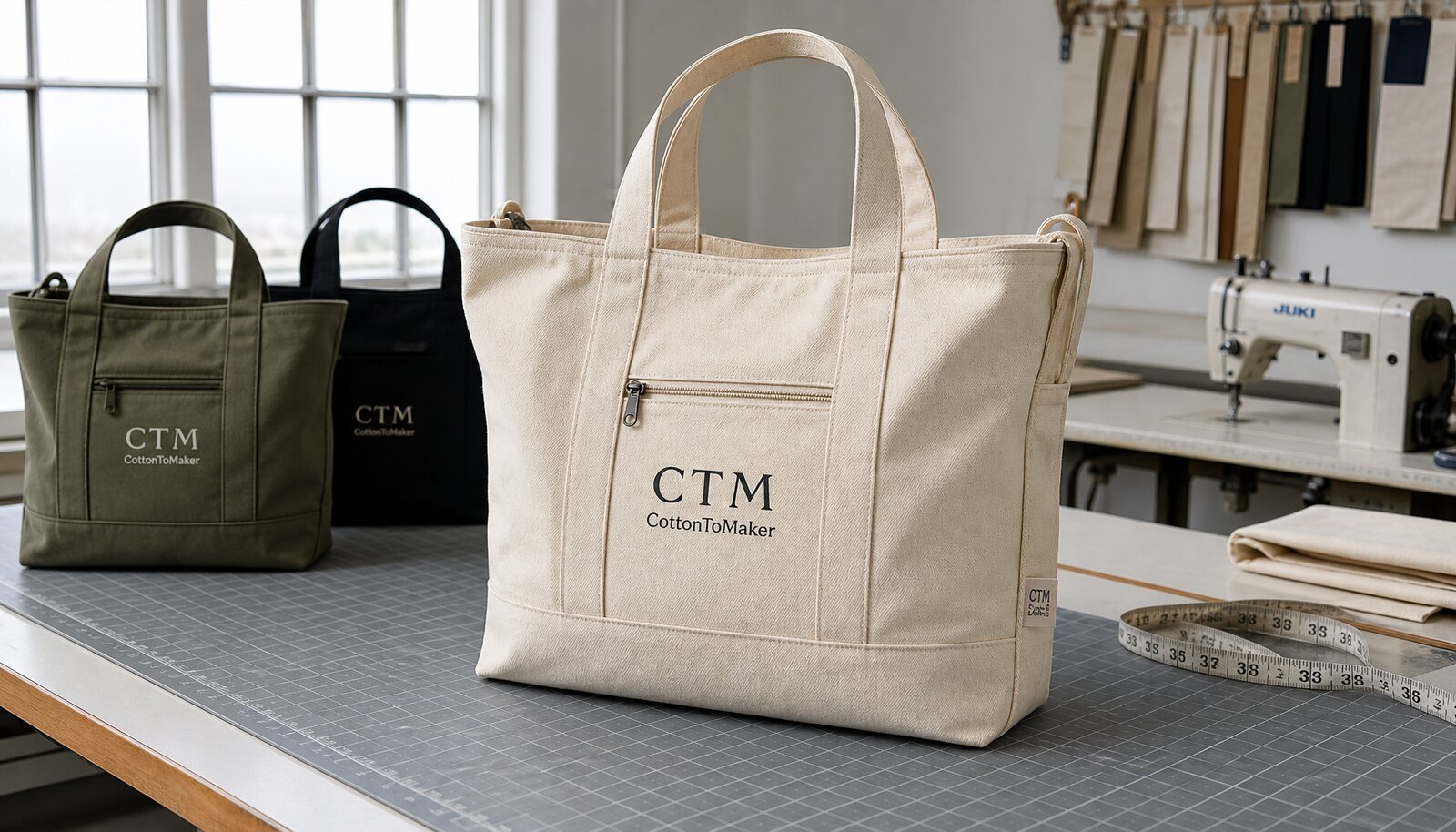
Why this bag needs a different buying spec
A canvas conference bag for a hotel program is not the same purchase as a generic tote for giveaway use. The buyer is usually balancing three jobs at once: the bag must look credible on arrival, it must survive repeated handling by guests or retail customers, and it must fit a tight packing and freight plan. When those goals are not written into the RFQ, the supplier will often quote a light cloth, a simple seam build, and a low headline unit price that becomes expensive once you add rework, packing changes, or damage claims.
The practical way to buy this item is to define the usage first and let the spec follow. Hotel conference bags usually need a clean front panel, stable gusset, and enough structure to hold a brochure, notebook, bottle, and small amenity set. Retail launch bags need stronger presentation, cleaner stitching, and a more controlled print finish because the customer will compare them against other merchandise on the shelf. The same logo can work in both channels, but the bag body, reinforcement, and packing standard should not be identical.
- Write the use case into the RFQ: conference kit, gift shop resale, or dual-use program.
- State whether the bag must feel promotional, retail-ready, or premium enough for paid carry use.
- Decide early if the bag needs to stand upright, hold shape, or fold flat for storage.
Fabric weight, weave, and structure
Canvas weight is the first real cost and quality decision. For hotel conference distribution, 10 to 12 oz / 340 to 410 GSM is often the workable middle ground because it gives enough body without pushing freight or sewing difficulty too high. If the bag will be sold in a shop or used repeatedly after the event, 12 to 14 oz / 410 to 470 GSM is safer because it holds shape better and resists that soft, low-value look that lighter cloth can develop after folding. If the supplier only gives you a generic canvas label, push back and ask for the actual construction, weight tolerance, and whether the cloth is bleached, dyed, pre-shrunk, or washed.
Structure matters as much as GSM. A heavier canvas with weak handles still fails in use, and a lighter canvas can be acceptable if the handle, gusset, and seam build are honest. For this product, buyers should pay attention to handle width, handle drop, side gusset depth, bottom reinforcement, and whether the top edge is turned and top-stitched or left raw under binding. If the bag is intended to carry catalogs or wine bottles, add bar-tacks at the handle ends and specify the load direction. That small detail changes both the factory method and the defect rate.
- Use 10 to 12 oz for event use where cost and volume matter more than shelf feel.
- Use 12 to 14 oz for resale, premium hotel kits, or any program that needs shape retention.
- Require bar-tacks, reinforced corners, or double stitching when the bag will carry weight.
Printing and branding that survive handling
For a hotel or retail launch, the branding has to stay readable after folding, transport, and guest handling. Screen print remains the default choice when the logo is simple, the colors are solid, and the volume is large enough to justify screens and setup. It gives the cleanest cost-to-visibility ratio for most conference bags. If the art is small or detailed, embroidery or a woven patch can look more deliberate, but only if the canvas weight can support the stitch density without puckering. Heat transfer and digital methods can be useful for short runs or multi-color art, but they need more control on fabric finish and can look less durable if the buyer is trying to sell the bag as a long-life item.
The best way to avoid print disputes is to define the art like a production spec. State the print area in millimeters, number of colors, Pantone references if relevant, and whether the supplier must match a front panel, side panel, or pocket position. If the logo has fine type, ask the supplier to show the smallest printable text size and line thickness they can hold cleanly on the chosen canvas. On dark canvas, ask how they will handle opacity and underbase. On natural canvas, ask how they will control fiber show-through and whether the ink will crack when the bag is folded tight.
- Use screen print for bold logos and repeat volume.
- Use embroidery or a woven patch when the logo must feel more premium or survive abrasion.
- Avoid tiny text and thin lines unless the factory proves the method on the actual fabric.
MOQ logic and quote comparison
MOQ is not only a factory constraint. It is a cost structure problem. Canvas bag quotes usually step down when the supplier can spread fabric booking, cutting loss, print setup, and sewing line time across a larger run. That means a 500-unit quote can look very different from a 3,000-unit quote even when the bag appears identical. The buyer should ask for at least three tiers, because the real decision is often whether to order enough volume to reach a lower cost band or stay small and accept a higher unit price for speed.
When comparing supplier quotes, do not compare unit price alone. Put the quotes into the same box by asking for the same fabric weight, the same handle length, the same number of print colors, the same packing format, and the same carton count. A lower unit price can disappear if one supplier charges separately for screens, samples, polybags, barcode stickers, or outer cartons. For a retail launch, that hidden spread is often what breaks the budget, not the sewing cost itself. Quote data should include ex-factory price, setup charges, sample fees, and carton specs so the landed calculation is not guesswork.
- Request pricing at 500, 1,000, 3,000, and 5,000 units, even if you expect to buy one lot.
- Ask for separate lines for print setup, sample fees, packing, and cartons.
- Normalize all quotes to the same fabric weight, size, and print method before comparing.
Sample approval and production evidence
A good sample does not prove the order is safe unless it reflects the actual production material. This is where many buyers get trapped: the sales sample is stitched neatly from a better cloth or finished by a more skilled operator, then bulk units arrive with softer corners, weak seams, or a print that sits slightly lower. For this reason, the right approval sequence is artwork proof, material swatch, pre-production sample, then a bulk reference sample if the order is large enough. The approval should show fabric weight, color tone, stitch quality, and print placement on the real body fabric the factory plans to cut.
The acceptance standard should include visible and functional checks. Confirm that the handle ends are reinforced, seams are even, corners are square, and the logo is placed consistently on every panel. If the bag is for hotel resale or premium use, ask for a simple load test on the sample, even if it is not a formal lab test. Put a realistic weight in the bag, lift it repeatedly, and watch for handle stretch, seam opening, and body distortion. That is more useful than approving a sample because the fabric looks nice on a table.
- Approve the actual production fabric, not only a prettier sample material.
- Treat logo position, handle reinforcement, and seam alignment as acceptance criteria.
- Use a load test on the sample to catch weak handle construction before bulk sewing starts.
Packing, carton data, and retail presentation
Packing is part of the product, not an afterthought. A canvas conference bag that ships in a messy fold or a crushed carton will reach the hotel or retail back room with a poor first impression, even if the sewing is fine. Buyers should specify the folding direction, whether the bag is individually polybagged, whether a barcode sticker or hangtag is needed, and how many pieces go into each master carton. If the bag is for a retail channel, add a clean fold and a straight top opening so the shelf team can repack it without fighting the shape. If it is for conference distribution, prioritize efficient packing density and fast counting on receipt.
Ask for carton dimensions and gross weight before the order is confirmed. Those numbers drive freight planning, warehouse handling, and receiving speed. A slightly smaller bag can cost more to ship if the carton layout is inefficient. If the route is humid or long, ask whether the supplier will include moisture protection or a liner. If the bags must stay clean for retail, specify a packing method that avoids print transfer, edge crushing, and loose thread contamination. Good packing should preserve both appearance and count accuracy, not just keep the bags together.
- State the fold method and whether the bag should arrive retail-ready or bulk-ready.
- Get carton dimensions, carton count, and gross weight before approving the quote.
- Use barcodes, size stickers, or insert cards only if they are mapped into the pack spec.
Lead time risk and schedule control
Canvas bag lead time usually slips in predictable places: fabric booking, color approval, print plate work, sample corrections, and final inspection. If the launch date is fixed, the buyer should not rely on one promised delivery date. Instead, build a small schedule with checkpoints and make the factory commit to each one in writing. The simplest control method is to separate approval time from production time, then force the supplier to show what is waiting on the buyer and what is waiting on the factory. That makes it easier to see where the delay is actually coming from.
For hotel launches and retail programs, the safest path is to freeze the artwork, lock the fabric, and avoid late changes to handle length or pack format. Even a small design shift can trigger a new cut layout or a new print screen. If the project has multiple destinations, add time for carton labeling and split shipment planning. The practical rule is to protect the launch by holding a buffer rather than trying to recover schedule at the last minute. A bag program is simple only when the spec is stable.
- Ask the factory to separate approval time from production time in the schedule.
- Freeze fabric, artwork, and packing before the line is booked.
- Allow buffer time for print revision, inspection fixes, and carton labeling.
Landed cost comparison by sourcing route
The cheapest ex-factory quote is not always the best landed cost. A direct factory order usually gives the strongest control over fabric, sewing, and print, but it requires a buyer who can manage approvals and spot problems early. A trading company can simplify coordination when the bag has multiple components, yet the margin stack can obscure the real cost drivers. A local stock importer plus local print can be useful for a rush launch, but the buyer gives up control over exact canvas weight, handle build, and color consistency. The right route depends on whether the project is driven by speed, cost control, or spec precision.
A disciplined landed-cost comparison should include unit price, print setup, packing, cartons, inland freight, ocean or air freight, import duty, and destination handling. That is the only way to compare a factory quote with a stock route honestly. For hotel or retail launches, buyers often discover that a slightly higher unit price from a factory-direct supplier wins once packing and freight are included, especially when the bag is large or the carton efficiency is poor. The final sourcing decision should reward the route that protects the spec and the launch date, not just the lowest line item.
- Compare ex-factory, packing, freight, duty, and handling together.
- Do not accept a low unit price until carton efficiency and pack format are clear.
- Choose the sourcing route that best matches speed, control, and repeat order potential.
A practical buyer workflow for this category
The cleanest workflow is simple: define the use case, lock the fabric, specify the print, request quote tiers, approve a production sample, and then check packing and carton data before bulk sewing starts. That order prevents most of the common mistakes in canvas conference bag sourcing. It also helps procurement teams compare suppliers on the same basis instead of debating different assumptions about GSM, handle build, or artwork method. If the launch has both hotel and retail channels, decide whether one shared spec can work or whether the retail version needs a heavier cloth and better finishing.
This product category is forgiving only when the buyer is precise. The supplier can usually make a bag that looks acceptable at first glance, but that is not the same as making a bag that lands well, stacks neatly, prints cleanly, and survives the actual customer use case. Put the technical detail into the RFQ, request a quote that separates real cost from setup cost, and make the sample do real work. That gives procurement a meaningful basis for comparing offers and protects the launch from avoidable production mistakes.
- Use one RFQ that defines use case, fabric, print, structure, and packing together.
- Compare suppliers on sample quality, quote transparency, and carton data, not only on unit price.
- Treat the bag as both a product and a logistics item.
Specification comparison for buyers
| Spec decision | Recommended option | When it fits | Buyer risk to check |
|---|---|---|---|
| Source direct from factory with in-house print | Best for stable programs with one main logo and repeat reorder potential | 1,000 to 10,000 units when the design is fixed and the schedule is not urgent | A separate print subcontractor can slow approvals, shift color, or weaken accountability |
| Use a trading company to coordinate fabric, sewing, and print | Useful when the bag has multiple components or mixed trim requirements | Complex programs with zippers, lining, pockets, or multiple SKUs | Margin stacking can hide the real factory cost and make problem solving slower |
| Buy stock blanks then add local print | Fastest route for pilot launches and short retail windows | Under 500 to 2,000 units when speed matters more than exact spec control | Blank bag weight, handle length, and print area may not match the brand standard |
| Specify 12 to 14 oz / 410 to 470 GSM canvas | Heavier body with better retail feel and more shape retention | Hotel retail launches, gift shop resale, and bags that will be reused often | Higher freight cost and slower drying if the bag is washed or finished heavily |
| Specify 10 to 12 oz / 340 to 410 GSM canvas | Good balance for conference kits and controlled promotional use | Hotel events, delegate packs, and lower-budget launch programs | The bag can look soft or collapse if the gusset and handle reinforcement are weak |
| Choose screen print for the main logo | Best for solid spot colors and repeat production | Simple branding, larger art, and orders that need consistent color | Tiny text, halftones, or gradients can fill in or drift between runs |
| Choose embroidery or woven patch branding | Best for premium positioning and abrasion resistance | Small front logos, hotel gift retail, or tote styles that need a more elevated finish | Heavy stitch density can pucker lighter canvas or distort the panel |
| Request pre-production sample plus bulk reference sample | Best for any new supplier or new fabric lot | First order, new artwork, or when print and sewing will be judged strictly | A perfect sample made from non-bulk material can hide production variation |
Buyer checklist before sampling
- Confirm target use case first: hotel conference distribution, retail resale, or a hybrid program, because that changes GSM, handle build, and finishing.
- Lock the fabric in both oz and GSM, plus the weave and any washing or enzyme treatment, so suppliers do not quote different cloth under the same name.
- Specify the print method, print area, number of colors, and acceptable color match range before asking for pricing.
- State the required handle length, gusset depth, seam reinforcement, and whether the bag must stand upright on a shelf or in a carton.
- Ask for quote breakouts for unit price, print setup, sample fee, packing, carton spec, and any testing or documentation cost.
- Approve a pre-production sample against production material, not only against a polished sales sample.
- Align on pack format, barcode placement, carton count, and outer carton strength before mass production starts.
- Get a written lead time with milestones for sample approval, fabric booking, print approval, production, inspection, and dispatch.
Factory quote questions to send
- What exact canvas weight, weave, and finish are you quoting, and can you state it in both oz and GSM?
- Is the price based on direct factory production, or does it include a trading layer or outsourced print step?
- How many colors are included in the quoted print method, and what is the setup charge for additional colors or positions?
- What are the MOQ tiers at 500, 1,000, 3,000, and 5,000 units, and where does the unit price step down?
- What sample types are included: artwork proof, pre-production sample, and production-reference sample?
- What packing format is quoted, including folding method, polybag use, barcode label, insert card, and master carton count?
- What carton dimensions, gross weight, and carton loading quantity are you quoting, and how does that affect CBM?
- What is the production lead time after sample approval, and which steps are the usual delay points?
Quality-control points to confirm
- Canvas weight matches the approved spec within the agreed tolerance, and the hand feel is consistent across panels.
- Handle width, stitch count, and bar-tack placement match the approved sample and do not twist under load.
- Seam allowance is even, side gussets are square, and the bag sits flat without leaning or puckering.
- Print registration is clean, color is within the agreed tolerance, and there is no cracking, pinholing, or ghosting.
- Top edges, pocket openings, and zipper lines are straight, with no skipped stitches or loose threads.
- Odor, stains, oil marks, and needle damage are absent on visible surfaces and inner seams.
- Packing is consistent: folding direction, label placement, polybag count, and carton count all match the packing list.
- Carton strength and drop resistance are acceptable for the route, with no crushed corners or broken handles after transit handling.