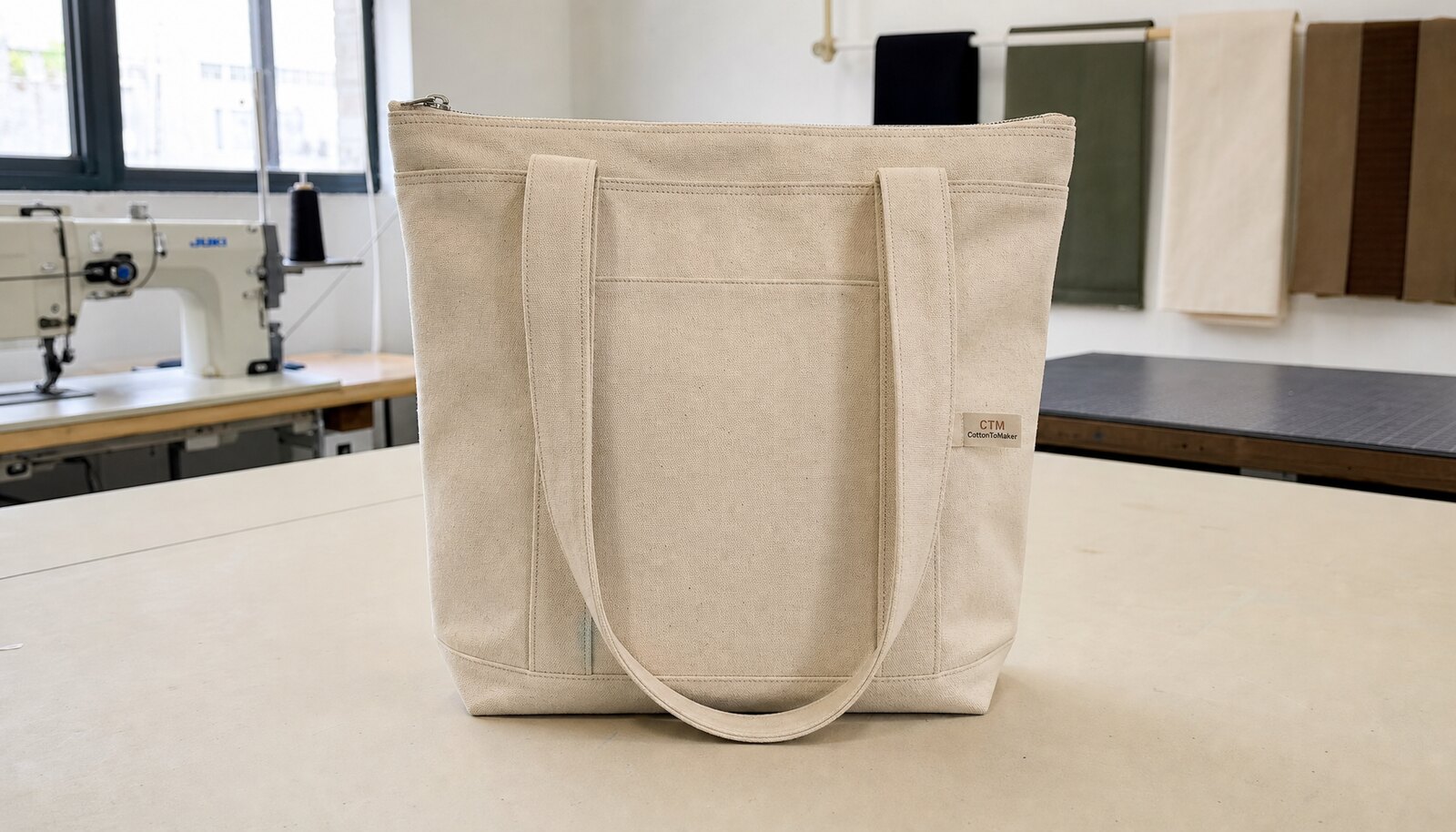
What gift shop buyers are really solving
Gift shops do not buy canvas conference bags the same way a corporate buyer does. The bag has to work as a retail item first. It needs to sit on a shelf, justify its selling price, and still look like a practical souvenir or carry bag rather than a cheap giveaway. That changes the whole procurement brief: the issue is not only capacity, but how much perceived value the bag creates for the price tag. A gift shop buyer is balancing presentation, margin, and replenishment risk in the same order.
That is why the sourcing question starts with the intended retail role. Is the bag a low-ticket impulse add-on near the checkout, a mid-priced souvenir with a destination print, or a more premium conference accessory that must hold books, brochures, and a laptop sleeve? Each version implies a different fabric weight, decoration method, and acceptable landed cost. A bag that feels fine as a free conference handout may still be too plain or too flimsy to command a retail markup.
For this channel, the biggest mismatch usually comes from ordering a spec that is too heavy, too plain, or too complex for the shelf price. If the bag costs too much to land, the shop cannot mark it up. If the bag is too basic, it disappears in a crowded display. If it is overbuilt, the buyer may end up with a nice product that the retail price cannot support. The best buy is usually a simple construction that feels intentional, prints cleanly, and can be reordered without redesigning the whole program.
Think of the buying brief in retail terms, not only sourcing terms. The store team will care about how the bag folds, whether it hangs well on a peg, whether the print can be seen from two meters away, and whether the packaging makes receiving easy. Procurement should translate those shelf realities into a measurable product spec before RFQs go out. If those details are left vague, the factory will price a different product than the one the shop can actually sell.
- Keep the design simple enough to repeat across seasons.
- Use one core body spec and vary artwork only when possible.
- Treat retail margin, shelf appeal, and receiving labor as part of the technical spec.
- Define the sales price target before finalizing fabric weight and trim.
- Choose a bag shape that hangs, stacks, and displays cleanly in the shop.
Pick the spec before you ask for a quote
The fastest way to get comparable quotes is to define the bag body first. For gift shop use, 8 oz canvas is usually the entry level, 10 oz is the practical standard, and 12 oz is the heavier retail version. In metric terms, that is roughly 272 gsm, 340 gsm, and 407 gsm. If the bag has to carry books, catalogs, bottles, or heavy souvenir items, 10 oz with reinforced handles is usually the safest starting point. If the retail price is tight, jumping to a heavier fabric too early can erase the margin before decoration is even added.
Do not rely on the word canvas alone. Factories can source different yarn counts, weave densities, and finishing treatments under the same marketing label. A buyer comparing only the phrase natural canvas may receive a softer, looser weave from one supplier and a denser, more structured cloth from another. That difference changes print sharpness, bag shape, and how premium the item feels on a shelf. If you want a softer hand feel, ask whether the fabric is bleached, enzyme-washed, or bio-polished. If you want a cleaner natural look, keep the finish simple and focus on stitching quality and print clarity.
The practical spec should include dimensions, seam style, handle width, handle drop, gusset depth, and whether the bag is lined. Many procurement teams skip one or two of those points and then wonder why the quotes are hard to compare. A 38 x 42 cm tote and a 35 x 40 cm tote are not interchangeable once decoration and packing are added. A short handle versus a shoulder-length handle also changes retail appeal and sewing time. If you need a structured look, say so; if you want a soft collapsible body for shelf packing, say that instead.
A useful shortcut is to build one baseline spec and only one optional upgrade. For example: baseline is 10 oz unlined natural canvas with one-color screen print; upgrade is the same body with zipper top and woven label. That gives the buyer a clean comparison without turning the RFQ into a design workshop. It also helps the supplier see where the money goes, which usually improves the quality of the quote.
If you are unsure about the best balance, ask the factory to quote a standard version and a retail-upgrade version side by side. The price gap will show you whether a zipper, lining, or extra print is worth the margin pressure. That is much more useful than asking for a generic premium version and hoping the factory interprets it the same way you do.
- 8 oz: low-cost impulse item, light retail use, limited load.
- 10 oz: standard gift-shop tote, best balance of feel and cost.
- 12 oz: premium bag, heavier contents, higher retail price point.
- Specify handle width, handle drop, gusset depth, and whether the bag is lined.
- If the bag must stand up on a shelf, ask for a more structured body and tighter stitching.
- If the bag will be folded and sold near checkout, prioritize foldability and low landed cost.
MOQ logic by print method and construction
MOQ is usually driven more by setup and sewing complexity than by the canvas body itself. A plain unlined tote with one-color screen print is the easiest case for a factory to plan. Add a zipper, inner lining, piping, a patch, or multiple print locations and the line balance changes. The factory then has to reserve more machine time, more material, and more inspection effort, so the MOQ rises. This is why a quote for a simple flat tote can look very different from a quote for a retail-ready conference bag even when the shell dimensions are the same.
For a gift shop buyer, the mistake is splitting demand across too many small styles. Three 400-piece designs can be harder to run than one 1,200-piece design, even if the total volume is the same. Every style change creates a new material pull, a new print setup, and a new packing check. If your artwork strategy allows it, keep the base construction fixed and vary only the print or label. That gives you better leverage on price and makes replenishment less painful. The more the body changes, the more the factory treats it as a new product rather than a repeat order.
Print method matters. Screen print is usually the most efficient for simple logos, slogans, and single- or two-color graphics because setup is straightforward once the artwork is finalized. Heat transfer can work for smaller runs or multi-color art, but it may raise the price if the supplier has to buy specialized material or extra press time. Embroidery can feel premium, but on canvas it often pushes the bag into a different cost and lead-time bracket, especially when dense stitching or large logo coverage is involved. Woven labels, zipper pulls, contrast piping, and custom linings each add another layer of complexity.
The buyer's job is to ask the supplier for break points. Do not accept one MOQ number without context. Ask what happens at 300, 500, 1,000, and 3,000 pcs. Ask whether the MOQ changes if the print moves from one side to two sides. Ask whether the zipper top alone changes the MOQ, or whether a zipper plus lining changes it again. Some factories can absorb a small trim change without moving the minimum much; others will treat any structural change as a new setup. If you do not ask for the break point, you may approve a design that quietly exceeds the budget or the calendar.
The most useful commercial rule is simple: keep the first version close to stock and reserve custom features for proven sellers. That lowers the risk of carrying slow-moving inventory and helps the team learn what customers actually want before spending on the more complex build.
- Lowest MOQ usually comes from stock natural canvas plus one-color screen print.
- Embroidery, woven labels, and heat transfers often sit in the middle.
- Zipper tops, linings, custom trims, and multi-color art usually push MOQ higher.
- Ask the factory for MOQ break points, not one single number.
- Treat every added component as a separate cost and schedule driver.
- If the product is for a first-time retail test, keep custom construction to a minimum.
Which sourcing route fits the order pattern
Different sourcing routes solve different procurement problems. A direct factory is usually the best path when you want the lowest possible unit cost and full control over the bag build. A trading company can be useful when your team wants one contact for several product types or does not want to manage factory communication directly. A local decorator working from imported blanks may be the quickest route for a small launch order, but that convenience usually costs more and gives you less control over the fabric base. None of these routes is universally best; the right choice depends on quantity, speed, and how much design control the buyer needs.
The decision becomes clearer if you think about risk severity. Direct factories have the lowest unit cost but can be slower to respond when you need changes. Trading companies can reduce communication friction but may hide the true factory and complicate accountability on defects. Local decorators are fast but often limited by the quality of the blank they have in stock, so the bag may not match your desired fabric shade or size as closely as you want. Stock importers can be efficient for basic neutral canvas, but the trade-off is limited customization. Nearshore suppliers can save transit time, yet their product cost may be high enough that the retail margin only works if the bag is priced as a premium item.
For repeat business, the key question is continuity. Can the supplier repeat the same fabric shade, same handle length, same stitch count, and same print position six months later? If the answer is vague, the first order may be fine but the replenishment may create a mismatch on shelf. This is especially important for destination shops, museum stores, event venues, and tourist retail where buyers notice when the next batch looks different from the first. A supplier that cannot hold continuity may still be useful for a test order, but it is a weak choice for a long-running retail program.
A practical sourcing logic is to match the route to the stage of the program. Use a stock or local route for an initial sell-through test when speed matters more than customization. Move to a factory or cut-and-sew route once the style proves itself and the team can justify a tighter spec. That sequence protects margin and avoids overengineering the first buy. If you skip the test stage and launch with a complex custom bag, you may lock yourself into MOQ and lead-time pressure before you know whether the bag will actually move.
- Direct factory: best for repeat programs and tight spec control.
- Trading company: best when you need coordination more than factory visibility.
- Local decorator on blanks: best for urgent small runs.
- Nearshore supplier: best when transit time matters more than the unit price.
- Stock importer: best when you need speed and can accept fewer customization options.
- Marketplace broker: only use if you can verify the true source and QC ownership.
What a usable factory quote should show
A usable quote should break the job into parts. If the supplier gives one blended number, procurement cannot see whether the cost is coming from fabric, print setup, sewing, or packing. Ask for a quote that separates the bag body, decoration, packing, and logistics assumptions. That is the only way to compare two factories fairly when one uses stock fabric and the other uses a custom order. Without this split, the cheapest number may simply be the least complete number.
The quote should also carry the technical details that affect the final cost. At minimum, it should show bag size, fabric weight, print method, number of colors, handle type, and pack method. If the supplier has not stated the quantity break points, request pricing at several levels so you can see where the cost curve changes. A quote that looks good at 5,000 pcs may be weak at 500 pcs, which is the more realistic order size for many gift shops. For retail buyers, it is often better to understand the 1,000-piece and 3,000-piece price gap than to chase a single lowest number.
Ask for explicit sample and setup charges. Screen setup, color separation, artwork cleanup, embroidery digitizing, and carton labeling can each add cost that is invisible in a headline quote. If those items are not shown, procurement cannot tell whether the supplier is being transparent or merely incomplete. The same is true for packing details: polybag, hang tag, barcode label, moisture protection, and master carton marks should be named clearly. If the factory expects the buyer to supply the label artwork, say so. If the supplier will print the barcode, ask whether it is included in the unit price or charged separately.
There is also a commercial reason to demand clean quotes: gift shop margins are tight. A bag that lands a little too high may still be acceptable if it sells at a stronger retail price, but only if the shop team knows the margin math in advance. That means procurement should ask the supplier for enough line-item detail to model landed cost, not merely to approve the PO. Better quoting discipline usually leads to better reorder discipline later.
- Quote the same quantity, same artwork, and same packing spec across all suppliers.
- Ask for the fabric weight in gsm or ounces, not only a vague quality description.
- Separate unit price from setup cost, sample fee, carton cost, and any packing labor.
- Confirm the quote validity period and the incoterm used for comparison.
- Request pricing at multiple break points to expose hidden step-ups.
- Make sure the quote states whether the bag is produced as stock blank, semi-custom, or full custom.
Sample approval and QC thresholds
Do not approve a canvas conference bag from a photo alone. Measure the sample flat and filled, then inspect the parts that usually fail in bulk: handle stitching, print registration, seam alignment, and zipper movement if the bag has one. A clean-looking sample can still hide weak reinforcement at the handle base or a print that rubs off after handling. If the bag is going into retail, presentation defects matter too, including stray threads, dirty marks, odor, and crooked labels. These are the defects that shoppers notice first and that receiving teams are most likely to reject when merchandise arrives.
The sample stage should lock the production reference. Once the sample is approved, keep one physical reference sample and one signed spec sheet that shows the approved fabric, print placement, thread color, and folding method. If the factory changes any of those without approval, the bulk order is no longer built to the same standard. That is where many disputes start, especially when the buyer only reviewed images and not the actual sample in hand. A photo can hide grain, stitching tension, or minor skew that becomes obvious in bulk.
For procurement use, QC should be more specific than a general checklist. Define measurement tolerance, defect categories, and acceptance thresholds before bulk production begins. Common practice in many retail programs is to classify defects as critical, major, and minor. Critical defects are not sellable or safe to use, such as a broken seam at the handle, a missing zipper stop, or the wrong artwork entirely. Major defects affect saleability, such as wrong dimensions, visible print offset, or mixed SKU packing. Minor defects are cosmetic, such as a loose thread or very small shade variation, but if they appear too often they can still make the lot look cheap.
A practical way to inspect is to sample units from different cartons, not only from the top row. Check stitching under light tension, inspect seam corners for opening, and compare the print position against a ruler or template. If the bag includes a zipper, open and close it several times and watch for snagging. If the bag is lined, look for trapped fabric and loose lining edges. If a woven label is present, confirm its position on both left and right sides of the bag because asymmetric placement becomes obvious on a simple canvas body.
The important point is that QC should protect the retail shelf, not just the factory exit. A bag can technically pass if it is usable, but still be a poor retail product because the print is crooked or the handle height varies from unit to unit. That is why the acceptance standard should be written in the same language as the shop team uses: shelf-ready, presentable, consistent, and reorderable.
- Set your acceptable size tolerance before bulk production starts.
- Reject open seams, wrong artwork placement, and loose handle reinforcement.
- Use a rub test for print durability and a smooth-run test for zippers.
- Apply your house AQL or defect limit before shipment, not after delivery.
- Inspect cartons from multiple locations in the batch, not only the top layer.
- Keep one approved physical sample and one signed spec sheet for every reorder.
Packing and shelf readiness
Gift shops sell presentation as much as function, so packing is not a minor detail. The bag should be folded the same way every time, packed cleanly, and labeled so the receiving team can move it straight to shelf or storage without repacking. If the cartons arrive with mixed sizes, unclear labels, or loose folding, your labor cost rises and the product looks less premium when it reaches the floor. Packing discipline also affects whether the warehouse can receive the goods quickly during peak season.
Packing also affects freight efficiency. A bag that folds flat and packs densely will ship more efficiently than a bag with an awkward fold or bulky insert. That matters even more on air shipments, where volumetric weight can dominate the freight bill. For destination-ready retail, confirm whether you need polybags, hang tags, barcode stickers, silica gel, or carton marks. Those details should be fixed in the quote, not added later as a surprise. If the bag is a souvenir item that customers will immediately open, you may not need heavy retail packaging; if it sits in a humid coastal shop or tourist market, moisture protection may be worth the small extra cost.
Ask the supplier how they pack by default and whether they can hold the same fold and carton count across reorders. A good packing sheet should show the number of bags per inner pack and outer carton, carton dimensions, gross weight, barcode placement, and carton marks. For gift-shop programs, the receiving team often cares more about consistency than elegance: they need every carton to look identical, open easily, and reconcile to the purchase order without manual counting. If the supplier cannot document the packing method, you may save a small amount on the quote but spend far more in warehouse handling.
Retail buyers should also think about shelf readiness at the store level. If the bag is sold flat, the fold needs to be neat enough that the front print is visible without refolding. If it is hung, the handle drop and hang-hole placement matter. If it is stored in backstock, the carton labeling must be clear enough that staff can pull the right style quickly. These are small details, but they determine whether the product enters the store smoothly or creates extra work before it ever reaches a customer.
- Use one fold method and one carton count for every unit.
- Mark carton labels with size, color, quantity, and PO number.
- Ask whether polybags are needed for moisture control or retail presentation.
- Leave barcode space aligned with your store or distributor standard.
- Confirm carton dimensions for both warehouse efficiency and freight planning.
- Ask for a carton photo or packing sample on first production if the pack-out is new.
Lead time planning without surprises
A realistic lead time is a chain of steps, not a single number. Fabric confirmation, sample approval, printing, sewing, packing, inspection, and booking all take time. If a factory gives you only one total lead-time figure, ask what assumptions sit behind it. In many cases, the short number depends on stock fabric, simple artwork, and no changes after approval. Once the spec changes, the schedule moves. A buyer who understands the schedule by stage can identify the real delay risk before the PO is released.
For gift shop replenishment, the real risk is schedule drift. Artwork revisions, label changes, and carton mark updates can each add days. Seasonal orders are especially exposed because the shipment has to clear before the retail window opens. A standard canvas order may be feasible in about 20 to 35 days after sample approval when materials are ready, but custom-dyed fabric, special trims, or a holiday backlog can push that much further. Build your buying calendar backward from the in-store date, not from the PO date. The right question is not just “How long will production take?” but “What is the last safe date to approve artwork without missing the launch?”
Ask the supplier to separate sample time, bulk production time, and transit time. That matters because a quote with a short production schedule can still fail the project if sample approval takes too long. If your team is slow on approvals, the factory schedule is only half the story. If artwork is likely to change, keep a buffer built into the plan. One useful rule is to protect the critical path with a contingency window rather than hoping the factory can absorb every revision. The more custom the bag, the more valuable that buffer becomes.
There are also operational calendar risks that buyers forget to ask about. Factory holiday shutdowns, peak shipping congestion, and port delays can all change the real delivery date. If the order is for a museum shop, tourist destination, or conference venue with a hard event date, ask the supplier for the earliest physically shippable date and the latest date that still protects the launch. That forces a more honest conversation than a single optimistic ETA. It also helps procurement decide whether sea freight is acceptable or whether a partial air shipment is justified to avoid a stockout.
In short, lead time is not just a production metric; it is a commercial risk metric. A cheap bag that arrives after the shop has missed the selling window is not actually cheap.
- Ask for a step-by-step schedule from sample to shipment.
- Hold extra time for holiday shutdowns and peak season congestion.
- Reserve a buffer for artwork correction and packing revisions.
- Plan air freight only when the retail launch justifies the extra cost.
- Ask for the earliest shippable date and the latest safe date.
- If the schedule is tight, simplify the bag before pushing the factory for speed.
Landed cost and reorder math
The cheapest factory quote is not always the cheapest landed bag. For retail buyers, the real number is landed cost per sellable unit after freight, duty, inspection, repacking, and expected defects. A quote that looks better on paper can become more expensive if it forces extra local labor or uses cartons that fail in transit. The right comparison is not unit price alone, but landed price at the shelf-ready standard you actually need. That includes the cost of getting the product into a form the gift shop can sell immediately.
A useful way to compare is to calculate landed cost at several quantity levels: 500, 1,000, and 3,000 pcs. This exposes the hidden step-up between small test runs and real production. If setup costs are high, a 500-piece buy may carry too much overhead per unit. If freight dominates, a small air shipment may erase the benefit of the lower factory price. The buyer should also model defect allowance, because a 2% or 3% reject rate changes the real sellable cost. In gift retail, that margin math matters because the shop often has limited room to absorb hidden losses.
Reorder math matters just as much as the first buy. If the bag sells through, the supplier's ability to repeat the same spec becomes more valuable than shaving a few cents off the opening order. Hold the art file, approved sample, and fabric reference together so the next lot matches the first. For a gift shop program, consistency usually protects margin better than chasing a slightly lower quote from a different factory every season. Reorders should be treated as continuity purchases, not new design projects.
There is also a practical buying threshold to consider. If a style is unproven, keep the first order small enough to test sell-through but large enough to avoid excessive setup cost. If the style is already proven, concentrate volume into fewer SKUs so the factory can quote better and the store can simplify inventory. Buyers often save more by reducing style sprawl than by negotiating a small unit-price cut. One strong style with a stable reorder path is more valuable than several marginal styles that all require separate sourcing effort.
The last piece is risk allocation. If the supplier missed a spec or the packing was wrong, who pays for the correction? If the answer is unclear, the landed cost model is incomplete. Procurement should know whether rework, replacement, or inspection failure falls on the supplier, the buyer, or the freight forwarder. That is not just a legal detail; it is part of the true cost to the store.
- Compare landed cost at 500, 1,000, and 3,000 pcs.
- Spread sample fees and setup charges across the first shipment.
- Include repack labor and a realistic defect allowance in the model.
- Use sea freight for replenishment and air only for launch stock when needed.
- Keep reorders on the same spec sheet to avoid hidden requalification costs.
- Model retail margin before approving a more expensive construction.
Common RFQ mistakes that distort quotes
The worst quotes usually start with vague instructions. Terms like thick canvas, premium quality, or nice printing do not help a factory price the order. They force the supplier to guess, and guessing usually shows up later as either a higher price or a weaker product. A clean RFQ should give the bag size, fabric weight, decoration method, packing method, target quantity, and required delivery window in one place. If the bag is for gift shops, include the shelf role too: impulse item, souvenir, premium add-on, or event carry bag.
Another common mistake is mixing the base version and upgrade version in the same request without saying which one is the real target. If you want a simple tote and a zipper version, price them separately. That gives procurement a clean basis for comparison and avoids approving a bag that looks good on screen but misses the margin target in the shop. In other words, compare like with like before you ask the supplier to optimize. If the factory thinks the zipper version is the main target, the base bag quote may be understated or not representative.
A third mistake is under-specifying artwork. If the print color, Pantone reference, artwork size, and placement tolerance are not clear, the factory may quote conservatively or interpret the design differently. This is especially true when the design includes small text, thin lines, or a large logo that wraps close to a seam. Ask the supplier whether the chosen print method can hold the detail you want without extra setup. If the answer is vague, the quote may not reflect the real production risk.
Buyers also get into trouble by forgetting the commercial assumptions around packing and logistics. If one quote is EXW and another is FOB, the numbers are not comparable until freight responsibility is normalized. The same applies if one supplier includes polybags, cartons, and barcode labels while another does not. The lowest quote can easily be the least complete one. A good RFQ should therefore state what is included, what is excluded, and what changes would trigger a price or MOQ revision.
When the brief is clear, the quote is clearer, the sample cycle is shorter, and the reorder process is less painful. In procurement terms, precision is not bureaucracy; it is margin protection.
- Send one baseline spec and one optional upgrade spec if needed.
- Provide vector artwork and clear color references when print quality matters.
- State whether freight, duty, and destination delivery are inside or outside the quote.
- Keep the approved sample and spec sheet attached to every reorder request.
- Ask the factory to identify any assumption that could change MOQ or lead time.
- Avoid phrases like premium or thick unless they are backed by a measurable spec.
Specification comparison for buyers
| Spec decision | Recommended option | MOQ / lead time reality | When it fits | Buyer risk to check |
|---|---|---|---|---|
| Direct factory in Asia | Best unit cost and the most control over fabric, stitching, and decoration | Typical MOQ: 500-3,000 pcs per style depending on print complexity; lead time often 20-40 days after sample approval if materials are ready | Repeat orders, stable artwork, and volumes where you can justify a full production run | Check whether the same fabric lot, print screen, and trim source can be repeated on reorder |
| Trading company | Useful when you need one contact for multiple product types or factories | MOQ often mirrors the underlying factory, but admin fees and margin can raise unit cost by 5%-15%; lead time may be similar or slightly longer if the order is routed through more hands | Buyers managing mixed assortments or limited internal sourcing staff | Confirm who owns final QC, who issues production follow-up, and whether the price hides a service margin |
| Local decorator using imported blanks | Fastest route for small urgent runs with simple print needs | MOQ can be as low as 50-300 pcs per design; lead time may be 3-14 days if blanks are in stock, but inventory availability is the main risk | Launch events, short deadlines, and low quantities | Blank quality, size consistency, and shade matching can vary by batch; ask for actual blank photos and measurements |
| Stock bag importer | Lowest-risk choice for basic natural canvas with local branding added later | MOQ is often driven by stock availability rather than production setup; lead time can be 7-21 days for branding, but out-of-stock risk is common | When lead time matters more than a custom fit or custom fabric | Choices are limited and repeatability depends on stock depth; ask how many cartons are physically available now |
| Cut-and-sew factory | Best for zipper tops, lining, woven labels, and custom trim | MOQ usually rises to 1,000-3,000+ pcs per style when custom parts are added; lead time often 25-45 days depending on sampling and accessories | Premium gift-shop programs and bags that need a more finished retail look | MOQ rises quickly if you add too many custom parts; verify accessory availability before approving artwork |
| Hybrid route: stock body plus local print | Good for testing artwork before committing to a full custom run | MOQ for the blank body may be low if stock exists, while decoration MOQ depends on print method; lead time is often medium, not fastest, because two vendors are involved | Pilot orders, seasonal campaigns, and range testing | Print position and color match can shift between lots and vendors; agree a master sample and print tolerance |
| Nearshore supplier | Useful when transit time is the main constraint | MOQ is often smaller than a large offshore factory, but unit cost may be 10%-30% higher; lead time can be reduced by 1-3 weeks versus distant origins | Replenishment orders, smaller regional programs, and reduced shipping risk | Higher unit price only works if speed saves real business value; compare against lost sales from stockouts |
| Marketplace broker | Only suitable for very small test buys when speed matters more than control | MOQ can look attractive, but lead time and continuity are unpredictable because the real source may change; sample-to-shipment time can be short, but reorder continuity is weak | One-off samples or market tests with limited procurement overhead | Hard to verify the real factory, QC ownership, and reorder continuity; request factory identity and inspection responsibility upfront |
Buyer checklist before sampling
- Lock the bag size, gusset depth, handle length, and fabric weight before requesting quotes.
- Choose one decoration method as the baseline and list any upgrade version separately.
- Set the target quantity by SKU, not only the total order value.
- Ask for ex-factory or FOB pricing with the same packing assumption across suppliers.
- Approve a physical sample against measured dimensions, not only a photo.
- Define carton count, polybag requirement, barcode placement, and fold method.
- State the delivery window and work backward from the store launch date.
- Request the factory's MOQ break points for print, zipper, lining, and label changes.
- Confirm the expected defect standard and who pays for rework or inspection failure.
- Keep one reference sample and one approved spec sheet for all reorders.
Factory quote questions to send
- What is the MOQ for the base tote, and how does it change if we add a zipper, lining, woven label, or second print location?
- What fabric weight do you recommend for this size, and is the canvas stock-dyed or custom dyed?
- Which print method is included in the quote, and what are the setup charges for screens, plates, or artwork prep?
- What exactly is included in the unit price: bag body, decoration, polybag, hang tag, barcode label, and carton packing?
- What lead time do you need after sample approval, and what parts of the schedule are at risk if artwork changes?
- Can you keep the same fabric shade, handle length, and label position for a reorder placed later?
- What inspection standard do you follow, and can you share inline or final inspection photos before shipment?
- What changes would increase the price or MOQ, and how much does each change affect the quote?
- Can you quote 500, 1,000, and 3,000 pcs side by side so we can see the break points clearly?
- If you cannot meet the target date, what is the earliest shippable version with the fewest spec changes?
Quality-control points to confirm
- Fabric weight should match the approved GSM or ounce target within a practical tolerance of about ±5% for fabric batch variation, unless the buyer's spec is tighter.
- Finished width, height, and gusset depth should match the approved sample within about ±0.5 cm for small bags and ±1.0 cm for larger tote formats, unless the bag style is intentionally soft-structured.
- Handle length, handle drop, and the distance from top edge to handle stitch line should be consistent from unit to unit; visible asymmetry is a retail defect even when the bag remains usable.
- Stitching should be even, with no skipped stitches, broken thread, open seam, or missed backtack at stress points such as handle attachment and base corners.
- For a sewn tote, a practical acceptance check is that handle seams do not gap or twist when the bag is loaded with a test weight similar to retail use, such as books or brochures.
- Print placement should stay within the approved position tolerance; for a front print, a shift of more than a few millimeters can look off-center on a simple retail design.
- Screen print or transfer should pass a dry rub and light wet rub test without visible smearing, cracking, or tackiness under normal handling conditions.
- Zippers, if used, should run smoothly from end to end, stop cleanly, and not catch on seam allowances, lining edges, or loose threads.
- Labels, side tabs, and hang tags should face the correct direction, sit flat, and avoid crooked placement; misaligned branding is a common gift-shop rejection point.
- Visible contamination such as oil marks, dirty fingerprints, yarn slubs, loose fibers, and odor should be screened out before packing; gift-shop buyers often reject these because they affect shelf appeal.