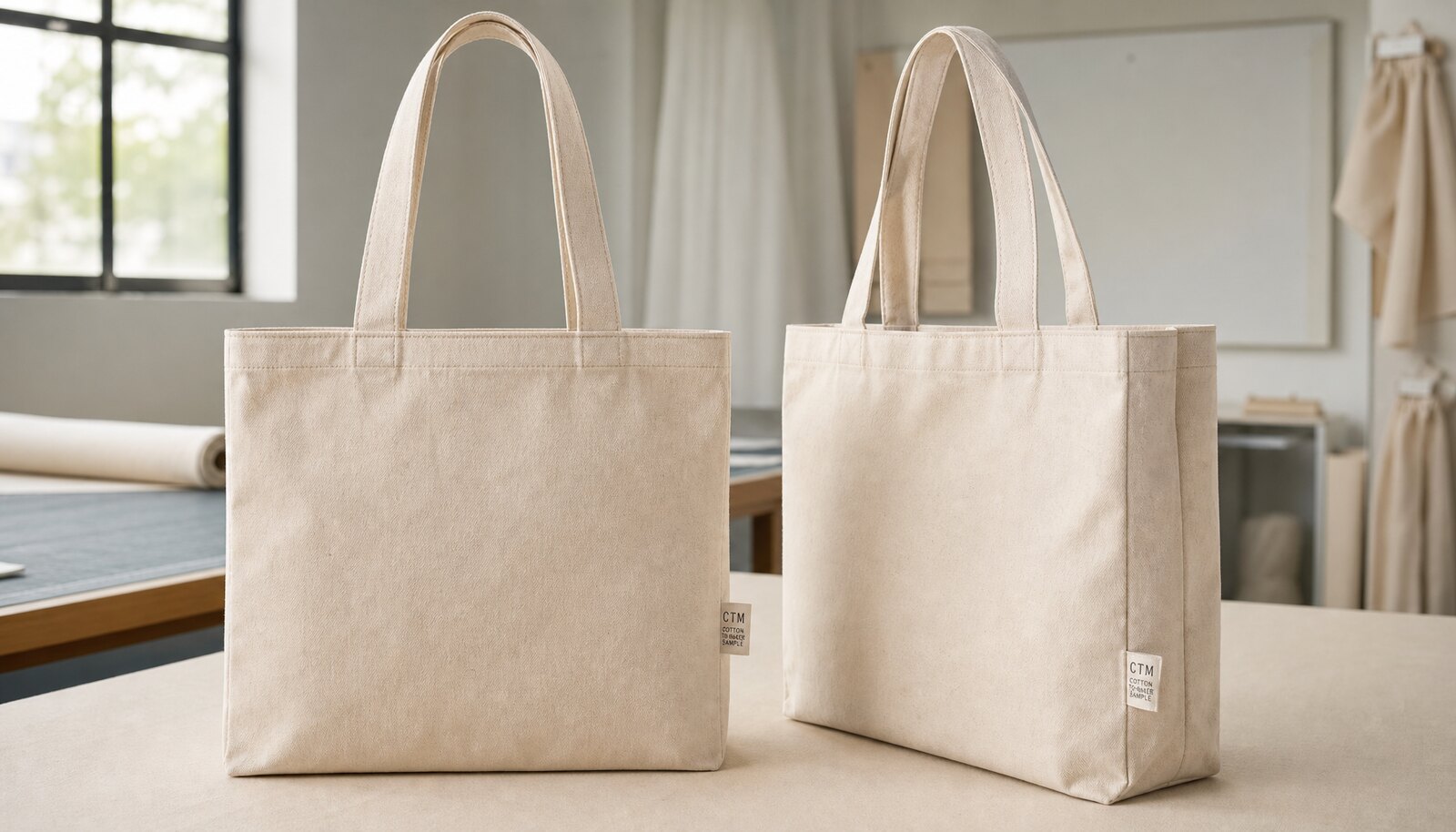
1) Start With the Retail Job, Not the Tote Shape
Canvas conference bags for gift shops sit in a different buying environment from a free conference giveaway. They have to sell from a shelf, hang neatly on a peg, and look intentional beside postcards, notebooks, travel accessories, or branded stationery. A gift shop buyer is not only buying storage capacity. They are buying a small retail product that has to carry a margin, survive handling, and still look clean after a customer picks it up twice and puts it back.
That is why the first sourcing mistake is usually a vague brief. If you say “conference bag” and stop there, suppliers will assume different things. One factory may think you want a soft event tote. Another may quote a thicker retail bag with a stronger handle build. A third may price a promotional item that is technically usable but not polished enough to sit on a shop fixture. The quote becomes a comparison of assumptions instead of a comparison of real offers.
Before you ask for price, write the use case in plain language. Is the bag a paid retail item in a museum shop, an entry-level souvenir in a visitor center, or a branded carry bag bundled with tickets, notebooks, or conference kits? Each one changes the right fabric weight, print style, trim level, and packing method. If you do not define the retail context, the factory will optimize for the cheapest interpretation rather than the best-selling one.
A useful brief also includes the customer experience you want. Does the bag need a more premium hand feel? Does it need to hold catalogs, a water bottle, and a paperback without sagging? Should it hang straight on a hook and keep its shape on the sales floor? Those answers matter because they guide everything that follows: fabric, stitch count, handle width, and the amount of packing labor you should budget for.
In procurement terms, this early definition saves time later. It prevents re-sampling, avoids specification drift, and reduces the chance of comparing a premium sample from one supplier with an underbuilt quote from another. If the product is meant for retail, the quotation should be written for retail from the beginning.
- State the buying channel: gift shop retail, museum shop, visitor center, conference resale, or event bundle.
- Define the target shelf price range so the factory can work backward to a realistic construction.
- List the expected contents or carry weight if the bag needs to hold books, brochures, boxed gifts, or a laptop sleeve.
- Say whether the bag should feel premium, casual, souvenir-like, or display-forward on the shelf.
2) Lock the Fabric Before You Compare Prices
For canvas totes, the quoted fabric weight affects almost everything: body, drape, sewing difficulty, print appearance, and retail perception. The common buying range for these bags is usually around 10 oz, 12 oz, or 16 oz canvas, but the number alone is not enough. Two suppliers can both say “12 oz” and still send very different cloth if one is raw and loosely woven while the other is washed, denser, or finished for better hand feel.
In gift shop programs, 12 oz / about 410 gsm is often the most balanced starting point because it gives the bag enough body to sit upright without becoming bulky or expensive. Ten-ounce fabric may work for lightweight merchandise, but on the shelf it can read as too soft or too promotional unless the design is doing a lot of work. Sixteen-ounce canvas feels more structured and premium, but it adds cost, stiffness, and more sewing resistance, which can slow production and raise the risk of needle marks or bulky seams.
You should also ask about finish. Raw natural canvas, washed canvas, bleached canvas, and dyed canvas do not perform the same way. Raw canvas can have more shade variation and a more natural look, which some gift shops prefer. Washed canvas generally feels softer and may shrink less after sewing, but it also changes the look and can influence print sharpness. Bleached or dyed fabric can improve shelf presentation, but it usually adds cost and may require stricter color control between batches.
Fabric width and shrinkage matter too. If a factory cuts from a narrower loom-state width or does not account for shrinkage, the final bag size can drift after cutting or after the first handling cycle. A buyer who wants a clean rectangular retail silhouette should ask the supplier to state the cutting allowance and the shrinkage control assumption in writing. That one sentence is often the difference between a bag that samples well and a bag that actually reorders well.
Another point worth checking is the weave quality. A quote that gives only weight but not construction can hide a loose weave that prints poorly or wears unevenly. Ask for visible defects policy on the front panel, because slubs, thin spots, and uneven yarn tension show up quickly on retail goods. If the supplier cannot describe the fabric source clearly, the quote is not mature enough to compare.
For many B2B buyers, the safest approach is simple: compare only like for like. Use the same fabric finish, same loom-state assumptions, and same shrinkage note across all suppliers. If one quote is built on raw 10 oz and another on washed 12 oz, the cheapest number is not the comparable one. It is just a different product.
- Use 12 oz / 410 gsm as the default comparison point unless the bag needs a lighter souvenir feel or a heavier premium build.
- Ask for fabric finish in writing: raw, washed, bleached, dyed, or pre-shrunk.
- Request loom-state width and shrinkage control details so final dimensions do not drift.
- Reject any quote that uses only “canvas” with no weight, finish, or tolerance note.
3) Choose the Print Route Around the Artwork, Not the Other Way Around
Most canvas conference bags for gift shops are bought for their logo or artwork first and their carry function second. That means the print route must match the art, the budget, and the retail use pattern. For simple logos and short brand names, one- or two-color screen print is usually the strongest starting point. It is durable, repeatable, and comparatively easy to quote. It also gives the bag the crisp visual edge many gift shops want when the product is displayed from a distance.
Embroidery adds texture and a more tactile feel, but it is not the default choice just because it looks premium. On a tote, embroidery can make the panel stiffer, increase needle distortion, and raise the unit price enough to push the bag out of a gift shop’s target margin. It works best when the artwork is small, the canvas is heavy enough to support it, and the brand intentionally wants a stitched look. Heat transfer and other transferred graphics are useful when the artwork includes gradients, detailed illustration, or a short production window, but the buyer should ask about wash, flex, and abrasion performance if the bag will be handled heavily.
The best quote does not just name the method. It spells out print size, exact position, color count, and the matching standard. If the logo is centered, say how far from the top seam or side seam it sits. If the artwork is meant to fit a certain store fixture, define the visible area. If you want Pantone matching, ask whether the factory matches to coated or uncoated standards and whether they can provide a strike-off or lab dip for approval. Without those details, print quality becomes subjective fast.
You should also ask about the print workflow itself. Screen count, film preparation, alignment method, curing or fixation process, and whether the printer uses manual or automatic equipment all affect consistency. A supplier may quote a low print price, but if the setup is weak or the curing control is poor, you end up with off-center logos, color variation, or ink that feels tacky in carton. That is a production cost, not just a cosmetic issue.
If the design has more than one decoration element, quote them separately. A woven side label, a back print, or a hangtag may look small on paper, but these details add real labor and change the total landed cost. The buyer who breaks decoration into components gets a cleaner comparison and fewer surprises after sample approval.
- Use screen print for simple, repeatable branding on most gift shop tote programs.
- Use embroidery only when the fabric weight, margin, and desired look justify the added labor.
- Ask for print size, print placement, color count, Pantone target, and curing method in writing.
- Separate the cost of side labels, back prints, hangtags, and special finishes from the base bag price.
4) Build the Quote Around Real Cost Drivers
A useful quote separates recurring unit price from one-time setup charges. This sounds basic, but it is where many sourcing conversations get messy. The base unit should include the fabric, cutting, sewing, standard print, and standard packing described in the spec. Then the supplier should list any non-recurring charges separately: screen setup, plate making, embroidery digitizing, artwork adjustments, sample fees, special label tooling, and special carton markings. If everything is folded into one number, you cannot tell what a repeat order will really cost.
This is also the right time to look at MOQ tiers. A supplier might offer a very competitive price at 5,000 pieces, but the pricing may rise sharply at 500 or 1,000 pieces because setup cost is spread across fewer units. That does not automatically make the supplier wrong. It just means the buyer needs a real volume curve, not a single headline number. Ask for tiered pricing at the exact same construction so you can compare apples to apples. If the supplier changes the fabric weight, handle width, or print method between tiers, the quote is not a volume comparison anymore.
Incoterms matter more than many first-time buyers expect. FOB gives you a clear factory-side price and lets you compare vendors more cleanly. EXW may look lower but shifts more logistics work onto you. CIF can be convenient if you want a quick freight-inclusive figure, but it can also hide assumptions around port fees and destination handling. DDP sounds simple but needs very careful definition because taxes, duties, and clearance responsibilities can vary by market and by broker. If you want a procurement-grade comparison, ask for FOB first and then build the landed cost separately.
A strong quote also shows quote validity, currency, and payment terms. Without those three items, a cheap number can move for reasons that have nothing to do with manufacturing. Exchange rates, raw material swings, or a short validity period can erase the value of a low initial quote. Ask the supplier to state how long the quotation stands and what triggers a reprice. If a factory refuses to be explicit, that is usually a sign that the offer is more provisional than it looks.
Finally, do not underestimate the cost of packing detail. Inner packs, inserts, barcode stickers, retail hangtags, and special carton labels all add labor. They may seem minor individually, but for a store-ready product they are part of the cost structure, not optional extras. The buyer who sees them early can protect margin; the buyer who discovers them later usually pays more.
- Request separate lines for fabric, cutting, sewing, print setup, packing, and export handling.
- Compare the same MOQ tiers on the same construction, not on a simplified sample version.
- Ask for quote validity, currency, and payment terms before shortlisting suppliers.
- Use FOB for clean supplier comparison, then estimate freight and destination costs separately.
5) Compare Supplier Routes on Landed Cost, Not Just Factory Price
For canvas conference bags for gift shops, the sourcing route can change the economics as much as the product spec. A direct factory is often the best fit for repeat business because you can control cutting, sewing, printing, and packing in one place. That usually gives better visibility over production and a cleaner path to reorders. A trading company can be useful when the buyer needs coordination across multiple product lines or wants one contact for several categories, but the margin stack and accountability chain can make cost and defect ownership harder to track. A local decorator can solve a rush or replenishment order, but the available bag shapes, fabric options, and decoration methods are usually narrower.
The more important comparison is landed cost per sellable unit. That means the buyer should add freight, duty assumptions, customs clearance, warehouse receiving, carton handling, and any store-ready labeling to the base quote. A factory price that looks low can become expensive if the cartons are too large, the packing is inefficient, or the supplier did not include the exact retail packing you need. For a gift shop buyer, every extra handling step matters because the bag has to arrive clean, flat, and easy to put out on display.
To estimate landed cost, ask for a line-by-line breakdown. Product cost is only one part. Add the cost of setup charges spread across your order size, the carton packing cost, inland freight to the port or consolidation point, export documentation, international freight, customs duty assumptions, destination handling, and final warehouse delivery if applicable. If you are comparing suppliers from different regions, make sure each one uses the same freight basis. Otherwise a “cheap” quote can simply be a quote with missing logistics.
This is where many buyers get trapped by trading-company quotes. A trading company may quote a factory-looking unit price, but the real production location may be unclear, the packing assumptions may be different, and subcontracting may not be visible. Ask directly where sewing, printing, and packing happen, and whether the product will pass through more than one site. If the answer is vague, ask for the real factory name, location, and production scope in writing. A quote without traceability is harder to manage if quality slips or lead time moves.
When in doubt, score suppliers on three questions: Can they repeat the spec? Can they prove where the work happens? Can they itemize what makes up the landed cost? If the answer is yes to all three, the quote is useful. If not, the number is only a starting point.
- Direct factory: best for repeatability, process control, and lower long-run unit cost.
- Trading company: useful for coordination, but require written disclosure of the real production site.
- Local decorator: useful for rush replenishment, but expect fewer fabric and construction options.
- Compare landed cost per sellable unit, not just factory gate price.
6) Make Sample Approval Physical, Measurable, and Hard to Misread
A sample is only useful if it is tied to the real production spec. Many procurement problems start when the buyer approves a sales sample that looks good but does not match the final fabric, print method, or packing method. For a retail bag, that is not enough. You need a pre-production sample that reflects the actual cloth, decoration, seam construction, and retail presentation the bulk order will use. Otherwise the bulk order can drift in hand feel, print sharpness, or bag structure.
The sample should be handled like a measurement object. Measure the bag body, gusset, handle width, and handle drop. Check the distance from print to seam, the symmetry of the logo, and the alignment of the side panels. Put a small load inside the bag and see whether the handles sit evenly and whether the bottom panel stays square. If the bag is supposed to look premium, look at it on a shelf or from a standing customer’s eye line, not only on a table.
There is also a useful distinction between sales sample, pre-production sample, and top-of-bulk reference. A sales sample can show the idea. A pre-production sample should show the real materials and processes. The approved reference sample then becomes the standard against which bulk is checked. Label it, photograph it, and keep it sealed if possible. When a supplier says “same as sample,” everyone should mean the same sample.
The approval workflow should not be purely email-based if the order matters. Send a signed or clearly acknowledged sample approval sheet that lists all key dimensions, decoration positions, packaging details, and any acceptable variation. If something is left open, it will be interpreted later, usually in the supplier’s favor. Buyers with recurring bag programs usually save time by standardizing this one-page approval form.
One more point: if the sample uses different fabric or a different print route from the intended bulk order, do not approve it as final. Use it only as a visual reference and ask for another sample made from the correct inputs. A fast approval on the wrong sample is one of the most expensive shortcuts in soft goods sourcing.
- Approve a physical pre-production sample before bulk production starts.
- Measure finished dimensions, handle drop, print position, and gusset depth against the written spec.
- Keep the approved sample sealed and labeled as the bulk master reference.
- Do not approve a sales sample as a bulk standard if it uses different fabric or print methods.
7) Set QC Thresholds That Match How Gift Shops Sell
Gift shop buyers care about appearance first and durability second, but both matter because the product is handled, hung, and resold. A bag that looks slightly uneven on a warehouse dock can look obviously wrong on a boutique shelf. This is why the QC standard should be written before production begins. Otherwise the factory will use its own internal standard, which may be fine for promotional giveaways but too loose for retail display goods.
Start with measurement tolerances. For smaller bags, many buyers accept about +/- 0.5 cm on body dimensions and handle drop if the product is not highly engineered. For larger tote formats, +/- 1.0 cm may be acceptable depending on the visual design. The important part is consistency: if one bag is visibly short on handle drop and another hangs lower by a noticeable amount, the line looks inconsistent even if both are technically usable. The same logic applies to gusset depth and top opening width.
Then define visual defects. Common major defects include broken stitching at handle stress points, skipped stitches along visible seams, off-center print that is obviously noticeable at shelf distance, undercured ink that feels tacky, fabric holes, greasy marks, or mixed SKUs in the same retail carton. Minor defects might include very small loose threads, slight shade variation within an approved range, or a tag that is crooked but still readable. The key is to write the distinction down so the inspector and the factory are using the same language.
The inspection standard should be specified too. Many buyers use an AQL approach for bulk inspection, often around AQL 2.5 for major defects and 4.0 for minor defects, unless the retail channel needs stricter control. The important thing is not the exact number alone but the fact that there is a shared acceptance rule before shipment. If the factory pushes back on an inspection standard, that is worth noting. Good suppliers usually prefer clear standards because they know what success looks like.
For print quality, use a simple retail-facing criterion: if the customer would notice the defect from normal shelf distance, it is a problem. That is more useful than a vague “good quality” statement. Ask the factory to show how they check placement, color, and curing. If you expect a printed logo to remain crisp after folding and carton pressure, mention that in the PO. Bulk quality often fails in transit, not at the sewing line, so carton compression and print rub resistance matter.
Finally, remember that carton quality is part of QC. A bag can be perfect individually but arrive crushed, wet, or mixed if the carton spec is weak. Ask for carton material strength, closure method, and whether the carton can survive stacking without collapsing the top layer of bags. That may sound operational, but for retail it is a commercial issue because damaged cartons slow receiving and can delay shelf replenishment.
- Set written tolerances for size, handle drop, and print placement before the PO is issued.
- Define major and minor defects in terms of shelf appearance, function, and brand trust.
- Use an AQL-based inspection plan rather than a generic “acceptable quality” statement.
- Include carton condition, stacking, and packing integrity in the acceptance criteria.
8) Pack for Shelf Presentation and Warehouse Handling at the Same Time
Packing is one of the easiest places for cost to hide and one of the easiest places for margin to leak. For canvas conference bags in gift shops, the right packing method depends on whether the product is sold as a gift item, a counter display item, or a replenishment piece. Flat-fold packing is usually the most efficient starting point because it reduces carton volume and keeps handling simple. If the store needs the bag to hold its shape visually, an insert card or shaped fold may be worth the added labor.
Ask the factory to quote the full packing format rather than just “polybag.” Does the bag need an individual polybag? Is the polybag suffocation-warning compliant for your market? Is there a barcode sticker, a hangtag, a retail insert card, or an outer polybag over an inner bundle? These details affect both the quote and the receiving process. If the bag is going to be sold at a gift shop register, easy scanability and clean presentation often matter more than the absolute lowest packing cost.
Carton dimensions and gross weight should be written into the quote. A carton that is too heavy creates warehouse handling problems. A carton that is too large can raise freight cost and fill pallet space inefficiently. Ask the supplier to tell you how many units fit per carton, how the bags are folded, and whether the carton size is optimized for stacking or for display replenishment. This lets you estimate freight more accurately and assess whether the carton format is practical for your receiving site.
Retail buyers should also ask about color grouping. If multiple colors or artwork variations are being made, should they be packed in mixed cartons or color-separated cartons? Mixed cartons can reduce carton count but can complicate store replenishment. Color-separated cartons are usually easier to manage if the retail team wants to put out a single SKU at a time. The factory can often do either, but only if the instruction is explicit.
A useful rule is to pack for the downstream user, not for the factory line. If your warehouse or store team opens cartons all day, the packing needs to support fast handling. If the item will sit in reserve stock, the carton may need stronger protection. Either way, the packing spec should be part of the commercial quote, not an afterthought.
- Use flat fold packing unless the retail display needs a shaped presentation.
- Define whether the bag needs a polybag, insert card, barcode, or hangtag.
- Ask for carton dimensions, gross weight, and units per carton in the quote.
- Specify whether SKUs should be color-separated or mixed by carton.
9) Estimate Lead Time as a Schedule With Pressure Points
Lead time should be broken into parts because each part has a different risk profile. A supplier that gives you a single delivery date without context is not actually giving you a schedule. For a canvas bag program, the normal sequence is sample approval, fabric booking, print setup, bulk production, inspection, packing, and freight. If any one of those steps is unclear, a rush order can slip even if the sewing line itself is efficient.
Ask for the lead time after sample approval, not just the overall calendar. Sample lead time and bulk lead time are different. If the sample takes two weeks and the bulk takes four, that is not the same as saying “six weeks total” because the schedule depends on approval speed and material availability. The buyer should know which step is on the critical path. In many bag programs, print setup and fabric booking are the first bottlenecks, not the sewing line.
For repeat orders, keep the spec stable. Use the approved sample, same print file, same fabric reference, and same packing configuration. The more variables you change, the more likely you are to re-open the approval cycle. This is especially important for seasonal gift shop items where delivery windows matter. If a buyer wants to vary artwork but keep the bag structure identical, that is usually the easiest way to protect lead time and avoid re-testing the whole product.
Also ask what could move the schedule. A good supplier can usually tell you whether the risk is fabric availability, print capacity, packaging procurement, or export congestion. That is useful because it tells you where to place your follow-up effort. If packaging is the bottleneck, for example, you do not need to accelerate sewing; you need to confirm carton and insert availability earlier. Buyers who ask this question tend to get more realistic delivery promises.
Finally, remember that freight is part of lead time. A quote may be ready in production terms but still not be on shelf because shipping space or consolidation timing adds delay. If your launch date is fixed, ask the supplier or forwarder to map the full path from deposit to warehouse receipt. The sooner you identify the slowest step, the easier it is to protect the launch window.
- Ask for a step-by-step timeline: sample, raw materials, production, inspection, packing, and freight.
- Separate sample lead time from bulk lead time in every quote.
- Ask the supplier which step is most likely to slip and why.
- For reorder programs, keep the fabric, print file, and packing spec unchanged whenever possible.
10) Write the RFQ So Every Quote Can Be Audited
A good RFQ is not long for the sake of being long. It is precise enough that several suppliers can quote the same product without filling in gaps differently. For canvas conference bags for gift shops, that means one spec sheet, one artwork file, one packing instruction, and one pricing structure. If each supplier is allowed to interpret the brief on their own, the resulting quotes will be impossible to compare, and the lowest price may simply be the least complete offer.
The RFQ should include the finished bag size, gusset, handle measurements, fabric weight, fabric finish, print method, color count, packing format, carton dimensions, units per carton, target MOQ, destination, incoterm, and requested quote validity. It should also state whether the buyer wants a sales sample, pre-production sample, or both. If any special compliance rules apply, such as barcode placement or retail hangtag positioning, those should be listed too. This is not bureaucracy; it is the cheapest way to avoid rework.
It is also smart to request a short supplier self-audit with the quote. Ask the factory to confirm which steps are in-house, whether the product will be subcontracted, what machine types are used for sewing and printing, and whether the factory has experience with comparable retail packaging. Those answers help you assess not just price, but execution risk. A quote that is transparent about process is usually easier to manage than a quote that focuses only on a low number.
If you are auditing a trading-company quote, ask for the real factory name and address, the production scope handled there, and the cost items that sit outside factory cost. Trading companies can be perfectly legitimate, but the buyer needs to know where margin is being added and who will actually own the defect if something goes wrong. That is especially important for retail products where finishing quality matters. A quote that hides the production location is hard to verify and harder to hold accountable.
A practical buyer process is simple: issue the same RFQ to all shortlisted suppliers, score the replies on completeness, then compare landed cost and risk. If one supplier is only slightly cheaper but is vague on subcontracting, packing, or QC, that quote may not be the better buy. The best procurement decision is the one that gives you a repeatable product, a clear approval process, and a predictable landed cost, not just the lowest factory number on paper.
- Attach a complete spec sheet and artwork file to every RFQ.
- Ask every supplier to quote the same MOQ tiers and the same packing format.
- Request a written statement of in-house versus subcontracted work.
- Compare suppliers on completeness, traceability, landed cost, and inspection readiness, not only on unit price.
Specification comparison for buyers
| Buyer decision point | What to ask for in the quote | Why it matters | Red flags or hidden cost |
|---|---|---|---|
| Fabric weight and hand feel | State fabric in oz and gsm, plus whether it is raw, washed, bleached, dyed, or enzyme-treated; ask for loom-state width and shrinkage note | Two bags with the same nominal weight can feel and behave very differently in sewing, printing, and retail display | A quote that says only “canvas” or uses a weight without finish, shrinkage, or tolerance |
| Construction level | Specify bag body size, gusset depth, seam allowance, handle width, handle length, and handle drop | Construction drives material usage, appearance, load capacity, and the bag’s shelf silhouette | A low price based on a slimmer body, shorter handles, or narrower webbing than the spec |
| Print method | Ask the factory to quote screen print, heat transfer, embroidery, or woven label as separate options with setup charges | The method changes durability, detail quality, hand feel, and repeat order economics | A quote that includes artwork setup but not screen counts, digitizing, transfer plate, or curing assumptions |
| MOQ and price breaks | Request tiered pricing at the same exact spec, and separate one-time charges from recurring unit price | This shows the real cost curve as volume changes | A supplier giving only one price or changing the construction at lower MOQs |
| Packing format | Define flat fold, polybag, insert card, barcode, hangtag, and carton marking requirements | Retail-ready packing can add labor and freight cost, but also reduce store handling work | A quote that excludes retail packing labor, inner packs, or barcode application |
| Carton and transport assumptions | Request carton size, units per carton, gross weight, and an incoterm such as FOB, EXW, CIF, or DDP | Oversized cartons and unclear incoterms distort landed cost | A quote with no carton dimensions, no weight, or a destination-based price without a clear cost breakdown |
| Sampling and approval | Ask for sales sample, pre-production sample, and approval timeline in writing | The wrong sample stage is one of the most common causes of bulk surprises | A supplier willing to start bulk from a sales sample or photo approval only |
| Quality control standard | Ask for AQL level, measurement tolerances, print placement tolerance, and packing acceptance criteria | You need an agreed test and inspection standard before bulk begins | A factory saying “quality good” without measurable acceptance limits |
| Subcontracting and traceability | Ask which steps are in-house and which are subcontracted, and require disclosure if any process moves off-site | Subcontracting can affect accountability, schedule, and defect ownership | A trading company or factory refusing to identify the sewing or printing location |
Buyer checklist before sampling
- Confirm the bag is for gift shop retail, conference resale, or event merchandising before requesting a quote.
- Lock the bag dimensions, gusset depth, handle width, handle length, and handle drop in one spec sheet.
- State canvas weight in oz and gsm, and note whether the fabric is raw, washed, bleached, dyed, or pre-shrunk.
- Attach the artwork file and specify print size, print position, color count, and Pantone references.
- Ask for tiered pricing at the same exact spec, not a simplified or lighter version of the bag.
- Separate one-time charges such as screens, plates, sample fees, or artwork setup from recurring unit price.
- Ask for the exact print process and curing method, especially if the logo will be handled frequently in retail.
- Require a pre-production sample and keep an approved sealed reference for bulk comparison.
- Define the packing format, barcode placement, inner pack, and carton marking before production starts.
- Request carton dimensions, gross weight, and units per carton so you can estimate freight and warehouse handling.
Factory quote questions to send
- What exact fabric weight are you quoting in oz and gsm, and is the canvas raw, washed, bleached, dyed, or pre-shrunk?
- What is the loom-state width, and what shrinkage or shrinkage-control allowance do you use in cutting?
- What are the finished bag dimensions, gusset depth, seam allowance, handle width, handle length, and handle drop?
- Which steps are done in-house, and which steps are subcontracted to another plant or workshop?
- What is the print method, print size, color count, Pantone matching basis, and curing or fixation method?
- Can you quote each one-time charge separately, including screens, plates, embroidery digitizing, sample fees, and artwork changes?
- What are your MOQ tiers and unit prices at the same exact spec for each tier?
- What are the units per carton, carton dimensions, gross weight, and carton material specification?
- How do you pack the bags for retail, including flat fold, insert card, polybag, barcode, hangtag, and carton marks?
- Can you provide a pre-production sample that matches the bulk fabric, print, and packing exactly?
Quality-control points to confirm
- Acceptable bag body dimensions should be within +/- 0.5 cm for small bags under 35 cm wide and within +/- 1.0 cm for larger bags unless the buyer requires tighter limits.
- Handle length and handle drop should be within +/- 0.5 cm, because even small variation changes how the bag hangs on a peg or shoulder.
- Seam allowance should be consistent within the approved sample range; visible seam waviness, popped stitches, or uneven topstitching should be treated as defects.
- Handle anchors and stress points should have no skipped stitches, missing bar-tacks, broken threads longer than 5 mm, or weak backtack coverage.
- Screen print registration should stay within about 1.5 mm for simple logos and 2.0 mm for larger multi-color art unless the artwork itself requires looser placement.
- The printed image should not show visible smearing, pinholes, undercure, cracking after light flexing, or ink bleed into the fabric weave.
- Color should be judged against the approved sample or Pantone target under daylight-equivalent light; a noticeable retail-facing shade shift is a defect even if the bag is still usable.
- Fabric should be free of obvious holes, loose slubs, grease marks, and woven defects in the visible front panel and handle area.
- For retail orders, there should be no mixed-color packing, no incorrect SKUs, and no missing inserts or barcodes in cartons marked for display stock.
- Carton marks should match the PO exactly, and the carton condition should be dry, square, and free from crushing or water damage.