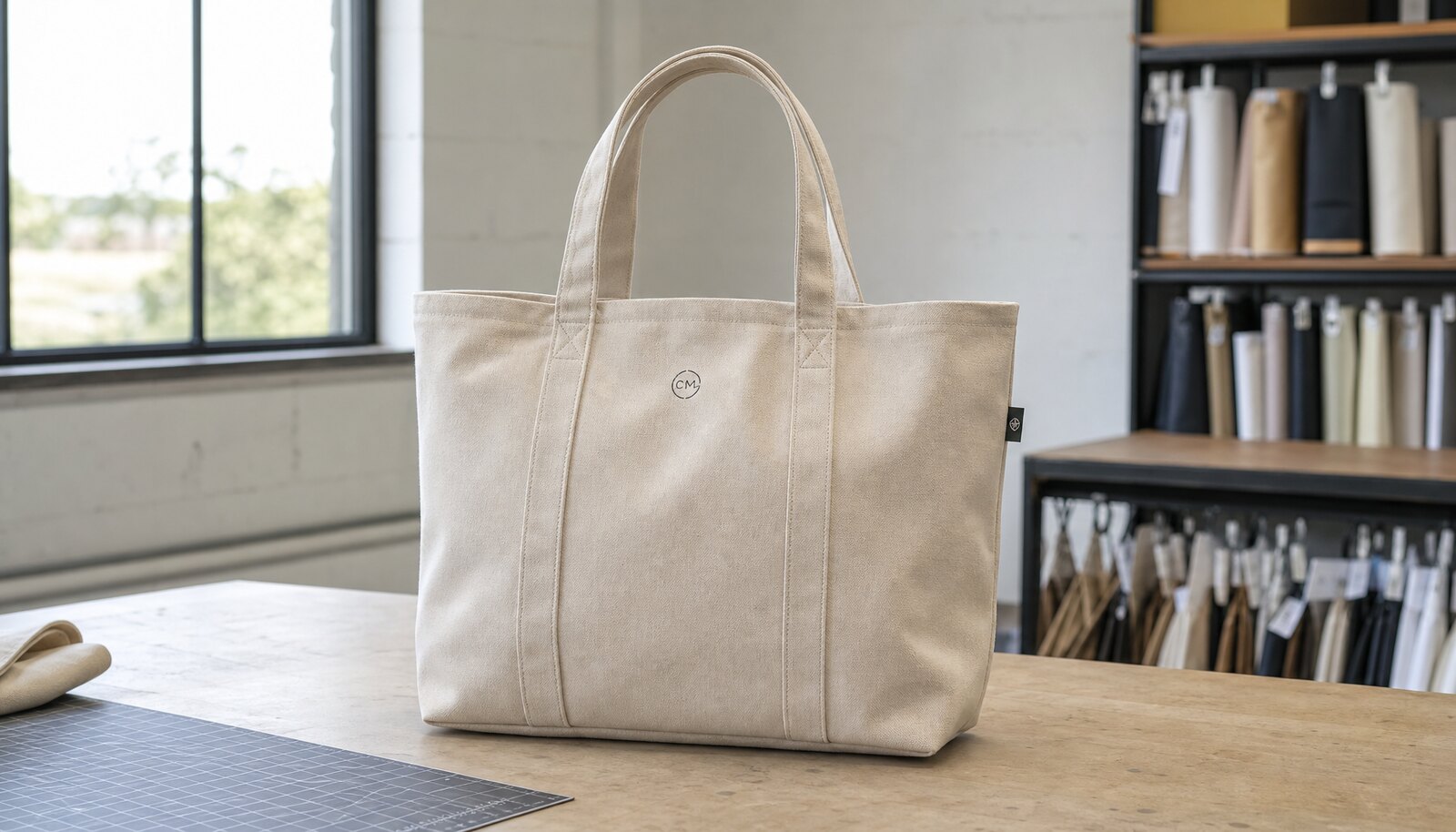
What a gift-shop tote has to do that a giveaway bag does not
Gift-shop buyers are not sourcing a one-time conference handout. They are buying a retail item that has to hold its shape on a shelf, look clean from a few feet away, and still feel worth the price after the customer handles it in store. That changes the sourcing logic. A bag that is acceptable for an event may be too soft, too sloppy, or too inconsistently packed for retail resale.
That is why canvas conference bags for gift shops should be specified as a merchandised product, not a generic tote. The buyer is paying for visual consistency, predictable replenishment, and fewer surprises at receiving. The bag has to work beside books, souvenirs, apparel, and local specialty goods. It also has to survive storage, receiving, and repeat handling without looking tired before the shelf cycle is finished.
The first commercial decision is the bag’s role in the assortment. Is it a low-ticket add-on, a mid-tier souvenir, or a more premium branded item? That answer determines how much structure you need, how simple the artwork can stay, and how aggressively you can pack the order without hurting presentation. If the role is unclear, every supplier quote will drift in a different direction.
- Treat the tote as a retail SKU, not a conference throwaway.
- Match the build to the shelf position and the expected selling price.
- Use the item’s merchandising role to drive fabric, print, and packing decisions.
Turn the idea into a spec the factory can actually build
The fastest way to get reliable quotes is to remove ambiguity. Write the tote spec in millimeters, not broad retail language. That means finished body width, body height, gusset depth, handle width, handle drop, and the exact print window. If the bag is being made in multiple sizes, each size needs its own line item rather than a vague size range.
Use tolerances that reflect the real retail need. For a standard canvas tote, a small tolerance is normal, but the point is not to invite creative interpretation. The buyer should know whether a 5 mm drift is acceptable or whether that drift changes shelf appearance enough to reject the batch. Once the tolerance is written down, the factory can cost to that expectation instead of guessing.
Add a version number to the spec and keep it tied to one approved sample. Reorders are where many programs lose consistency. If the buyer, warehouse, and supplier are all working from the same revision, the tote is much easier to repeat without a fresh round of back-and-forth. The real value is not documentation for its own sake. It is preventing a second order from quietly becoming a different product.
- Write finished dimensions in millimeters and include tolerance.
- Specify the exact print window and keep it separate from overall bag size.
- Version-control the spec so reorders are compared to one approved standard.
Fabric weight, weave, and structure should be chosen together
For most retail tote programs, 10 oz to 12 oz canvas is the practical range. Ten ounce gives a softer, lighter feel and helps keep cost under control. Twelve ounce usually gives the bag a firmer hand, cleaner standing shape, and a more premium shelf presence. Fourteen ounce is worth considering only when the bag needs more structure or the store wants a noticeably heavier retail impression.
Weight alone is not enough. Buyers should ask what weave is being quoted, whether the fabric is washed or pre-shrunk, and how stable the color lot is expected to be. A plain weave with a consistent yarn count will usually print more predictably than a vague generic canvas description. That matters because print quality and panel behavior can change even when two suppliers both say canvas and quote the same ounce weight.
Structure should follow the merchandising use. An open-top, unlined tote is usually the most efficient base choice for a gift shop. If the bag has to stand more upright, show better on shelf, or carry heavier souvenir items, then a boxed base or reinforced bottom may be worth the extra labor. The same is true of stitching. A main seam that looks fine on paper can still fail the retail test if the stitch density is too low or the handle anchors are not reinforced properly.
- 10 oz: softer hand and lower cost, suitable for lighter souvenir use.
- 12 oz: the best general retail balance for shape, feel, and price.
- 14 oz: reserve for premium presentation or heavier carry expectations.
- Ask for stitch density on seams and reinforcement at handle anchors, not just a fabric spec.
Decoration needs a safe zone, not just a logo file
Print quality is one of the easiest places for a tote program to look cheap, even when the fabric is decent. The buyer should define not only the artwork but the safe zone around it. A useful rule is to keep the print at least 12 to 15 mm away from seams, edges, and heavy construction lines. That buffer reduces cutoff risk, makes print registration easier, and keeps the logo from looking crowded on the front panel.
For simple retail logos, screen print is usually the most reliable choice. It tends to hold color well, gives repeatable results across reorders, and is usually easier to compare across suppliers. Heat transfer can work when the art is more complex or the run is short, but it should be approved with care because folding, pressure, and handling can expose weaknesses if the transfer is not cured properly. Embroidery or patches can create a premium look, but they only make sense when the price point supports the extra labor and the design size does not distort the canvas.
Small type is a real risk. If the logo includes fine wording, ask the supplier to confirm the minimum line thickness and final text size that will still print cleanly. A good quote should include a print-area limit for each bag size. That prevents a sales or design team from assuming the art can simply be scaled up later without changing the construction or price.
- Use a 12 to 15 mm no-print buffer from seams and edges.
- Screen print is the default for simple one- or two-color logos.
- Require the supplier to confirm line thickness and final text legibility at actual size.
Compare suppliers on manufacturing route, not just on unit price
Two quotes can look similar and still be built on very different supply chains. One factory may sew, print, and pack under one roof. Another may outsource printing, buy in some components, or move packing to a second site. Those differences change the real risk profile. A lower number means less if the supplier cannot control print consistency or if no one can clearly own rework when something is out of spec.
A direct factory usually gives the cleanest path for repeat gift-shop SKUs. It is easier to match samples, keep print placement consistent, and trace a defect back to the step that caused it. A trading company or hybrid supplier can still be useful when the buyer needs multiple bag styles or wants broader sourcing support. The key is to know who owns what. If print, packing, and carton marking are spread across different parties, the PO needs to spell out acceptance responsibility in plain language.
Quotes should be normalized before anyone compares them. Ask for the same fabric weight, same print method, same handle construction, same packing format, and the same carton plan. Then compare them on the same Incoterms and the same landed-cost assumptions. Otherwise, the cheapest quote may just be the least complete quote.
- Ask who sews, prints, packs, and marks cartons.
- Compare quotes only after the spec is normalized.
- Use the same Incoterms and the same packing scope across suppliers.
Build a quote that shows the real landed cost
A buyer-friendly quote separates the bag body, print, packing, labels, and cartons. That is the only way to see what is truly driving cost. If a supplier gives one clean number, the buyer cannot tell whether the quote includes folding labor, barcode labels, retail polybags, carton printing, or any setup fee. In gift-shop sourcing, those omissions often matter more than a small difference in the bag body price.
It helps to request three pricing views: a pilot run, a normal run, and a reorder. That shows where setup costs sit and where the price begins to flatten at scale. A supplier may be competitive only after a certain volume, which is useful to know if the SKU will become a long-run item. The buyer can then decide whether the first order is worth the launch cost or whether the margin is too thin for the expected sell-through.
Landed cost should also include the practical costs of getting the bag ready for shelf or warehouse receipt. If the item needs retail folding, barcode stickers, master carton labels, moisture protection, or stronger outer cartons, those are not side notes. They are part of the product cost. A quote that hides them will distort the sourcing decision.
- Request a line-item quote for bag, print, packing, labels, cartons, and setup.
- Compare pilot, standard, and reorder pricing to expose the setup burden.
- Use one landed-cost basis so suppliers are judged on equal terms.
Sample approval should test retail presentation, not just dimensions
A sample is not only a print approval. It is the first chance to test whether the bag behaves like a retail product. Measure it, but also hang it, fold it, and place it beside the sort of items it will actually sell with. A tote can meet the stated size and still disappoint if the handles pull awkwardly, the side seams twist, or the front panel collapses in display.
The approval sample should be evaluated against a simple grading rubric. Fit, construction, print, and packing can each be scored separately. A design can tolerate a minor cosmetic issue if the bag still looks strong on shelf, but a handle anchor defect or a print shift near a seam should be treated as a reject. If the bag will ship folded, inspect the fold line on the approved sample. A crease through the artwork can turn a good tote into a downgrade the minute it lands in store.
Keep a golden sample on both sides whenever the program is expected to repeat. That matters because memory drifts and email chains get messy. A retained sample is the fastest way to settle whether the next run matches the approved product. It also gives the warehouse and receiving team a concrete reference if something arrives looking different from the original order.
- Review the sample under retail conditions, not only on a bench.
- Use a simple pass, conditionally pass, or reject rubric for each key feature.
- Keep a golden sample at the buyer and, where practical, at the factory.
MOQ and lead time should be planned around the selling season
Minimum order quantity is not a bargaining trick. It usually reflects the cost of fabric sourcing, print setup, and packing labor. When the bag is simple, stock fabric and a one-color print can support a lower MOQ. When the bag uses custom construction, multiple print colors, or retail-folded packing, the MOQ rises because the factory has more setup work to absorb. Pushing for a lower number is possible, but there is always a tradeoff somewhere in cost, lead time, or product flexibility.
For a gift-shop program, the real question is whether the SKU will be a test, a seasonal item, or a repeat reorder. A test order should stay narrow and controlled, with fewer variables and less custom packing. A repeat SKU should be locked down early so the second order can move faster and cheaper. Buyers often lose time because the first order is treated like a one-off and the reorder is treated like a new product. That creates unnecessary sampling and slows replenishment just when the item is already proven.
Lead time planning should also account for approval gates. The schedule is not only cutting and sewing. It includes artwork signoff, sample review, carton confirmation, and any final packing validation. If the delivery date is fixed, make sure the factory knows which step is most likely to hold the order. A fast order with unresolved sample issues is not really a fast order.
- Use pilot, seasonal, and reorder thinking instead of one generic MOQ target.
- Lock the spec early if the tote is expected to repeat.
- Treat sample approval and packing validation as schedule-critical steps.
Packing and carton rules protect the bag after production
Many tote programs fail after the sewing line, not before it. If the bag is folded incorrectly, packed in mixed cartons, or labeled inconsistently, the receiving team inherits the problem. That adds labor and creates count errors before the product ever reaches a shelf. For a gift shop, that is not just an operations issue. It changes how polished the whole program feels when the cartons are opened.
Define one packing method per SKU whenever possible. Flat pack works well when the bag is simple and the print is not affected by a fold. Retail folding can work when the customer needs a neat presentation, but the fold direction must be chosen so the logo is not crushed or hidden. If a barcode sticker or hangtag is required, decide where it goes and make the supplier show the placement on a sample carton and a sample bag.
Carton standards should be practical. Fixed carton counts, one SKU per master carton, readable carton marks, and clear outer labels all reduce receiving errors. For export or longer transit, the buyer may also want moisture protection or a stronger corrugated grade. The goal is simple: the carton should arrive in a way that preserves the bag’s saleable appearance and lets the warehouse process it without sorting.
- Use one packing method per SKU whenever possible.
- Keep carton counts fixed and avoid mixed SKUs unless approved in writing.
- Make carton labels, barcode text, and PO records match exactly.
Define QC thresholds before bulk production starts
Quality control works best when the factory knows the line it cannot cross. A useful QC plan separates critical, major, and minor defects. Wrong SKU, open seams, broken handles, or the wrong print placement are critical or major issues because they change the product or create a safety concern. Loose threads, minor shade differences, or small cosmetic marks may be minor, depending on the retail standard and the selling price.
The buyer should also set measurable thresholds wherever possible. For example, dimensions can be checked against the approved tolerance, print placement can be measured from the seam, and handle reinforcement can be checked for symmetry and stitch integrity. If the bag is supposed to carry a certain load, run a simple agreement test and write down what failure looks like. That may be handle stretch, seam opening, fabric tearing, or unacceptable deformation after the load is applied.
Random carton inspection should not be treated as a formality. Check cartons across the lot, not only from the top of the pallet. Look for odor, stains, broken carton corners, crushed folds, loose hardware if any is used, and mixed color tone. If the program will be reordered, keep the QC record with the approved sample. That makes the next batch easier to evaluate and reduces arguments about what the standard really was.
- Separate critical, major, and minor defects in the QC plan.
- Use measurable checks for size, print placement, seam integrity, and handle reinforcement.
- Inspect cartons from different locations in the lot, not only the easiest ones to reach.
Specification comparison for buyers
| Spec decision | Better default | Why it matters for gift-shop buyers | Buyer risk to verify |
|---|---|---|---|
| Fabric weight | 10 oz to 12 oz canvas for most retail tote programs | Balances shelf shape, carry feel, and unit cost | Confirm finished weight tolerance and whether the fabric is pre-shrunk or washed |
| Fabric weave | Plain weave with a consistent yarn count, not an undefined generic canvas | More consistent surface for print and more predictable hand feel | Ask for the weave description, shrinkage expectation, and color lot control |
| Seam construction | Double-needle main seams with 6 to 8 stitches per inch and reinforced handle anchors | Reduces seam slippage and keeps the bag looking crisp at retail | Check seam straightness, stitch density, and whether handle ends use bartack or box-X reinforcement |
| Handle spec | Cotton webbing or self-fabric handles with a defined width and drop | Comfortable to carry and easier to compare across quotes | Lock handle width, handle drop, and attachment length before sampling |
| Print area | Artwork centered inside a defined safe zone with at least 12 to 15 mm clearance from seams and edges | Prevents cutoff logos and keeps the bag looking balanced on shelf | Verify maximum print size on each bag size, especially near seams and gussets |
| Print method | Screen print for simple logos; heat transfer only for short runs or complex art | Screen print usually gives the best reorder consistency and cost control | Ask for rub resistance, cure method, and a sample from the exact print path |
| Sample grading | One pre-production sample, then a signed golden sample kept by both sides | Creates a real reference for reorder and inspection decisions | Use a written accept/reject list for size, print placement, seams, and packing |
| Landed cost | Quote on the same Incoterms with packing, labels, and cartons broken out | Prevents cheap-looking quotes that become expensive after add-ons | Compare freight, duty, cartonization, and local delivery on the same basis |
| Packing format | Flat-pack or retail-folded pack, one method per SKU | Simplifies receiving and keeps the retail presentation consistent | Define fold direction so the logo is not creased or hidden |
Buyer checklist before sampling
- Finished bag size is written in millimeters, including body width, body height, gusset depth, handle length, and handle drop.
- Fabric is specified by weight and weave, with an acceptable tolerance and a rule for substitutions if the mill changes.
- Seam construction is defined, including stitch density target, reinforcement method at handle anchors, and any top-stitch requirement.
- Logo artwork is supplied in vector format with the final print size, print window, and a no-print buffer from seams and edges.
- The approved print method is named in the PO, along with the number of colors, ink type, and any cure or rub-resistance requirement.
- If the bag is retail folded, the fold direction and fold depth are approved against a physical sample before bulk release.
- Carton count, inner pack count, barcode label text, and carton mark format are locked before production starts.
- A golden sample is retained by the buyer and, where practical, by the factory for reorder comparison.
- Inspection criteria define critical, major, and minor defects, with a written AQL target or equivalent acceptance rule.
- Reorder rules state what can change without resampling and what changes trigger a new sample or a new quote.
Factory quote questions to send
- What exact fabric weight, weave, and finishing are you quoting, and what tolerance should we expect in bulk?
- Is sewing, printing, packing, and carton marking done in one facility or across separate sites?
- What is the maximum print area on this bag size, and what minimum clearance do you require from seams and edges?
- Please itemize the quote into bag body, print, packing, label, carton, and any setup or tooling fee.
- What is your MOQ by color, by print method, and by packing format, and where does the price step down?
- What does your pre-production sample include, and how close is it to final bulk materials and final packing?
- What is your inspection standard for size, seam quality, handle reinforcement, and print alignment?
- If we need both flat-pack and retail-folded versions, what changes in cost, lead time, and carton count?
- How do you quote landed cost under the same Incoterms so we can compare suppliers fairly?
- If the handle length, print size, or gusset changes later, what resets MOQ, sampling, and lead time?
Quality-control points to confirm
- Finished dimensions should stay within the agreed tolerance, with no visible panel skew, twisted gusset, or uneven top line.
- Main seams should be straight and secure, with no open stitching, skipped stitches, or seam puckering at stress points.
- Handle anchors should use the agreed reinforcement method and should not show loose threads, popping stitches, or asymmetry.
- Stitch density should be consistent enough that the seam does not look sparse or compressed from panel to panel.
- Logo placement should stay inside the approved print window, with no cutoff letters, tilt, bleed, or registration drift.
- Ink should be fully cured, dry to the touch, and resistant to rubbing under the agreed test or handling simulation.
- Color should match the approved sample or approved pantone range closely enough that the bag does not read as a different SKU.
- If the tote is retail folded, the fold should not crush the logo, distort the bag body, or leave a permanent crease through the artwork.
- Carton count should match the packing list exactly, with no mixed SKUs unless the buyer has approved the mix in writing.
- Any odor, stain, oil mark, broken bartack, loose thread cluster, or damaged carton should be recorded before shipment.