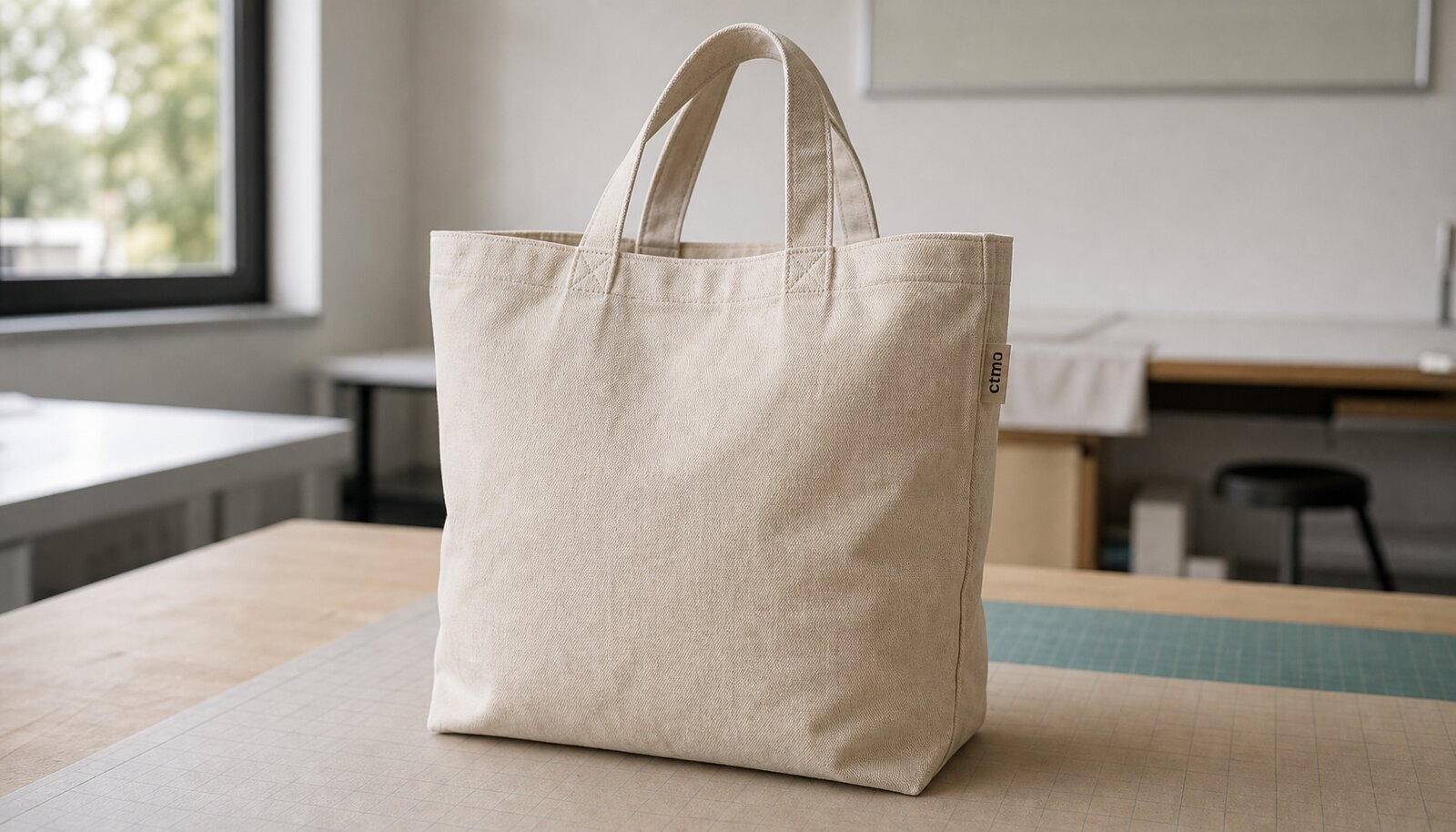
Start With the Carry Profile, Not the Canvas Label
For farmers market programs, the real question is not whether the tote looks premium in a sample room. It is whether the bag can carry a mixed, awkward load: produce, jars, a bottle of oil, flyers, and sometimes a folded jacket or a second purchase. That profile is different from a conference giveaway bag that only needs to survive one event and a short commute home. A market tote has to tolerate repeated folding, uneven loading, and the kind of abrasion that happens when it is dropped into a car boot, set on a wet table, or stuffed under a stroller.
Write the use case into the RFQ before you start comparing prices. State the expected typical load and the peak load, and be explicit about whether the bag is for weekly reuse, seasonal resale, or a one-time promotional handout. If the bag will carry heavy glass or sharp-edged packaging, that changes the spec immediately: you need stronger handles, a more stable base, and a tighter weave that resists snagging and print distortion. If you do not define the use case, the factory will quote a generic canvas tote and you will spend the rest of the process correcting predictable failures.
- Typical reusable market totes often need to handle about 4 kg to 7 kg without looking strained.
- If the bag will regularly carry glass or dense goods, design and test for a higher working load.
- The shorter the product life is supposed to be, the less you should pay for structure the user will never need.
Choose Fabric Weight, Weave Density, and Finish as One Decision
For most buyer programs, 12 oz to 14 oz cotton canvas, roughly 340 to 400 gsm, is the safest commercial range. That weight gives enough body for repeat use without turning the tote into a stiff, overbuilt promotional box. A lighter 10 oz to 11 oz canvas can save cost and freight, but it usually looks thinner, collapses faster at the base, and shows more print-through on natural cloth. Heavier fabric is not always better either. Once you go too high, the bag starts to feel bulky, costs more to sew, and can create unnecessary carton volume.
Weight alone is not enough. Ask the supplier how tightly the fabric is woven, whether the weave is plain or duck-style, and whether the finish is washed, bleached, dyed, or left natural. A looser weave may still hit the same oz or gsm target but behave badly in production: print edges can feather, seams can distort, and shrinkage can be harder to control. If the bag needs to be reused often, ask for prewashed or sanforized cloth and define the acceptable shrinkage in writing. A practical target for repeat-use tote programs is no more than 3% after one cold wash and no more than 5% after repeated washing unless you explicitly accept more drift.
- 10 oz to 11 oz works for lower-cost distribution and short-life promotional runs.
- 12 oz to 14 oz is the best middle ground for farmers market use and retail resale.
- Ask for finished fabric weight, weave description, and expected shrinkage together, not as separate afterthoughts.
Use Construction Details to Prevent Handle Failure
A market tote usually fails at the handle or handle attachment before it fails at the body. That is why handle width, stitch density, and reinforcement matter more than a nice front panel. A practical spec is a self-fabric double-fold handle between 2.5 cm and 4 cm wide, with bartacks at each attachment point and enough length to give a comfortable drop on the shoulder or in the hand. Narrow handles may look tidy in a mockup, but they concentrate stress, dig into the hand, and tear out faster when the bag is loaded unevenly.
The bottom and gusset deserve the same level of attention. A gusset depth of about 10 cm to 15 cm usually gives the bag enough volume for market use without making it too boxy. If the tote needs to stand upright for shelf display or to protect jars and bottles, consider a reinforced bottom seam or a removable insert board. That adds structure, but it also adds material cost, packing complexity, and the risk of warping if the board is cut badly. In many cases, a well-controlled gusset and a strong bottom stitch are a better commercial tradeoff than a rigid insert.
- Ask for handle width, finished handle drop, and reinforcement method in millimeters or centimeters.
- Confirm that every handle attachment point has the same reinforcement pattern.
- If the bag will carry hard goods, define whether the base must stand upright or just resist sagging.
Decide on Lining Only When It Solves a Real Problem
Lining is often added because it sounds like an upgrade, not because the bag needs it. For many farmers market programs, an unlined canvas tote is the right choice. It keeps sewing simpler, reduces cost, avoids extra bulk at the seams, and usually folds flatter for packing. If the bag is intended for wet produce, sharp packages, or premium retail presentation, a partial or full lining can be useful, but it should solve a defined problem. Otherwise it becomes an expensive layer that the user never notices.
If you do specify a lining, define why it exists. Is it there to hide seam allowances, reduce abrasion, support a structured silhouette, or protect the contents? That matters because each purpose leads to a different construction. A lining can also create hidden risks: twisting at the top edge, wrinkles at the base, or a bag that looks boxy when it is empty. Ask the factory to show a sample with the same lining arrangement, not just a flat fabric swatch. If the lining is for a premium program, insist on clean anchoring points and no loose corners.
- Unlined is usually the best default for standard market totes.
- Partial lining is a targeted upgrade, not a blanket quality signal.
- If a lining changes the silhouette, approve the packed and empty appearance, not just the material spec.
Pick Decoration by Wear, Not by Presentation Alone
For canvas tote programs, screen print remains the workhorse when the artwork is simple, the color count is limited, and repeat production matters. It works well on natural canvas, handles bold logos, and usually gives the best balance of cost and durability. If the art contains fine lines, gradients, or photographic detail, a different decoration method may be needed, but that should be a deliberate choice. The factory should quote the method that matches the artwork, not the method that is easiest for them to run.
The buyer should specify the print size, position, color count, and any fold-line risk up front. A large print area across a natural canvas tote can look strong in a mockup and fail in production if the ink is under-cured, over-absorbed, or too brittle on the fold. Ask how the factory cures the print and what they do to check edge sharpness and rub resistance. If you want a soft hand feel, say so. If you want a heavier opaque print to cover the weave, say that instead. The worst outcome is a visually nice proof that hides a weak production process.
- Use screen print for simple logos and sponsor marks.
- Use a different method only if the artwork or durability requirement clearly justifies it.
- Approve the actual print on the actual fabric, not just a digital rendering.
Treat Sustainability Claims as a Documentation Task
Canvas buyers often want a sustainability story, but the story needs documentation. If you are specifying recycled cotton, organic cotton, or a cotton-poly blend with recycled content, ask exactly what the supplier can prove on paper. That may include a certificate scope, a recycled content declaration, a mill statement, or test documentation, depending on what the supplier actually has. Do not write a marketing claim into the purchase order unless the supplier can support it. Otherwise you create a compliance problem for the brand and a dispute with the factory later.
This is also where route selection matters. A direct factory may be able to trace the fabric and packaging more cleanly for repeat runs. A trader may still be able to supply the right documents, but you need to ask who owns the paperwork and whether the claimed standard is in scope for the actual factory used. If the canvas is natural and undyed, that is not automatically a sustainability claim. It is just an input choice. Keep the language precise and avoid vague terms like eco-friendly unless you can define them in a way procurement and marketing both accept.
- Ask for the exact documentation behind recycled, organic, or certified content claims.
- Do not let a supplier substitute a general sustainability statement for specific paperwork.
- Keep marketing claims aligned with what is actually on the PO and the carton label.
Compare Supplier Routes Before You Compare Unit Prices
Many buyers start by comparing fabric swatches and unit prices, but the more important question is who is actually controlling the spec. A direct factory is usually the best route when the program repeats, the artwork is stable, and the buyer cares about stitch consistency, bulk color control, and carton accuracy. A trading company can be useful when the order mixes several bag types or needs more handholding, but the quote has to be read carefully because the margin layer is not always obvious. A local decorator can shorten lead time for a small urgent run, yet the material choices may be narrower and the landed cost can rise quickly if the canvas needs upgrading.
Ask every supplier the same set of questions and compare only on the same spec. Who is the actual manufacturer? Is the canvas in stock or custom-booked? What is included in the sewing, print, packing, and carton line? Who performs the final inspection? If the supplier cannot answer those questions clearly, the quote is not ready for procurement review. A good quote makes the cost drivers visible. A weak quote hides them in the unit price and leaves you guessing where the quality was reduced.
- Direct factory is usually best for annual reorders and tighter QA.
- Trading companies are useful when you need coordination across multiple SKUs.
- Local decorators work best for urgent small runs, not for the lowest landed cost on larger volumes.
Write the RFQ So Every Quote Is Comparable
A strong RFQ removes ambiguity before price negotiation starts. Include the finished dimensions, target fabric weight, weave description, handle size, gusset depth, print method, and packing format. Add tolerance bands for measurements and shade so the factory knows what it must hit. If you only say 'premium canvas tote', you will get a spread of quotes that are hard to compare because each supplier will make different assumptions about fabric, finishing, and reinforcement. Procurement work improves when the spec is explicit enough that the only variable left is execution.
The RFQ should also force the supplier to quote alternates. Ask for a base option and one or two upgrade paths, such as unlined versus lined, 10 oz versus 12 oz canvas, or bulk pack versus retail pack. That makes it easier to see what each spec change really costs. If the supplier can separate fabric, sewing, print, and packing in the quote, do it. If they cannot, ask for a written explanation. The goal is not to make the RFQ longer. The goal is to make the numbers defensible enough that you can choose a supplier on real tradeoffs instead of hopeful assumptions.
- Quote the same product three ways if needed: base spec, upgraded fabric, and upgraded packing.
- Define acceptable size tolerance, print placement tolerance, and color reference before price comparison.
- Ask for a landed-cost view that includes freight, duty, and local re-pack where possible.
Approve Samples With Measurable Criteria
A sample should be approved against a written reference, not a general impression. Measure the opening width, body height, gusset depth, handle drop, and print placement against the spec sheet. Check that the bag sits flat when empty, that the bottom corners do not twist, and that the handles are symmetrical. If the bag includes a lining or insert, make sure it does not distort the shape or create a weak fold line. The sample is not just a marketing asset. It is the reference used to control the bulk order.
The sample should also be tested the way the bag will actually be used. For reusable consumer programs, do a simple load check with the type of items the tote will carry. If the supplier can provide test references, common ones include rub resistance checks such as ISO 105-X12 or AATCC 8, wash references such as ISO 105-C06 or AATCC 61, and tensile references such as ASTM D5034. You do not need every test on every order, but you do need a consistent standard if the tote will be reused often or if the print has to survive handling and laundering. If the sample misses, rewrite the issue in measurable terms instead of approving it verbally and hoping the bulk run improves itself.
- Keep one sealed golden sample for shade, print, and stitch comparison.
- Check size, handle length, print placement, and seam alignment before approving bulk.
- If repeat washing matters, test the sample before production release.
Plan Packing, Cartons, and Freight Before Production Starts
Packing is part of the product, not just the last step. Bulk packing with size-labelled inner bundles is usually the best choice for importers and distributors who will repack locally or move the goods through a warehouse. Retail-ready packing adds polybags, hangtags, barcode labels, and folding labor, which increases cost and carton volume. The bag may be perfect and still create receiving problems if the pack count is wrong or the carton spec was never clearly written. That is why the PO should call out the inner bundle count, master carton quantity, and gross weight target before the first cut is made.
Think about moisture and shape retention as well. Canvas absorbs humidity, so if the route is humid or the transit time is long, ask whether the factory uses a moisture barrier, desiccant, or cleaner carton stock. Keep the gross weight at a level the receiving team can handle safely, often around 12 kg to 15 kg per carton unless your warehouse standard says otherwise. If the bag includes a board or insert, make sure the carton dimensions still protect the silhouette without crushing the corners. Freight planning is easier when the product spec and pack spec are written together instead of separately.
- Confirm inner count, carton quantity, and gross weight target in writing.
- Ask for carton dimensions before freight booking so you can compare actual volumetric cost.
- Include barcode, hangtag, and retail-fold requirements in the first RFQ if they matter.
Specification comparison for buyers
| Spec decision | Buyer-safe default | Tradeoffs / cost impact | QC checkpoint |
|---|---|---|---|
| Body fabric weight | 12 oz to 14 oz cotton canvas, about 340 to 400 gsm | Best balance for market loads, repeated use, and a cleaner retail hand feel. Lighter fabric can save 5% to 12% on material but often looks and performs thinner. | Confirm the finished fabric weight is within about +/- 5% of the agreed gsm or oz. |
| Weave density | Tighter plain weave with no open windows, slubs, or loose floats; ask the supplier to state ends and picks if they track them | Tighter weave improves print sharpness, reduces snag risk, and helps the bag hold shape, but it usually raises fabric cost and may feel stiffer at first touch. | Reject samples with visible gaps, diagonal distortion, or uneven weave coverage on the body and handle panels. |
| Shrinkage control | Prewashed or sanforized canvas when the bag will be reused often; target finished shrinkage no more than 3% after one cold wash and no more than 5% after repeat washing unless the spec says otherwise | Better shrink control reduces size drift and logo misalignment, but it can add mill cost and may slightly soften the hand feel. | Wash a sample before bulk approval and measure length, width, and handle drop against the approved spec. |
| Handle build | Self-fabric double-fold handles, at least 2.5 cm to 4 cm wide, with bartacks at each load point | Wider handles improve carry comfort and reduce tear-out risk. Narrow handles may look neat in a photo but usually fail sooner under heavy mixed loads. | Check stitch density, handle symmetry, and no thread cutting or seam puckering at the attachment points. |
| Bottom and gusset | Reinforced bottom seam with a gusset depth matched to the load, usually 10 cm to 15 cm for market totes | A deeper gusset increases usable volume and shelf presence, but it also raises fabric consumption and carton size. | Verify the bag sits flat, the base corners do not twist, and the gusset is even on both sides. |
| Lining option | Unlined for most standard market programs; partial lining only if the bag carries sharp, wet, or fragile items | Lining improves interior finish and can hide seam allowances, but it adds sewing time, cost, and potential bulk at the seams. | Inspect whether the lining is anchored cleanly and does not create wrinkles, twists, or a boxy silhouette. |
| Decoration method | 1 to 3 color screen print for simple logos and sponsor marks | Screen print is usually the lowest-risk decoration for canvas. Each added color raises setup cost and can slow production, while complex art may need a different method. | Check print registration, cure quality, edge sharpness, and fold-line cracking after a bend test. |
| Wash performance | Ask for a basic wash or rub test if the bag is meant for repeat consumer use | Testing adds time, but it is cheaper than replacing a batch that bleeds, fades, or shrinks out of spec. | Request the supplier's available test method and use a repeatable internal acceptance standard. |
| Supplier route | Direct factory for repeat runs and tighter spec control | Usually better for annual reorders and stable QA, while traders can help with mixed SKUs and local decorators can help with fast small runs. | Confirm who owns the actual factory, who inspects the goods, and what spec is written into the production order. |
Buyer checklist before sampling
- Define the real use case: produce, bottles, jars, brochures, folded apparel, or mixed market purchases.
- Set the expected load in the RFQ, including typical load and peak load, not just the word durable.
- Lock the canvas weight in oz or gsm and ask for the finished fabric weight tolerance, not a vague canvas description.
- Specify weave tightness, finish type, and whether the fabric must be prewashed or sanforized to control shrinkage.
- Write handle width, handle drop, and reinforcement method into the spec, including bartacks or X-box stitching if needed.
- Decide whether the bag needs a gusset, lining, or bottom insert based on the items it will actually carry.
- State the print method, color count, placement, and maximum print size in the RFQ.
- Require one pre-production sample, one approved reference sample, and a written tolerance band for size, shade, and placement.
- Ask for any available test reports or certification scope if the order depends on sustainability, food-contact adjacency, or compliance claims.
- Confirm packing count, carton dimensions, gross weight target, barcode needs, and whether retail hangtags or polybags are required.
Factory quote questions to send
- What exact fabric are you quoting, including finished weight in oz or gsm, weave density if you track it, and whether the cloth is natural, bleached, dyed, recycled, or prewashed?
- What shrinkage should we expect after one cold wash and after repeated washing, and how do you control that in production?
- How are the handles built, what is the finished handle width and drop, and how many bartacks or reinforcement stitches are used at each end?
- What are the gusset depth, seam allowance, and bottom reinforcement details, and can you quote an alternate version with a lining or insert board if needed?
- Which decoration method is included, how many colors are priced, what cure method is used, and what is the extra cost for a larger print area or second placement?
- What MOQ applies by fabric color, print design, and pack format, and how do the price breaks change at 500, 1,000, and 5,000 pieces?
- What sample stage is included before mass production, is the sample fee refundable, and what will you use as the golden sample for bulk comparison?
- What packing details are included: inner bundle count, carton count, carton dimensions, gross weight, and whether polybags, hangtags, or barcode labels are priced separately?
- What overrun or shortage tolerance do you work to, and what is your remake or replacement policy if measurements, stitching, or print quality miss the approved sample?
- Can you share factory identification, recent production photos of a similar tote, and any available lab or in-house test references for fabric strength, rub, or wash performance?
Quality-control points to confirm
- Fabric weight must stay within the agreed tolerance, typically about +/- 5% of the target gsm or oz unless the PO says otherwise.
- Finished bag dimensions should stay within about +/- 1 cm for smaller totes and +/- 2 cm for larger totes, with handle drop held tighter because it affects use and retail appearance.
- Handle reinforcement must be present at every load point, with no skipped stitches, broken threads, or loose bartacks.
- Seams should be straight and consistent, with no puckering, seam slippage, open corners, or twisting at the gusset.
- If the bag is meant for repeat consumer use, run a simple load check at the expected working load plus margin and confirm the handles do not open or tear.
- If a wash claim matters, check that the bag returns close to spec after the agreed wash cycle and that print edges do not crack, peel, or bleed visibly.
- Print should match the approved placement and color count, with no heavy ghosting, pinholes, wet ink, or fold-line cracking after a bend test.
- Shade must match the sealed reference sample closely enough that carton-to-carton variation will not be visible in normal retail display.
- Cartons must be packed to prevent crushing, with the correct bundle count, style code, and destination label on every case.
- If a sustainability claim appears on the packaging or web copy, confirm the exact documentation in hand before release.