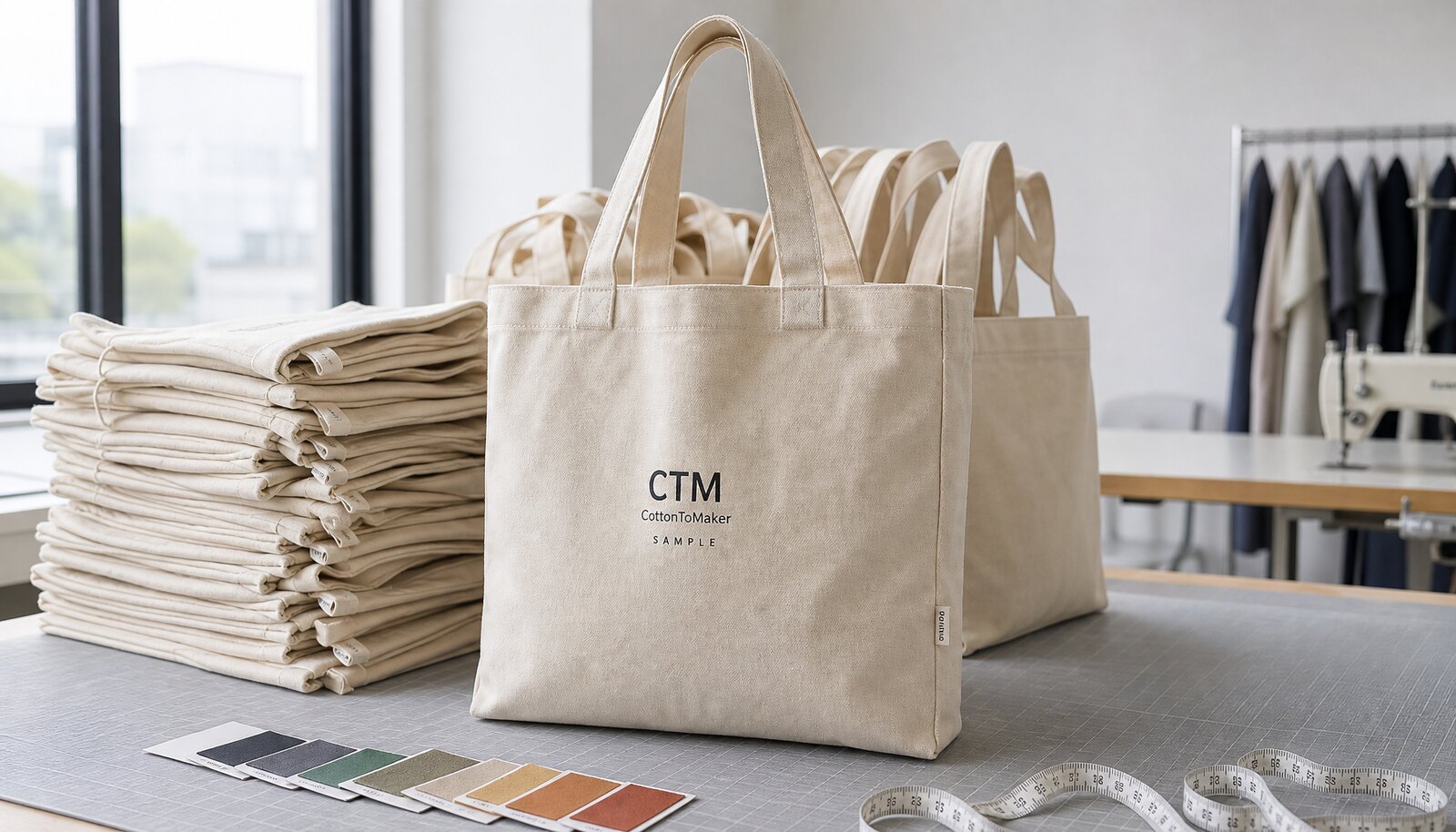
Why print method matters more than the bag spec on ecommerce orders
For canvas conference bags, the fabric shell is only part of the buying decision. Ecommerce brands care about how the bag photographs, how it lands in a fulfillment center, whether the logo stays crisp after folding, and whether the final product looks consistent when reordered months later. The decoration method changes all of that. A logo that looks fine on a render can fail once it meets canvas texture, curing heat, carton pressure, or warehouse handling.
Procurement teams often start with unit price and miss the real trade-off. Screen print may appear cheapest, but a weak ink system or rushed curing can create cracking or set-off when bags are stacked. Heat transfer can handle detail and short runs, but it may create a plastic hand feel and higher peel risk. Embroidery looks premium, but stitch density can distort lighter canvas and slow production. For ecommerce buyers, the right decision is usually the one that protects reorder consistency, not just the lowest first quote.
- Define the decoration method in the RFQ, not only the artwork file.
- Match the finish to the channel: conference giveaway, retail bundle, subscription insert, or VIP kit.
- Treat fabric weight, decoration, and packing as one sourcing system.
Start with the canvas structure: GSM, weave, finishing, and finished size
Most conference-style canvas bags sit in the 10 oz to 12 oz range, which is roughly 340 to 410 GSM when referring to finished fabric weight. That range usually gives enough body for clean screen print edges without making the bag too heavy for bulk distribution. If the fabric is too light, it wrinkles during printing and can distort the logo after folding. If it is too heavy, freight cost rises and the bag can feel oversized for ecommerce inserts or conference handouts.
Buyers should ask the supplier to confirm whether the quoted GSM is finished weight or loom weight. Those numbers are not interchangeable. Loom weight can come down after washing, coating, or finishing. A bag quoted as 12 oz on paper can behave more like an 11 oz bag after treatment. For procurement comparison, finished weight is the more useful number because it relates more closely to appearance, hand feel, and shipment weight.
Finished dimensions matter just as much as fabric weight. The spec should include body width, height, gusset depth if any, handle length, and whether the top edge is folded or raw-finished. A bag intended to hold notebooks and catalogs needs a different base and handle reinforcement than a soft promotional tote. If the seller only gives a flat-cut size, clarify how much shrinkage, seam allowance, and hem depth are already included.
- Practical conference bag range: 10-12 oz canvas for standard promo use; 12-14 oz if the bag must feel premium or carry heavier inserts.
- Ask for finished-size tolerance in writing; a workable example for many bags is +/- 1 cm on height and width, with tighter control on handle symmetry.
- Confirm whether the fabric is raw, washed, bio-washed, pre-shrunk, or coated, because finishing affects both the print surface and final dimensions.
Print method comparison: screen print, heat transfer, embroidery, woven label, and supplier route
Decoration choice should be based on artwork complexity, run size, handling conditions, and brand position. For most ecommerce conference bag programs, screen print remains the strongest value method when the logo is simple and the order will be repeated in bulk. It gives better ink penetration on canvas and generally survives folding better than film-based methods. If the design uses gradients, fine type, or multiple variable names, heat transfer can produce a sharper result, but the buyer needs to test feel, adhesion, and edge wear.
Embroidery and labels are worth considering when the brand wants a more durable or more premium look. Embroidery performs best on heavier canvas and on smaller logos; a large stitched panel can make the bag stiff or create puckering. Woven labels or sewn patches work well when the front panel must stay clean and understated. For B2B procurement, the right question is not which method looks best in isolation, but which method survives the handling pattern of your channel and your storage plan.
Supplier route matters too. A factory with in-house decoration usually has better control over lead time and defect ownership because cutting, printing, sewing, and packing sit under one schedule. If the supplier outsources decoration, the quote may look flexible, but the project gains an extra handoff and an extra failure point. That can be fine for low-risk trial runs, but it requires tighter sample approval and clearer accountability in writing.
- Screen print: best for 1-3 spot colors, large quantity, and lower per-unit decoration cost.
- Heat transfer: best for detailed artwork, gradients, small MOQs, and short-term campaigns.
- Embroidery: best for premium positioning, but check stitch density and fabric distortion.
- Woven label or sewn patch: best for subtle branding or when front-panel print space is limited.
- In-house supplier route: best when one owner must control schedule and defect responsibility.
Decision thresholds buyers can actually use
To keep the RFQ practical, many buyers need decision rules rather than broad advice. A useful starting point is this: if the artwork is one to three solid colors, the order is at least moderate volume, and the bag will be handled often, screen print is usually the safest default. If the logo contains gradients, small type, or variable personalization, heat transfer may be worth the trade-off if you can accept a slightly higher risk of edge wear. If the bag will be part of a premium conference kit and the logo is small, embroidery or a sewn label becomes more compelling.
There is also a size and weight threshold worth watching. On soft canvas below roughly 10 oz finished weight, dense embroidery can pucker panels and skew the logo. On structured canvas above roughly 12 oz, screen print and woven labels typically remain easy to control, and the bag holds its shape better during packing. If the order must ship flat to a warehouse or overseas center, buyers should also favor methods that tolerate stacking without offset or surface damage.
For many ecommerce brands, the real decision threshold is not visual style but tolerance for risk. If a decorative method has a meaningful chance of peel, sticking, or late rework and the campaign launch cannot move, the safer choice is usually screen print or a woven label on a stable canvas weight. If the campaign is a low-volume launch and art flexibility matters more than long-term use, heat transfer may be acceptable. The most commercial answer is the one that aligns with your release date and acceptable defect exposure.
- If the logo is simple and the order is repeatable, start with screen print.
- If the art has gradients or variable content, request heat transfer as the backup option.
- If the bag is premium and the logo is small, compare embroidery and woven label against the same canvas weight.
- If launch timing is fixed, favor the method with the lowest rework risk, even if unit price is slightly higher.
How supplier route changes MOQ, price, and accountability
A lot of quote confusion comes from the supplier route rather than the decoration method itself. If the bag factory prints in-house, the MOQ is usually tied to fabric cutting, print setup, and packing efficiency together. That can be efficient for a standard ecommerce run because one plant owns the whole job. The downside is that the factory may steer you toward its preferred decoration method, even when another option would better fit the brand.
If the factory outsources printing, the quote may seem more flexible at first. In practice, this often adds uncertainty around print shade, lead time, and reject responsibility. Trading companies can be useful when you need to consolidate several products into one order, but the buyer should always confirm the actual sewing unit and decoration partner. The supplier’s role in the paperwork is less important than who physically controls fabric, printing, and final packing.
A practical procurement rule is to ask for the real production chain in writing. Who buys the fabric? Who makes the screens or plates? Who cures or finishes the print? Who performs final packing inspection? If the supplier cannot answer those questions cleanly, the risk is not just slower delivery; it is also a higher chance that the final bag differs from the approved sample in shade, print placement, or trim quality.
- In-house production usually gives clearer ownership of defects and better schedule control.
- Outsourced decoration may help with small trial runs but needs stricter sample approval.
- Split sourcing is only practical when your timeline can absorb extra handoffs and re-inspection.
Cost drivers that change the quote faster than unit price
When comparing canvas conference bag quotes, unit price is only one line. Setup charges for screens or plates, labor for multi-color printing, bag construction complexity, and packing format all move the final landed cost. A quote that looks 8% lower can become more expensive once you add print setup, custom labels, carton strengthening, and freight on heavier fabric. Buyers should ask for a full quote structure, not just a single unit figure.
The most common hidden cost is a low-MOQ surcharge. If you want a limited run for a product launch, the supplier may spread cutting loss, print setup, and color matching across fewer pieces. That is normal, but it should be transparent. A good quote should show the quantity break at several levels, such as 1,000 pcs, 3,000 pcs, and 5,000 pcs, so the team can see where the economics improve.
There is also a practical cost difference by method. Screen print usually has the lowest per-piece cost once the setup is absorbed. Heat transfer can look inexpensive on a small run, but repeated handling and film cost may make it less attractive at scale. Embroidery often has the highest decoration cost because stitch time increases quickly with logo complexity. Woven labels can sit between the two depending on label size, weave detail, and sewing labor. Procurement buyers should compare landed cost, not just decoration cost, because a slightly cheaper unit can carry more defect risk or require more corrective labor at the warehouse.
- Break out fabric, sewing, decoration setup, decoration labor, label cost, packing, and carton cost.
- Request tiered pricing by quantity to understand the true MOQ pressure.
- Check whether the quote includes replacement pieces for defects or only finished-good output.
- Ask whether screens, plates, or digital setup are reusable on the next reorder and for how long.
Expanded comparison table: what to ask for and what can go wrong
The table below is a practical sourcing view rather than a marketing one. It compares the main decoration and supplier routes on cost, durability, MOQ, lead time, and the risk points buyers should watch. The right option depends on artwork, budget, and how strict your launch calendar is. If two options appear close, ask the supplier to quote both on the same bag spec so you can compare like for like.
- Compare sample quality first, then lead time, then defect control, then price.
- Use the same artwork file and same canvas weight when requesting multiple quotes.
- Do not compare a blank-bag quote against a fully decorated quote.
- Ask for photos or a short video of the actual print stage if the route is unfamiliar.
Sample approval should test the real failure points
For canvas conference bags, sample approval should not stop at visual matching. Ask for a pre-production sample using the actual fabric lot, actual decoration method, and intended packing configuration. A hand-made sample on a different cloth tells you very little about the bulk result. Buyers should be able to review hand feel, logo placement, stitch density, corner reinforcement, and how the bag behaves when folded into a carton.
The most useful sample checks are commercial and measurable. Measure the logo placement from the top edge and side seam, not just by eye. Check whether the print cracks when the bag is folded along the natural crease line. If embroidery is used, inspect whether the thread pulls the canvas or creates a raised ridge that makes stacking difficult. If a woven label is sewn on, check its alignment and the finish of the label edge so it does not fray in transit.
Keep one sealed golden sample for the warehouse team and one for the factory. If the bulk run starts to drift, the golden sample gives both sides the same reference. That is especially important for reorders, when different production teams may interpret the original approval differently. A supplier who claims “same as sample” should be able to explain exactly which sample they are following and which dimensions, colors, and pack-out details are locked.
- Approve logo placement with measured distances from seams, hem, and top edge.
- Verify fabric lot, thread color, and print shade against the signed sample.
- Keep one sealed golden sample for warehouse receiving and one for factory reference.
- Reject samples that show wrong logo size, poor edge finishing, or misaligned top stitching before bulk starts.
QC standards: tolerances, color checks, rub tests, and pack tests
Procurement-grade QC works best when it uses specific thresholds, not vague language like “good quality” or “same as sample.” For a typical small to medium canvas conference bag, a practical dimensional tolerance is often around +/- 1 cm on height and width, with handle length and symmetry checked separately. If the bag has a gusset or boxed bottom, the base dimension should be measured as well because it affects capacity and stack shape. Tightening the tolerance is possible, but it may increase cost if the supplier needs more manual trimming or rework.
Color control should start with the signed sample or Pantone target, but the acceptance method should be realistic. On natural canvas, a small shift in base fabric shade can change how ink or embroidery thread appears. Buyers should ask whether the supplier measures color visually against a standard under controlled light or uses instrument-based checks. If the brand color is critical, request a reference sample, written acceptable delta if measured, and a decision on whether shade variation is allowed between panels or not. The key is consistency within one order and predictability across reorders.
Durability checks should match the use case. For printed bags, ask for a dry rub and wet rub test on sample pieces, plus a fold test at the logo line. If the supplier can reference a standard such as ISO-style rub evaluation or an internal equivalent, note the method in the PO. You do not need a laboratory report for every order, but you do need a repeatable way to judge whether the print will smudge, transfer, or crack during regular handling. For packaging, simulate a simple drop or stack condition: confirm that carton corners remain intact, contents do not shift excessively, and inner bags do not show rub damage after compression.
If the bag will ship long distance or be stored in a warehouse before distribution, ask for a carton stack check and a basic drop review from the supplier. A practical threshold for many buyers is no visible carton rupture and no deformation that exposes the contents after a short stacked or dropped simulation. That is not a formal lab standard, but it is a useful commercial control. For ecommerce brands, the real risk is often not the bag itself; it is damage caused by weak packing, thin cartons, or print offset in transit.
- Use written dimensional tolerances, not only “same as sample.”
- Check print placement, seam alignment, and handle symmetry with a tape measure.
- Ask for dry rub and wet rub evidence for printed areas before bulk release.
- Review folding and stack behavior so the decoration does not mark or peel in transit.
- Require packaging review: carton strength, pack count accuracy, and drop or stack resilience.
Packing details affect warehouse receiving and retail readiness
Packing is often treated as an afterthought, but it changes damage rates and warehouse efficiency. For ecommerce brands, the bag may go directly to a fulfillment center, so loose bulk packing can create friction during receiving and make counts harder to verify. Inner polybags are not always necessary, but they can help when the decoration needs rub protection or when the bags must arrive retail-ready with a cleaner appearance.
The best packing spec is the one that fits your receiving process. If you need size separation, ask for inner bundles by quantity and carton labels that clearly show size, color, and purchase order number. If you are shipping mixed SKUs, keep the carton structure simple and readable. Strong cartons, accurate carton marks, and a clean packing list usually matter more than decorative packaging for most B2B buyers. For export shipments, also ask whether the cartons are single-wall or double-wall, and whether the supplier can apply corner reinforcement if the bags are dense or the route is rough.
A practical packaging review should also include stack height assumptions. If cartons will be palletized, ask how many layers are intended and whether the supplier has tested compression at that arrangement. If bags are lightly filled but bulky, the carton may fail by bulge rather than by weight. That distinction matters because a carton that looks fine in the factory can collapse in transit once it is stacked in a warehouse or container.
- Define pieces per carton and whether inner bundles are tied, boxed, or loose.
- State whether you want individual polybags, tissue, or no inner packaging.
- Confirm carton dimensions before booking freight, especially for heavier canvas.
- Ask whether the carton spec assumes palletization or floor stacking.
- Request carton marks that clearly show SKU, size, color, and PO number.
Specification comparison for buyers
| Spec decision | Recommended option | When it fits | Buyer risk to check |
|---|---|---|---|
| Supplier route | Bag factory with in-house screen printing | Best for repeat ecommerce orders, tighter control on shade and print registration | Ask whether printing is truly in-house or subcontracted; outsourced decoration can hide delays and reject rates |
| Supplier route | Bag factory plus local decorator | Useful when you need very small MOQs, short-term trials, or mixed decoration across SKUs | Two-vendor chains create blame gaps on color drift, shrinkage, and late delivery |
| Print method | Screen print | Best for simple logos, 1-3 colors, and bulk runs on natural canvas | Poor mesh choice, under-curing, or wet stacking can cause cracking, set-off, or faint edges |
| Print method | Heat transfer | Good for short runs, detailed artwork, gradients, or variable data | Film can sit on top of the fabric and peel, crack, or show a glossy patch after folding |
| Print method | Embroidery | Works for premium conference kits and durable branding on heavier canvas | Dense stitch counts can pucker light fabric and increase unit price sharply |
| Print method | Woven label / sewn patch | Useful for subtle branding or when the front panel must stay visually clean | Label edge finish, thread tail trimming, and stitch placement must be controlled to prevent fraying |
| Supplier route | Trading company quoting as factory | May simplify communication for multi-item orders | Confirm the actual mill, sewing unit, and printer; otherwise sample quality may not match bulk |
| Fabric weight | 10-12 oz canvas (about 340-410 GSM finished weight) | Balances print clarity, body, and acceptable freight cost for most conference bags | Too light wrinkles and distorts artwork; too heavy raises shipping cost and can overbuild the bag |
| Fabric weight | 12-14 oz canvas (about 410-475 GSM finished weight) | Better for premium feel, structured bags, or heavier inserts | Adds cost and can reduce flexibility in folding and warehouse packing |
Buyer checklist before sampling
- Specify canvas weight in GSM and ounces, finished size, gusset depth, handle length, and whether the bag needs a structured base.
- State the decoration method you want compared in the RFQ, and include artwork file type, number of colors, placement size, and Pantone targets where needed.
- Ask for a pre-production sample using the actual fabric lot, the final print or branding method, and the intended pack-out.
- Request carton pack count, inner packaging choice, master carton dimensions, and carton mark format before approving the PO.
- Define inspection standards for print registration, seam strength, thread trimming, odor, and packaging damage.
- Confirm sample lead time, bulk lead time, and whether fabric is committed before sample approval.
- Ask how the supplier handles overrun or underrun, rework, late cartons, and damaged goods at dispatch.
- Request photos of the actual production line or decorated sample lot if the supplier says the work is outsourced.
Factory quote questions to send
- What exact canvas weight are you quoting, and is it finished fabric weight after washing or loom weight before shrinkage?
- Which decoration method is included in the quote, how many colors are included, and is there a screen, plate, or setup charge?
- Is MOQ driven by fabric sourcing, print setup, sewing line efficiency, or carton packing, and can it be split across colors or sizes?
- What sample fee applies, what type of sample will be provided, and can the sample reflect the real logo size, placement, and pack-out?
- What are the pack-out details per carton, is inner polybag used, and are barcodes, size stickers, or warning labels included?
- What is the expected bulk lead time after sample approval, and which steps can extend it?
- How do you test print adhesion, rub resistance, seam strength, and carton durability before shipment?
- Can you share your QC checklist and acceptance criteria for print coverage, dimensional tolerance, and defect rate?
Quality-control points to confirm
- Fabric weight should match the agreed spec within a practical production tolerance, and panel feel should be consistent from bag to bag.
- Finished dimensions should be checked against an agreed tolerance such as +/- 1 cm on small to medium canvas bags, unless the structure requires tighter control.
- Handle length and symmetry should be checked against a measured tolerance, not just a visual approval.
- Print registration should stay aligned within the approved tolerance, and color density should be consistent across the run.
- Use a color tolerance approach that references the signed sample or Pantone target where applicable; accept small variation only when it does not affect brand identity.
- Ink, transfer, or embroidery should not interfere with folding, stacking, or carton packing.
- A dry rub and wet rub check should be performed on sample pieces before bulk release, and the buyer should ask for the test method used by the supplier.
- If the bag will be handled repeatedly, request fold and rub checks after packing simulation; visible cracking, peeling, or transfer offset should trigger rework.
- Seams should be reinforced at the handle base and bottom corners if the bag is intended for heavier conference inserts.
- No oil stains, loose threads, broken needles, misaligned labels, or harsh odor should be present in packed goods.