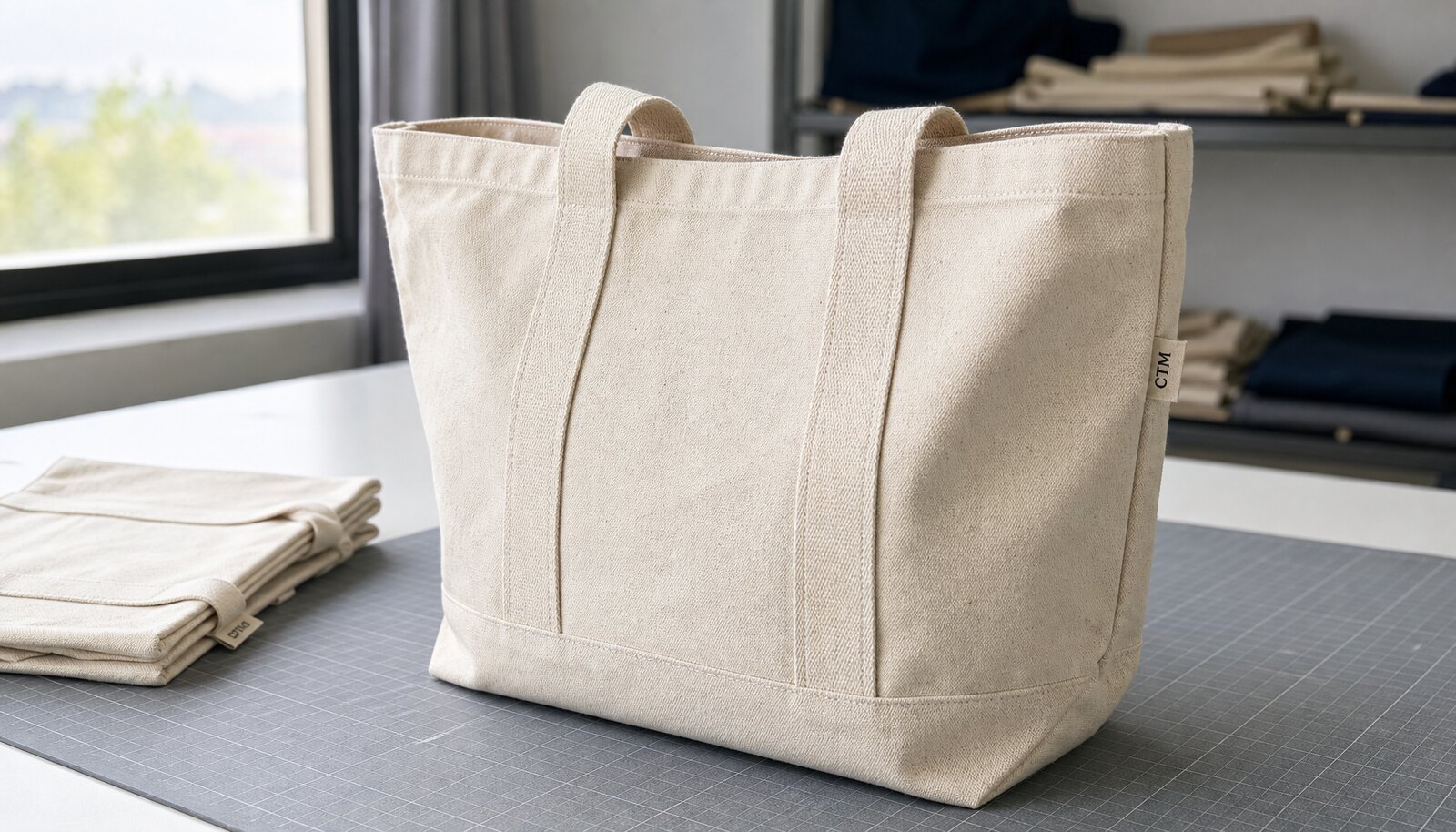
Start With the Bag's Real Job
A canvas conference bag for an ecommerce brand is not just a tote with a logo on it. It usually has to carry brochures, samples, inserts, small gifts, and sometimes a notebook or bottle, then still look clean when it reaches the attendee or the warehouse. That means the right material choice starts with use case, not with the cheapest canvas quote. If the bag is only meant to hold printed collateral for a one-day event, a lighter cloth may be fine. If it will be reused after the conference or sold as merch, the same cloth will feel thin and fail at the seams faster than a buyer expects.
The most common mistake is to select fabric only by price, then discover the bag sags once it is packed flat with hard items or heavy inserts. For ecommerce brands, the bag also has to survive fulfillment. If it is shipped as part of a kit, the fabric needs enough body to fold cleanly, stack consistently, and open without permanent crease damage. That is why the first buying question is simple: what will be inside the bag, how long must it last, and where will it be packed and distributed?
- Define the load before asking for price.
- Treat resale use and one-time event use as different products.
- Write the packing path into the spec: event floor, warehouse kit, or direct mail.
Choose Canvas Weight by Use, Not by Habit
For most conference programs, canvas lands in three practical bands. Around 10 to 12 oz, or roughly 340 to 400 GSM, is the standard range for lighter event bags, brochure carriers, and short-use giveaways. Around 14 to 16 oz, or roughly 475 to 540 GSM, is better when the bag carries heavier inserts, sample products, or needs a more premium retail feel. Below that range, the bag may print easily but look too soft. Above it, the bag may become bulky, expensive to sew, and harder to fold for efficient packing.
Weight alone is not enough. Two 12 oz canvases can behave very differently if one has a looser weave, uneven yarn, or poor finishing. A tighter weave gives a cleaner print surface and better abrasion resistance, but it can also make the bag stiffer and slightly more expensive to sew. If you need the bag to look sharp on a conference table and still fold flat for a kit, ask for a fabric swatch, not just a weight number. The swatch should show the same color, the same weave, and the same finishing that will appear in bulk.
- 10 to 12 oz: best for paper collateral, lighter swag, and lower-cost distribution.
- 14 to 16 oz: best for premium kits, heavier inserts, and later resale.
- Ask for both weight and weave description, not weight alone.
- If the cloth is too soft, the bag will wrinkle and print blur more easily.
Match Decoration Method to the Fabric Surface
The print method has to fit the canvas, not the other way around. For one or two spot colors, screen print is usually the most durable and the most cost-efficient choice. On natural canvas, it gives a clean, direct look and can hold up well if the curing is done correctly. If the artwork uses gradients, fine text, or a photo-style design, a transfer method may be necessary, but you should treat that as a technical decision, not a style decision. Transfer looks better than a weak screen print on complex art, but it can crack or lift sooner on heavy fold lines if the heat application is rushed.
On a buyer level, the question is not which method sounds modern. The question is whether the print will survive folding, warehouse handling, and repeated event use. If the canvas is dark or heavily dyed, ask how the printer will control opacity. If the art has a large solid field, ask for a test on the actual fabric rather than a mockup on white paper. A woven side label, sewn patch, or small CTM style side mark can be a safer branding choice when the full surface is not worth the risk.
- Screen print is the default for simple spot-color branding.
- Transfers fit complex art, but they need abrasion and fold-line testing.
- Woven labels or side tags reduce print risk when subtle branding is enough.
- Ask for rub-test results on the exact fabric color you plan to buy.
Compare Supplier Routes Before You Compare Price
A low unit price means little if the supplier route hides risk. A one-stop cut-and-sew factory is usually the cleanest option when you need control over fabric, stitching, print, and pack-out under one QC system. That route is better for repeat orders, because the same team can carry the spec from sample to bulk. A blank bag plus local decoration route can be faster for a regional launch, but only if the blank bag is stable and your decorator understands the construction limits. Trading companies can be useful when you need flexibility across several material options, yet they only work if they can show who actually owns each process step.
Small workshops can be useful for pilot runs, especially when your team wants to validate the bag in the market before placing a large PO. The tradeoff is usually manual variation, fewer automated controls, and a higher chance that the first sample looks better than the bulk. Large OEM plants are better once the specification is fixed and the volumes are real, because they can hold consistent cutting and sewing once the line is set. The right route depends on whether you are buying a test run, a launch program, or a replenishment order.
- Direct factory: best for control and repeatability.
- Blank plus local print: best for speed if the blank is already proven.
- Trading company: best when you need sourcing flexibility, but only with traceable factory ownership.
- Small workshop: best for low MOQ testing, not for tight repeatability.
Build the Quote Around Cost Drivers That Actually Move Price
The fastest way to compare quotes is to force every supplier onto the same data set. Ask for the exact canvas weight, finished size, handle length, print method, number of colors, lining or pocket details, bundle count, carton pack, and shipping basis. If one supplier quotes a 10 oz blank bag and another quotes a 14 oz reinforced bag with a woven label, the numbers are not comparable. The same problem appears when one quote includes carton labeling and the other does not. A fair comparison needs the same scope, or the buyer is comparing noise instead of cost.
The main price drivers are usually fabric weight, reinforcement at the handle point, print complexity, and pack-out labor. Lining, gussets, zippers, pockets, and overlock finishing all add time. Custom color canvas usually adds more risk than buyers expect because shade matching and lot consistency become harder. The quote should also separate sample cost, screen or plate cost, packing cost, and freight assumption. If the supplier cannot give the price at multiple quantities such as 1,000, 3,000, and 5,000 pieces, the buyer cannot see where the real step-down happens.
- Do not compare quotes without the same fabric weight and construction.
- Separate sample charges, tooling charges, and unit price.
- Ask for tiered pricing so you can see MOQ logic.
- Require carton dimensions if you need a landed-cost estimate.
Use the Sample to Approve the Real Product, Not the Demo Piece
A sample is only useful if it reflects the actual production path. The simplest test is to pack the bag with the real contents it will carry in market use. If the bag is meant for a conference kit, put in the brochure stack, notebook, sample product, and any inserts that will actually ship with it. Then evaluate whether the top edge twists, whether the print shifts once the bag is loaded, and whether the handles still sit comfortably in hand. A pretty empty sample is not enough. A bag that looks clean until it is filled can still fail in bulk use.
You should also use the sample stage to lock your acceptance criteria. Decide what counts as acceptable stitching, print registration, and size variation before bulk starts. A pre-production sample should be close to golden sample quality, not a rough mockup. If the factory changes fabric lot, print method, or seam construction after approval, that should trigger a new sample review. This is the point where many buyer teams lose control: they approve a sample and then tolerate a different bulk version because the schedule is tight.
- Test the sample with real inserts, not an empty bag.
- Approve a golden sample before bulk begins.
- Reject any late change in fabric lot, print process, or construction without re-approval.
- Keep the approved sample as the reference for QC at inspection.
Set QC Thresholds That a Factory Can Actually Hold
QC thresholds should be practical, visible, and tied to the bag's function. For a canvas tote, that usually means holding the finished dimensions within a narrow range, keeping the print centered, and making sure all load-bearing seams are reinforced. Loose threads alone are not the real issue; open seams, skipped stitches, and weak bartacks are. If the bag is going into retail or direct-to-consumer fulfillment, the face panel also needs to stay clean. A faint oil stain or a needle mark might be acceptable on a sample in a sewing room, but it should not pass on finished goods.
A good QC plan compares the bulk shipment to the approved sample under the same lighting and loading condition. Check the handles under tension, not just by sight. Check the print after folding, because some defects appear only on the crease line. The factory should know exactly what is a reject and what is a rework item. If that decision is left vague, the shipment will be delayed while both sides argue about finish quality. For buyers, the best protection is a written defect definition paired with one real approved sample in hand.
- Hold size, print placement, and seam quality to written tolerances.
- Treat open seams, weak bartacks, and face-panel stains as hard defects.
- Inspect under load and after folding, not only on an empty bag.
- Use one approved sample as the quality reference for every shipment.
Plan Packing for Ecommerce Fulfillment, Not Just Factory Dispatch
Packing changes the real cost of a canvas conference bag more than many buyers expect. A bag folded too tightly can hold permanent creases and degrade the print appearance. A bag packed too loosely wastes carton space and raises freight cost. For ecommerce fulfillment, the most workable approach is usually a fixed fold pattern, an inner bundle count that matches the warehouse workflow, and a carton size that avoids compression. If the bag is retail-ready, add a barcode, label placement rule, and clear master carton marking so the warehouse does not need to open cartons just to identify the SKU.
If the order includes multiple colors or sizes, separate them clearly at the bundle and carton level. Mixed cartons save space on paper but create mistakes in receiving, especially when the bag is going into a kit program or a marketplace resale channel. Moisture control also matters. Canvas can pick up warehouse odor or dampness if the carton is overfilled or stored too long in a humid yard. Keep the pack spec simple enough that the factory can repeat it every time. When the pack-out is stable, the warehouse sees fewer damaged units and the buyer sees fewer complaint emails.
- Use a fixed fold pattern and inner bundle count.
- Avoid over-compressing canvas, especially on printed faces.
- Separate SKUs clearly at bundle and carton level.
- Specify barcode, carton labels, and master carton marks in the RFQ.
Control Lead Time and MOQ Before the Schedule Controls You
Lead time on canvas conference bags is usually a chain of smaller delays, not one big delay. Fabric reservation, screen making, sample approval, sewing line scheduling, and carton artwork all have their own timing. A simple one-color bag can move quickly if the factory already holds the fabric and the spec is stable. Custom fabric, multiple print colors, or a washed finish can stretch the schedule because each step needs a separate approval. Buyers often underestimate the time needed for artwork corrections or pack label revisions, then blame the factory for a delay that started upstream.
MOQ should be treated as part of the design decision. A low MOQ pilot is useful if the product is still being tested, but the unit price will reflect manual setup and smaller fabric usage. Larger MOQs usually improve price, but only if the product is locked and the factory can run the same process across the full batch. The smart approach is to define the pilot quantity, the scale quantity, and the reorder quantity before the first PO. That way the supplier can tell you where the cost break actually sits and you can decide whether the premium is worth the flexibility.
- Assume several small approval steps, not one single lead-time clock.
- Treat custom fabric, special finish, and complex pack-out as schedule risks.
- Define pilot, scale, and reorder quantities separately.
- Ask where the real price break occurs, not just the headline MOQ.
Specification comparison for buyers
| Spec decision | Recommended option | When it fits | Buyer risk to check |
|---|---|---|---|
| One-stop factory with sewing and print | Use a supplier that cuts, sews, prints, and packs under one QA plan | You want one sample path, one owner for defects, and fewer handoffs before launch | Confirm whether print is truly in-house or subcontracted, because that changes lead time and color consistency |
| Blank canvas bag plus local decoration | Buy a standard blank and finish it with a domestic print partner | You already trust a regional decorator and need a short turnaround for a campaign drop | Blank size, handle strength, and cloth handfeel can vary from batch to batch, so verify each incoming lot |
| Trading company coordinating several factories | Use a sourcing partner that can assemble fabric, sewing, and packaging across multiple plants | You need a broader range of material options, but still want one commercial contact | Demand factory traceability and a single written spec, or quality responsibility gets blurred between suppliers |
| Low-MOQ workshop for pilot runs | Choose a smaller workshop for test quantities and first-market validation | You are launching a new conference kit and want to reduce inventory risk | Manual sewing variation is common, so set tighter approval rules for seams, size spread, and print placement |
| High-volume OEM line with dedicated cutting | Use a larger OEM for repeat programs and stable volume | You already know the spec and want lower unit cost once the design is locked | Check fabric reservation, dye lot control, and change-order fees before you release the PO |
| 14-16 oz natural canvas | Choose heavier cloth for premium conference kits or retail resale | The bag must carry brochures, samples, notebooks, and heavier inserts without collapsing | Make sure the handles and bartacks are upgraded as well, or the bag will still fail at the load points |
| 10-12 oz natural canvas | Choose midweight cloth for give-aways and lighter event kits | The bag will hold paper collateral, a small gift, and short-term use without high load stress | Test opacity and print show-through, especially if the artwork has a dark background or large solid areas |
| Printed side label or woven brand tag | Use a clean brand mark instead of full-surface decoration when the bag should stay understated | You want a subtle CottonToMaker style identifier without risking large print coverage defects | Verify placement, stitch tension, and edge fray resistance, because small labels still fail when rushed |
Buyer checklist before sampling
- Define the actual load: brochure only, brochure plus sample kit, or notebook plus bottle plus insert card.
- Lock the target fabric weight in GSM and ounces before requesting quotes.
- Specify whether the cloth must be natural, bleached, dyed, washed, or pre-shrunk.
- Choose the decoration method based on artwork, not preference: one-color screen print, multi-color print, transfer, or woven label.
- Set finished size, handle length, gusset depth, and reinforcements in writing.
- State the packaging format: flat-fold, tissue, inner bundle count, polybag, barcode, or retail-ready pack-out.
- Ask for sample photos, fabric swatches, and a pre-production sample before bulk approval.
- Require the same quote basis from every supplier: quantity tiers, Incoterms, packing, and freight assumptions.
- Confirm the supplier owns or controls the critical processes that drive the defect risk.
- Build a schedule buffer for artwork approval, sample revision, and carton labeling changes.
Factory quote questions to send
- What exact canvas weight in GSM and ounces are you quoting, and what tolerance do you hold on incoming fabric?
- Is the fabric woven, cut, sewn, and printed in the same facility or split across subcontractors?
- What print method are you recommending for this artwork, and how many colors or passes are included?
- Are handles reinforced with bartacks or cross-stitching, and what seam construction is used at the load points?
- What finished size, handle drop, gusset depth, and print area are included in the unit price?
- What is your MOQ at each quantity tier, and do you charge extra for size changes or artwork revisions?
- Can you quote sample cost, plate or screen cost, and carton labels separately from bulk pricing?
- How are bags packed per inner bundle and master carton, and what is the expected carton size and gross weight?
- What is the normal lead time after sample approval, and what steps can extend it?
- Which inspection standard or internal QC checklist will you use before shipment?
Quality-control points to confirm
- Fabric weight matches the approved range and the handfeel is consistent across the lot.
- Finished dimensions stay within the agreed tolerance, especially on width, height, and gusset depth.
- Stitching is straight, load-bearing seams are secure, and no open seam appears at handles or side panels.
- Bartacks or reinforcement stitching are present at every handle attachment point.
- Print position is centered within the approved tolerance and color density is even on both panels.
- No visible oil stains, hole marks, loose threads, or shade variation appear on the face panel.
- The bag passes a real-use load test with the intended insert set, not just an empty hang test.
- Packaging matches the agreed fold direction, bundle count, and carton labeling format.