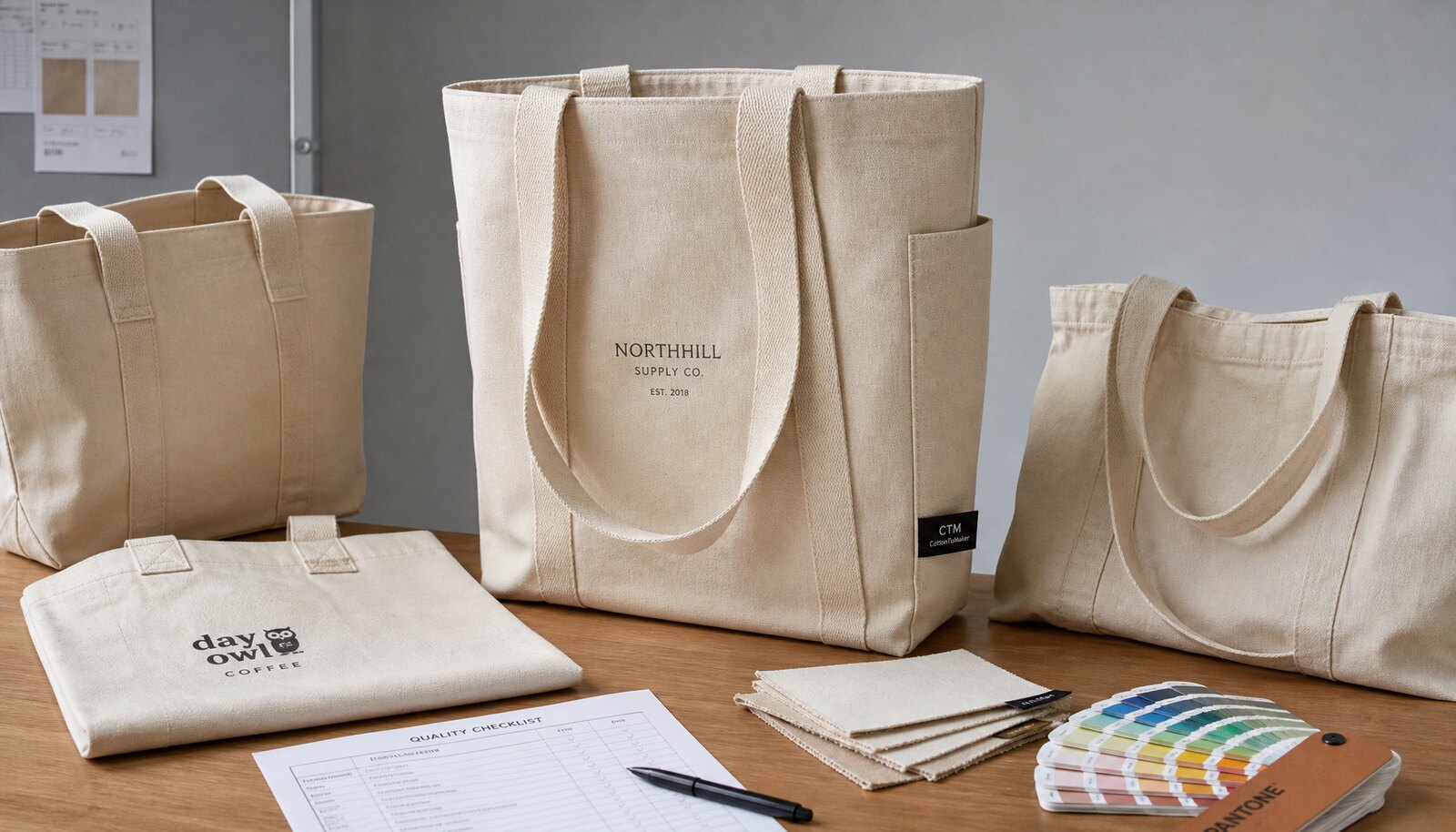
Why conference bag quotes vary so much
Canvas conference bags look simple, but factory quotes often reflect very different assumptions. One supplier may be pricing a basic stock tote with a single-color print. Another may be quoting a custom cut-and-sew bag with reinforced handles, a heavier canvas, a specific pack method, and a tighter inspection standard. If you compare only the unit price, you can end up choosing the wrong offer for the wrong product.
For ecommerce buyers, the real job is to buy a bag that performs in the event environment, presents well in photos, packs efficiently, and lands without avoidable claims. The price only makes sense when the underlying spec is clear. A good quote is not the cheapest line item; it is the most complete description of what you are actually buying.
This matters because conference bags sit at the intersection of merchandising, operations, and procurement. Marketing cares about the look. Operations cares about box count, freight cube, and delivery date. Procurement cares about supplier reliability, margin, and landed cost. A useful quote has to satisfy all three.
- A low quote often means lighter canvas, looser sewing tolerances, or a simpler print route.
- Setup fees, color separation charges, and packing materials can change landed cost more than the tote base price.
- A quote that does not specify fabric, print method, and packing is not comparable to a quote that does.
Start with the use case, not the bag category
Before you send an RFQ, define what the bag must carry and how it will be used. A conference tote for a notebook, product samples, brochures, and a bottle is a different spec from a welcome bag that only holds inserts and a small gift. If the use case is vague, the factory will default to its most economical construction, which may not match the event program.
The cleanest way to brief a supplier is to describe the contents, not just the style. List the heaviest item, the approximate fill size, whether the bag needs to stand upright on a table, and whether it will be reused after the event. Those details determine the width, gusset depth, handle reinforcement, and fabric weight more accurately than a generic tote category name.
For most ecommerce brands, 10-12 oz canvas is a practical range because it balances structure, print quality, and cost. That is not a universal answer. If the bag is being handed out with heavier kits or sample boxes, you may need stronger handles and a tighter seam standard. If the item is a promotional giveaway, a simpler bag with clean print execution may be the better commercial decision.
- Describe the contents, total expected weight, and whether the bag will be carried by hand or over the shoulder.
- State whether the bag must sit flat, stand upright, or fold compactly after use.
- Use the use case to decide whether you need an open top, closure hardware, or internal pockets.
Fabric, weave, and color choices that change price and performance
Canvas is often described by oz or GSM, but those numbers only matter if you connect them to feel, structure, printability, and cost. A 10 oz canvas can work for many conference programs, but it may sag if the load is heavy or if the tote is oversized. A 12 oz canvas usually gives a firmer body, a more premium hand feel, and a better surface for crisp print, but it also adds material cost and sewing time.
The weave matters too. A cleaner, more even weave usually gives better logo edges and fewer visual distractions in brand photography. Coarser cloth can still be acceptable for a natural craft look, but buyers should approve it knowingly because visible slubs, weave breaks, and slight color variation are part of the material character. If the brand is positioned as premium, the base cloth must support that perception before print even goes on.
Color choice changes the risk profile. Natural canvas is the easiest for sourcing and often the lowest cost, but it shows contamination, oil marks, and fiber variation more easily. Bleached or dyed canvas can look cleaner and more intentional for retail or event use, yet the buyer must then control shade consistency and color fastness more carefully. If the quote includes dyeing, ask whether the color is stock, custom, piece-dyed, or yarn-dyed, because that affects both lead time and color repeatability.
- Ask for GSM or oz, weave construction, and whether the fabric is preshrunk.
- Request the expected shrinkage range after pressing or washing if the tote will be reused.
- Confirm whether the visible branding area has enough surface consistency for the print method you intend to use.
Print method, decoration placement, and artwork control
The decoration method is one of the biggest quote drivers, because the right process depends on artwork complexity, run size, and durability expectations. Screen print is usually the cleanest option for one to three flat colors on canvas. It is efficient at volume and gives a strong, familiar look, but it becomes less attractive when the art has very fine lines, gradients, or many colors.
Heat transfer and digital methods can handle more complex art, but they are not automatically better. The buyer should ask what the decoration needs to survive. If the bag will be handled repeatedly, packed in cartons, and reused at multiple events, print abrasion matters. A method that looks good on the sample but cracks or peels after mild use will create a quality problem, not a brand asset.
For some ecommerce brands, a small woven label, side label, or sewn patch delivers a better value proposition than a large printed front panel. It may cost more per unit than a simple one-color screen print, but it reduces decoration risk and can look more premium. The quote should specify exact decoration size, location, and artwork reference, otherwise you are not comparing the same product across suppliers.
- Lock print size in millimeters or centimeters, not only in visual terms.
- Define the placement window for front, back, side, or handle decoration.
- Ask for a light rub test and a view of the print under standard daylight or D65 lighting.
MOQ logic and how to read price breaks
MOQ is not just a factory rule; it is also a production economics signal. A supplier can offer a low MOQ on stock totes because the cloth, pattern, and sewing operations already exist. Once you ask for a custom size, custom handle length, or a different print placement, the MOQ rises because the factory must allocate cutting, sewing, and finishing time for your job.
This is where buyers often misunderstand the quote. A quote at 500 pieces may include a larger margin for setup and line disruption, while a quote at 3,000 pieces may absorb the same fixed cost across more units. The price break tells you whether the factory is genuinely efficient at your target scale or merely willing to accept a small order at a premium. For recurring ecommerce programs, you need the latter number more than the intro-run number.
The useful comparison is not simply the lowest MOQ. It is the relationship between MOQ, unit price, and the cost of repeat orders. Ask for tiered pricing at 1,000, 3,000, and 5,000 units so you can see how quickly the price falls. If the curve is flat, the offer may not be optimized for scale. If it drops sharply, you may have leverage for a reorder program or a forecast-based contract.
- Separate MOQ for sewing, print, and packaging if the factory treats them differently.
- Clarify whether MOQ is per SKU, per colorway, or per artwork version.
- Ask how the price changes if you split volume across two print colors or two bag colors.
What a usable factory quote must include
A workable quote for canvas conference bags should be specific enough that another supplier can reproduce it without guesswork. The finished size, fabric weight, handle spec, print method, packing method, and sample assumptions need to be visible in the offer. If those points are missing, the supplier is protecting room for interpretation, not helping you compare sources.
Packing is a common gap. One factory may quote bulk folded bags in a master carton. Another may include individual polybags, retail inserts, barcodes, and carton labels. Those are not minor details. They affect material cost, packing labor, freight cube, warehouse receiving, and sometimes customs documentation. A quote that ignores them is incomplete even if the unit price looks attractive.
The same is true for tooling and setup. Screen print screens, plates, color matches, woven labels, and carton mark changes may be treated as separate charges. If the buyer does not ask where those costs sit, they often reappear later as added charges after artwork approval. This is one of the fastest ways for a cheap quote to turn into an expensive order.
- Finished dimensions and tolerance.
- Fabric spec, handle spec, and stitch spec.
- Print method, color count, and setup charges.
- Packing method, carton count, and carton dimensions.
- Sample cost, sample lead time, and production lead time.
- Incoterm, freight responsibility, and excluded charges.
How to tell a real manufacturer from a trading layer
Many sourcing problems start with assuming every quote comes from a factory. Some suppliers are direct manufacturers. Others are trading companies, agents, or decorators that subcontract the sewing or printing. None of those models are automatically bad, but you need to know which one you are dealing with because the risk profile and control points are different.
A real manufacturer should be able to describe the production line, the machines used for cutting and sewing, the number of sewing lines available for this product, and the monthly capacity for the quoted spec. They should also be able to share business registration details, a verifiable factory address, and photographs that match the actual production environment. If every photo looks like a showroom or a stock image library, treat that as a signal to verify more deeply.
If the supplier is a trading company, the key question is not whether they exist, but whether they can enforce the spec at the actual factory. Ask who approves the pre-production sample, who controls raw material purchase, and who signs off on the final inspection. If the answer is vague, you have a visibility gap. For a procurement buyer, the practical issue is not the label attached to the seller; it is whether you can trace responsibility to one accountable production site.
You can also infer control by asking for a short factory verification package: registration, production video, machine list, recent inspection report, and the name of the person who will own your order. A real producer can usually answer these quickly. A middle layer often needs time because it has to ask someone else.
- Request factory registration and the exact production address.
- Ask which steps are done in-house and which are outsourced.
- Request photos or video of the actual sewing line, cutting area, and packing area.
- Confirm who owns QC sign-off and who handles rework if the bulk shipment fails inspection.
Factory audit signals, Incoterms, and freight lane risk
A quote is not complete unless you know where risk transfers and how the cargo will move. Incoterms define what the supplier is responsible for and when the buyer takes over. Ex-works pricing can look low, but it pushes pickup, export handling, and first-mile logistics onto the buyer. FOB or FCA may be cleaner for sea freight, while DDP can simplify delivery but requires trust in the seller's customs handling. The right term depends on your internal logistics capability and the shipment lane.
Freight lane risk matters even for low-value tote orders. A bag order can be delayed by peak season congestion, local trucking shortages, port bottlenecks, or a poorly packed carton that collapses in transit. If the bags are tied to a launch or event date, the shipping path matters as much as production time. Ask whether the supplier has shipped this product type to your destination before and whether they know the documentation expectations for that lane.
If you are comparing suppliers in different regions, compare transit time, export readiness, and the likelihood of inspection delay, not only the base production price. A lower price from a factory with weaker export execution can easily lose to a slightly higher price from a supplier with cleaner freight discipline. The landed cost is what matters.
A practical quote review should separate factory cost, export side charges, main freight, destination charges, duties, and local warehouse receiving. If the supplier cannot itemize the first two or three layers, the quote is not procurement-ready.
- Confirm the Incoterm and where risk transfers.
- Ask whether the supplier is experienced with your destination country or region.
- Include transit time and customs risk in the quote comparison, not only production time.
- Request a landed-cost view if you are comparing suppliers across countries.
Sample approval should freeze the features that cause claims
A good sample is not just a visual reference. It is the legal and operational baseline for the bulk order. It should freeze the fabric type, the decoration method, the handle length, the seam behavior, the fold method, and the packing arrangement. If the buyer approves only the look and not the measurable features, the factory can still deliver a product that is technically close but operationally wrong.
Use a pre-production sample made from the same fabric and the same process route as the bulk order. Counter samples are useful for design discussion, but they are weak approval tools if they use better cloth, different thread, or a different print setup. The moment you approve a sample that does not mirror production, you give away control of the final result.
For ecommerce brands, the strongest sample review is measurable. Measure finished dimensions, check symmetry between left and right handles, inspect the print placement against a ruler, and validate the carton packing method. If the bag is going through a customer-facing event or retail channel, also check how it photographs and whether it keeps a clean shape after refolding.
- Measure the approved sample and record the actual dimensions, not just the target spec.
- Verify handle symmetry, strap alignment, and seam straightness.
- Rub the print lightly and inspect for transfer, flaking, or edge lifting.
- Open, refold, and repack the sample to see whether the bag keeps its shape.
QC standards that are specific enough to enforce
QC guidance becomes useful only when it is concrete enough for a factory and inspector to execute. For canvas conference bags, the right approach is to define the defect classes, the sampling plan, and the test methods before mass production starts. AQL 2.5 for major defects and AQL 4.0 for minor defects is a common starting point for general tote programs, but the buyer should decide whether a tighter threshold is needed for logo-sensitive or retail-facing orders.
The inspection should check dimensions, print placement, handle attachment, stitch integrity, and packing accuracy. Critical defects should have zero tolerance. A torn seam, incorrect bag size outside tolerance, or a handle that detaches under basic load is not a minor issue; it is a shipment stop. Major defects are those that affect saleability or use, such as skewed print, obvious stain, or a crooked handle that makes the bag look unprofessional. Minor defects are cosmetic issues that do not change function, such as a stray thread or small surface variation outside the brand's approved range.
Load testing should be tied to real use. For many conference totes, a static hang test at 5-7 kg for 10 minutes is a practical factory check. If the bag is intended for heavier kits, increase the requirement and write it into the PO. Stitch density should also be stated. Buyers often use a higher standard at the handle join and bottom seam than on non-critical seams, because those are the failure points that create claims after the event. If the bag includes metal parts, snaps, zippers, or magnets, add an opening and closing function check and inspect for sharp edges or misalignment.
Do not rely on a generic factory promise that the goods are inspected. Ask which inspection standard they use, who performs it, and whether you can receive photos, measurements, and defect counts. If the supplier refuses to define test methods, they are asking you to accept quality by assertion instead of evidence.
- Use AQL 2.5 major and AQL 4.0 minor as a baseline unless the brand needs a tighter standard.
- Set zero tolerance for wrong size outside tolerance, torn seams, missing parts, and unsafe hardware.
- Define a static load test, a print rub check, and a dimensional check in the purchase order.
- Require top-of-production and final random sample comparison against the approved sample.
Specification comparison for buyers
| Spec decision | Recommended option | When it fits | Buyer risk to check |
|---|---|---|---|
| Fabric weight | 10-12 oz cotton canvas, about 340-410 GSM | Conference kits, ecommerce brand events, and reusable giveaway programs that need structure without excessive weight | Below 8 oz can look thin and distort print; above 12 oz can raise cost, increase sew time, and add freight weight |
| Handle style | 25-30 mm cotton web handles with X-box or bar-tack reinforcement | When bags will carry notebooks, brochures, samples, and a water bottle | Narrow handles cut into the shoulder; weak attachment points fail under load or after repeated use |
| Print method | Screen print for 1-3 solid colors; heat transfer or digital for complex art; woven label for subtle branding | Simple logos, short runs, or artwork with gradients and small type | Choosing the wrong method can create misregistration, cracking, or poor abrasion resistance |
| MOQ route | Blank stock plus local print, or custom cut-and-sew at factory MOQ | When you need speed for a campaign or full brand control for a launch | Stock routes limit size and fabric options; custom MOQs may force higher unit cost or longer lead time |
| Closure | Open top unless contents need security; add snap or zipper only when the use case justifies it | Event bags used for brochures, catalogs, or welcome kits | Extra closures add labor, hardware cost, and QC risk without improving function in many conference use cases |
| Lining | Unlined for simple tote use; partial lining only when small items, darker interior, or premium feel matter | Conference swag packs, lightweight merch, and cost-sensitive programs | Lining raises labor and can conceal internal sewing defects until inspection |
| Packing method | Flat-packed with fixed carton count; polybag only if cleanliness or retail presentation requires it | Bulk import and warehouse distribution with predictable carton loading | Overpacking increases freight cube; loose packing creates crease marks, count errors, and warehouse disputes |
| Supplier route | Direct factory for stable volume; trading company for multi-item consolidation; local decorator for urgent domestic jobs | Depending on deadline, art complexity, and whether you need one-stop sourcing | Middle layers can hide real MOQ, markup, and the actual production site |
| Sampling approach | Pre-production sample with exact fabric, print, handle length, carton mark, and packing method | Any order where color, logo placement, or bag size matters to the brand | Counter samples that differ from mass production create rejection, rework, and delivery slip |
Buyer checklist before sampling
- Define the finished bag size, not only the cut size, and state acceptable tolerance for width, height, and gusset in writing.
- Specify fabric weight in GSM or oz, plus whether you want natural, bleached, dyed, or piece-dyed canvas.
- State the print method, number of print locations, maximum color count, and acceptable color tolerance against Pantone or a physical reference.
- Define handle length, width, attachment method, and the target load requirement for the bag.
- Request a pre-production sample or fully sewn approval sample that uses the same fabric, thread, and print method as bulk production.
- Set carton pack count, inner packing requirement, barcode/label needs, and whether bags must be folded flat or left semi-open.
- Ask for production lead time, sample lead time, and the date the factory can start after artwork approval and deposit.
- Require a quote breakdown that separates base bag price, print cost, packaging cost, and any tooling, setup, or carton mark fees.
- Ask the supplier to confirm Incoterms, origin country, freight readiness, and whether the quote includes export documents or only ex-works pricing.
- Verify whether the supplier is a manufacturer, a trading layer, or a decorator by requesting factory registration, production photos, machine list, and recent QC records.
Factory quote questions to send
- What is the exact finished size, fabric weight, weave type, and shrinkage range included in this quote?
- Is the price based on a blank stock tote, a custom cut-and-sew tote, or an existing factory pattern that will be modified?
- Which print method is included, how many colors are covered, and what is the setup charge per color or per location?
- What handle width, handle length, thread type, and attachment method are assumed in the price?
- What is the MOQ for the quoted spec, and how does unit pricing change at 1,000, 3,000, and 5,000 pieces?
- What is the sample process, sample cost, and what exact sample will be approved before mass production?
- What carton size, carton quantity, packing method, and carton mark format are included in the quote?
- What inspection standard will be used for dimensions, stitching, print quality, and packing accuracy?
- What are the lead times from deposit, artwork approval, and sample sign-off, and what can extend them?
- What parts of the quote exclude freight, duties, taxes, customs clearance, origin charges, and warehouse handling?
Quality-control points to confirm
- Use a written AQL standard before bulk shipment. For general cosmetic and functional tote orders, a common starting point is AQL 2.5 for major defects and AQL 4.0 for minor defects, with zero tolerance for critical defects such as torn seams, wrong size beyond tolerance, or unsafe attachments.
- Set clear defect definitions: critical defects affect safety or usability, major defects affect saleability or function, and minor defects are cosmetic issues that do not change use.
- Measure finished dimensions on a statistically meaningful sample and require the bag to stay within the agreed tolerance, commonly plus or minus 0.5 cm to 1 cm depending on bag size and spec.
- Inspect handle attachment strength by checking stitch density at the stress points and confirming no skipped stitches, loose loops, or thread breaks at the join.
- Require a load test aligned to the use case. For many conference totes, a practical factory check is a static hang test at 5-7 kg for 10 minutes with no seam opening, handle detachment, or visible deformation beyond agreed limits.
- Ask for stitch density in stitches per inch or stitches per 3 cm in the critical seams, then define a minimum for handles and bottom seams. Many buyers use a tighter standard at stress points than on decorative topstitching.
- Review print quality under daylight-equivalent lighting: no major misregistration, no obvious pinholes in the ink film, no color shift beyond the approved sample, and no cracking after a light rub test.
- Use a rub test on printed areas with dry and damp cloth checks. The print should not transfer noticeably, smear, or flake under light handling.
- Check fabric defects in the visible branding zone: no oil stains, broken yarns, heavy slubs, dye bars, or weave distortion beyond natural canvas variation that was approved in advance.
- Inspect the top of production and final random samples against the approved sample for size, handle length, seam alignment, label placement, folding method, and carton marks.