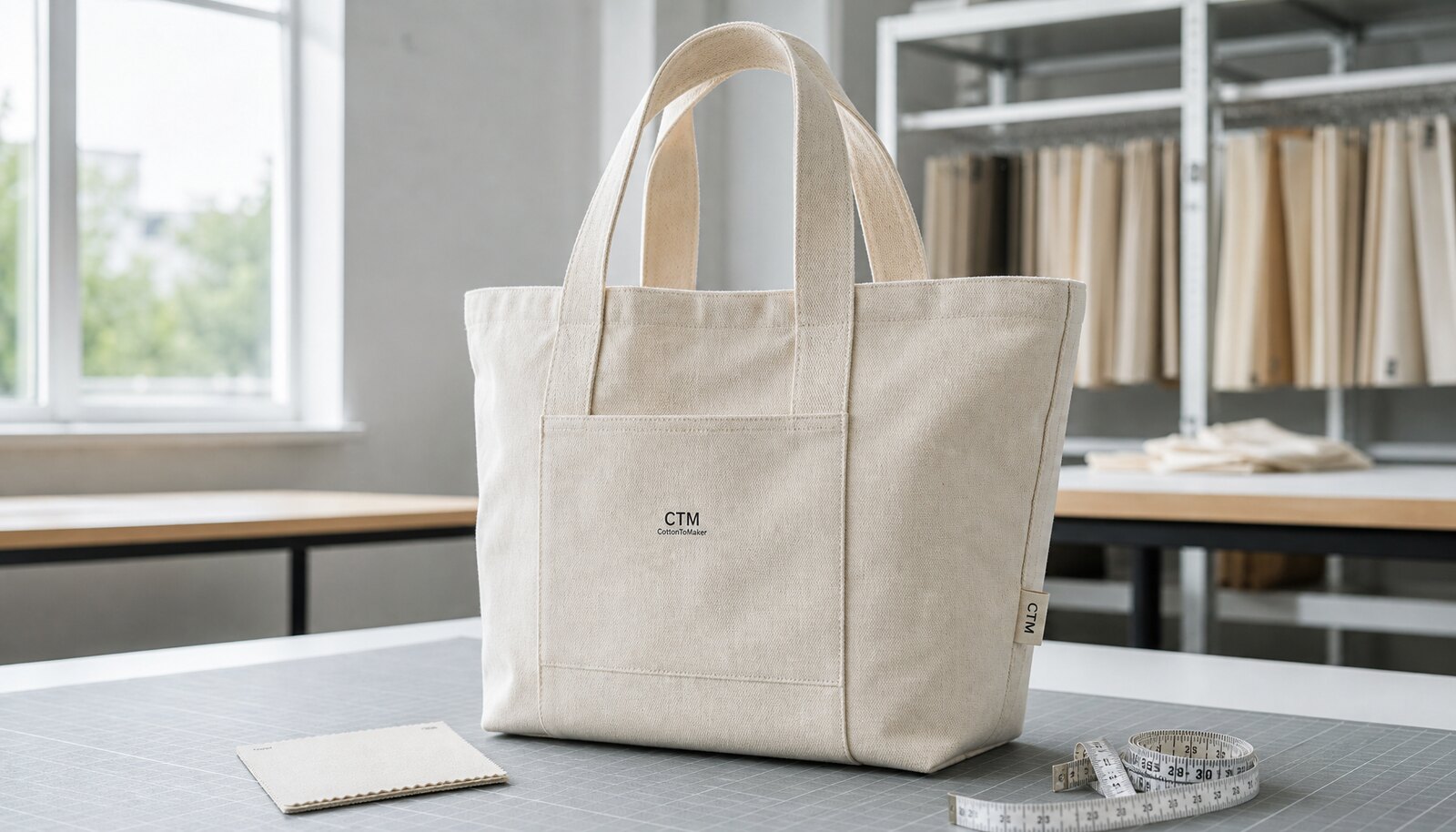
1. Start with the event job, not the tote design
For ecommerce brands, conference bags are usually part of a larger event giveaway system: product samples, brochures, inserts, discount cards, launch materials, or a welcome kit. Procurement should start with the event job the bag has to perform. If you only start with artwork, suppliers will quote to their own assumptions and you will spend the next two weeks correcting size, structure, and packing.
There are three common use cases, and they do not price the same. A simple handout tote needs fast packing, low unit cost, and enough strength to survive a few hours of carry. A sample carrier needs better seams, more body, and a fit that protects what goes inside. A premium event gift bag may need a cleaner finish, a more stable shape, or special packing so it looks right when handed over at a booth or VIP desk.
The event context also changes the acceptable failure mode. For a handout tote, minor fold marks may be acceptable. For a branded sample kit, print scuffing or misaligned handles can make the whole presentation look careless. If the bag is going to be pre-packed in a warehouse and distributed by an event team, the carton plan matters just as much as the fabric choice.
A good sourcing brief answers five operational questions before quote collection: what is going inside, who will carry it, how far or how long it must be reused, whether the bag needs to stand up on a table, and whether presentation or lowest cost is the main objective. Those answers shape every later decision, including whether to add a gusset, reinforce handles, or change the packing format.
Useful rule of thumb: if the bag must support a branded insert set or a product sample kit, define the internal load first and the tote second. That prevents the all-too-common situation where the bag looks fine empty but is too shallow, too floppy, or too small once the inserts are loaded.
- Define the event use case: handout, sample carrier, or premium kit.
- List the actual items that must fit inside the tote.
- Decide whether the bag must stand on its own or only carry flat collateral.
- Treat the tote as part of the giveaway system, not a separate merch item.
2. Build an RFQ that removes guesswork
A procurement-ready RFQ should leave almost no room for default assumptions. At minimum, specify finished dimensions, gusset depth, handle length, fabric weight, color, print area, print method preference, closure style, and packing format. If any one of those is missing, a supplier may quote a different product than the one your team thinks it is buying.
Dimensions should be written in finished measurements, not just a reference image. State bag width, height, and gusset in millimeters or inches, plus handle drop if shoulder carry matters. Handle width matters too, because wide handles feel more substantial and can be more comfortable when the bag is full. If brochures or samples must stand upright, note the interior height required to keep the contents from curling or bending.
The print section should be equally specific. Do not write only “logo on front.” State the exact placement, size, number of colors, whether there is a back print, whether QR codes or legal text are included, and whether the artwork needs a high-contrast version on natural canvas. Ask the supplier to confirm the minimum readable line thickness if your design includes small type or a scan code.
Packing instructions belong in the RFQ, not as a late-stage note. Ask for bulk fold, individual polybag, or kitted pack-out and state whether the print should face a specific direction in the carton. Packing changes labor cost, carton density, and how fast the event team can receive and distribute the bags. If you want a reusable tote, request a fold that minimizes deep creases and avoids crushing the print.
RFQ fields that save time later: - Finished size, gusset, and handle length - Fabric weight and color standard - Print method, color count, and placement map - Closure or hardware requirements - Pack method and carton target - Delivery term, destination, and event date
- Write finished dimensions, not implied size.
- Specify print placement in measurable terms.
- Include packing format in the quote request.
- Ask suppliers to confirm every open assumption in writing.
3. Fabric choices: what changes cost, look, and failure rate
Fabric is the first real quality decision in canvas conference bags for ecommerce brands event giveaway planning, and it affects more than the price per piece. Buyers usually see only the oz or gsm number, but fabric performance also depends on weave density, yarn consistency, finishing, and shrink behavior after sewing. Two bags with the same nominal weight can behave very differently once printed and loaded.
For standard conference giveaways, 10–12 oz canvas is often the practical starting point. It generally gives enough structure for brochures, a slim product sample, or a small retail-style giveaway kit without pushing sewing costs too high. If the bag will carry heavier inserts or needs a more premium hand feel, 14–16 oz can be justified. Expect a heavier cloth to increase material cost, sewing resistance, and freight weight; depending on size, the landed cost can rise noticeably even when the factory price only moves modestly.
The key procurement mistake is assuming “heavier” automatically means “better.” A stiff or coarse weave can still distort small print, create seam puckering, or make the tote fold poorly in cartons. For artwork with small text or a QR code, the print surface matters as much as the cloth weight. Ask for a swatch and look at the weave under light. You want a surface that is even enough for logo edges, not a fabric that looks premium only from a distance.
Finish also affects risk. Natural unbleached canvas has a good organic look and can be cost-efficient, but shade variation is more visible on natural stock. Dyed or bleached cloth can improve contrast and presentation, but it introduces dye-lot control and potential shade mismatch between batches. Washed or softened finishes can make the bag feel more premium, yet they may alter shrinkage or hand feel after packing. If the supplier cannot explain how the finish affects the final bag, ask for a physical swatch and a note on shrink and color variation rather than approving by description alone.
What to ask on fabric before award: - Finished weight after finishing and print - Whether the weight is before or after washing - Weave density and any visible slub risk - Expected lot-to-lot shade range - Whether the fabric shrinks after cutting or sewing
- 10–12 oz suits most standard event handouts.
- 14–16 oz suits heavier inserts or a more premium presentation.
- Ask for finished weight, not just base cloth weight.
- Check weave consistency and shade variation before bulk approval.
4. Print method decisions should follow artwork complexity
Print selection should be driven by the artwork and the event use, not by the factory’s default method. For simple logos, screen print remains the most reliable option for canvas because it can give solid coverage and predictable repeatability once the screens are approved. It is usually the best fit when the design is one or two colors and the order volume can absorb the setup cost.
Transfer or digital transfer methods become more useful when the art is complex, the quantity is lower, or the event requires variable content. They can reproduce gradients, thin type, and multi-color marks more easily than screen printing, but they also carry different failure modes. Low-grade transfers may crack after repeated folding, lift at the edges, or look too glossy against the matte surface of canvas. That matters if the tote will be folded into cartons and then reused at the conference.
Procurement should treat durability as a quote question, not an afterthought. Ask the supplier how they test rub resistance, fold resistance, or wash stability if the bag is likely to be reused. If the tote will only be handed out once and used lightly, durability requirements can be lower. If the brand expects it to become a reusable carry bag, print failure becomes a reputational issue, not just a cosmetic defect.
Small text, QR codes, and compliance language deserve special attention. These elements are often the first to fail on textured fabric. Ask the supplier for the minimum line thickness and smallest readable text size they are willing to guarantee. If the code must scan at the event, request a pre-production sample that you can test with the actual phone or scanner your team will use. A design that looks fine in a PDF but fails at the booth is not acceptable.
Print-method questions that sharpen the quote: - What is the smallest line thickness you will accept? - What rub or flex test do you perform? - Is print done in-house or outsourced? - Will the actual tone match the approved sample under neutral light? - Can the QR code be scanned after folding and handling?
- Screen print fits simple logos and reorder programs.
- Transfer print fits complex art or shorter runs.
- Ask for a durability test if the tote will be reused.
- Treat QR codes and small text as functional requirements.
5. Compare suppliers on like-for-like spec sheets, not unit price
A unit price means very little unless the quotes are truly for the same bag. One factory may be quoting thinner canvas, a smaller logo, looser handle reinforcement, or a different pack format. Another may be including a pre-production sample or individual polybags. Procurement should use a structured comparison sheet and force every quote onto the same basis before judging price.
The most common hidden cost drivers are print setup, packing format, carton volume, and freight density. A quote with bulk folding may be cheaper at the factory but more expensive in your warehouse if the event team has to sort and repack every unit. A quote with larger cartons can drive freight cost higher even when the tote itself is the same. This is why landed cost should be compared per usable giveaway unit, not just ex-works price.
Lead time is another comparison variable that is often underweighted until it becomes a problem. A factory with a lower unit price but no capacity buffer can become the most expensive option if it forces emergency air freight or causes the giveaway to miss the event altogether. Ask the supplier where the schedule is most vulnerable: fabric sourcing, cutting, sewing, print, packing, or booking. A supplier that can name the bottleneck is usually managing production more realistically than one that answers vaguely.
A practical quote matrix should include: - Fabric weight and color - Finished size and gusset - Handle construction and reinforcement - Print method, size, and color count - Packing method and units per carton - Carton dimensions and gross weight - MOQ and price breaks - Production lead time and shipment term
If one quote looks unusually low, the right question is not “Can you match it?” It is “What changed?” That single question usually reveals whether the gap is real or whether the quotes are not comparable.
- Compare only like-for-like specs.
- Include carton dimensions and gross weight in every quote.
- Price the target quantity and the next break point.
- Use landed cost per usable giveaway unit.
6. MOQ and order sizing: when to negotiate and when to simplify
MOQ is often treated as a negotiation number, but for canvas totes it is usually a production constraint. Fabric dye lots, screen setup, cutting efficiency, and packing labor all affect the minimum. A tote with standard fabric and one-color print will often be more flexible than one with custom lining, multiple print locations, or special hardware. The right response is not always to push for a lower MOQ; sometimes it is to simplify the product enough that the MOQ naturally drops.
Ask the supplier what specifically creates the MOQ. That answer tells you where the friction is. If the bottleneck is print setup, reducing color count may help. If the bottleneck is fabric sourcing, a standard color may matter more than a lower quantity. If the bottleneck is packing labor, bulk fold may be the lever instead of product design. Buyers who ask “what drives the MOQ?” usually get a better answer than buyers who only ask “what is the MOQ?”
Order size should also reflect how the giveaway will actually be used. If the bag is for one conference only, overbuying just to reduce unit cost can be poor cash use unless the tote can be reused in future events. If the ecommerce brand runs multiple launches in a season, a slightly larger order may be worthwhile because the leftover bags can be reused without looking stale. Procurement should compare the cost difference between the target quantity and the next price break against storage, obsolescence, and cash tied up in inventory.
A practical MOQ decision checklist: - Is MOQ driven by fabric, print, or packing? - Can color count, size, or closure be simplified? - Are leftovers reusable for future events? - What is the price gap to the next break? - Can the supplier stage production or split shipment?
When the MOQ feels too high, request a deconstructed quote. Sometimes a standard base tote plus a simpler print and standard packing format gets the order into an acceptable range without sacrificing the event objective.
- Ask what specifically drives the MOQ.
- Quote your target quantity and the next break point.
- Simplify size, color count, or packing before accepting excess volume.
- Consider future reuse before overbuying for one event.
7. Samples should prove fit, print legibility, and handling—not just appearance
A sample is only useful if it proves the bag can survive the actual giveaway job. For procurement, the sample stage is where size, load fit, print clarity, seam strength, and packing method are validated before the full order is committed. If the tote only looks correct when empty, the sample has not done enough work.
Start with a physical reference. Keep one approved sample sealed and dated, and make sure the factory signs off against the same reference. Measure the sample after pressing and compare it to the written spec, not to a memory of the artwork. Then load it with the actual brochure set, product sample, or welcome kit the bag is meant to carry. That immediately exposes weak bottoms, short handles, or a gusset that collapses under weight.
For print-heavy orders, inspect the sample at normal viewing distance and under neutral light. Thin text, QR codes, and logos with fine outlines need to be checked as they will be seen on the event floor. If the design includes a transfer or special finish, fold the sample several times and look for cracking, edge lift, or gloss changes. A sample that survives the first minute of handling but breaks down after repeated folding is not production-ready.
Use the sample stage to remove ambiguity, not to rewrite the project. If the factory suggests a change to simplify sewing or improve yield, document it as a revision and get written approval before bulk production starts. Informal “okay by email” language causes disputes later when the finished bags differ from the approved master.
Sample acceptance checklist: - Size matches the approved spec after pressing - Logo placement matches the artwork map - QR code or small text is readable - Handles and seams hold under realistic load - Fold method matches the packing plan - Any change is documented and dated
- Approve against a physical reference, not only a photo.
- Load the bag with the actual inserts before signoff.
- Check readability at normal viewing distance.
- Document every approved change before bulk starts.
8. Put QC thresholds into the PO so inspection is objective
Quality control is where procurement can prevent most tote problems before shipment. The key is to move from vague expectations like “good quality” to measurable acceptance thresholds. That means writing down the acceptable range for size, weight, stitch quality, print placement, shade consistency, and pack count. If the factory understands the test criteria, it can correct problems before shipment instead of after the bags arrive at your warehouse.
For many event bag orders, an AQL-based inspection is appropriate, but the defect categories need to be defined in advance. Critical defects should include wrong artwork, torn seams, missing units, or a functional closure failure if the closure is part of the spec. Major defects can include dimensions outside tolerance, badly skewed handles, severe shade mismatch, or print that is visibly off-center. Minor defects may include loose thread ends, small fold marks, or slight surface roughness that does not affect use.
Inspection should sample multiple cartons, not just the first pieces off the line. Open cartons from different parts of the shipment, verify count, check carton marks, and inspect folding consistency. If the tote uses transfer print or a delicate finish, check for rub marks and crease damage. If the bag will carry heavy inserts, test the handles and bottom seam with a realistic load. This is where weak reinforcement usually shows up.
Recommended QC thresholds to write into the PO or QC plan: - Finished size tolerance: commonly ±0.5 cm to ±1.0 cm depending on bag size - Print position tolerance: commonly within 3–5 mm for standard logos, tighter if QR codes are critical - Thread tail limit: set a measurable maximum rather than saying “clean finish” - Carton count: 100% count accuracy or agreed tolerance by carton - Fold and pack method: must match the approved sample exactly
If the supplier resists objective criteria, that is not a minor wording issue. It is a sourcing risk. Good factories usually welcome clear acceptance rules because they reduce arguments later.
- Define critical, major, and minor defects before production.
- Inspect multiple cartons, not just first-off samples.
- Write size and print tolerances into the QC plan.
- Use realistic load tests for bags that must carry inserts.
9. Packing, carton loading, and warehouse handling should be quoted, not guessed
Packing directly affects cost, freight, and downstream labor. A canvas conference tote can be bulk folded in a master carton, individually polybagged, or packed as part of a kitting operation. Each option has a different failure mode. Bulk packing is usually cheapest, but it increases the chance of uneven folds and shifts more handling to your warehouse or event team. Individual polybags improve protection and presentation but add material cost and carton volume. Kitting is the most operationally useful when the tote must go out with inserts, but it usually adds labor and packing complexity.
Ask the supplier for a full packing plan. That should include units per carton, carton dimensions, gross weight, fold method, and whether moisture protection is needed. This is not administrative detail; it changes freight quotes and receiving effort. Two quotes with the same tote price can land very differently if one uses compact cartons and the other uses oversized cartons that increase chargeable volume.
Packing pressure matters more than many buyers expect. Transfer prints can crack or crease if cartons are over-compressed. Heavy canvas totes can distort if the pack is too loose or if the folding method is inconsistent. Ask the supplier to show how the tote is folded and whether the print faces inward or outward. If the event team will distribute bags straight from cartons, the carton label should be easy to read without opening every box.
A useful RFQ packing request can look like this: - Bulk fold: state approximate carton range for the approved size - Individual polybag: one tote per bag, then master carton packed - Kitting pack: tote plus event inserts packed by SKU Do not treat those as universal standards. The factory should confirm the final carton loading once the sample is approved, because exact pack counts depend on bag size, fabric thickness, and whether handles are tucked or flat. What matters is that the factory gives you a realistic loading plan before you award the order.
Warehouse question to ask: can the receiving team identify the event, SKU, quantity, and pack method from the carton mark alone? If the answer is no, the packing spec is incomplete.
- Ask for units per carton and carton dimensions before award.
- Choose bulk, polybag, or kitting based on receiving workflow.
- Protect transfer prints from crease damage.
- Use carton marks that warehouse teams can read quickly.
10. Lead time, freight choice, and the landed-cost model procurement actually needs
The best tote quote is the one that arrives on time at the right total cost. That means the procurement timeline has to run backward from the event date and include sample time, revisions, bulk production, packing, transit, and any customs or inland delivery steps. A cheap factory quote can become an expensive program if it forces emergency air freight or split shipment to make the conference date.
Separate production time from transit time. The factory owns material sourcing, cutting, sewing, printing, and packing. The freight forwarder owns vessel or flight booking, customs timing, and last-mile delivery. If the event date is fixed, ask the supplier for the earliest ship-ready date and the latest safe dispatch date. That creates a more honest basis for deciding between sea freight, air freight, or a mixed plan.
A useful landed-cost model should include unit bag price, print setup, sample charges if non-refundable, packing materials, carton cost, inland freight, international freight, duties or brokerage where applicable, and destination delivery. If any one of those is missing, the quote comparison is incomplete. For event giveaway planning, the right question is not which quote is lowest at the factory. It is which quote delivers the right bags to the venue with the least total risk.
Carton efficiency can move freight materially. Two quotes with identical unit price can land at very different totals if one packs far more efficiently or uses cartons that stay under a better freight bracket. Ask for carton dimensions and gross weight on the quote itself, not after award. Then compare the shipping estimate on the same method and the same destination. That is especially important when volume weight, not piece count, drives the bill.
Build time buffer into the schedule for artwork approval, one sample revision, and shipment delay. If the event has no flexibility, do not optimize purely for price. In event sourcing, on-time arrival and usable condition are often more valuable than a slightly lower piece cost.
- Work backward from the event date, not the PO date.
- Separate production time from freight time.
- Build landed cost from bag, print, packing, freight, and destination charges.
- Compare carton efficiency because it can change transport cost materially.
Specification comparison for buyers
| Buying decision | Option A | Option B | Procurement tradeoff | Typical quote driver / check |
|---|---|---|---|---|
| Fabric weight | 10–12 oz natural canvas | 14–16 oz canvas | 10–12 oz is usually enough for brochures and light kits; 14–16 oz improves body and reduces panel collapse but increases cut loss, sewing resistance, and freight weight by roughly 15–25% depending on size | Ask for finished oz/gsm after finishing; confirm swatch under a realistic load |
| Print method | 1-color screen print | Transfer or digital transfer | Screen print is usually lowest cost on simple logos once setup is amortized; transfers suit small runs or complex art but can show edge lift or cracking if folded tightly | Ask for minimum line thickness, rub/flex test, and whether print is in-house |
| Bag structure | Open tote with gusset | Gusset plus zipper, snap, or insert board | Open totes are cheaper and pack faster; closures and boards improve presentation and item retention but add sewing steps and hardware defects | Confirm whether closure is needed for samples, valuables, or retail-style presentation |
| Handle build | Standard folded handle with basic bar tack | Reinforced handle with box-x or double bar tack | Standard handles are adequate for light giveaways; reinforced handles reduce pull-out risk when bags carry catalogs or product kits | Request handle stitch pattern and a realistic loaded-weight target |
| Packing method | Bulk fold in master carton | Individual polybag or kitted pack-out | Bulk fold cuts packaging cost and carton volume; individual packing improves presentation and protection but increases labor and carton count | Check fold method, units per carton, and whether print faces the same direction |
| MOQ structure | MOQ driven mainly by print setup | MOQ driven by fabric dye lot or special components | Lower MOQ is realistic when the bag uses standard fabric and one print color; special trims, lining, or custom packing usually justify higher MOQs | Ask the supplier to name the real bottleneck behind the MOQ |
| Supplier route | Direct factory | Trading company / sourcing agent | Factory direct often gives better control over stitching and QC; intermediaries may help with speed or consolidation but can reduce transparency | Ask who owns sewing, print, packing, and pre-shipment inspection |
| Cost view | Ex-works unit price only | Landed cost per usable giveaway unit | Unit price can hide costly differences in carton size, pack count, freight density, and delivery term | Compare ex-works, packing, inland freight, and destination cost on one sheet |
Buyer checklist before sampling
- Define the event use case before requesting quotes: handout only, brochure carrier, sample kit carrier, or premium gift tote.
- Lock the bag spec in writing: finished size, gusset depth, handle length, fabric weight, print area, closure, and packing method.
- Ask each supplier to quote the exact same artwork count, color count, print position, and fold/packing format.
- Request a physical pre-production sample when the artwork has fine lines, QR codes, small text, or tight registration requirements.
- Compare quotes on the same basis: ex-works price, sample charges, packaging, carton dimensions, gross weight, freight term, and inland charges.
- Set acceptance thresholds before production starts: finished size tolerance, print placement, stitch quality, shade variation, and pack count.
- Ask for carton loading photos or a packing plan so you can estimate freight and warehouse handling before approval.
- Decide whether individual polybags are required for presentation, protection, or kitting; do not assume the factory default is correct.
- Confirm who owns each process step: material sourcing, cutting, sewing, printing, packing, inspection, and shipment booking.
- Reserve time in your schedule for one sample revision cycle unless the artwork and structure are already proven.
Factory quote questions to send
- What finished fabric weight will the bags have after weaving, finishing, and printing, and what tolerance do you hold on that weight?
- Which process is in-house at your facility, and which steps are outsourced: cutting, sewing, printing, packing, or inspection?
- What is the MOQ by color, by print design, and by total order quantity, and what specific production constraint creates that MOQ?
- Can you quote the same bag with three packing options: bulk fold, individual polybag, and retail-ready packed cartons?
- What are the sample charges, what does the sample include, and how long does a physical sample take from artwork approval?
- Which print method do you recommend for this artwork and why: screen print, transfer print, or another method?
- What are the exact carton dimensions, units per carton, gross weight, and packing ratio you plan to use?
- Can you show a real production or pre-shipment carton photo from a previous similar order, with the SKU and pack count visible?
- What seam reinforcement do you use at the handle stress points, and can you specify bar tack, box-x, or another stitch pattern?
- What is your production lead time after sample approval, and what steps are most likely to delay shipment?
Quality-control points to confirm
- Fabric weight should be verified by a measured swatch, not only by supplier declaration; agree on an acceptable tolerance before sampling, such as ±5% on finished weight or a documented factory-verified range.
- Finished size should be checked after pressing and folding: length, height, and gusset depth should match the approved spec within a negotiated tolerance, especially where inserts must fit.
- Print alignment should keep the logo centered or positioned exactly per artwork placement guide; reject obvious ghosting, bleeding, double images, or blurred small text.
- Handle reinforcement should be visible and consistent: bar tacks or box-x stitching must be placed at the stress points and should not show skipped stitches, loose knots, or fabric tearing around the attachment.
- Seam quality should be inspected along the side seam, bottom seam, top edge, and gusset junctions; look for puckering, thread breaks, exposed raw edges, and loose threads longer than about 3 mm.
- Shade consistency should be checked against an approved lab dip or sealed physical sample under daylight-equivalent lighting, not just under warehouse LEDs.
- Packing should preserve both count accuracy and product shape; folding should be consistent, and polybag or bulk packing should not crush transfer print, distort panels, or leave excessive creases.
- Carton marks should be complete and legible: SKU, color, quantity, gross/net weight if required, destination, and packing method should match the PO and carton plan.
- If the bag includes hardware such as a zipper, snap, or inner board, check alignment and functional operation on multiple samples, not just one approved piece.
- Use a pre-shipment inspection sample set from multiple cartons, not only the first off the line, so variance in later cartons does not go undetected.