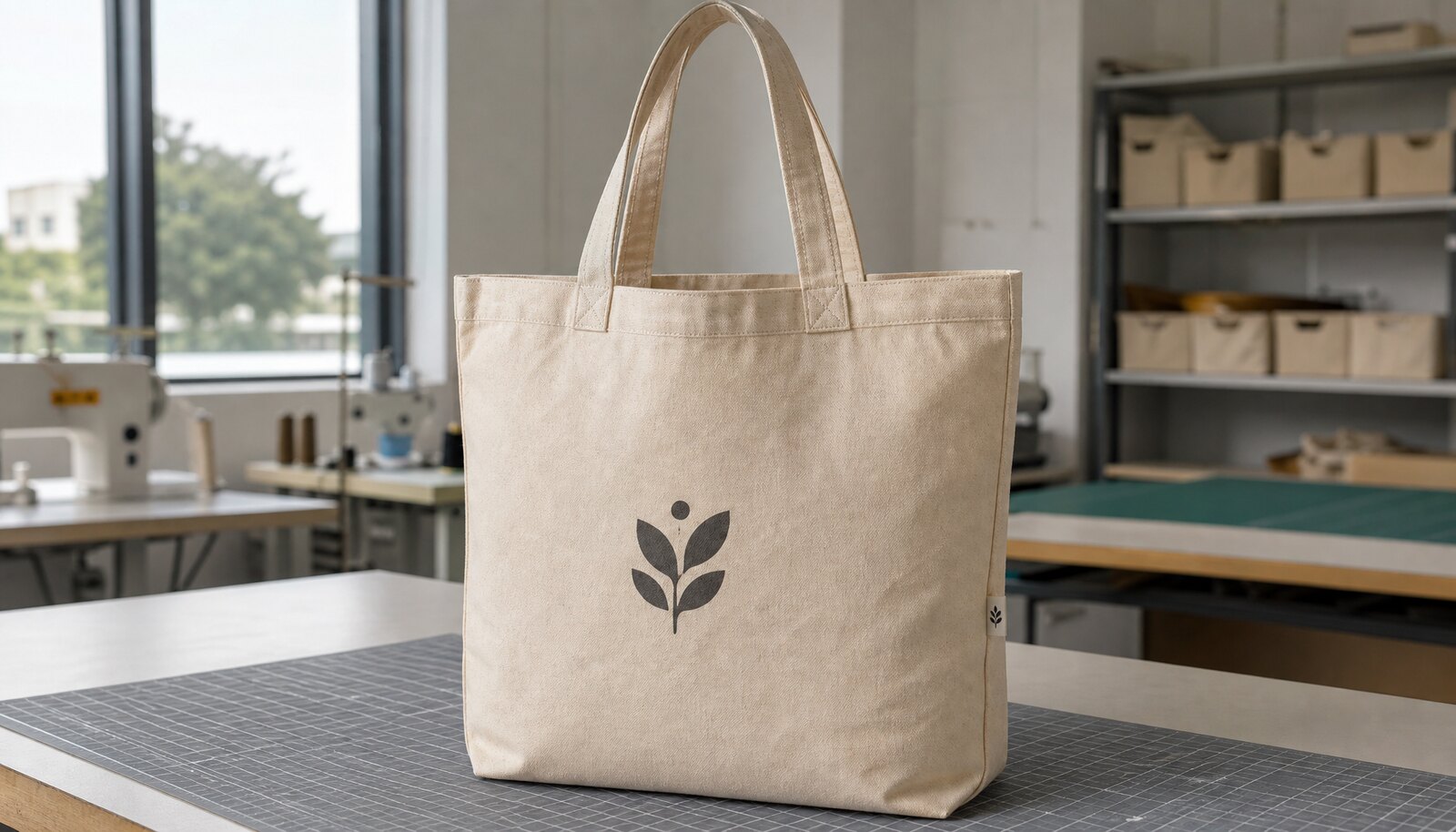
What cosmetic brands are actually buying
Canvas conference bags for cosmetic brands are usually not simple giveaways. They often sit inside a launch kit, buyer meeting pack, PR mailer, conference handout, or retail event bundle that needs to carry brochures, sample jars, shade cards, and boxed products without collapsing. That changes the procurement question. The buyer is not only trying to get the lowest unit cost. The real target is a bag that looks on-brand, survives handling, and lands on time with no repacking.
That is why this topic is best handled as an RFQ review, not a generic tote-bag search. Procurement needs one specification that separates the mandatory requirements from the optional upgrades: usable size, load target, fabric weight, decoration route, packing format, and date risk. If those are not locked early, every supplier will quote a different assumption set, and the comparison will be unreliable even when the numbers look close.
- Treat the bag as packaging plus merchandising, not just a carry item.
- Build the RFQ around event date, load target, and brand finish.
- Use one written spec version so the sample, quote, and PO stay aligned.
Start with the contents, not the bag
Before asking for price, define what the bag must hold. A bag that only carries brochures can be lighter and flatter. A bag that must hold sample bottles, fragrance cards, compact cases, or boxed skincare kits needs more structure, a stronger bottom, and better handle attachment. If the program includes heavier contents, ask the factory to confirm the fabric weight and seam reinforcement before quoting. Otherwise the supplier may give you a low number that only works for a lighter use case.
A practical starting point for many cosmetic conference orders is a body size around 35 x 40 cm with an 8 to 12 cm gusset and a handle drop that works in hand or over the shoulder. That is not a universal rule, but it is a useful baseline for sourcing conversations. If the bag must stand upright in a display tray or fit inside another kit box, top-edge finish and side-seam stability matter as much as the printed face.
Do not leave these fields vague. Words like premium, strong, or event-ready do not help a factory make a repeatable bag. The supplier needs measurable inputs: canvas weight, finished dimensions, handle length, seam allowance, print area, and whether the bag needs a gusset, lining, pocket, or closure.
- Define the actual contents before you ask for fabric advice.
- Lock the finished dimensions and handle drop in the RFQ drawing.
- State whether the bag must stay upright, fold flat, or fit into an outer box.
- If the load is heavy, ask for seam reinforcement and bar-tack guidance.
Fabric and structure are where risk starts
Fabric choice is often the first place MOQ and lead time move. Stock natural canvas is usually the simplest path because the mill sourcing is easier and the factory can cut from common inventory or greige stock. Once you ask for custom dyed fabric, washed finishing, a recycled content claim, or a specific shade match, the supplier may need extra mill confirmation, shade approval, and order overage to absorb variation. That can raise the minimum order or extend the timeline even if the bag pattern itself stays simple.
Canvas weight also changes the order. A lighter cloth is easier to sew and often cheaper, but it can wrinkle more easily, show print distortion, and feel less substantial in a cosmetic setting. Heavier canvas gives better structure and a more premium hand feel, but it can slow stitching and add friction at the seams and handles. For procurement, the right question is not what is the heaviest canvas. It is what weight gives the right balance of appearance, load support, and repeatability for this use case.
If the bag needs lining, interlining, a pocket, or a specialty finish, ask how those materials change both sourcing and inspection. Recycled or certified materials can require documentation, and custom finishing can introduce shade variation or shrinkage that needs to be controlled before mass production. If the supplier cannot explain the fabric source and lot tolerance in writing, the quote is too soft to award.
- Stock natural canvas usually gives the lowest-risk MOQ path.
- Custom dyed, washed, or certified fabric usually needs extra approval and more buffer time.
- Heavier canvas improves structure but can increase sewing difficulty and defect risk.
- Ask for fabric source, weight, color method, and shrinkage expectation in writing.
Decoration method should shape the award decision
Decoration often drives both MOQ and lead time more than the bag body does. A one-color screen print is usually the most efficient choice for canvas because the setup is simple, the logo reads well, and the result is repeatable. If the logo needs two colors, expect more registration control and a higher chance of alignment issues. If the art includes tiny type, gradients, or photographic detail, the supplier may recommend transfer printing or another method that reproduces detail better but changes the look and adds cost.
For cosmetic brands, the print method should match the brand finish. A minimal logo with a woven label or small patch can look more premium than a busy oversized print. Embroidery can also raise perceived value, but it is not free. It changes the fabric hand, can distort lighter canvas, and usually creates a higher setup burden than print. A buyer should ask the factory to confirm the minimum line thickness, smallest readable text size, and whether the decoration will sit cleanly across seams or handle anchors.
Approve decoration on the real material, not just on screen art. A logo that looks sharp on a PDF can close up on natural canvas if the lines are too thin. Ask for a real strike-off or production-style decorated sample, then inspect it in normal light and at arm's length. If the brand cares about precise Pantone behavior, do not assume canvas will match paper swatches exactly; the base fabric color changes how the ink reads.
- Use screen print for simple, repeatable bulk orders.
- Use transfer or digital methods only when the art needs that detail level.
- Use embroidery or a woven patch when the finish should feel more elevated than a plain promo tote.
- Approve decoration on the actual canvas, not only from artwork files.
Read MOQ as a design constraint, not a surprise
The most useful MOQ discussion starts with component separation. Many suppliers quote one overall minimum, but the real constraint often sits inside the build: fabric source, decoration method, label type, pocket structure, and packing method. If any one of those is custom, the order minimum can rise even when the finished bag looks simple. Buyers should ask for MOQ by component so they can see what is actually causing the threshold.
For planning, think in bands instead of a single universal minimum. A stock-fabric tote with one-color print sits in the lowest-risk band. Add a woven label or small patch and the band usually moves up modestly. Add custom dye, lining, a zipper pocket, or a metal closure and the band moves up again because the supplier has more materials to source and more assembly steps to control. That is normal factory behavior, not an arbitrary penalty. The point is to surface the constraint early so the brand can decide whether the upgrade is worth it.
If the campaign is a pilot, ask the supplier to quote both the test quantity and the repeat quantity. Sometimes the buyer is willing to pay a slightly higher unit price for the first run in exchange for a lower commitment. That can be sensible if the event is a test market or the bag will be revised after feedback. What should not happen is an informal promise that the factory can be flexible without a written note on what changes in price, sampling, and lead time once the spec scales.
- Ask for MOQ by fabric, decoration, label, and packing, not only by finished bag.
- Treat custom dye, lining, and hardware as separate MOQ triggers.
- If the project is a pilot, request pricing for both trial and repeat quantities.
- Do not let a vague flexibility promise replace a written spec.
Lead time is a chain of approvals
A reliable lead time review should break the order into steps: artwork signoff, sample development, material sourcing, cutting, printing or embroidery, sewing, packing, and shipment. For a straightforward stock-canvas order, the factory may move quickly once artwork is approved. But the date that matters is the latest gate, not the first one. If the artwork is not final, the sample is not approved, or the carton spec is still open, the production clock is effectively stopped.
Custom components add separate time risk. A custom-dyed canvas needs shade approval. A woven label needs a strike-off or label proof. A zipper pocket or lining adds extra cut-and-sew work and can create a second approval loop if the first sample reveals fit issues. In practice, this means lead time is often controlled by the slowest custom element, not by the base tote itself. Ask the supplier to identify which steps are sequential and which can run in parallel so you can see where the schedule can be compressed and where it cannot.
This is why a lead-time quote without process detail is weak. If the factory says 30 days, ask what happens inside those 30 days. How many days for sample confirmation? How many for material receipt? Is print done in-house or outsourced? Is packing started only after sewing is finished, or can it overlap? Buyers who understand the critical path can protect event dates more effectively and can spot a quote that is optimistic but not operationally grounded.
- Treat artwork approval, sample approval, and packing approval as separate gates.
- Custom dye, labels, and hardware often add their own approval loop.
- Ask which steps can run in parallel and which are strictly sequential.
- If the event date is fixed, build internal buffer time before the factory ship date.
Compare suppliers on control, not headline price
When two quotes are close, the better offer is usually the one with fewer exclusions and clearer control. A direct factory often gives better visibility into pattern making, sewing quality, and packing flow. That matters if the cosmetic brand wants repeatable results and a clean approval trail. A trading company can still be useful when the order mixes several SKUs or needs faster coordination across different product types, but the buyer should then work harder to confirm which factory will actually sew the bags and who owns quality decisions.
A proper quote comparison should include the same line items from each supplier: fabric weight, decoration method, label or patch, packing method, carton count, lead time after sample approval, and any setup fees. If one supplier bundles decoration into a single price and another breaks it out, the comparison is not apples-to-apples. Ask for the production site, the process owner, and the point at which the factory considers the order approved for mass production.
There is also a hidden difference in sample hierarchy. Some vendors can show a good sales sample but cannot reproduce it cleanly in production because they subcontract decoration or change material source at scale. The quote should tell you whether the same line will make the blank sample, strike-off, and bulk order. If the answer is unclear, the supply chain is not tight enough for a deadline-driven cosmetic program.
- Direct factory: better for control, repeatability, and clearer quality ownership.
- Trading company: useful for mixed baskets or speed, but confirm the real factory.
- Compare quotes only after you have the same line items and the same production assumptions.
- Identify who makes the sample, who makes the bulk order, and who signs off QC.
Use samples to prove function, not just appearance
A sample should prove construction first and decoration second. A blank sample tells you whether the body shape, gusset depth, handle length, and seam layout are workable. A decorated sample tells you whether the logo sits in the right place and whether the print or embroidery behaves correctly on the real fabric. A pre-production sample ties the two together with the final materials, final packing, and final label. For a cosmetic launch or conference run, skipping any of these steps increases the chance of rework later.
The approval also needs to be functional. Load the bag with the real contents or a close proxy, then check whether the handles feel secure, the mouth stays open enough to pack the kit, and the bottom panel holds shape. Photograph the sample, measure it, and record the approval version. If a revised sample comes back with a better logo but a smaller body or a different handle drop, that is a change, not just a refinement. Keep that distinction clear so production does not drift silently.
For final approval, seal one reference sample and keep it tied to the PO. That sample is the benchmark for the batch and the shipment. If the order later comes into question, the buyer needs a physical reference that shows the approved color, print placement, label position, and construction details. A golden sample is more useful than a vague email thread, especially if the order is being managed across time zones or through multiple approvers.
- Blank sample for shape and dimensions.
- Decorated sample for logo position and decoration behavior.
- Pre-production sample for final materials, packing, and label position.
- Seal one golden sample and tie it to the PO and spec version.
Set a QC framework the factory can actually follow
Quality control on canvas conference bags should start with a simple rule: critical defects are not negotiable. Wrong artwork, wrong color beyond the agreed tolerance, holes, stains, open seams, missing handles, or missing labels should be zero tolerance. Major defects should be defined before production, not after the shipment is in transit. That includes visible print misregistration, handle lengths that are no longer matched, seam puckering at the stress point, or a carton count that does not match the packing list.
Set practical thresholds in the PO so the factory knows what acceptable means. A common starting point is a size tolerance written by dimension, such as plus or minus 0.5 cm on smaller panels and plus or minus 1 cm on larger panels, with handle length held tighter if the bag is meant to be worn on the shoulder. For print, ask the supplier to confirm the minimum registration tolerance and the acceptable edge sharpness on the actual fabric. If the logo has fine type, it is safer to define what is too small before the sample is approved than to argue over it after production.
Do not limit QC to the final carton count. Check the first production pieces, then a mid-run batch, then the end-of-line pieces. That helps catch drift in print alignment, stitch tension, or packing sequence before the whole batch is affected. If the bags are retail-facing, inspect polybags, tissue, carton marks, and SKU labels as part of the shipment-stage checklist. A clean tote in a damaged carton still creates a problem for the buyer receiving the goods.
- Critical defects: wrong art, wrong color, holes, stains, open seams, missing parts.
- Use written size tolerances so the factory does not guess.
- Check early pieces, mid-run pieces, and end-of-line pieces.
- Treat packing quality as part of QC, not as a separate admin task.
Cartonization can move landed cost more than the unit quote
Canvas bags pack efficiently only when the fold method is controlled. A flat-fold tote with a simple body and no hard insert usually ships in a compact carton, which helps freight efficiency. Once the bag includes a lining, pocket, zipper, or thick canvas body, it becomes bulkier and may require fewer units per carton. That does not only affect shipping cost. It can also change how the bag arrives, because over-packed cartons can crush printed areas or deform the handles.
For cosmetic brands, the packing choice should match the receiving plan. If the bags go directly into event kits, bulk packing may be enough as long as cleanliness is controlled. If the bags are retail-facing or will be distributed from a showroom, polybags, tissue, and cleaner carton marks may be worth the extra labor. The buyer should ask for the outer carton dimensions and gross weight before freight is booked, because those numbers directly affect transport planning and receiving storage.
If multiple SKUs are involved, keep carton assortment simple unless the brand explicitly wants mixed packing. Mixed cartons slow receiving and increase the chance of count errors. If a mixed pack is approved, it should be documented with a carton loading list and a labeling plan. Otherwise, a simple one-SKU-per-carton approach is easier to count, inspect, and store.
- Flat-fold bags usually ship more efficiently than structured or lined bags.
- Ask for outer carton dimensions and gross weight before booking freight.
- Use polybags and tissue only when the receiving plan actually needs them.
- Avoid mixed cartons unless the assortment is explicitly approved and labeled.
Specification comparison for buyers
| Spec decision | Typical MOQ effect | Sample path | Cartonization impact | Lead-time impact |
|---|---|---|---|---|
| Stock natural canvas, one-color screen print | Lowest planning threshold; often the easiest to source at smaller quantities | Blank sample, then print strike-off, then pre-production sample | Flat-fold packs efficiently; usually the best carton yield | Shortest path because fabric and decoration are both simple |
| 12 oz to 14 oz canvas, one- or two-color print | Low to mid threshold; still manageable if the factory stocks the base cloth | Blank sample plus decorated sample is usually enough if the pattern is stable | Slightly bulkier cartons than lighter canvas; carton count may drop modestly | Low to moderate impact from heavier sewing and print setup |
| Custom dyed canvas, one-color print | Mid threshold or higher because dye lots, shade approval, and fabric overage become part of the order | Add lab dip or color approval before decorated sample signoff | Cartons usually stay similar, but rejected shade lots can delay packing | Moderate impact because fabric approval can sit on the critical path |
| Print plus woven label or woven patch | Mid threshold; extra component adds sourcing and stitching steps | Blank sample, label strike-off, then decorated pre-production sample | Minimal change to carton size, but packing steps increase | Moderate impact from label proofing and added assembly control |
| Print plus inner pocket or lining | Higher threshold because cutting, sewing, and fit control become more complex | Pattern sample plus decorated sample plus pocket fit check | Bulkier fold and lower units per carton are common | Moderate to high impact from extra sewing operations |
| Print plus zipper top or metal hardware | Higher threshold; hardware introduces extra sourcing and defect points | Component confirmation, then decorated sample, then assembly approval | Heavier cartons and more protective packing are often needed | High impact because hardware and closure checks add risk |
| Embroidery or large woven patch | Mid to higher threshold because setup and stitch control matter | Real stitch sample or patch strike-off before bulk approval | No major carton change, but thicker decoration can affect stacking | Moderate impact from stitch density and decoration approval |
Buyer checklist before sampling
- State the end use first: conference handout, PR mailer, sample kit, or retail-facing event bag.
- Confirm finished body size, gusset depth, handle drop, and target load in the RFQ drawing.
- Specify canvas weight in oz or GSM, fabric color, and whether the cloth must be natural, dyed, washed, or recycled.
- Provide vector artwork, Pantone references, print area, and the exact decoration placement.
- Ask the supplier to quote blank sample, decorated sample, and pre-production sample separately.
- Require carton dimensions, units per carton, gross weight, and packing method before award.
- Define the acceptance framework in the PO using ANSI/ASQ Z1.4 and an agreed AQL, with zero tolerance for critical defects.
- Keep one signed quote version, one approved artwork file, and one sealed golden sample tied to the PO.
- Ask the supplier to identify the critical path and confirm which steps can run in parallel.
- Get a written change-control rule for any post-approval changes to fabric, decoration, carton count, or ship date.
Factory quote questions to send
- What is the MOQ by fabric type, decoration method, and any added component such as lining, zipper, pocket, woven label, or metal hardware?
- Do you have stock canvas available, or will this order require mill sourcing, custom dyeing, or a new weave lot?
- Which sample do you provide first: blank pattern sample, print strike-off, or full pre-production sample with final materials?
- What is the lead time after artwork approval, and which steps are sequential rather than parallel?
- Who owns printing or embroidery in your factory flow, and do you subcontract any part of the decoration?
- What are the finished size tolerances for body length, body height, gusset, and handle length?
- What is the minimum line width, smallest text size, and color registration tolerance your decoration method can hold on canvas?
- Can you break the quote into fabric, cutting, decoration, sewing, labeling, packing, and carton costs so I can compare suppliers fairly?
- What carton count, carton dimensions, gross weight, and packing method do you recommend for export and receiving at destination?
- What change fees or schedule impact apply if we revise artwork, fabric color, label position, or carton spec after sample approval?
Quality-control points to confirm
- Critical defects should be zero tolerance: wrong artwork, wrong color beyond approved tolerance, holes, stains, missing handles, open seams, missing labels, or wrong size beyond the agreed limit.
- Use ANSI/ASQ Z1.4 sampling in the PO and define the acceptance target before production starts; a common starting point is AQL 2.5 for major defects and AQL 4.0 for minor defects, with critical defects set to zero.
- Set dimensional tolerances in writing, for example plus or minus 0.5 cm on smaller dimensions and plus or minus 1 cm on larger panels, then reject out-of-range lots.
- Check the first production piece, a mid-run piece, and an end-of-line piece so print drift, stitch tension issues, or label shifts are caught early.
- Require handle attachment reinforcement to match the approved stitch count and bar-tack pattern on every unit, with no loose or skipped stitches at the stress point.
- Verify print registration, edge sharpness, opacity, and rub resistance under normal light and with a basic flex check before shipment.
- Inspect high-stress seams, including bottom corners, side seams, mouth seam, and handle joins, for puckering, thread breaks, and oil marks.
- Count cartons against the packing list and PO, and do not accept mixed SKUs unless that assortment was pre-approved in writing.
- Treat polybags, tissue, desiccants, carton marks, and retail labels as shipment QC items, not administrative extras.
- Ask for photo evidence of carton loading and seal points before final balance payment if the order is time-sensitive or being shipped directly to a campaign partner.