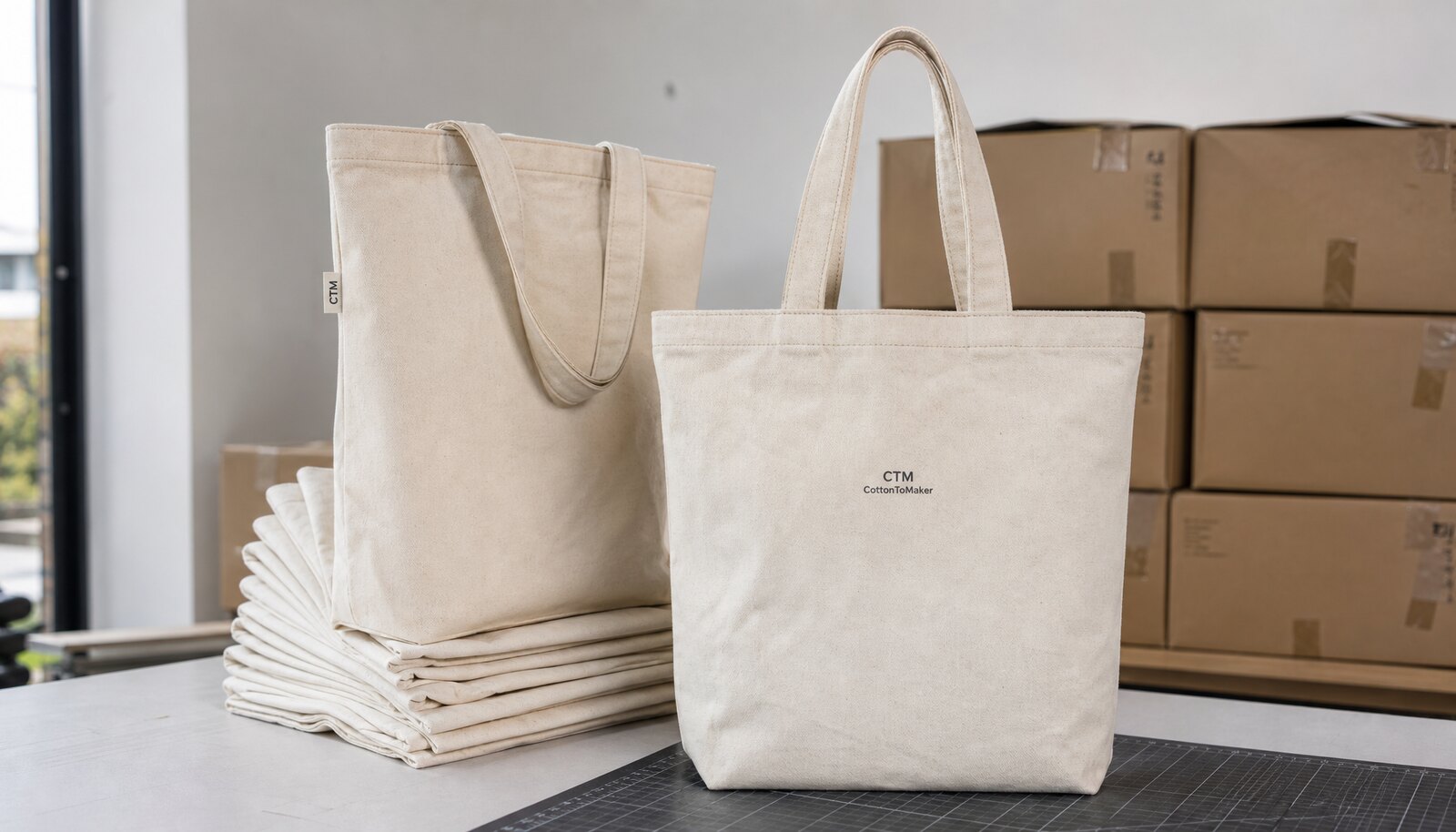
Why shipping carton planning matters as much as the bag spec
For canvas conference bags for corporate events, the bag itself is only one cost center. The carton plan often decides whether the shipment lands on budget, whether receiving is fast enough for event deadlines, and whether the bags arrive looking like a brand asset rather than a warehouse afterthought. A bag can be sewn well and printed cleanly, but if the carton is overfilled, too weak, or badly sized for freight, the program still fails at delivery.
Procurement teams sometimes focus on unit price and print setup first, then treat packing as a housekeeping line item. That is a mistake. Carton dimensions affect freight cube. Carton count affects warehouse labor. Fold method affects presentation and print rub. Gross weight affects manual handling and pallet safety. If the order is going to multiple event locations, the carton plan also affects how easy it is to split the shipment without repacking.
In practical terms, the carton decision is part of the product spec, not an add-on. The right plan depends on how the bags will be used: handed out at registration, stored in a conference venue, shipped to regional offices, or included in a premium kit with notebooks, brochures, or gifts. The same canvas bag can be packed in ways that create very different landed costs and very different customer-facing results.
A useful way to think about it is this: the bag spec controls how the product performs for the attendee, while the carton plan controls how the product performs for the buyer. Good sourcing work connects those two sides early, before the PO is issued.
- Carton packing changes freight cube more than small changes in canvas GSM.
- A low ex-factory bag price can be offset by oversized cartons or inefficient pack-out.
- Damage from crushed handles, scuffed print, or bent corners is a brand issue, not only a logistics issue.
Define the bag spec first, because packing follows the bag geometry
The most efficient carton plan starts with a bag that has a clear shape and repeatable fold behavior. For most corporate events, 10 oz to 12 oz finished canvas is the most practical range. It gives enough body for a conference notebook, brochure pack, brochure sleeves, or a small welcome kit without turning the bag into a heavy freight item. If the bag must carry a tablet, water bottle, hard gift box, or multiple catalogs, the reinforcement at the handle and the seam becomes just as important as the fabric weight.
Below 8 oz, the bag can feel soft and visually thin once printed, especially with bold logos or large coverage areas. The fabric may also distort when folded, which makes carton packing less consistent. Above 12 oz, the finished bag becomes heavier and usually more expensive to print and ship. That does not mean heavier is wrong, but buyers should choose it deliberately for a reason, not by habit.
The same logic applies to dimensions. Common corporate-event sizes sit around 15 x 16 in., 16 x 14 in., or 17 x 13 in., sometimes with a gusset if volume is needed. A gusseted bag can hold more items, but it also changes how many units fit into a master carton and how cleanly the bag stacks. Handle length should match real use. If attendees will carry the bag on one shoulder while moving between sessions, a short hand-carry handle may be awkward even if the bag looks attractive in a mockup.
When you send an RFQ, ask the supplier to quote not just size and GSM, but also the fold method, seam reinforcement, handle length, and whether the quoted GSM is finished fabric weight or raw fabric weight. Those details change both the product feel and the packing cube.
- Use one size and one body color if you want the cleanest carton plan and the lowest complexity.
- Ask whether the bag needs a gusset based on actual contents, not on appearance alone.
- Specify reinforcement at the handle root if the bag will carry dense conference materials.
Choose the print method based on artwork complexity, not just unit price
The print decision should be driven by the logo, not by the supplier’s default method. Screen print is usually the best route for simple logos, one or two colors, and stable volume. On canvas, it generally gives strong coverage and a durable look. It also tends to be more cost-effective when the artwork is bold and easy to separate. But screen printing has limits. Fine serif text, tiny reverse-out copy, hairline rules, and very close registration can become weak points.
When the artwork includes gradients, very fine detail, multiple colors, or a more photographic treatment, heat transfer or digital print may be the safer option. Those methods can preserve detail better, but buyers should ask for evidence that the chosen technique holds up on actual canvas after handling. The question is not only whether the print looks good in a proof. The real question is whether it still looks good after folding, carton friction, venue storage, and event-day handling.
Procurement teams should also think about print placement. A large front-panel logo may look strong in a presentation deck, but if the bag is folded in a way that puts the print against another surface, rub marks can appear before the event starts. A small chest-size logo may be cheaper, but if it becomes visually weak at attendee distance, the money spent on printing does not buy much brand value. Good buyers ask for a strike-off on actual fabric and then review the logo size from the same distance it will be seen at the event.
For a repeat program, lock down the print method early. Late artwork changes often force new screens, new setup, or new proofing cycles, which can move the shipping date more than the sewing time would suggest.
- Approve the print on the real canvas, not on a substitute swatch.
- Set a minimum line thickness and minimum text size so the supplier cannot simplify the art later.
- If the bag is reused after the event, ask for rub resistance or light abrasion checks on the print.
Use a comparison framework that goes beyond direct factory versus trader
The direct-factory-versus-trader question is too blunt on its own. For canvas conference bags, the better comparison is control versus convenience. A direct factory is often the strongest route when you have one stable bag body, one print position, and a need for repeated reorders. It is easier to align sewing, printing, and packing in one place, and easier to understand how cartons are built and labeled. That matters when the event calendar is tight and the buyer wants to repeat a successful program with minimal variation.
A trading company can still be useful, especially when the buyer is sourcing several event items at once or needs paperwork support, multilingual coordination, or consolidated shipping. The tradeoff is transparency. If the trader cannot show the factory carton plan, cannot explain the actual pack-out, or cannot match the approval sample to the factory reference, the buyer may lose control over the details that matter most during receiving.
The best sourcing decision is usually not the cheapest quote in isolation. It is the quote that gives the buyer enough control over artwork, packing density, carton strength, and schedule risk to meet the event date without surprise costs. If two suppliers look similar on ex-works price, compare them on the packing details. One supplier may be cheaper on paper but more expensive after freight, carton materials, and repacking labor are added.
This is especially important for corporate event programs, where bags often need to be distributed fast and look clean immediately. In that scenario, packing quality is not a back-end issue. It is part of the attendee experience.
- Choose direct factory when the design is stable and repeat orders are likely.
- Use a trader only if the added coordination value is real and documented.
- Ask the supplier to explain who owns the packing spec and who signs off carton quality.
A real procurement comparison: three sourcing routes and their tradeoffs
The table below shows how buyers can compare common routes for canvas conference bags for corporate events shipping carton planning. The point is not that one route is always best. The point is that the route changes what you can control and what you need to verify before approving the order.
For a sourcing decision to be useful, the buyer should compare measurable items: what is included in the quote, how packing is handled, what documentation is available, and how much flexibility remains if the event program changes. That is much more useful than a generic supplier ranking.
- Compare the same spec version across all suppliers.
- Ask each supplier to include packing and freight assumptions in writing.
- Treat missing carton data as incomplete quoting, not as a small omission.
How to build the carton plan from the inside out
Carton planning should start with the finished bag, then move outward to the master carton, then to palletization, then to freight booking. Too many buyers do the opposite: they ask the supplier for a standard pack count first, then try to fit the product into the freight plan later. That approach creates awkward carton dimensions, crushed handles, and avoidable cube waste.
A flat-folded canvas bag can often be packed more efficiently than a gusseted or rigidly folded version. But there is a limit. If the carton is compressed too tightly, the print area can crease, the handles can flatten, and the bag can look tired when opened. For corporate events, presentation matters. A wrinkled bag in a welcome kit makes the entire kit look lower in value.
The practical target is to find the pack count that keeps the carton within an acceptable gross weight while avoiding over-compression. For many programs, 25 to 50 bags per carton is a realistic range, but that range only matters if the carton dimensions and fold method are also known. A 40-count carton may be sensible for a slim flat tote and wrong for a gusseted conference bag. Ask the supplier to propose the pack count and carton dimensions as a pair, not separately.
If the bags are destined for a warehouse or venue that handles receiving manually, keep the gross carton weight practical for lift and stacking. If palletized delivery is required, use the pallet as part of the design. That means checking the carton footprint, layer count, stack pattern, overhang tolerance, and final pallet height before production starts.
- Ask for the carton dimensions, gross weight, and bag count together in the same line item.
- Do not pack so tightly that handles bend permanently or print areas crease visibly.
- If the destination is not pallet-capable, keep cartons manageable for manual receiving.
A useful carton-and-lane decision table for procurement buyers
Packing is not only about what fits. It is about what fits safely on the intended route. A carton that survives a short domestic move may not survive a long export lane, a transshipment, or humid warehouse storage. Use route-based thinking when deciding carton strength, inner protection, and palletization.
The table below gives practical thresholds buyers can use during RFQ comparison and supplier review. It is not a substitute for actual packaging testing, but it helps prevent unrealistic packing assumptions from entering the purchase order.
- Match carton strength to the worst handling point, not the best one.
- Humidity, transshipment, and mixed loads increase packing risk.
- If the route is uncertain, choose the more conservative carton spec.
Sample approval should cover the bag, the print, and the carton packed state
One of the most common procurement mistakes is approving a bag sample without reviewing how it will be packed. A sewn sample can look excellent on a table and still fail once folded into a master carton. Handles may bulge, print may scuff against an adjacent layer, or the fold line may make the bag look uneven when opened. That is why a proper approval should include three views: the sewn sample, the print strike-off on actual canvas, and the carton-packed sample.
The carton-packed sample matters because it reveals issues that are invisible in a flat photo. Does the logo sit where the buyer approved it after folding? Do the handles lie flat? Is the bag too stiff to nest efficiently? Does the insert card warp the pack? Does the carton close cleanly without forcing? These are practical questions, not perfectionist ones. They affect whether the buyer can receive, store, and distribute the bags without extra labor.
For important programs, keep one signed golden sample at the buyer side and one at the supplier side. They should be tied to the same spec revision. If the factory later changes carton size, print position, or handle stitch detail, the discrepancy should be visible immediately. A sample that is not tied to a version-controlled spec is useful only once.
If the order is for a premium event kit, consider approving the exact fold orientation, insert style, and shipping mark layout. That sounds detailed because it is. Event buyers often have to distribute bags quickly and visually, and small packing decisions can determine whether the bags look polished on arrival.
- Approve a physical carton-packed sample, not just a photo.
- Tie the golden sample to one spec version and store it clearly.
- If presentation matters, sign off the fold method, insert style, and label placement.
QC checkpoints that catch the failures buyers actually see
Quality control for canvas conference bags should be built around the failures that hurt buyers in real life: loose handle stitching, crooked print, stained fabric, carton crush, count mismatch, and mixed lots. These are not exotic defects. They are the everyday issues that show up when an event team opens cartons under deadline and discovers that the bags do not match the approved sample.
A practical inspection plan usually starts with a pre-production check of the fabric and print setup, then moves to in-line or final inspection of stitching and pack-out, and ends with carton checks before shipment. The factory should know the defect definitions in advance. For example, a slight natural variation in undyed canvas is normal, but an obvious streak, oil mark, or severe shade difference should be classed as a defect. Likewise, a small print variation may be acceptable within the approved window, while a misaligned logo or broken text should not pass.
For buyers used to formal QC systems, it helps to set inspection levels and defect classes before mass production. You do not need to overcomplicate the process, but you do need a shared standard. AQL-style sampling is useful because it creates a repeatable method for checking random cartons and counting defects. More importantly, it prevents the factory and buyer from arguing later about what was acceptable.
The carton itself deserves attention during inspection. A bag can meet sewing standards and still arrive damaged if the carton is soft, crushed, or overpacked. Check corners, top closure, and stacking condition. If the order will travel in humid conditions or spend time in a warehouse, inspect carton rigidity and any signs of dampness or odor as part of release.
- Define major vs minor defects before production starts.
- Inspect carton condition at the same time as bag quality, not separately.
- Use random carton sampling instead of only checking the outer layer.
Set measurable QC thresholds instead of vague inspection language
Procurement teams often hear generic promises such as “good stitching,” “nice printing,” or “strong cartons.” Those phrases are too loose to manage a bulk order. Better procurement practice is to define the attributes that can be checked and the pass/fail logic that applies to them. That way, the supplier knows what to build, and the inspector knows what to reject.
A reasonable QC sheet for canvas conference bags should include fabric weight tolerance, stitch quality, logo placement window, color consistency, carton count, carton condition, and packaging cleanliness. If the order uses inner polybags, the buyer should also define what clean means, what odor is unacceptable, and whether moisture control matters for the shipping lane. These are the points that tend to create friction after arrival.
For stitching, the most important checkpoint is the handle root and any gusset corner or load-bearing seam. For printing, verify both position and legibility. For carton packing, check gross weight, count accuracy, and whether the bag layout damages the handles or print. If the buyer wants transit confidence, ask for an agreed packaging test such as compression, drop, or rough-handling simulation appropriate to the lane. It does not need to be a laboratory exercise, but it should be more than a visual glance.
The inspection standard should also reflect the event calendar. If the bags are needed for a one-day conference, the cost of a late correction is high. That means the QC threshold should be stricter before shipment than it might be for a normal replenishment item. Event buyers do not get a second delivery window easily, so quality control has to be front-loaded.
- Write pass/fail criteria for fabric, print, stitches, carton, and packing cleanliness.
- Use one inspection standard across all cartons, not a different standard for each batch.
- If timing is tight, tighten pre-shipment control rather than relying on post-arrival fixes.
Specification comparison for buyers
| Route or spec decision | Best-fit option | Measurable advantages | Tradeoffs and buyer checks |
|---|---|---|---|
| Canvas weight | 10 oz to 12 oz finished canvas for most corporate events | Good balance of body, print clarity, and freight weight; usually strong enough for notebooks, brochures, and light premium kits | Below 8 oz can look thin and distort after printing; above 12 oz can push up freight and carton gross weight. Ask whether the quoted GSM is finished fabric weight or greige weight before finishing. |
| Print method | 1-2 color screen print for simple logos; heat transfer or digital print for complex artwork | Screen print is usually lower cost at scale and has strong color coverage on canvas; transfer or digital preserves gradients, fine lines, and multi-color art | Check rub resistance, line fidelity, and whether the artwork needs a strike-off on actual fabric. Fine text can fill in or break up if the method is mismatched. |
| Bag construction | Self-fabric handles with bar-tacks or reinforced box-X stitching | More reliable for conference kits than light decorative stitching; better load transfer at the handle root | Request stitch count or reinforcement detail at the handle attachment. A visually neat bag can still fail if the reinforcement is weak. |
| Carton pack count | Usually 25-50 bags per master carton, finalized by folded thickness and gross weight | Efficient if cartons stay within manual handling limits and keep cube under control | Do not accept a generic pack count without carton dimensions and gross weight. Too many per carton crush handles; too few waste cube and raise carton cost. |
| Carton strength | 5-ply for controlled short lanes; 7-ply export carton for long transit, mixed loads, or humid lanes | Better resistance to corner crush, stacking load, and rough handling during transshipment | Ask for board specification, burst strength or ECT basis, and whether inner polybags or tissue are needed to prevent print rub. |
| Palletization | Palletized when destination receiving, warehouse rules, or long-distance freight justify it | Reduces manual handling risk, speeds receiving, and stabilizes stacked cartons | Confirm pallet dimensions, stacking pattern, overhang limits, and total pallet height before the PO. Non-pallet delivery may need lower gross weights per carton. |
| Packing presentation | Flat-folded with minimal inserts for standard events; tissue, belly band, or insert card only for premium kits | Minimizes labor and carton volume for high-volume events; premium options improve unboxing appearance | Each extra insert adds labor and can reduce pack count per carton. Ask for a costed packing breakdown before approving presentation upgrades. |
| Sourcing route | Direct factory for repeatable single-SKU programs; trader only when consolidating multiple items or compliance paperwork | Factory route usually gives clearer carton accountability and better control of pack-out details | If using a trader, identify the actual factory, ask for packing photos, and make sure the approval sample matches the production carton plan. |
| Commercial planning | Quote bag price, print, carton spec, and freight assumptions together | Lets procurement compare true landed cost rather than ex-works unit price only | A quote that omits carton dimensions, gross weight, or packing method is incomplete for event procurement. |
Buyer checklist before sampling
- Write the bag size, canvas GSM, handle length, gusset depth, and stitching detail into the RFQ, including acceptable tolerances.
- Confirm the print method, number of colors, and maximum line thickness the supplier can reproduce clearly on canvas.
- Require carton dimensions, gross weight per carton, pack count, and whether the bags are flat-folded, half-folded, or nested.
- Ask for carton board specification, stacking guidance, and whether the carton is designed for export, warehousing, or direct event delivery.
- Approve a sewn sample, a print strike-off on actual fabric, and a carton-packed sample before mass production.
- Set AQL targets, defect definitions, and pass/fail checkpoints before the factory starts bulk packing.
- Confirm overrun or underrun allowance in writing, especially for custom print orders and multi-destination shipments.
- Work backward from event date to include fabric booking, print setup, production, packing, export docs, and transit time.
- If the destination receives on pallets, define pallet height, pallet pattern, overhang tolerance, and labeling requirements in advance.
- Request a quote that separates bag cost, print cost, carton cost, packing labor, and freight assumptions so landed cost can be compared properly.
Factory quote questions to send
- What is the quoted canvas weight in GSM, and is it finished fabric weight after treatment or raw fabric weight before finishing?
- Which print method do you recommend for this artwork, and what is the minimum line thickness and smallest text size you can hold clearly?
- Can you show the proposed carton dimensions, gross weight per carton, and expected bag count per carton for this size and fold method?
- What carton board specification are you using, and what is the expected stacking or compression resistance for export handling?
- Will the bags be flat-folded, half-folded, or nested, and how does that change labor cost and carton cube?
- Do you recommend inner polybags, tissue, or separators to avoid print rub or moisture issues during transit?
- What are your sample stages, and can you provide a pre-production sample, a print strike-off, and a carton-packed approval sample?
- What is your AQL standard for this order, and what defects count as major versus minor?
- What is the realistic production lead time after sample approval, and which step is most likely to cause delay?
- Can you provide the shipping mark format, carton label wording, and palletization plan if the order ships on pallets?
Quality-control points to confirm
- Inspect fabric weight against the approved sample and confirm the batch feels consistent, not noticeably thinner or softer than agreed.
- Check stitch quality at handle roots, side seams, and gusset corners. No skipped stitches, loose thread bundles, or seam puckering should appear in the critical load areas.
- Measure print placement against the approved layout window and verify the logo is centered, straight, and readable from normal event distance.
- Run a simple rub test on the print using a clean white cloth or approved internal method to check whether ink transfers excessively.
- Confirm bag count per carton, and check that mixed sizes, mixed print lots, or mixed color lots are not present in the same carton unless explicitly approved.
- Check carton corners, edge compression, and lid fit after packing. Cartons should not bulge, collapse, or show crushed handles beneath the top layer.
- If pallets are used, confirm pallet pattern, layer count, top-sheet protection, and stretch wrap coverage before shipment release.
- For long or humid lanes, verify inner packaging is clean, dry, and odor-free, and that no moisture is trapped inside the cartons.
- Use random carton checks at a defined inspection level, such as a practical AQL plan agreed before production, rather than visual spot checking only.
- Keep a signed golden sample and carton-packed reference sample at both supplier and buyer side so disputes can be judged against the same standard.