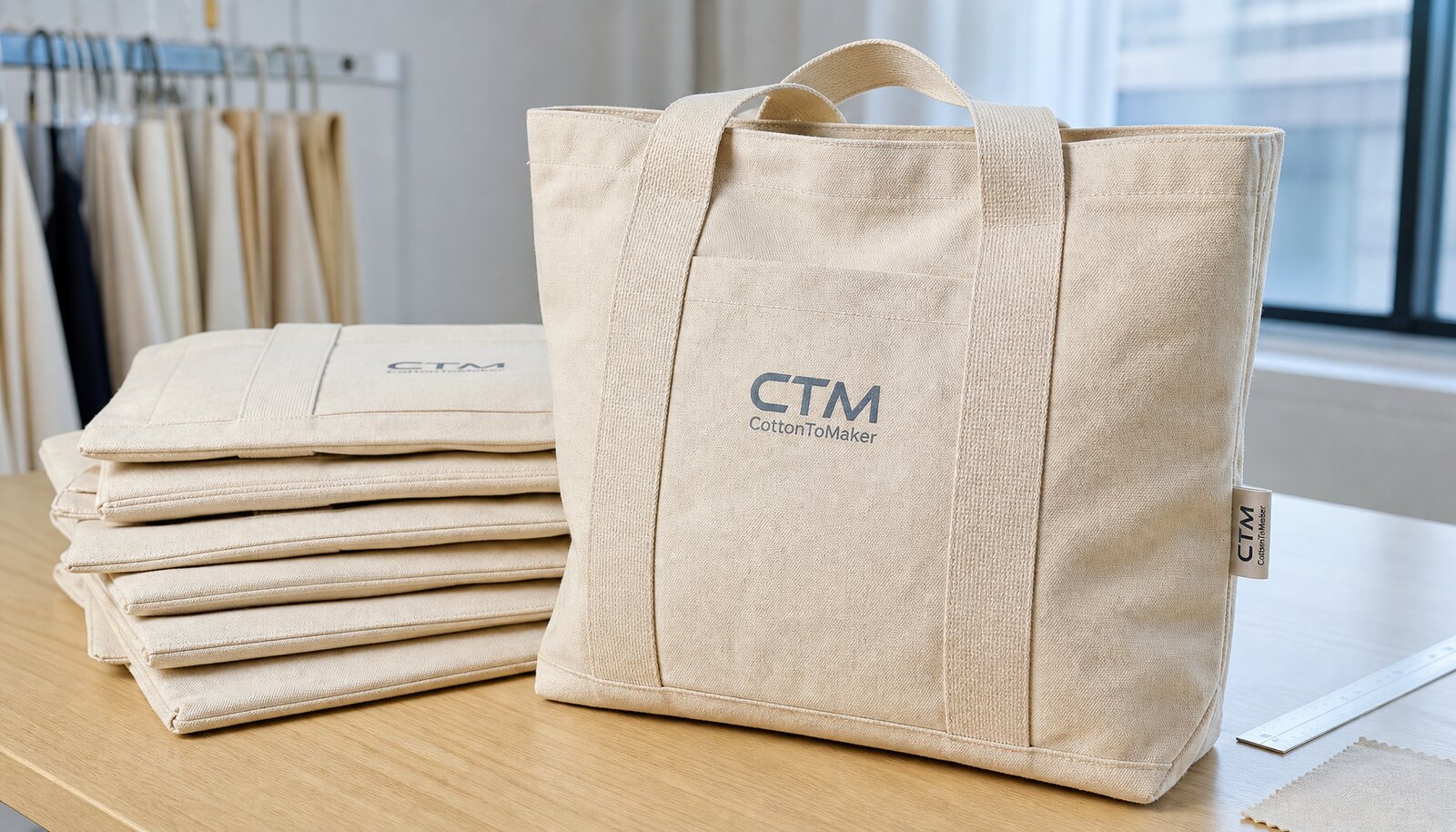
Why charity campaign bags need a different material brief
A charity campaign bag is not the same buy as a standard conference tote. It has to carry literature, small gifts, or donor kit items, but it also has to signal care, restraint, and credibility. If the canvas feels too flimsy, the campaign can look underfunded. If the bag is overbuilt or overdecorated, the spend moves away from the distribution problem and into presentation for its own sake. The right material choice is the one that supports the campaign message and survives the logistics.
For procurement, the main mistake is copying a generic tote spec and changing only the logo. Charity programs often mix channels: live events, donor mailers, volunteer packs, and retail tie-ins. That means the bag has to stack well, print cleanly, and stay consistent across a repeat order. It also means the buyer needs a material brief that gives the factory enough information to price accurately the first time. When the brief is thin, the supplier fills the gaps with assumptions, and those assumptions show up later as sample churn, print mismatch, or unexpected cost increases.
- Start from the contents and distribution channel, not from the logo layout.
- Treat the bag as a campaign asset with a load requirement, not just a giveaway.
- Keep one primary use case in the spec so suppliers quote the same assumption.
What canvas should mean in a sourcing spec
Canvas is not a single material class. In sourcing terms, it usually means a cotton or cotton-blend woven cloth with enough body to carry shape and print clearly. The details matter. Plain weave, duck-style construction, yarn thickness, weave density, and finishing all change how the bag looks and performs. Two bags with the same quoted weight can behave very differently if one is loosely woven and the other is tightly packed.
Buyers should ask for more than a GSM number. The supplier should identify the construction, whether the cloth is greige or finished, and whether the fabric was singed, pre-shrunk, washed, or calendered. Those steps affect hand feel, fray resistance, dimensional stability, and print clarity. If a vendor cannot explain those choices clearly, the quote is not yet decision-ready. For a charity program, that gap matters because the bag often sits in public view, is handled by volunteers, and may be compared against donor expectations at close range.
A practical spec should also call out the surface state. Natural canvas is easier to source and usually gives the most forgiving print result. Bleached cloth creates a cleaner background but can show dirt faster. Dyed or washed fabrics create a more curated look, but they add process variables that need to be tested before a bulk commitment.
- Plain weave usually prints well and is easier to control than a loosely specified decorative cloth.
- A tighter weave can improve body and print sharpness, but may increase fabric cost.
- Ask for the fabric state before sewing: greige, bleached, dyed, washed, or coated.
How to choose weight without turning it into a blind rule
Weight is useful, but only as part of the whole spec. For many charity conference bags, a mid-range canvas is a practical starting point because it balances shape, cost, and print behavior. Lighter cloth may be fine for flat literature kits, while heavier cloth is better when the bag must hold bottles, books, or multiple inserts. The mistake is treating a single weight as a universal default. Weight alone does not guarantee strength if the weave is loose or the finishing is weak.
A better method is to define the carry scenario. If the bag will hold a few brochures and a notebook, a lighter or mid-weight cloth may be enough. If it will be reused after the event or loaded with dense items, increase the fabric body and reinforce the handle area. Ask the supplier how the cloth behaves after cutting and sewing, not only how it feels on the roll. Finished performance is what matters to the user, and the end user will notice sagging, seam strain, or a handle that cuts into the hand long before they care about the quote sheet.
A useful decision rule is to connect load, reuse, and decoration. Light loads can tolerate lighter canvas and simple printing. Medium loads need a tighter weave and better seam control. Heavier or repeat-use programs need stronger fabric plus better finishing discipline, because the bag will be judged after it has been filled and carried, not while it is lying flat on a table.
- Use lighter canvas when the load is flat and the bag is disposable after the event.
- Use mid-weight canvas when you need a more credible hand feel and repeat use.
- Use heavier canvas only when the contents or brand position justify the extra cost and sewing load.
- If possible, test the actual campaign load in a sewn sample before final approval.
A practical weight matrix for procurement decisions
The clearest way to narrow the spec is to match load, reuse, and decoration method. The table above is more useful than a single “8 to 12 oz” rule because it shows the buying tradeoffs in one view. That range is too broad to support a quote comparison. Two bags at the same nominal weight can land differently in cost, appearance, and failure risk depending on weave density and finishing.
For low-load handouts, the goal is not maximum durability. It is clean presentation, predictable print, and enough structure to avoid a limp look. For moderate-load donor or conference packs, the goal shifts to body retention and seam stability. For higher-load or premium re-use cases, the bag needs reinforcement detail, tighter quality control, and a fabric choice that keeps its shape after handling and folding. These are different products, even if they share the same outline.
The decision matrix should also influence sample planning. A low-load bag may only need a swatch and a sewn sample. A mid-weight repeat-use bag should go through pre-production approval with the actual print and reinforcement. A heavier or coated bag should include more than one sample round because finishing, hand feel, and print adhesion need validation against the real production route.
- Lightweight bags should be evaluated on presentation and print, not only on cost.
- Mid-weight bags usually give the best balance of body, price, and repeatability.
- Heavier bags need stronger stitching, more inspection, and a more controlled sample path.
- If the weight is quoted without load context, treat the quote as incomplete.
Shrinkage, dye, washing, and coating tradeoffs
Pre-shrunk or washed canvas can be useful, but it is not automatically better. Those finishes can improve dimensional stability and soften the hand feel, yet they can also change the fabric's body, alter seam behavior, and introduce lot variation if the process is not controlled. If the campaign needs a bag that keeps a neat shape across multiple reorders, ask for measured post-finish dimensions and the supplier's test method. Do not accept a vague claim that the fabric is stable. Ask what was measured, when it was measured, and against which sample.
Color and finish choices also change risk. Natural canvas is usually the easiest to source and print, but it can vary in tone from lot to lot. Bleached cloth can give a cleaner background for logos, but it often shows stains more easily. Piece-dyed or yarn-dyed canvas improves color control, but it raises cost and can add shade variation if the dye house is not disciplined. Light coatings can help with spill resistance, yet they may stiffen the cloth, affect print adhesion, and complicate recycling or wash behavior. For a charity campaign, those tradeoffs matter because the bag may be handled in public, packed in cartons for transport, and judged in daylight under event conditions.
The procurement point is simple: do not buy a finish without evidence. Ask for shrinkage data after the real finishing route, a shade standard for dyed goods, and a written note on any coating chemistry that could affect print or hand feel.
- Ask for shrinkage figures after the actual finishing process, not a pre-production estimate.
- Treat washed canvas as a finish choice, not as a guarantee of quality.
- Use coatings only when spill resistance or presentation justifies the extra tradeoffs.
- If the campaign is color sensitive, require a clear shade standard and a tolerable lot variation range.
Decoration should follow the fabric, not fight it
The print method should match the artwork and the fabric surface. One-color screen print is often the most practical choice for charity campaigns because it is legible, cost-controlled, and repeatable. It works well when the logo is simple and the brand wants a clean, restrained look. Heat transfer is useful when the artwork needs more colors or finer detail, but it should be tested for edge lift, fold marks, and abrasion. Embroidery can feel premium, but it is not always the best answer on a tote-style canvas bag because it adds cost and can distort a large graphic area.
Decoration placement matters as much as method. The print should avoid seam intersections, handle anchors, and overly textured panel edges. On coarse canvas, small text can fill in and thin lines can close up, especially if the ink deposit is heavy or the surface has been washed. Ask the supplier for a physical sample at actual size, then check it under normal event lighting. A design that looks fine on a screen can become weak once it meets woven fabric. For procurement teams, this is where artwork approval becomes a production-control step, not a design exercise.
If the campaign needs the logo to survive heavy handling, insist on a simple abrasion check or rub test on the actual print surface. If the bag will be folded for shipping, confirm that fold lines do not break the print image or expose weak edges. The most successful decoration choice is the one that still looks intentional after packing, transport, and distribution.
- Use screen print for simple logos, campaign slogans, and repeatable color control.
- Use heat transfer only after checking durability, fold tolerance, and edge lift.
- Use embroidery sparingly and only when the logo size and budget fit the method.
- Keep print away from high-stress seams and handle attachment points.
How to compare suppliers without comparing the wrong thing
A factory quote and a trader quote can look similar on paper while carrying very different risks. Direct factory sourcing gives you more visibility into fabric selection, sewing control, and the actual inspection point. A trading company can be useful when the order needs bundled sourcing or when internal procurement bandwidth is limited, but the buyer should know who really owns fabric traceability, print control, and final packing. If that is unclear, defects become harder to correct and reorder quality becomes harder to replicate.
The practical question is not only who is cheapest. It is who can prove the material, explain the production path, and keep the same result on the next order. If a supplier cannot identify the mill, the fabric lot, the print process, and the release check, you are not buying a controlled program. You are buying a promise. That distinction matters more in charity campaigns than in many standard tote purchases because the order often runs against a public event date and carries reputational risk if the bags arrive with inconsistent color or sloppy finishing.
When quotes are compared properly, the differences usually become obvious. The best supplier is not just a lower number. It is the one with the clearest chain of custody, the cleanest sample trail, and the least ambiguity about where the cloth came from and how the finished bags will be checked.
- Direct factory works best when you need repeatability and material traceability.
- Trading layers may add convenience, but they should not hide origin details.
- Local decoration can be fast, but it locks the bag construction you receive.
- Ask every bidder to quote the same fabric state, print method, and packing format.
Questions that force a real quote instead of a generic one
If you want a useful quote, the request has to force specificity. Ask for the exact fabric construction, the finishing route, and the measured size after sewing. Ask whether the bag is cut from one lot or multiple lots, because lot mixing can create subtle shade variation. Ask which parts of the process are in house and which are subcontracted. Those answers tell you where quality is actually controlled and where it can slip. The point is not to overload the supplier with paperwork. The point is to remove the easy room for assumption.
Cost should also be broken into visible parts. Fabric, sewing, printing, labels, packing, and freight can all move independently. A quote that hides those pieces makes supplier comparison unreliable. For charity programs, this matters because you may need to compare an event version, a donor version, and a retail fundraiser version with different packing or decoration needs. If the supplier cannot separate the cost drivers, you cannot make an informed sourcing tradeoff.
A better quote request also asks for proof documents. A mill certificate, fabric composition note, shrinkage test record, shade approval reference, and inspection format are far more useful than a polished price line. They turn the discussion from sales language into production reality.
- Ask for the fabric source, finish, and measured shrinkage method.
- Ask whether the printed area has a stitch-clearance rule or seam allowance rule.
- Ask for a line-item breakdown if you are comparing multiple suppliers.
- Ask who owns the pre-production sample and how the final approved sample will be stored.
Sampling should test the bag as a system
A sample is useful only if it is tested like the finished product. Hold the sewn sample with the actual brochures, donor materials, or merchandise kit inside it. Check whether the handles feel balanced, whether the mouth opens wide enough, and whether the bag still looks clean when folded for packing. The sample should also reflect the same fabric state you are buying, because a fabric that looks good in a swatch can behave differently once it is cut, sewn, and stressed at the seams.
Keep a sample record that includes the date, fabric lot, print file version, and any revision notes. If the supplier sends multiple rounds, mark which change fixed which issue. That gives you a traceable approval trail and prevents future disputes about what was approved. For repeat campaigns, store one signed physical sample as the golden reference. It is much easier to enforce quality later when everyone is looking at the same object.
The most useful sample review is blunt and physical. Open it, load it, fold it, compare it under daylight, and check the print at arm's length. If the campaign will be distributed in a formal room, look for fiber lint, odor, and packaging compression marks as well. Those defects are easy to ignore in an email chain and easy to notice once the bags are stacked on an event table.
- Test the sample with the real carry load, not an empty bag.
- Check the print both flat and after the bag has been folded and unpacked.
- Record sample revisions so the approval trail matches the production order.
- Keep one signed golden sample and reference it in the bulk inspection plan.
Production QC and acceptance criteria that buyers can actually use
Quality control for charity campaign bags should focus on the defects people will notice immediately. The bag needs to open cleanly, sit square, and carry the intended load without handle failure or seam distortion. Stitch quality matters because loose threads, skipped stitches, or weak reinforcement are visible and functionally risky. Print quality matters because crooked placement, bleeding, or poor ink coverage will undermine the campaign's presentation faster than a modest fabric downgrade would.
An effective inspection plan should include size measurement, seam review, print check, lot and shade comparison, and carton count verification. If the order is important, ask for photo evidence that shows the measured point, not only a general product shot. If the campaign is distributed indoors or to donors, also check odor, lint, dust, and compression marks. Those issues are often ignored in generic tote orders, but they are easy to notice in a controlled event setting. If the program is sensitive, require a third-party or factory inspection report that records counts, defects, carton condition, and photo evidence so the release decision is documented.
The acceptance criteria should be written before production starts. Define what counts as a major defect, what measurement tolerances are allowed, and whether shade variation is acceptable across multiple cartons. If those rules are only discussed after inspection, the order becomes a negotiation instead of a control process.
- Inspect fabric for thin spots, loose weave sections, and visible contamination.
- Inspect handle anchors for reinforcement consistency and balanced stitching.
- Inspect print placement against the approved sample, not just against the artwork file.
- Inspect carton count, carton condition, and packing style before release.
- For higher-risk orders, require a pre-shipment inspection with defect counts and photo records.
Specification comparison for buyers
| Canvas build | Typical carry load | Reuse expectation | MOQ / lead-time impact | Best print method |
|---|---|---|---|---|
| 8 oz / 140-170 gsm plain canvas, natural finish | Flat literature, lightweight inserts, single notebook | Low; event-day use with limited repeat carry | Lowest MOQ and fastest lead time; easiest stock-based quoting | 1-color screen print or simple heat transfer |
| 10 oz / 180-220 gsm tighter weave canvas | Brochures, small merchandise, donor packs up to moderate weight | Moderate; suitable for repeated use after the event | Usually still stock-friendly, with a small cost and sewing increase | Screen print, woven label, or restrained embroidery |
| 12 oz / 220-280 gsm heavier canvas with reinforcement | Books, bottles, folder kits, or mixed content packs | Higher; better for repeat carry and resale-style programs | May raise MOQ slightly and add sewing time for handle reinforcement | Screen print or woven label; embroidery only for small marks |
| Washed or pre-shrunk canvas in mid-weight range | Moderate loads where consistent finished size matters | Moderate to high if shrinkage is controlled | Adds sampling and test lead time; may increase fabric cost | Screen print after wash validation |
| Bleached or dyed canvas with tighter shade control | Brand-led campaigns that need a cleaner visual tone | Moderate; depends on finish stability | Higher MOQ risk if color is custom or fabric lots are limited | Screen print, heat transfer, or woven label |
| Coated or resin-finished canvas | Spill-aware kits, premium donor packs, or presentation-led campaigns | Moderate; coating can improve wipeability but change hand feel | Higher lead-time impact because coating adds process control and testing | Screen print after adhesion testing |
Buyer checklist before sampling
- Define the bag's role first: flat literature handout, donor kit, retail fundraiser, or mixed event pack.
- Specify fabric construction, not just weight: weave type, target GSM or oz, finish, and whether the cloth is greige, bleached, dyed, washed, or coated.
- State the carried load, handle drop, and expected reuse level so the supplier can size the body and reinforcement correctly.
- Request a fabric swatch, a sewn sample, and a pre-production sample made from the same or equivalent lot whenever possible.
- Ask the supplier to identify fabric roll numbers, dye lots, print batch references, and carton marks so you can keep a traceable record.
- Lock artwork, print position, logo color reference, and seam clearance before bulk approval.
- Agree the test method for shrinkage, rub resistance, seam strength, and shade control before you compare suppliers.
- Confirm packing format, carton count, inner bundling, and shipment marks before production starts.
Factory quote questions to send
- What is the exact fabric construction, including weave type, target GSM or oz, and whether the cloth is greige, bleached, dyed, washed, or coated?
- Which mill or fabric source is being used, and can you provide roll numbers, lot identifiers, or dye lot references for traceability?
- What shrinkage range do you see after finishing and after any washing or steam treatment, and what test method do you use to measure it?
- Is the quote based on direct factory production, or is any sewing, printing, finishing, or packing subcontracted?
- What print method is included in the price, what is the ink or transfer system, and how is rub resistance checked?
- What tolerances are included for finished size, handle length, print placement, and shade variation between lots?
- Can you share your pre-shipment inspection checklist, AQL level, or internal QC points before the goods are released?
- How many sample rounds are included, who pays courier costs for revised samples, and what changes count as a new sample?
- If we add a liner, woven label, coating, or custom dye, how do MOQ, lead time, and price change?
Quality-control points to confirm
- Check finished fabric weight on a calibrated sample and compare it to the agreed production range rather than a marketing claim.
- Inspect weave density, thin spots, slub clusters, and edge fray on cut panels before sewing begins.
- Measure finished dimensions after packing and after light handling to confirm the bag still matches the approved size.
- Verify handle attachment with consistent X-box or bar-tack reinforcement and no skipped stitches, loose ends, or uneven tension.
- Test print placement, edge sharpness, and rub resistance on the actual canvas finish, not only on a paper proof.
- Confirm lot-to-lot shade consistency for body fabric, handles, labels, and any lining or trim.
- Reject bags with oil marks, lint, odor, dust, or compressed creases that would be obvious in an indoor charity event.
- If the program is sensitive, require a third-party or factory inspection report that records counts, defects, carton condition, and photo evidence.