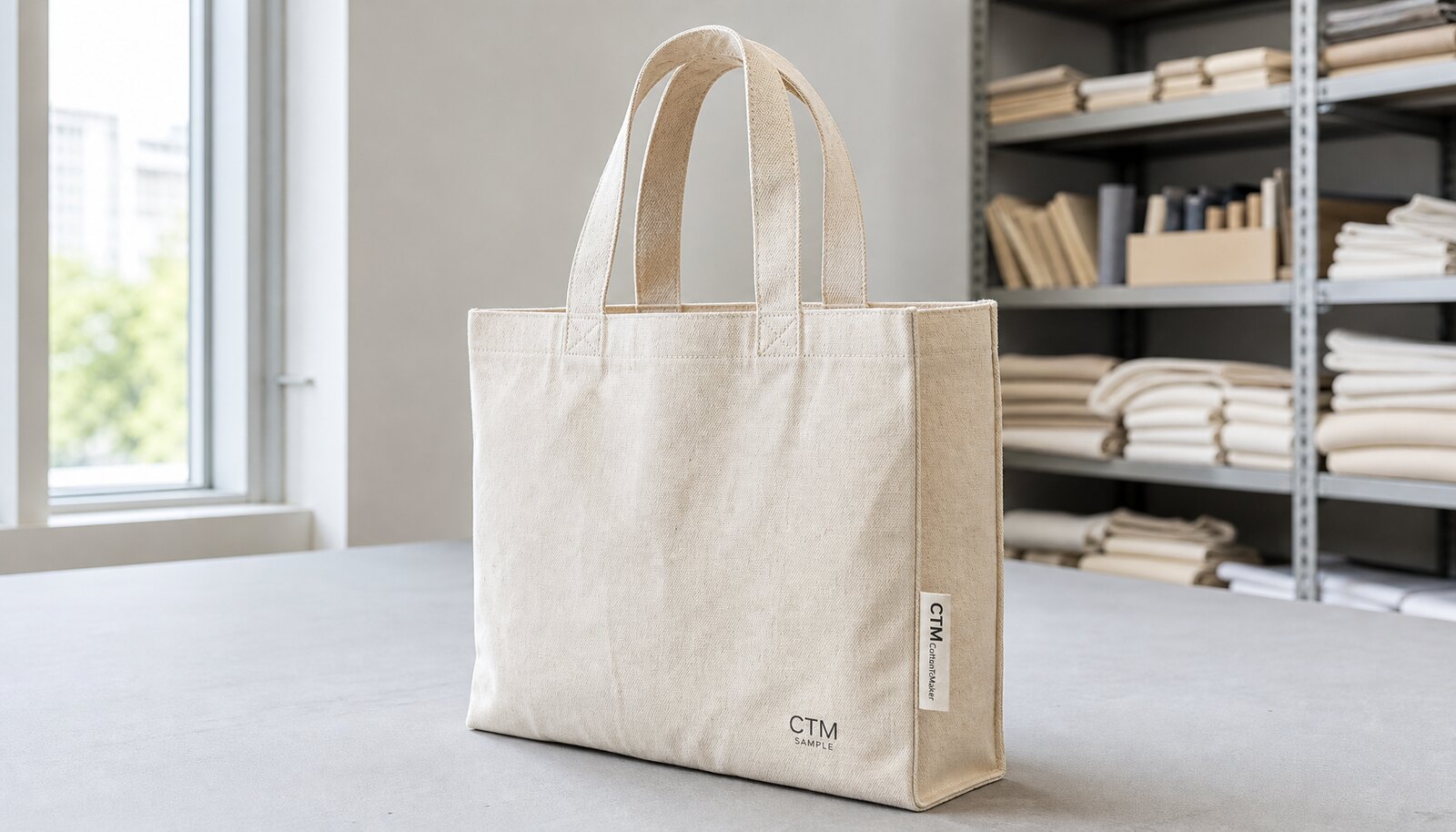
Start With the Real Use Case
Bookstores do not use canvas conference bags the way a fashion brand uses a shopping tote. The bag usually has to carry hardcovers, catalogs, notebooks, and a few impulse items in one trip, then survive reuse at events or in the shop. That means the first quality question is not whether the bag looks clean on a table. It is whether it keeps its shape under a rectangular book load, holds the print after repeated folding, and still feels presentable when a customer walks out of the store.
Most production problems start when the buyer writes a generic tote request and assumes the factory will fill in the blanks. For bookstores, the weak points are easy to predict: handles that dig into the hand, a body that twists once the load is inside, seams that open at the bottom corners, and artwork that lands too close to the edge. Build the bag around the actual use pattern, not the idea of a tote in general.
- Define the heaviest real carry load, not only the giveaway weight.
- State whether the bag is for retail sale, conference distribution, or in-store use.
- Match the size to books, catalogs, or event kits instead of quoting a generic tote size.
- Treat logo durability and seam strength as functional requirements, not decoration.
Set the Spec Around Fabric Weight and Construction
Canvas weight drives almost every performance decision. For light promotional use, 8 oz or about 270 gsm can be enough if the bag only carries brochures, postcards, or one paperback. Once the bag needs to hold hardcovers or a bundled conference kit, 10 oz to 12 oz canvas is usually the safer range. If the program is retail-facing and the buyer wants a more structured feel, a heavier weave or reinforced base may be justified, but the bag should still fold cleanly and not feel overbuilt for the customer.
Construction details matter just as much as the cloth. Handle width, stitch density, seam allowance, gusset depth, and whether the top edge is turned or bound all change durability and labor cost. A single-layer body with reinforced handle patches is often enough for event use, while a lined body or internal pocket may only be worth the extra cost if the bag is being sold as merchandise. Print method should match the artwork: one-color screen print is usually the most durable and predictable, while more complex artwork may justify digital or transfer methods if the buyer accepts the tradeoff in abrasion resistance.
- Use 8 oz for light event packs, 10 oz for mixed book loads, and 12 oz when retail durability matters.
- Prefer screen print for simple bookstore logos and slogans that need better wear resistance.
- Add reinforcement where stress concentrates: handle joins, bottom corners, and top hem.
- Do not add pockets, lining, or zipper closures unless they solve a real use problem.
Choose the Right Sourcing Route
The same canvas conference bag can be sourced through very different supplier models, and the quote only makes sense if the route is known. A direct cut-and-sew factory gives the best control over fabric, stitch quality, and repeatability. A one-stop factory that also prints and packs the bags reduces handoffs and makes fault ownership easier. Trading companies and sourcing agents can simplify communication if you are buying multiple product types, but the buyer needs to know whether the quote reflects the factory's true scope or a bundled margin layer.
Bookstore buyers should avoid treating every supplier as interchangeable. A small workshop may be fine for a limited launch run, but not for a chain program that needs consistent packing and barcode discipline. A large export factory may deliver better process control, but usually wants clearer volume commitments. The right route depends on whether the risk sits in quantity, artwork variety, speed, or the need for strict approval control.
- Use a factory when construction consistency and repeat reorder quality matter most.
- Use a one-stop supplier when you want one party responsible for sewing, print, and packing.
- Use a trading company only when it adds real sourcing capability, not just an extra margin.
- Use a local decorator mainly for rush orders or domestic replenishment, not for lowest landed cost.
Require Supplier Evidence Before You Compare Price
A serious quote should be backed by evidence, not just a line item and a product photo. Ask for recent photos of the sewing line, the print room, the packing area, and an actual bag with similar size and construction. If the supplier claims in-house control, they should be able to show where the cutting happens, how print screens or transfer setups are managed, and how final inspection is recorded. That evidence matters because canvas bags can look similar at the quote stage and still diverge sharply in the shop floor reality.
The red flags are predictable. If the supplier cannot state fabric shrinkage, does not know who owns print cure control, or avoids giving a packing method, the quote is not ready to compare. If the only sample is a polished sales sample with no production reference, treat it as a concept piece, not a commitment. Buyers should be looking for proof that the factory has made bags close to the requested build, not just that it can source something vaguely similar.
- Request photos or video of sewing, printing, and packing on similar canvas products.
- Ask how the supplier documents inspection results and rework decisions.
- Confirm whether the quoted factory or a subcontractor owns each production step.
- Treat vague answers about shrinkage, print curing, or fabric source as risk signals.
Understand the Cost Drivers and MOQ Logic
Canvas bag pricing is usually driven by a short list of choices. Fabric weight is the biggest one, followed by whether the cloth is bleached, dyed, or left natural. After that come construction choices: extra panels, gussets, inner pockets, zipper closures, webbing handles, reinforcement patches, woven labels, and the number of print colors. Packaging also matters. An individually polybagged bag with a printed insert costs more than a bulk-folded inner pack, even before freight is added.
MOQ is rarely only about total quantity. It is often tied to fabric allocation, print screen setup, label weaving, and packing labor. A buyer can usually reduce MOQ pressure by standardizing the bag body and varying only the logo print, or by keeping the same base bag while changing a side label for different bookstore locations. If the program needs several event names or city-specific versions, grouping them under one construction spec is usually the most efficient route.
- Use one base bag and vary only the print where possible.
- Expect higher MOQ when you change fabric color, add pockets, or use woven labels.
- Treat packaging changes as a real cost item, not a free add-on.
- Ask suppliers to quote at least two fabric weights so you can see the cost gap clearly.
Approve Samples Like a Production Buyer
A sample is only useful if it is measured against a written target. For a bookstore conference bag, that target should include finished size, gusset depth, handle length, handle drop, artwork location, stitch count at the stress points, and the fold method used for packing. Measure the sample on a flat table and compare both sides for symmetry. Then put a realistic load in it, because the shape a tote holds under books is more important than the way it looks empty.
The most common sample mistake is letting one good-looking sample become the entire approval basis. Buyers should record what is approved, what is still open, and what is zero tolerance before the production order starts. If the sample is off-center, the handle spacing is uneven, or the print is too close to the seam, do not assume bulk will magically improve. Bulk usually amplifies the sample's strengths and weaknesses.
- Use a written measurement sheet for every sample stage.
- Test the sample with the actual weight and shape of books or event kits.
- Approve a golden sample only after all visual and functional points are signed off.
- Reject samples that cannot hold the logo position, stitch line, or pack method agreed in the tech pack.
Lock the QC Points Before Bulk Sewing Starts
Good QC on canvas bags is mostly about preventing avoidable faults, not sorting them after the fact. In-line inspection should watch fabric lot consistency, thread tension, handle alignment, and print curing. If the print is applied before sewing, the buyer needs to know whether the print will distort at the seam or crack when the panel is folded. If the bag is sewn first and printed later, the factory must prove that the print position still aligns with the final shape. Final inspection should then compare the finished goods to the approved sample, not to a vague internal standard.
For branded bookstore bags, certain defects are not worth debating. A wrong logo, wrong colorway, wrong carton count, or a seam failure near the handle attachment should be treated as rejection-level issues. Small thread trims or light wrinkles may be acceptable depending on the price band, but the buyer should decide that before production. If the inspection standard is left open-ended, every defect becomes a negotiation and the shipment loses time.
- Treat wrong artwork, wrong size, and broken load-bearing stitches as major defects.
- Check print registration after the bag is fully formed, not only on the flat panel.
- Use the golden sample as the visual reference at final inspection.
- Do not allow the factory to redefine acceptable quality after bulk starts.
Specify Packing and Carton Rules Clearly
Packing can damage a good bag or preserve a mediocre one. Canvas wrinkles easily, and a poor fold can leave a permanent mark across the print panel. If the bag is going into retail or conference distribution, specify how it should be folded, whether it should be polybagged, and whether a desiccant is needed for humid shipping lanes. Some buyers want every bag individually packed; others prefer a bulk inner count to reduce plastic and labor. Either route works if it is spelled out early.
Carton data matters for warehouse receiving and store allocation. The supplier should label every outer carton with SKU, color, quantity, gross weight, net weight, and carton dimensions. If the bags are event-specific or location-specific, carton sorting should make that obvious. That prevents mixed boxes, reduces receiving errors, and keeps the shipment from being repacked after arrival. For reusable canvas products, a clean pack standard also improves the buyer's perception of quality before the bag is even handed out.
- Define fold orientation so the logo stays flat and visible after unpacking.
- State whether each bag needs a polybag, sticker, insert card, or no individual wrap.
- Lock carton count and carton label format before bulk packing starts.
- Keep cartons dry, square, and within the warehouse's max handling weight.
Protect the Schedule From the Usual Failure Points
Lead time for canvas conference bags is rarely just sewing time. The schedule usually includes artwork cleanup, sample approval, screen or label setup, fabric booking, cutting, sewing, printing, finishing, inspection, packing, and booking freight. The slowest step is often not the actual production run but the waiting time between sample feedback and final signoff. If the artwork changes after the factory has already set screens or cut fabric, the schedule can slip even when the factory is otherwise efficient.
The safest planning method is to separate the fixed items from the negotiable ones. Fix the size and construction first, then approve the print file, then approve the sample, and only then release bulk. If the bookstore program has a launch date tied to an event, leave buffer for one round of correction and one freight delay. Buyers who compress the process to save a week often lose two weeks later when the wrong detail has to be remade.
- Expect sample approval, bulk production, and freight booking to be separate schedule gates.
- Lock artwork early to avoid screen remake or reprint delays.
- Plan for holiday and peak-season capacity pressure at the factory and carrier level.
- Keep one buffer window for correction, not just for transport.
Compare Quotes on Landed Cost, Not Unit Price
A low unit price does not mean a good buying decision if the quote excludes packing, inspection, or the print setup you actually need. Compare quotes on the same Incoterm, the same fabric weight, the same print method, and the same carton spec. If one supplier quotes an unbagged bulk pack and another quotes individual polybags, the cheaper number is not comparable. The same applies to shipping terms. EXW, FOB, CIF, and DDP shift cost and risk in different ways, so the buyer has to line them up before any decision is made.
For bookstore buyers, the best RFQ packet is short but specific. It should include a tech drawing, print file, target order quantity, pack method, carton data, destination, target date, and the quality standard. If the order might be reordered, note the expected repeat volume and whether the supplier should keep the same fabric lot or matched shade for the next run. That gives the factory enough data to quote honestly and gives procurement enough structure to compare the quotes without guessing.
- Compare like with like: fabric, print, packing, and shipping basis must match.
- Ask for line-item pricing so setup costs and recurring costs are visible.
- Separate the landed cost from the selling price of the bag itself.
- Keep the RFQ tight enough that the supplier cannot hide missing scope in fine print.
Specification comparison for buyers
| Spec decision | Recommended option | When it fits | Buyer risk to check |
|---|---|---|---|
| Direct cut-and-sew factory | Best control over canvas weight, stitch quality, and repeat reorder consistency | Stable bookstore programs with one or two core SKUs and recurring annual demand | MOQ can be higher, and late spec changes often trigger cost or lead-time changes |
| One-stop factory with print and packing | Best for managing sewing, logo printing, folding, and carton packing under one QA system | Book launches, author events, and chainwide giveaways that need one accountable supplier | Print cure, fold method, and carton spec must be locked before bulk starts |
| Trading company or sourcing agent | Useful when you need access to multiple factories or mixed bag categories from one contact | Teams without local sourcing staff or programs combining totes, pouches, and backpacks | Margin opacity, weaker line visibility, and spec drift between quote and production are common risks |
| Local decorator using imported blanks | Fast route for small retail drops or emergency replenishment | Low-volume store programs that need domestic delivery and quick logo application | Blank bag quality may vary by lot, and total cost is often higher than a factory-made equivalent |
| Small workshop | Good for test runs and narrow-batch promotional campaigns | Pilot orders, limited editions, or niche bookstore merchandise tests | Stitch consistency, packing discipline, and documentation may be weak |
| Large export factory | Best for stable, repeated orders with formal QC and export process | Regional chains and distributors that can plan volume in advance | Higher MOQ and less flexibility on custom trims, labels, or odd packing formats |
| Hybrid blank-bag plus local logo application | Flexible for changing artwork, city names, or event-specific messages | Author tours, conference series, and multiple retail locations with different branding needs | Responsibility splits across suppliers, so defect ownership must be written down clearly |
| Regional sourcing agent with factory network | Helpful when buying several product types under one program | Procurement teams centralizing tote, pouch, and accessory buying | Extra handling can hide who owns a defect unless QC and rework rules are explicit |
Buyer checklist before sampling
- Fix the finished size, gusset depth, handle length, and handle drop before requesting quotes.
- State the target canvas weight in gsm or oz, not just the fabric name.
- Define the print method, number of colors, artwork format, and acceptable logo placement tolerance.
- Specify whether the bag needs a zipper, pocket, lining, or reinforcement patches.
- Set the pack method, polybag rule, carton count, and carton label format in the RFQ.
- Ask for a pre-production sample and a signed golden sample before bulk approval.
- Agree on the QC standard, defect severity levels, and whether any defects are zero tolerance.
- Compare quotes on the same Incoterm and the same packing scope.
- Reserve schedule buffer for screen making, artwork correction, and shipping delays.
- Request factory evidence for similar canvas work, not just a price sheet.
Factory quote questions to send
- What canvas weight, weave construction, and shrinkage range are included in the quote?
- Is the print method screen print, heat transfer, digital print, or embroidery, and how many setup charges apply?
- What is the MOQ by artwork version, colorway, and pack format?
- Can you quote the same bag in 8 oz, 10 oz, and 12 oz canvas so we can compare cost impact?
- What dimensional tolerance do you hold for finished size, gusset, and handle drop?
- Who handles cutting, sewing, printing, and packing, and which steps are subcontracted?
- What is included in the quote: polybag, desiccant, carton labeling, and master carton count?
- How many days are needed for sample approval, production, and ready-to-ship after deposit?
- What are the top three defects you reject internally before shipment?
- Can you share photos of a recent canvas tote order with similar logo placement and packing scope?
Quality-control points to confirm
- Fabric weight should match the agreed gsm or oz range, with no visible thin patches or mixed lot shading.
- Finished dimensions should stay within the agreed tolerance for body width, height, gusset, and handle length.
- Stitching should be even, with secure bartacks at handle joins and no skipped stitches at load points.
- Print placement should stay within the approved artwork window, with no major skew, smudging, or color mismatch.
- Logo edges should not crack, peel, or bleed when rubbed lightly and folded along the panel line.
- Handles should be symmetrical and securely attached, with no twisting or loose edge binding.
- If the bag includes a zipper, pocket, or snap, every unit should open and close smoothly without snagging.
- No holes, oil marks, loose threads, broken needles, or contamination should appear on finished units.
- Carton count should match packing lists exactly, with correct color, size, and SKU separation.
- Outer cartons should be dry, intact, and labeled to the buyer's spec before dispatch.