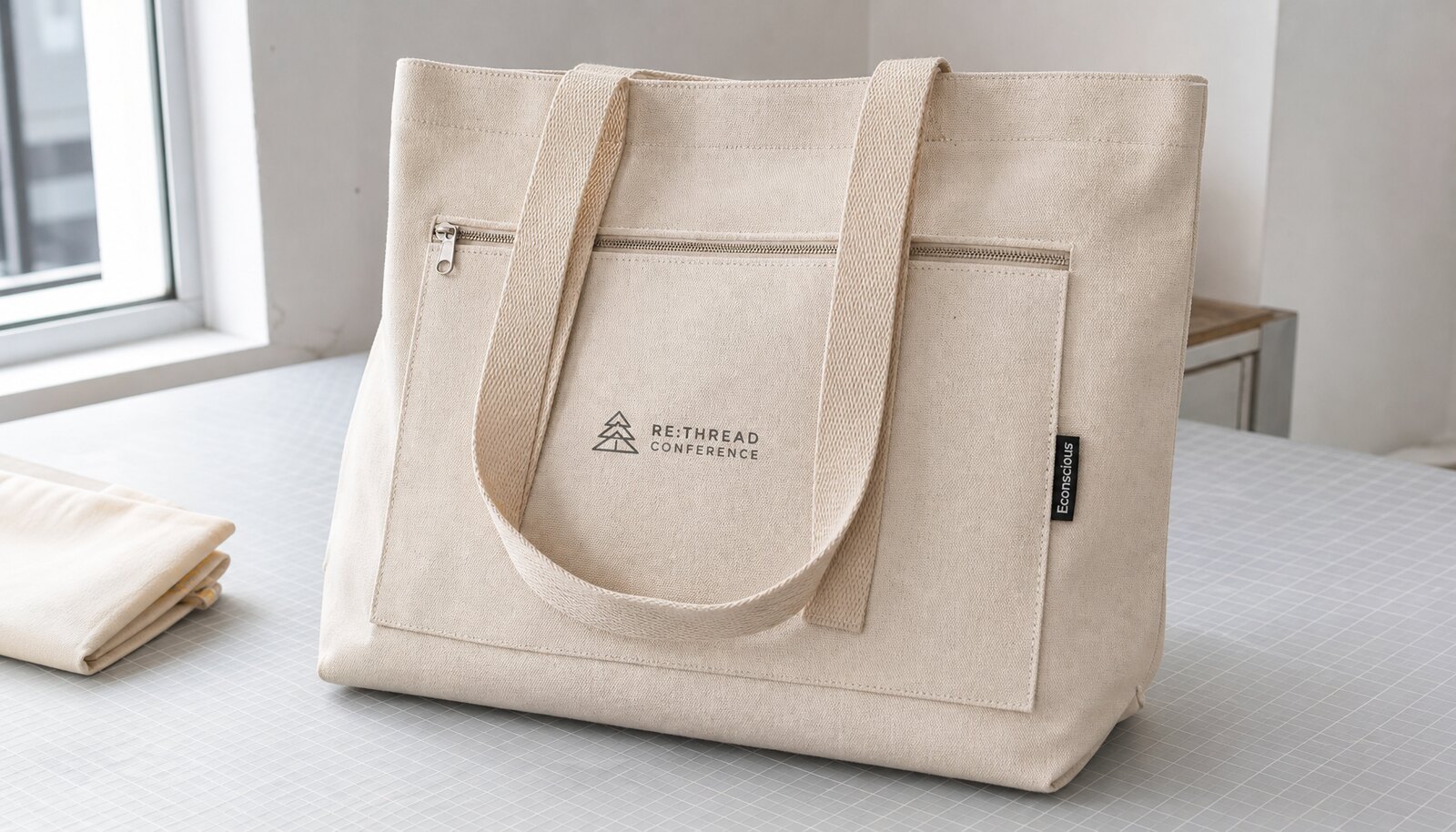
Why apparel brands buy canvas conference bags differently
Apparel brands do not source canvas conference bags the way a generic event buyer does. The bag is part packaging, part merchandising, and part transport tool. It may need to hold folded tees, lookbooks, hangtag cards, invitation inserts, or boxed samples while still reflecting the brand’s seasonal aesthetic. That means the buyer is not only comparing unit prices. They are comparing how the bag presents a collection, how it behaves under load, and how easy it will be to repeat the order later without reworking the spec.
This is also why the phrase canvas conference bags for apparel brands MOQ and lead time review matters commercially. For a fashion or lifestyle brand, the same tote can serve very different programs: a trade-show handout, a wholesale appointment kit, a press drop, a staff pack, or a retail giveaway. Each use case changes the tolerance for fabric softness, logo size, closure type, packing format, and schedule risk. A strong RFQ should start from the use case and work backward to the construction, not the other way around.
The common sourcing mistake is to treat the bag like a commodity with a logo. Once the supplier understands the load, the end customer, and the shipping route, the quote becomes much more meaningful. A bag intended for one-time event distribution can be optimized for speed and simple packing. A bag intended for repeated use in premium brand settings needs better consistency, tighter visual control, and more disciplined QC.
For procurement teams, the useful question is not simply “How much per piece?” It is “What does this spec allow, what does it prevent, and what will it cost us if the supplier changes a detail after approval?” That framing keeps the discussion grounded in the actual buying problem: stable quality, predictable timing, and a landed cost that holds up after freight and packing are added.
When apparel buyers define the job correctly, canvas bags become easier to source. When they do not, the factory fills in the gaps with its own assumptions, and those assumptions are usually where lead time slips and quality disputes begin.
- Trade-show programs prioritize speed, carton efficiency, and clear count control.
- Brand presentation programs prioritize fabric hand-feel, cosmetic consistency, and logo placement.
- If the bag is reused, seam strength and print durability become part of the brand experience, not just the bag spec.
Start with the fabric, then lock the construction
For most canvas conference bags, the best starting point is not the artwork. It is the fabric and the basic structure. A common procurement range is 10 oz to 12 oz canvas, because it usually balances hand-feel, visual substance, sewing efficiency, and freight weight. An 8 oz canvas may work for flat promotional inserts or very light handouts, but it often feels thin once folded apparel or catalogs are added. On the other end, 14 oz or 16 oz canvas can look and feel more premium, but it can also raise cost, slow sewing, and make the bag bulkier to pack.
That weight guidance should be treated as a starting point, not a rule. A buyer should ask the factory how the weight is measured and whether the fabric is greige, finished, washed, or dyed. Two suppliers can both say “12 oz canvas” and still send very different materials. Construction also matters: a flat body with a modest gusset is usually enough for apparel inserts and lookbooks, while a deeper gusset is more appropriate when the bag must carry boxed product or thicker sample sets. The more structure you add, the more the factory has to cut, sew, inspect, and pack.
Fabric finish affects brand perception and repeatability. Natural unbleached canvas is common because it prints well and usually gives a clean retail or event look. Bleached canvas can support a brighter presentation, but shade control matters more. Dyed canvas can fit a campaign palette, yet it introduces extra risk around shade consistency between lots. If the brand is comparing suppliers, the spec needs to name the fabric weight, finish, color, and whether any washing or softening is part of the process.
Handle construction deserves the same attention. A bag intended to carry apparel packs or event kits should not rely on a loose decorative handle. Ask for handle width, handle drop, reinforcement method, and stitch pattern at the attachment points. Webbing handles with bar-tacks or X-box reinforcement are common for a reason: they are easy to inspect, predictable in production, and less likely to fail under repeated carrying.
A good fabric-and-construction spec helps control MOQ too. Standard canvas and straightforward stitching give the factory more flexibility. Once the buyer adds special dyeing, lining, zipper tape, internal pockets, or non-standard reinforcement, the order starts to behave like a custom soft-goods program rather than a simple tote.
- Use 10 oz to 12 oz as the default procurement range for most apparel-brand conference bags.
- Ask whether fabric weight is measured before or after finishing, because the answer affects hand-feel and quote comparisons.
- Treat handle reinforcement as a load-bearing requirement, not as an optional cosmetic detail.
How print method changes MOQ, setup cost, and durability
Print choice is one of the biggest drivers of both lead time and MOQ. For most apparel-brand use cases, one-color screen print is still the most efficient route when the logo is bold, legible, and not too fine. Screen print is usually easier to repeat, easier to inspect, and easier to budget than more elaborate decoration. It also tends to give the cleanest balance between setup cost and bulk consistency when the art is simple.
That said, the right method depends on the graphic, not on a generic preference. Fine type, gradients, tonal artwork, metallic effects, or multiple print placements can raise setup cost and reject risk. Embroidery can deliver a premium feel, but on thick canvas it can distort the shape of letters, create needle marks, and alter the apparent size of the logo after stitching. Woven labels and sewn-on patches can solve certain visibility issues, but they add separate sourcing and attachment steps. The important point is that the decoration method changes the production route, and the production route changes the MOQ.
A buyer should ask the factory to recommend the method based on the artwork file, not simply quote the cheapest available process. For example, a clean one-color logo may be more durable and repeatable in screen print than in embroidery, especially when the bag will be folded, packed, and re-used. A premium brand, however, may accept the extra cost of embroidery or a woven label because it better matches its retail positioning. Procurement should treat that decision as a business choice, not a design preference.
Durability also matters if the bag will be reused after the event. Some suppliers will promise that a print is “good quality,” but buyers should ask how the ink performs under rub and handling. Ask whether the print is cured properly, whether there is any ink bleed risk on natural canvas, and whether the supplier has a basic print adhesion check before packing. Those questions are more useful than asking only whether the print is “sharp.”
In practical sourcing terms, the decoration method should be chosen with three constraints in mind: artwork complexity, repeat-order stability, and acceptable setup cost. If the buyer wants a tight MOQ, the fastest path is usually a simple artwork file, one print color, and a standard placement that the factory can repeat without extra tooling.
- Screen print is usually the first option for simple logos and repeatable bulk orders.
- Embroidery works best when the logo is large enough to remain legible after stitching.
- Woven labels and patches are useful when the brand wants premium presentation and can absorb extra steps.
MOQ is a process outcome, not a market slogan
Buyers often ask for a factory MOQ as if it were a fixed industry number. For canvas conference bags, that usually leads to confusion. MOQ comes from process logic: how much fabric the supplier must buy, how efficiently the factory can cut panels, how many setup steps the decoration requires, and how much packaging complexity has been added. A quote that looks like a low MOQ may simply be a standard bag with minimal decoration and no special packing. A quote that looks restrictive may reflect the reality of a more complex build.
The most useful RFQ structure separates the bag into layers. First, ask for the base tote body. Then ask for decoration as a separate line. Finally, ask for packing as a separate line. That makes it clear where the MOQ pressure comes from. If the bag is cheap in blank form but expensive once a zipper or lining is added, the buyer can see the tradeoff directly instead of guessing. It also helps the team decide whether to use one seasonal artwork or multiple versions that share the same base bag.
For repeat programs, the factory’s practical minimum often drops when the spec stays stable. If the same fabric, handle, seam path, and carton format are reused, the supplier can cut and sew more predictably. If each season changes the print location, handle color, or packaging method, the order becomes harder to batch and the MOQ may rise. This is one reason apparel brands with recurring events often keep a base spec and only update the graphics.
There is also an important caveat: some low-MOQ offers are viable but not directly comparable to higher-volume factory offers. A small-batch quote may rely on stock fabric, limited color options, or a simplified sewing route. That is not inherently bad, but the buyer needs to know it. Otherwise the procurement team may think it has secured a flexible supplier when in fact it has only accepted a narrower spec.
If a supplier cannot explain exactly what drives MOQ for your specific bag, that is a warning sign. A good factory should be able to say whether the minimum is driven by fabric booking, print screens, color changeover, or packing labor. If the answer stays vague, the quote is less reliable than it looks.
- Ask the supplier to state MOQ by body style, by colorway, and by print variation.
- Low MOQ may mean stock fabric, fewer decoration choices, or a higher unit price.
- The easiest way to protect reorder speed is to freeze the base bag and vary only the artwork.
Reading supplier quotes line by line
A serious procurement review needs a quote that can be audited. For canvas conference bags, the supplier should show the fabric spec, print method, setup cost, packing method, unit price, and trade term. Without that, the buyer cannot tell whether one offer is actually better than another. A low EXW number may not beat a higher FOB number once local transport, carton handling, export documents, and packing labor are accounted for. The only way to compare cleanly is to standardize the scope.
The best quotes usually separate the cost into simple buckets. Blank bag cost should be shown apart from printing. Packing should be shown apart from sewing. If the supplier offers options such as a zipper top, inner pocket, lining, or special label, those should be priced as add-ons rather than folded into a vague package price. That gives procurement a way to value each feature and decide which one matters for the program. It also helps the buyer remove cost if the target lands higher than planned.
When reviewing suppliers, pay attention to what is missing as much as what is shown. Some quotes exclude screen charges, sampling fees, carton artwork, or special packaging. Others hide the cost of repacking for retail compliance. If the supplier does not list the assumed carton size and case pack, freight comparison becomes guesswork. A buyer should treat missing scope as a problem, not as a generous simplification. Hidden assumptions are where many tote orders become expensive after approval.
The most useful quote comparison is not the lowest number. It is the quote that is most complete, most comparable, and least likely to produce add-on charges later. That means every supplier should quote against the same tech pack, the same artwork file, the same packing instruction, and the same shipping term. If one supplier quotes a blank natural tote and another quotes a printed, polybagged, carton-marked version, those numbers should not be compared as if they were equal.
For apparel brands, the commercial question is often whether the factory is pricing risk properly. A quote that is too cheap may be underestimating setup, under-specifying fabric, or assuming a slower schedule than the buyer really needs. A quote that is slightly higher but clearly scoped may actually be the safer and cheaper choice once the order lands.
- Compare apples to apples: same spec sheet, same artwork version, same trade term, same packing standard.
- Ask for separate line items for blank bag, print, packing, and any optional feature.
- Treat missing carton data, setup charges, or sample fees as quote gaps, not minor omissions.
Supplier capability: factory, trade route, or hybrid sourcing
Not every supplier is suited to every tote program. For canvas conference bags, the buyer should distinguish between three sourcing routes: a direct cut-and-sew factory, a trading company, and a hybrid model where production and decoration are split across partners. Each route can work, but each creates different control points. The wrong route can make lead time and quality troubleshooting much harder than necessary.
A direct factory with in-house sewing and printing usually gives the best visibility into process timing. When a supplier controls cutting, printing, sewing, and packing in one facility or within a very tight internal network, it is easier to track where delays appear and who is responsible for corrective action. That does not automatically mean the lowest price, but it often means fewer handoffs. For buyers managing launch dates, fewer handoffs usually means fewer surprises.
A trading company can still be useful, especially when a buyer wants access to multiple factory options or needs help with communication. The tradeoff is that technical questions may be answered indirectly, and corrective action may depend on the trader relaying information between the buyer and the factory. That can slow problem-solving if the print drifts or the carton pack is wrong. If a trading route is used, procurement should ask who owns sample approval, who owns defect correction, and who can authorize rework quickly.
The hybrid model is common when the bag is sewn in one location and printed elsewhere. This can work well when the decoration partner is stronger than the bag factory, but it also creates schedule risk because one delay affects the next stage. If print approval slips, sewing may be done but packing cannot finish. If sewing quality is not stable, the print partner inherits bad panels. Buyers should only use split routes when the cost advantage or capability difference is clear enough to justify the extra coordination.
A practical evaluation should ask whether the supplier can show recent work in the same construction class: similar weight canvas, similar handle method, similar print style, and similar packing requirements. A factory that mostly makes heavy travel bags may not be the best fit for a lightweight conference tote. Likewise, a supplier that excels at simple blanks may struggle when a retail-ready package requires tight cosmetic control. The key is not generic “bag experience.” It is relevant, demonstrated capability.
- Direct factory sourcing usually gives the cleanest control over schedule and corrective action.
- Trading routes can add sourcing flexibility, but they also add communication and escalation layers.
- Ask for examples of comparable builds: same fabric weight, similar decoration, and similar packing requirements.
Lead time review: where schedules actually slip
Lead time for canvas conference bags is often misunderstood because buyers focus on sewing time when the real delays happen earlier. The schedule usually begins with artwork confirmation and fabric availability, then moves into sample approval, cutting, printing, sewing, packing, and shipment booking. If any of those stages slip, the shipping date moves. In other words, the longest delay is often not the sewing line. It is the approval process.
A practical planning approach is to divide lead time into four checkpoints. First is sample preparation. Second is sample review and sign-off. Third is bulk production. Fourth is packing and shipment handoff. The buyer should ask the supplier for dates at each checkpoint rather than a single promised ship date. That makes slippage visible early enough to correct it. A supplier that only gives one end date may be hiding uncertainty in the middle of the process.
There are specific bottlenecks to watch. Custom-dyed canvas adds fabric lead time and shade risk. Multi-color printing adds screen setup and registration checks. Zippered or lined bags add more sewing operations and more QC time. If the buyer changes artwork after sample approval, even a small change can force a rework of screens, labels, or printing sequence. Those changes can extend the schedule more than buyers expect. The safest way to protect the calendar is to freeze the art file early and avoid late spec edits unless the business case is strong.
Regional sourcing route matters too. If the factory is close to the fabric mill and decoration partner, the program is usually easier to coordinate. If materials must cross multiple inland legs or cross-border transfer points, lead time becomes more fragile. A shorter route to port or to the buyer’s warehouse can reduce transportation variability, but only if the supplier’s packing and documentation are disciplined enough to support it. Buyers should therefore ask not only how long the bag takes to make, but also how long the supplier needs for materials booking, internal transfer, final packing, and export handoff.
For apparel launches, the easiest mistake is to start the bag order too late. If the bag is tied to a seasonal launch, the approval date should be treated as a real milestone, not a soft target. Once the sample is late, the whole program compresses. When the calendar gets tight, use standard canvas, one print color, and simple packing. Those are the levers that actually reduce schedule risk.
- Ask for a stage-by-stage production calendar, not just a promised ship date.
- Custom dyeing, multi-color print, zipper tops, and late artwork changes are common schedule killers.
- If the bag is tied to a launch window, lock the approval date before you negotiate the ex-factory date.
What to inspect in the sample before bulk release
A sample is only useful if it proves the full buying experience, not just the look of the bag. For apparel brands, the sample should be tested with actual contents: folded garments, a catalog, a small box, hangtag cards, or any other item that will be carried in the final program. A bag that looks balanced when empty can sag, twist, or expose print placement issues once it is packed. The sample has to answer the question, “Does this still work when used?”
The first review should confirm dimensions, handle drop, panel symmetry, gusset depth, and seam finish. Then review the decoration carefully. Check the logo against the approved art file for placement, size, centering, and opacity. If the bag has a zipper, test the zipper pull, the tape alignment, and the way the top seam closes under pressure. If the program includes a woven label or patch, inspect whether it sits flat and is sewn without distortion.
The best practice is to approve samples in writing with annotations. Photographs are useful, but a marked-up physical sample is more decisive because it shows exactly what was acceptable. If the factory changes fabric lot, print screen, or label source after approval, ask for a top-of-line sample before the run is released. That extra step is often the difference between a controlled bulk order and an expensive surprise.
Buyers should also define what not to accept. For example, a slightly off-center print may be acceptable on an event giveaway but not on a premium wholesale program. A small shade variation might be tolerable in a natural canvas tote but not in a dyed colorway tied to a campaign palette. These decisions should be made before bulk starts, not during dispute resolution.
A sample review is most valuable when it includes functional stress, not just visual approval. Put a realistic load into the bag, carry it, set it down, and check whether the handles stretch or the seams distort. That simple step catches more real-world problems than a flat tabletop review alone.
- Test the sample with real apparel contents, not just filler or empty-space checks.
- Approve size, print, handle, closure, and packing together rather than separately.
- Request a top-of-line sample again if the fabric lot, print screen, or decoration source changes.
Packing, cartonization, and shipping detail buyers should not ignore
Packing often gets treated as an afterthought, but it can change both cost and receiving performance. A canvas conference bag may be inexpensive to sew, yet expensive to receive if the packing format is unclear. For apparel brands shipping to a 3PL, retailer, or internal DC, packing instructions should be explicit: one bag per polybag or bulk packed, what label goes on each unit, how many pieces per inner pack, and how many pieces per carton. Without that detail, the receiving team can spend time counting, sorting, and correcting errors.
Carton design matters as well. If cartons are overfilled, the contents can crease, scuff, or crush during transit. If cartons are too large and loosely packed, the bags can shift and the carton can lose compression strength. Buyers should ask the supplier what carton size they recommend and what the gross weight will be. That gives procurement a better view of freight efficiency and warehouse handling. It also helps prevent later complaints that the shipment is too heavy or too bulky for the destination receiving team.
If the bag has metal trims, zippers, or printed surfaces that can rub, insert protection may be required. A simple tissue layer, dustbag, or internal divider can reduce marking, but only if the added labor is justified. Not every order needs premium packing. The point is to decide the standard in advance rather than discovering during inspection that the factory packed the goods differently than expected.
For export moves, buyers should also ask about carton marks, palletization, and stacking assumptions. Even if the order is not palletized at origin, the buyer should know whether the cartons can withstand compression during ocean or warehouse stacking. Carton drop and compression awareness is particularly useful when the bags are headed into retail distribution where cartons may be stacked high before unpacking.
The most practical packing rule is simple: if the buyer cannot explain the packing standard in one sentence, the factory probably cannot execute it consistently either. Clear packing instructions protect count accuracy, surface quality, and delivery speed.
- Define unit pack, inner pack, and master carton count before the factory starts packing.
- Ask for carton dimensions and gross weight because they affect freight and handling.
- Treat carton strength and stacking ability as part of quality control, not as logistics trivia.
QC standards that are specific enough to use in an inspection plan
A useful inspection plan needs more than “check quality carefully.” For canvas conference bags, buyers should set a measurable standard for dimensions, seams, print, packing, and carton condition. Start with the obvious: finished size, handle length, and panel symmetry. Then define which defects are critical, major, or minor. A missing handle tack or a torn seam is clearly more serious than a slight tonal fabric shift. A simple defect framework keeps the factory and buyer aligned during production and final inspection.
For measurement, do not inspect only one sample. Review a small lot from multiple cartons so the buyer sees whether the batch is stable or drifting. That matters for stitched products, because panel tension and cutting variation can accumulate across the run. The factory should also understand that the acceptable measurement band is not negotiable after approval. If the buyer wants plus or minus 1 cm on body size and a tighter handle tolerance, that should be written into the order file and used in inspection.
Print QC needs its own checks. Review logo position, ink opacity, edge sharpness, cure quality, and rub resistance. If the design has fine lines or small type, look at it under normal viewing distance, not just close up. Embroidery, if used, needs checking for thread tension, loop consistency, and logo distortion on the actual panel. A good print on a bad panel is still a bad bag.
Function tests should be basic but real. Load the bag with the kind of items it is expected to carry, then check handle comfort, stitch stress, zipper movement, and whether the bag sits correctly when filled. A bag that passes flat inspection but fails under load is not ready for bulk release. Likewise, a bag can look fine on a table and still fail packaging if carton count, label format, or polybag sizes are wrong.
For shipping cartons, ask whether the carton can survive stacking and transit handling. Carton compression awareness matters when goods move through long export routes or multiple warehouse touches. If the cartons are weak, the bags inside may arrive with corner damage or shifted packing even if the sewing was perfect. QC for soft goods is never only about the soft goods; it includes the box that protects them.
- Set defect categories and acceptance thresholds before bulk starts.
- Use sample-lot checks across multiple cartons, not a single-piece review.
- Add rub testing, load testing, and carton strength review to the normal visual inspection list.
Specification comparison for buyers
| Spec decision | Recommended option | When it fits | Buyer risk to check |
|---|---|---|---|
| Fabric weight | 10 oz to 12 oz canvas as the default procurement range; move heavier only if the load or brand position justifies it | You need a bag that carries lookbooks, folded apparel, catalogs, or light sample packs without feeling flimsy | Ask whether the quoted weight is greige, finished, or washed weight; the same label can hide a different hand-feel and cost base |
| Bag body style | Flat tote with a modest gusset, then add depth only when the contents truly need volume | The bag will carry flat print materials, folded tees, or mixed promotional inserts | A larger gusset increases cutting waste, seam count, and carton bulk; a flat tote may be too shallow for boxed product |
| Handle construction | Webbing handles with reinforcement stitching or bar-tacks at stress points | The bag is expected to be carried repeatedly, not only handed out once | Unreinforced handles can distort under load; confirm stitch pattern, handle drop, and whether the handle is folded or self-fabric |
| Print method | 1-color screen print for most logo-first programs; embroidery or woven label only when the brand value justifies it | You want legible branding, predictable setup, and manageable repeat orders | Fine type, gradients, and thin lines may not reproduce cleanly; embroidery can distort on thick canvas and shift the visual size of the logo |
| Closure | Open top for event giveaways; zipper top only for premium kits, security, or multi-piece contents | The bag will hold items that need to stay together in transit or be presented as a higher-value kit | Zippers add parts, inspection points, and timing risk; ask about zipper source, color matching, and pull-force checks |
| MOQ route | Direct factory cut-and-sew with in-house printing or tightly managed decoration partners | You have a repeatable design and want control over lead time, sample sign-off, and corrective action | Trading-only sourcing can work for breadth, but it often weakens technical accountability when print or measurement problems appear |
| Sampling path | Pre-production sample, then top-of-line or shipment sample if fabric lot or artwork changes | Color accuracy, logo placement, and handle length matter to your brand or retail partner | Skipping a true production sample is how buyers discover seam drift, panel shrinkage, or off-center prints after bulk starts |
| Packing method | Individual polybag if scuff protection matters; then master cartons with size, qty, and carton marks | You ship to a DC, 3PL, or retailer that needs clean receiving and accurate counts | Loose packing can reduce factory labor but creates downstream counting errors, scuffing, and chargeback risk |
| Quote structure | Ask for blank bag, decoration, packing, and freight-related costs as separate lines | You need a quote you can compare across suppliers and trade terms | A single all-in price hides setup charges, variable packing assumptions, and trade-term differences that distort comparison |
Buyer checklist before sampling
- Specify finished dimensions, measured on the sewn bag, and state whether the bag is flat or gusseted when measured.
- State canvas weight in oz or GSM, plus whether the fabric is natural, bleached, dyed, or washed after sewing.
- Define handle drop, handle width, reinforcement method, and any shoulder-carry expectation.
- Fix the artwork file version, logo size, print colors, placement tolerance, and acceptable ink opacity before sampling.
- Ask for separate pricing on blank bags, printed bags, packing, and any optional lining, zipper, or pocket features.
- Request sample photos with measurement notes and a physical pre-production sample before bulk approval.
- Ask the supplier to show process timing by stage: fabric booking, sample approval, cutting, printing, sewing, packing, and ex-factory handoff.
- Compare quotes on the same trade term and the same carton assumption so you are not comparing different scopes.
- Define your receiving standard: polybag, sticker format, carton mark, case pack, and whether inner packs are required.
- Set escalation checkpoints in writing: sample approval date, bulk start date, first-line inspection, and ship-confirmation date.
Factory quote questions to send
- What is the exact fabric specification, including canvas weight, weave type, and whether the weight is measured before or after finishing?
- How much shrinkage do you allow in your cutting spec, and do you test shrinkage before bulk cutting?
- What is your true MOQ by colorway, by print color count, and by optional feature such as zipper, lining, or inner pocket?
- Can you quote blank bags, printed bags, and retail-packed bags separately so we can compare the scope line by line?
- Which print method do you recommend for this artwork, and what setup charges, screen charges, or plate charges apply?
- What is the sample timeline, bulk production timeline, and the longest likely delay point in your process?
- Do you print, sew, and pack in-house or through separate vendors, and which steps are under your direct control?
- What inspection standard do you use for measurements, stitching, print quality, and carton packing?
- What carton size, pack count, and gross weight do you recommend, and what shipping method does that support best?
- Which parts of the quote change if we alter logo size, fabric lot, handle construction, or packaging after sample approval?
Quality-control points to confirm
- Agree measurement tolerances before sampling. For most tote-style bags, a practical starting point is plus or minus 1 cm on body dimensions and plus or minus 1.5 cm on handle length, unless the design is oversized or heavily structured.
- Use a simple AQL plan for bulk inspection rather than a vague pass/fail review. For cosmetic and functional tote programs, buyers commonly separate critical, major, and minor defects and tie each to a defined acceptance threshold.
- Check stitch quality at handle anchors, side seams, gussets, and top hems. Ask for bar-tacks or X-box reinforcement when the bag is meant to carry books, apparel packs, or multiple inserts.
- Verify print durability with more than a visual check. Review ink opacity, edge sharpness, registration, and adhesion after a rub test; if the bag is likely to be reused, request a simple dry rub and wet rub check on the approved print.
- If the program includes embroidery, inspect stitch density, thread tension, backing stability, and logo distortion on the actual bag panel, not only on a flat swatch.
- For size and symmetry, sample at least one carton from the first production lot and measure several pieces across the lot. Check handle drop consistency, panel squareness, and gusset depth.
- Review fabric defects before cutting: holes, slubs, oil marks, shade variation, and weak weave areas should be sorted or downgraded before panels are cut, not discovered in final packing.
- If the bag includes a zipper or snap, do a pull-open and close cycle test on a sample lot and check alignment of zipper tape, pull tab function, and seam capture at the ends.
- Confirm packing accuracy by matching inner pack quantity, carton marks, outer label, and purchase order SKU. Receiving errors often come from packaging mistakes, not sewing defects.
- If cartons will stack in transit or warehouse storage, ask for carton drop and compression awareness. Weak cartons can crush, shift, or open under stacking even when the bags inside are correctly made.