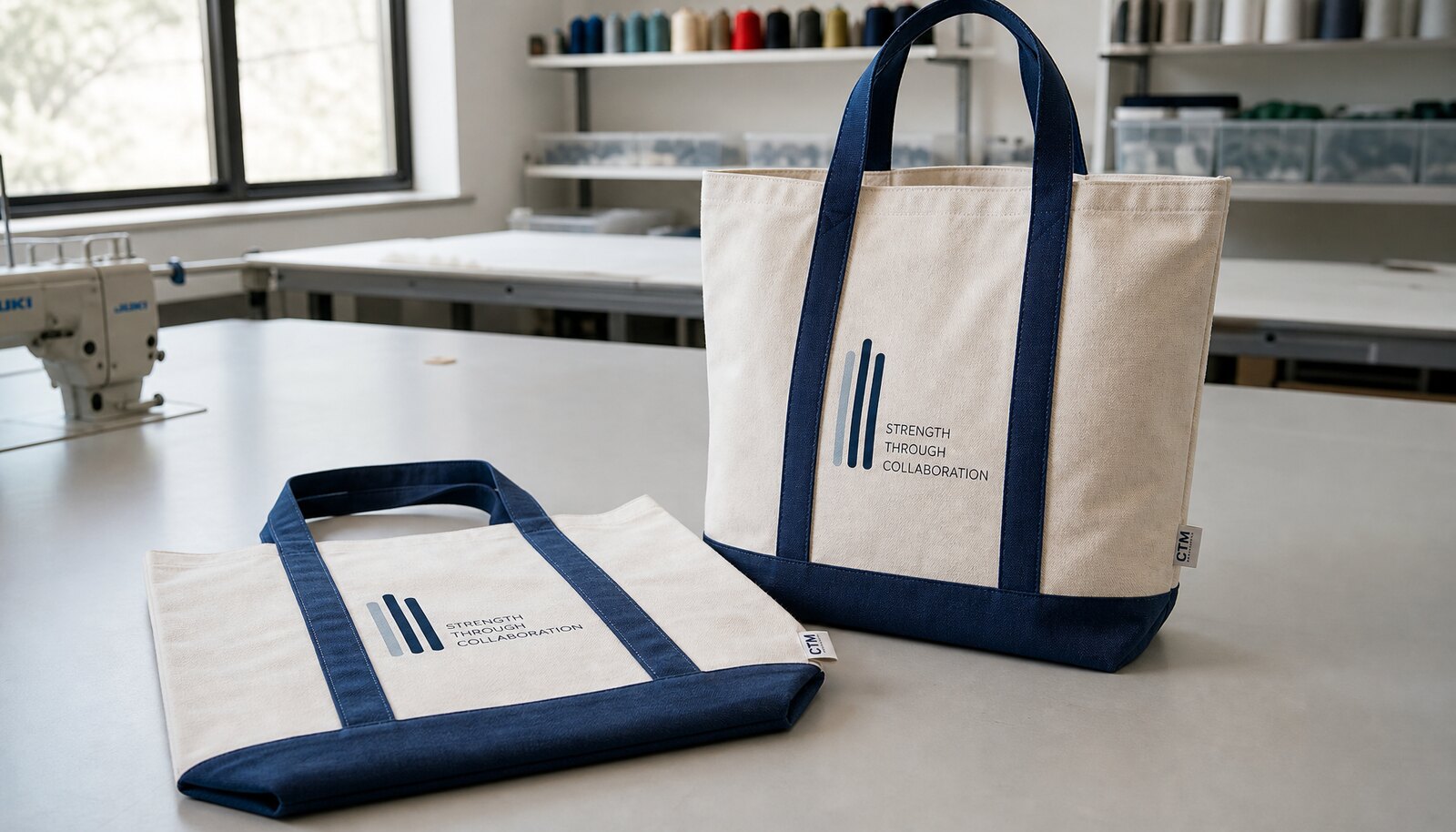
Start With the Use Case, Not the Tote
For corporate events, the wrong canvas conference bag is usually the one that looks fine in a sample photo but fails in the room. Buyers need a bag that handles brochures, notebooks, a phone charger, a water bottle, and sometimes a laptop sleeve without collapsing or scuffing the print. If the bag is only meant to hold a welcome kit, the build can be lighter. If it is going to be reused after the event, the fabric, stitching, and handle reinforcement need a higher standard.
The sourcing plan should start with how the bag will be used at the event, not with the logo. That means deciding whether the bag is a one-day handout, a premium delegate gift, or a reusable retail-style tote. Once that use case is clear, the rest of the spec becomes easier to defend: size, gusset, closure, lining, pocket layout, and whether the private label treatment belongs on the front panel, side label, or inner tag.
- Define the payload in practical terms: notebook only, full welcome kit, or device carrying.
- Choose a bag profile that matches the event format: flat tote, gusseted tote, or zip-top conference bag.
- Treat decoration as part of function, not separate from it, because print placement can interfere with pocket seams and handle stitching.
Choose the Canvas Build That Survives Event Handling
Canvas conference bags are usually quoted in GSM or ounce weight, and that number matters more than most buyers expect. For a basic corporate event tote, 280 to 300 GSM is a workable starting point if the bag is not carrying heavy loads. For a more durable delegate bag or retail-private-label program, 320 to 340 GSM gives a firmer hand feel and less distortion when filled. Very light canvas may reduce cost, but it also increases the risk of panel sagging, transparent print show-through, and weak handle attachment at the stress points.
Build details matter as much as fabric weight. A 10 to 12 inch gusset often gives enough volume for conference inserts without making the bag bulky. Handles should be long enough for shoulder carry if the event audience expects that, but not so long that the bag hangs awkwardly when carried by hand. If you need a zipper, inside pocket, or lining, make those decisions early because each add-on changes cutting, sewing time, and inspection scope.
- Use 280 to 300 GSM for light event kits and 320 to 340 GSM for better structure and repeat use.
- Specify handle length and handle width together so the bag feels balanced in the hand and on the shoulder.
- Add reinforcement at the handle stitch points if the bag will carry books, bottles, or devices.
Compare the Right Sourcing Route
The cheapest quote is not always the easiest route to execute. A direct factory can be the cleanest option if you want one team responsible for fabric, stitching, print, and packing, but only if that factory truly controls production. A trading company can help when the bag spec is still moving, yet it adds another layer of communication and can blur responsibility when a sample misses the mark. Local decorators are fast for simple branding, but they usually have less control over the raw bag build and fewer options for private label finishing.
For canvas conference bags for corporate events private label sourcing plan work, the most practical route depends on how much control you need. If the bag must be unique, private label cut-and-sew is worth the extra setup. If the event deadline is tight, stock blanks with local print may be the safer path. The key is to compare routes using the same spec sheet and the same quality standard, otherwise each supplier will quote a different build and the unit price will not mean much.
- Ask every supplier to quote the same canvas weight, size, print method, and packing method.
- Separate production accountability from sales coordination in your evaluation.
- Use a pilot order when the source is new, even if the quote looks clean on paper.
Read the Quote Like a Production Document
A usable quote should show more than a lump-sum unit price. It should identify the bag size, fabric weight, print method, logo locations, lining or pocket details, packing unit, and whether sample cost is credited against the bulk order. If the supplier only gives a number without the build detail, procurement cannot compare offers on equal terms. That is how buyers end up with one quote for a stiff, reinforced bag and another for a thinner version that only looks similar from a distance.
The biggest cost drivers are usually fabric weight, number of print colors, number of construction panels, and any special finishing such as piping, zipper tape, or internal lamination. Private label details also matter. A woven side label is cheap relative to embroidery or a custom deboss, but it still adds labor and must be placed consistently. Ask for separate lines for sample fee, tooling or screen setup, production unit price, packing, and freight assumption so you can see where the quote is actually moving.
- Make sure the quote states whether the canvas is stock dyed, piece dyed, or custom colored.
- Separate logo setup cost from unit price so repeat orders are easier to forecast.
- Request the packing spec by carton rather than only by inner pack quantity.
Set MOQ and Sample Rules Before the Design Drifts
MOQ on canvas conference bags is not just a factory policy; it is often tied to fabric color, print setup, and sewing efficiency. A single-color stock canvas bag with one print location can usually run at a lower MOQ than a custom dyed bag with multiple logos or contrast trim. The more private label elements you add, the more the factory needs to amortize setup across units. Buyers should be careful not to treat a small order as a prototype for a future volume order unless the supplier explicitly agrees to that structure.
Sampling should follow a simple sequence: first a preproduction sample to confirm the construction, then a print strike or logo placement approval, then a sealed approval sample if the order is large or the event is sensitive to color and finish. If the factory skips directly to bulk, the risk is that the buyer discovers a panel proportion issue or logo shift only after thousands of units are sewn. A good sampling plan costs time, but it saves far more than rework and air freight.
- Set MOQ by color and logo version, not only by total order quantity.
- Approve a physical sample against written measurements, not against memory or photos.
- Use one approved reference sample for the factory and one for the buyer file.
Choose the Print Method That Matches the Brand Standard
Screen print is still the most common choice for canvas conference bags because it is efficient for simple logos and solid colors. It works well when the brand wants a crisp, opaque mark on natural canvas. Heat transfer can support more complex artwork or small gradients, but it can look more printed-on than built-in if the artwork or substrate is not well matched. Embroidery gives a premium feel on heavier canvas, though it adds cost, stitch time, and thickness at the logo area. Woven or sewn labels are useful when the buyer wants subtle private label identity rather than a large front-panel graphic.
The right method depends on the event audience and the destination use. A retail buyer may want richer branding and stricter color control. A corporate event team may care more about quick setup and durable logo visibility across a large batch. Whatever the method, define the logo size in millimeters, specify the Pantone target if color is critical, and approve placement from a physical sample. Artwork that looks centered on screen can shift once it is mounted on a gusseted tote.
- Use screen print for bold logos and repeatable bulk runs.
- Use embroidery or woven labels when the brand needs a more premium private label signal.
- Avoid overly fine lines unless the print method and fabric texture can support them cleanly.
Set QC Thresholds Before Bulk Sewing Starts
A production bag should be judged by measurable points, not a general impression. The factory needs to know the acceptable finished dimensions, what counts as a color variance, and how much stitch variation is still acceptable. For canvas conference bags, the most common defects are crooked print placement, uneven handles, weak bartacks, dirty panels, and size drift after sewing. These are visible, but they are also preventable if the approval sample is treated as the benchmark rather than as a suggestion.
The best QC plan focuses on the parts that conference buyers will touch first. Handle strength, seam finish, fabric hand feel, and print clarity all affect perceived quality at the event table. If the bag has a zipper, pocket, or lining, those features need their own acceptance standard. A buyer should not wait until the shipment arrives to discover that the pocket opening is too narrow for a brochure or that the zipper pull is awkward to use.
- Measure the finished bag flat and loaded so you can catch distortion early.
- Inspect the first sewn units before the whole run is released.
- Reject obvious stains, loose threads, warped handles, and weak stitch reinforcement immediately.
Plan Packing for Events, Not Only for Freight
Packing can ruin an otherwise good tote program if it is left vague. Some buyers want bags folded and polybagged individually for retail presentation. Others want bulk-packed cartons so event staff can unpack quickly at the venue. If the bags will be distributed as part of a welcome kit, the factory may need to place inserts, cards, or other items inside the bag before carton sealing. That should be written into the order before production starts, not added as a late instruction.
Carton size, unit count per carton, and moisture protection are all part of the sourcing decision. Too many bags in one carton can flatten the product and crease the print. Too few cartons can inflate freight cost. For overseas shipments, carton labeling should show style, color, quantity, and carton number in a format the receiving team can use immediately. Event buyers often care more about clean unpacking than about theoretical packaging efficiency, so the packing plan should serve both freight and venue handling.
- Define whether the bags ship bulk, folded, polybagged, or kitted with inserts.
- Require carton marks that match the purchase order and the packing list.
- Use moisture protection if the route is long or the destination has humidity risk.
Build the Schedule Around Sample, Production, and Freight Risk
Lead time is easiest to manage when it is broken into stages. Sample development, sample approval, material booking, bulk sewing, inspection, and freight each carry their own risk. A buyer who only asks for the factory lead time will miss the real schedule pressure point, which is usually sample approval or artwork delay. If the bag is private label and the event date is fixed, the schedule should include a buffer for corrections after the first sample, because that is where the hidden issues usually appear.
Land freight, ocean freight, and air freight change the economics in different ways. Sea freight is usually the better route for non-urgent corporate programs, but it needs forward planning. Air freight can rescue a deadline, but it is rarely the right default for heavier canvas bags unless the order is small or the event is immovable. The cleanest way to manage landed cost is to compare the same bag spec under at least two timing assumptions: normal production and expedited shipment.
- Build the schedule backward from the event date, not forward from the order date.
- Reserve time for sample correction before the bulk order is released.
- Compare landed cost with freight included, not only ex-factory pricing.
Write the RFQ So Suppliers Quote the Same Bag
A strong RFQ does not have to be long, but it has to be specific. The supplier should receive the exact bag dimensions, canvas weight, handle length, logo placement, print method, packing format, target quantity, delivery timing, and any private label requirement such as woven labels or side tags. If those details are missing, each supplier will fill in the gaps differently and the quotes will be impossible to compare. The result is usually a cheap-looking quote for a different product.
For canvas conference bags for corporate events private label sourcing plan work, a simple RFQ pack is often enough to keep the process disciplined. Include a reference image, a dimension sketch, artwork files, carton expectations, and a sample approval path. Once the supplier sees that procurement has already thought through the construction and packing logic, the quote becomes more reliable and the sample process usually moves faster.
- Send one RFQ sheet, one artwork file, one size sketch, and one packing instruction.
- Ask the supplier to restate the spec in their quote so mismatches show up early.
- Keep the approval chain short so the sample does not stall between departments.
Specification comparison for buyers
| Supplier option | What to verify | Commercial advantage | Buyer risk to control |
|---|---|---|---|
| Direct sewing factory | fabric swatch, approved sample, seam close-ups, logo test photos, packing pilot, and final inspection evidence | Better sample-to-bulk control and faster production feedback | May be weaker on export paperwork or branded packing unless checked early |
| Trading company | Factory name, production photos, trim-source proof, and who owns QC decisions | Can coordinate small mixed orders and extra services | Markup can hide real factory capability and slow defect decisions |
| Specialized bag workshop | bag size, gusset, handle drop, seam allowance, stitch density, reinforcement patch, and loading expectation | More practical for detailed construction, trims, and repeat programs | Capacity may be limited during peak seasons |
| Low-price general supplier | 8-12 oz cotton canvas, 120-220 gsm cotton, recycled cotton, or blended fabric selected by use case and target price | Useful for simple promotional runs with loose specs | Material downgrades, weak packing, and vague inspection scope can erase savings |
| Retail-ready supplier | fold method, inner bundle, carton count, carton mark, moisture protection, SKU separation, and warehouse receiving needs | Can handle labels, SKU separation, carton marks, and receiving rules | Higher unit cost must be compared against reduced warehouse work |
| Compliance-focused supplier | Fabric records, labeling review, test plan, and production traceability | Safer for retail programs and repeat brand orders | Documentation claims need evidence, not only sales language |
| Local sample room plus bulk factory | Signed sample, bulk factory handoff, first-piece photos, and deviation owner | Good for complex branding before large production | Sample room quality may not match bulk line unless handoff is controlled |
Buyer checklist before sampling
- Lock the finished bag size, handle length, and gusset depth before asking for quotes.
- State whether the event bag must hold a laptop, notebook, water bottle, or brochure kit.
- Specify canvas weight in GSM or oz, not just canvas as a generic term.
- Define the print method you want approved, including color count and artwork file type.
- Confirm whether the logo belongs on one side, both sides, or the side label only.
- Set the packing method: bulk pack, individual polybag, insert card, or kit assembly.
- Ask for a preproduction sample and a top-of-production reference photo before bulk shipment.
- Request carton dimensions, carton count, and gross weight before freight booking.
- Confirm lead time separately for sample, production, and export booking.
- Keep one written approval trail for measurements, print placement, and color standard.
Factory quote questions to send
- What exact canvas weight, weave, and shrink allowance are included in your quote?
- Is the quoted bag made from stock fabric or woven to order, and what color tolerances apply?
- Which print method are you pricing, and what is the setup cost for each color or location?
- What is the minimum order quantity by color and by logo variation?
- What sample stages do you provide before bulk production, and what does each stage include?
- How do you pack the bags for export, and what carton quantity do you recommend for conferences?
- What is your standard production lead time after sample approval, and what causes delays?
- Which measurements, materials, and print details will appear on the final proforma invoice?
Quality-control points to confirm
- Finished dimensions must match the approved sample within a practical tolerance, especially width, height, and gusset depth.
- Handle length and attachment reinforcement should be consistent on both sides, with no twisting or loose stitching.
- Canvas weight should match the approved fabric spec, and the weave should not feel thinner than the approved sample.
- Print placement must stay centered and square, with no noticeable slant, blur, cracking, or under-inking.
- Seam lines should be straight, bartacks should be secure, and thread ends should be trimmed cleanly.
- If a lining, pocket, or zipper is included, the opening must operate smoothly without puckering or skipped stitches.
- Smell, stains, oil marks, and loose fibers should be inspected before packing, especially on light-colored bags.
- Carton packing should follow the agreed count, label format, and moisture protection method.