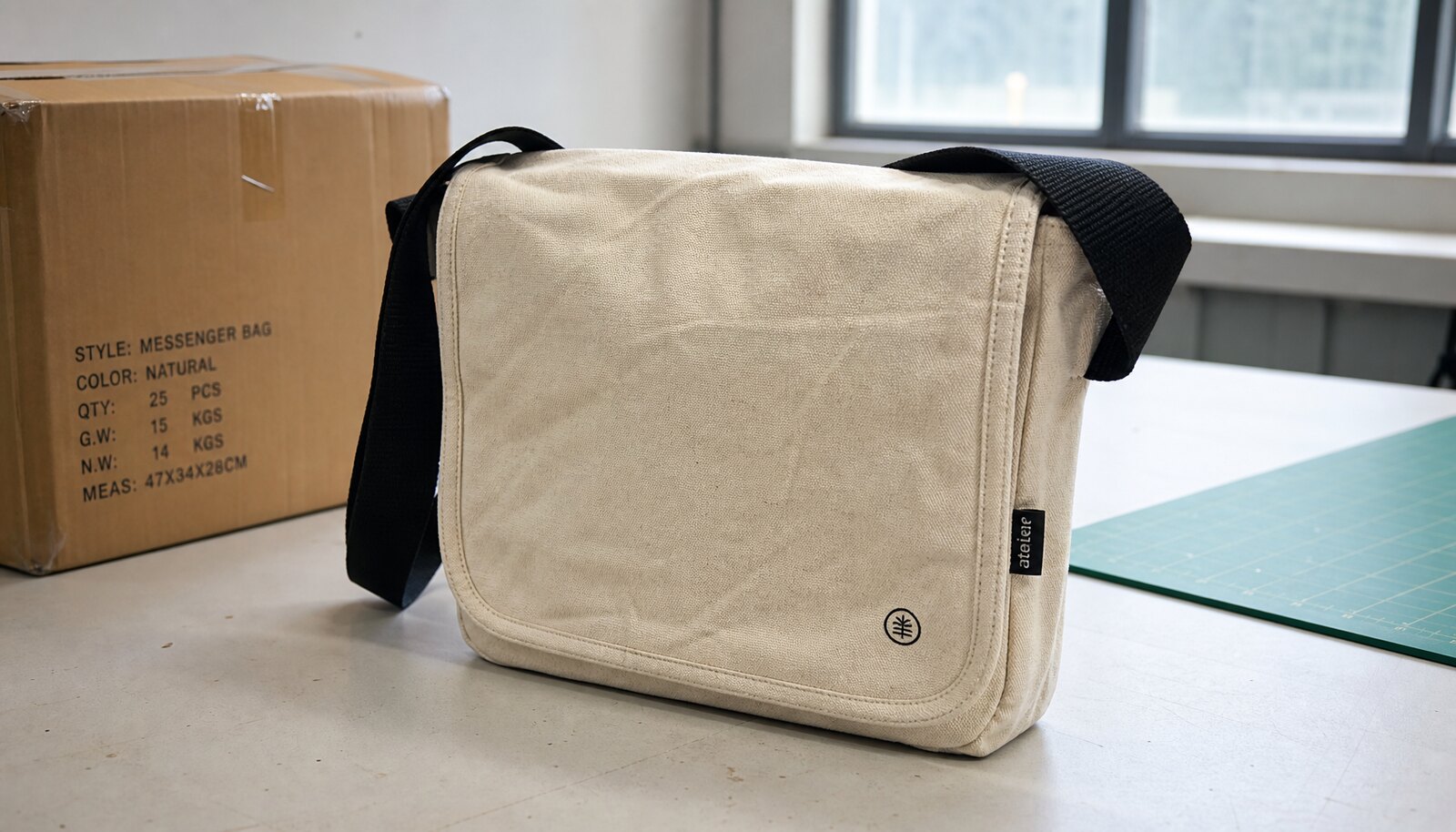
Why carton planning is part of the product spec
For canvas commuter messenger bags for corporate gifting, the product is not finished when the sample is approved. It is finished when the packed carton arrives in usable condition, the logo is intact, the strap lies flat, and the warehouse team can receive it without opening every box. That makes carton planning a product decision, not a logistics afterthought.
The failure mode is easy to miss. A messenger bag can look correct on a sample table and still fail in bulk if the flap print creases, the shoulder strap presses into the front panel, or the carton is too tight for the hardware. Corporate gifting increases the impact because you are shipping many identical impressions at once. One bad packing choice can create visible damage across the full batch and trigger repacking, delays, or replacement claims.
- Treat the fold method, carton count, and carton dimensions as approved product attributes.
- Design for the actual receiving point, whether that is a corporate warehouse, 3PL, office lobby, or event venue.
- Protect both the bag structure and the decoration during transit, not only the fabric itself.
Start with the use case before you ask for freight prices
The right carton plan depends on what the bag has to carry. A commuter messenger bag for laptops and chargers needs more body, more reinforcement at the strap anchor, and a more careful fold than a soft giveaway bag meant for notebooks and event materials. If the bag needs to hold a 13-inch or 15-inch device, the interior pocket, closure, and gusset depth should be checked before any freight quote is treated as real.
Fabric weight changes both presentation and packing behavior. A 12oz canvas bag can work for a lighter program, but it collapses more in transit and may need insert support if the front panel carries a large logo. A 14oz build is often the practical middle ground for corporate gifting because it balances body and packing efficiency. A 16oz bag makes sense when the buyer wants stronger shape retention, a more premium hand feel, or better protection for heavier loads.
- Use 12oz when cost and lighter shipping matter more than structure.
- Use 14oz when the program needs a balanced mix of body, presentation, and freight efficiency.
- Use 16oz when shape retention, load support, or shelf presence matters more than cube efficiency.
- Check pocket size, closure type, and strap reinforcement before approving a device-carrying use case.
Choose the packing architecture before you optimize carton density
There is no single best packing method. Flat-fold packing is the simplest and usually gives the best cube, but it can leave hard fold lines if the logo or flap sits across the crease. A paper board or tissue sheet can improve presentation, but every added layer increases labor and sometimes carton size.
Polybagging is useful when the lane is humid or the transit time is long, but it is not free. It adds material, labor, and sometimes friction if the bag needs to decompress after packing. Semi-structured or upright packing gives the most premium arrival state, but it usually costs the most in cube and carton volume. If the order includes a notebook, pen, charger, or other accessory, the packing architecture should be decided as a kit, not as separate items.
- Match the fold line to an area that can tolerate compression, not across the center of the logo.
- Use tissue or a paper board only when it improves the received appearance more than it increases cube.
- Add silica gel or a liner when the route is humid or the cartons sit in storage before delivery.
- If the bag is part of a kit, specify the exact placement of each accessory and the count sequence.
Set carton targets with numbers buyers can actually use
A useful carton plan starts with examples the supplier can quote against. For a standard commuter messenger bag around 14oz canvas, a practical starting range is often 6-10 pieces per master carton, with the exact count driven by size, insert use, and whether the product is polybagged. A lighter 12oz build may fit 10-16 pieces per carton if the bag folds cleanly and the logo does not sit on a high-pressure fold. A heavier 16oz or more structured build may need 3-6 pieces per carton to stay within a safe handling range.
The carton itself should be sized by both cube and weight. As a planning example, a 48 x 38 x 35 cm carton is 0.06384 CBM, while a 55 x 42 x 40 cm carton is 0.0924 CBM. Those dimensions are not universal targets, but they give buyers a realistic starting band. If you pack 8 cartons at 0.08 CBM each, the shipment is 0.64 CBM before pallets and overhang. If those cartons are averaging 12 kg gross, you are moving 96 kg gross before pallet weight. That matters because freight quotes, warehouse handling, and receiving labor all change once the carton spec changes.
- Ask the supplier to show the CBM formula from the packed carton dimensions, not only the final number.
- Keep most master cartons in a practical gross-weight band, often around 10-15 kg for manual handling unless your warehouse has a different rule.
- Avoid maximizing units per carton if it pushes the carton past a comfortable lift weight or crushes the bag face.
- If you need a premium fold, accept lower carton density and budget for the cube.
Use freight cube math before you compare suppliers
Freight is often where the cheapest bag becomes the most expensive buy. A quote that looks lower on the sewing line can become more expensive if the packing method increases carton size, forces air freight, or creates repacking at destination. The clean way to compare suppliers is to calculate landed cost from packed carton data, not from unit price alone. That means you need carton dimensions, gross weight, units per carton, carton count, and shipping mode in the same view.
A simple example makes the point. If an order is 240 bags and the packing method is 8 pieces per carton, you need 30 cartons. If each carton is 0.08 CBM, the shipment is 2.4 CBM before pallets. If another supplier fits 10 pieces per carton at 0.09 CBM, the carton count falls to 24, but the total cube becomes 2.16 CBM. The lower carton count may save handling even if the sewing price is slightly higher. In other words, carton density and gross weight can matter more than a small difference in factory price.
- Compare total shipment cube, not only piece price.
- Ask the supplier to separate production cost, packing cost, and freight assumptions.
- Check whether the quote assumes pallets, loose cartons, or both.
- Budget for a replacement buffer so you are not forced into an emergency freight decision after inspection.
Match carton size to the bag construction and the lane
Different constructions want different carton ranges. A flat-fold 12oz bag with no insert can often live in a carton around 48 x 38 x 35 cm with 10-16 pieces, depending on strap bulk and print position. A 14oz bag with tissue and a paper board often fits better in a carton around 55 x 40 x 35 cm with 6-10 pieces. A 16oz semi-structured build or a bag with a firm laptop sleeve may need a carton closer to 60 x 45 x 40 cm with 3-6 pieces so the body is not crushed at the corners.
Handling limits should follow the receiving lane, not the factory preference. For manual receiving, many buyers try to stay around 10-15 kg gross per carton. Once gross weight pushes higher, the carton should only be used if the receiving site agrees to lift it and the outer board can survive stacking. In a palletized lane, a heavier carton may be acceptable, but only if the pallet build, stack height, and corner protection are defined before production starts.
- Use smaller cartons for structured bags with hardware, thick straps, or laptop sleeves.
- Use larger cartons only when the bag compresses safely and the receiving team has the right handling method.
- Do not let one oversized accessory, such as a charger pouch or hard insert, dictate the whole carton design unless it is part of the brief.
- Confirm whether the destination will receive loose cartons or palletized cartons before the carton size is frozen.
Ask for a quote that exposes the real cost drivers
A supplier quote is only useful if it exposes the variables that change freight and quality. If the quote says only bag price and delivery date, the buyer does not yet know enough to award the job. The supplier should state the fabric weight, finished size, packing method, carton dimensions, gross weight, units per carton, decoration method, Incoterms, and carton board grade. Without those inputs, you cannot compare one offer to another on equal terms.
The quote should also show who owns each step. In some factories, sewing happens in one building, print in another, and final packing in a separate warehouse. That can work, but the handoffs need to be visible. Ask the supplier to state where the bag is sewn, where decoration happens, where packing happens, and where the carton label is applied. If any of those steps are subcontracted, the buyer should know before approval, not after a claim.
- Ask for packed-carton photos or a short packing video before mass production on launch orders.
- Require the same carton format across all quotes so you are comparing real alternatives, not different assumptions.
- Make the supplier state all exclusions, including destination charges, inspection fees, and special labeling.
- If carton or packing changes after sample approval, ask who pays for the repack and reinspection.
Evaluate the factory on control, not just capability
A good factory can sew the bag. A better supplier can repeat the same bag, the same fold, the same label position, and the same carton count across the entire order. For procurement, that repeatability matters more than a broad promise of capability. Ask for evidence of process control: what the factory checks at cut stage, what it checks after sewing, how decoration is approved, who signs off on the first packed carton, and whether the packing line has a count verification step.
The strongest suppliers are clear about change control. If the logo needs one more millimeter of clearance, if the carton size changes, or if the client updates a color callout, the supplier should explain whether that change affects tooling, packing, or lead time. Weak suppliers treat all changes as minor until the schedule slips. Buyers should also ask how the factory handles traceability by lot or batch, because carton-planning issues often become claims only after the goods are already in distribution.
- Ask for the quality checkpoints between cut, sewing, decoration, packing, and final carton sealing.
- Request one recent packing photo set for a similar bag structure, not a generic factory brochure.
- Confirm whether the factory can trace cartons by lot if a defect is found after shipment.
- Ask who makes the decision when a sample and a production carton do not match exactly.
Build QC gates around the defects that actually hurt gifting programs
The QC plan should cover the product in three states: preproduction sample, packed sample, and final shipment. A loose sample can hide problems that only show up after folding, carton stacking, or transit vibration. For example, a print that looks clean when flat may crack where the fold line crosses the ink film. A strap anchor that looks secure may become a stress point once the bag is stacked in a carton. A carton that looks sturdy may still bulge when the piece count is increased by one bag.
A sensible inspection plan focuses on the defects that hurt a corporate gift program the most. Those are not usually tiny cosmetic issues. They are mismatched counts, obvious print errors, crooked labels, broken stitching at the strap anchor, dirty surfaces, crushed cartons, and cartons that arrive too heavy for the receiving team. If you use an AQL standard, make sure the inspector is looking for the defect types that matter to the final recipient, not just counting trivial cosmetic marks.
- Set a finished-size tolerance before production, commonly a small band that keeps the bag functional and consistent across the run.
- Inspect the fold line against the logo position so the decoration does not become the crease.
- Check at least one full carton from the line-off stage before mass packing starts.
- Verify carton count, label placement, and carton condition at final inspection, not only bag appearance.
- Use a simple dry-rub check on the logo and a basic open-close cycle on zippers, snaps, or magnetic closures before release.
Plan lead time backward from the delivery date, not from the PO date
Lead time is a chain, not a single number. For canvas commuter messenger bags, the schedule includes material booking, cutting, decoration, sewing, packing, carton printing or labeling, inspection, and freight booking. If the buyer only asks for production lead time, the shipment can still miss the delivery date because the approval cycle took too long or the carton spec changed after the sample was signed off.
Build the plan backward from the gift date. Leave room for one sample round, one packed-carton approval, one inspection window, and transit buffers. That matters especially if the bags are tied to an internal event, executive launch, onboarding program, or year-end gifting push. If the route is ocean freight, the carton spec should be frozen earlier because any change in pack method can force a new cube calculation and a new booking. The smaller the margin between approval and delivery, the more the carton plan needs to be stable from the first round onward.
- Freeze artwork before mass production starts.
- Treat packed-carton approval as a separate gate from loose sample approval.
- Ask whether carton changes require a new packing trial or only a label update.
- Hold a small buffer of finished goods for replacement, showroom use, or late additions.
Specification comparison for buyers
| Packing spec | Typical carton target | Best use | Buyer risk to check |
|---|---|---|---|
| Flat-fold, no insert | 10-16 pcs/carton; usually the lowest cube for soft builds | Cost-sensitive corporate gifting where the bag can tolerate a simple fold and a low-touch pack | Watch for fold lines through the logo, strap imprint on the front panel, and loose movement inside the carton |
| Flat-fold with tissue and paper board | 6-10 pcs/carton; moderate cube with better presentation control | Standard gifting programs that need a cleaner first impression at receiving and display | Confirm the board does not force a crease through print or push the carton past a comfortable lift weight |
| Polybag plus paper board plus desiccant | 5-8 pcs/carton; higher protection and slightly higher cube | Humid lanes, ocean freight, and programs with longer warehouse dwell time before distribution | Check added pack cost, extra labor, and whether the bag needs to breathe after unpacking |
| Semi-structured or upright pack | 3-6 pcs/carton; premium arrival state with a larger cube | Executive gifts, launch kits, and bags with stiffer panels, laptop sleeves, or heavier hardware | Verify that carton dimensions stay within manual handling rules and do not create freight waste |
| Mixed accessory kit packing | 4-8 kits/carton depending on insert count and accessory size | Bag plus notebook, pen, charger, cable pouch, or event kit programs | Require a strict count method and a clear packing sequence so the kit stays complete |
| Double-wall export carton | Same unit count as the format above, but with stronger board and better stacking resistance | Long-haul export, stack-heavy lanes, and higher-value programs where carton crush is a real risk | Confirm board grade, edge crush resistance, and gross weight against warehouse handling limits |
Buyer checklist before sampling
- Freeze finished bag size, gusset depth, closure type, strap width, and pocket count before you request freight pricing.
- Define the intended load first: laptop, tablet, notebook set, charger, bottle, or event materials.
- Choose the decoration method early because print, embroidery, woven label, patch, and embossing affect fold behavior differently.
- Request one decorated bag sample and one fully packed carton sample, not only a loose bag sample.
- Ask for master carton dimensions, gross weight, net weight, units per carton, and CBM on the same quote line.
- Keep most cartons in a manual handling range, usually around 10-15 kg gross unless your receiving team accepts more.
- Ask for the exact fold direction and packing orientation so the bag arrives in the same shape every time.
- Confirm whether polybag, tissue, insert board, silica gel, carton liner, or outer wrap is included in the price.
- Separate production time, packing time, inspection time, and freight booking time in the schedule.
- Hold back 2-5 percent overage for damage replacement, showroom copies, and last-minute distribution changes.
Factory quote questions to send
- What is the finished size, seam allowance, and tolerance window for length, height, and gusset depth?
- What is the exact fabric weight in GSM or oz, and what finish, coating, or backing is approved for production?
- Where is the logo placed from the top edge, side seam, and flap edge, and what tolerance do you hold on placement?
- What fold method will you use, and where will the fold line land relative to the logo, pocket, flap, and strap?
- How many units fit in one master carton, what are the carton dimensions, and what gross weight do you expect?
- Can you calculate the carton CBM from the packed dimensions and confirm the freight cube is based on packed cartons, not loose samples?
- What packing materials are included: polybag, tissue, insert board, silica gel, carton liner, tape, or outer wrap?
- Is decoration done in-house, and what setup charge applies per color, location, or artwork revision?
- What inspection standard do you use for stitching, print placement, closure function, carton count, and label accuracy?
- Who owns the final packing stage, and can you share photos or a short packing video from a recent order with the same bag structure?
Quality-control points to confirm
- Finished dimensions should stay within the agreed tolerance window so the bag still fits the intended device or document load.
- Canvas weight and finish should match the approved swatch, not only the catalog description or a generic order sheet.
- Stitching should be straight, secure, and free of skipped stitches, loose thread tails, and weak stress points at the strap anchors.
- Bartacks or reinforcement at high-stress points should be symmetric and consistent from unit to unit.
- Decoration should land within the approved placement window, with no obvious skew, smear, uneven cure, or cracking after fold testing.
- Closures, zippers, snaps, and magnetic parts should open and close smoothly through repeated cycle checks.
- Strap length, hardware placement, and handedness should match the approved sample so the bag hangs correctly.
- The bag should pass a simple packed-state rub and compression check so the branding does not pick up transfer marks in the carton.
- Each carton should contain the correct count, color mix, packing orientation, and label set against the approved packing list.
- Master cartons should close without forced compression, should not bulge at the flaps, and should stay within the handling weight agreed with the receiving team.