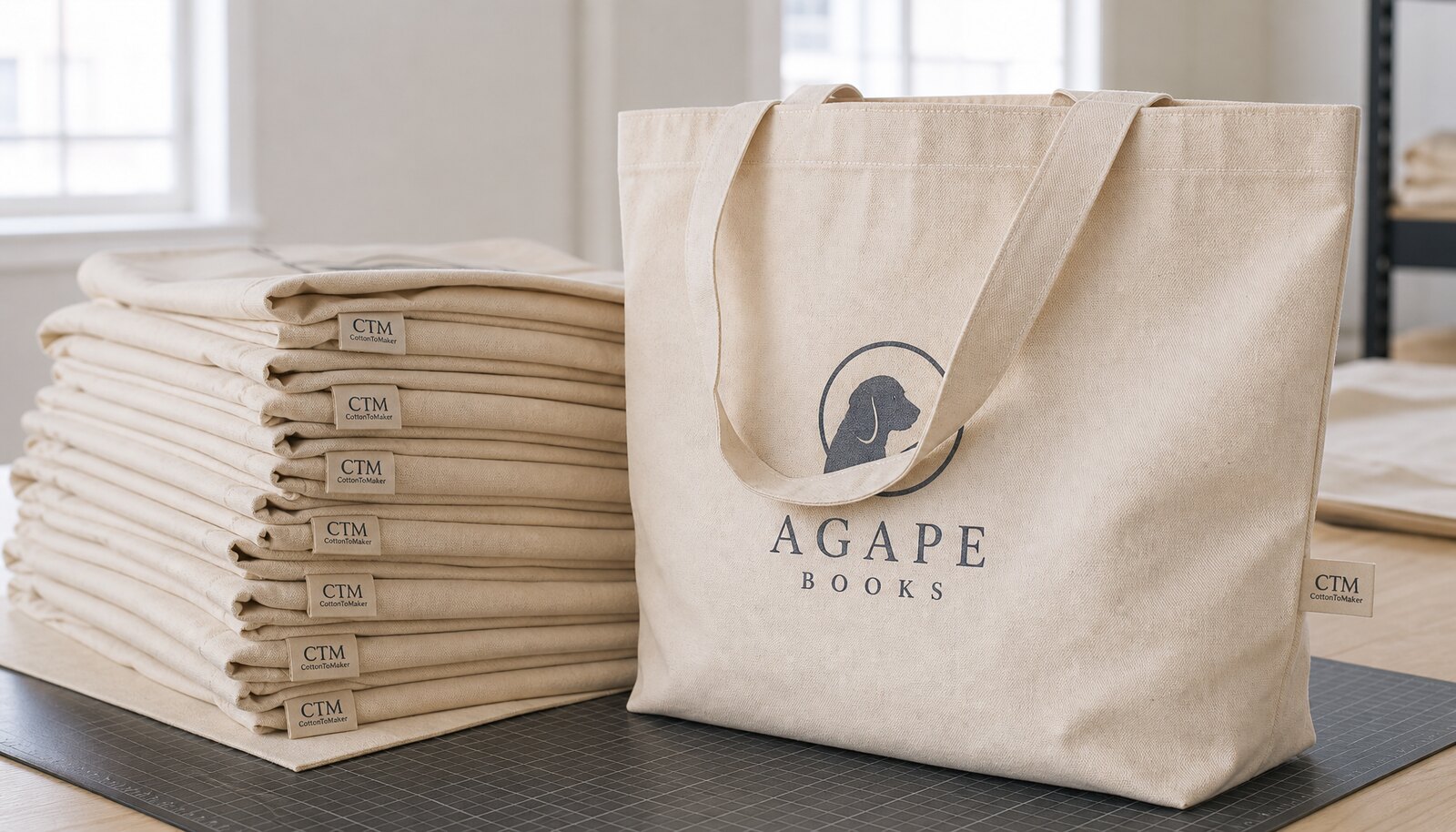
Why shipping carton planning matters for book fair totes
Canvas book fair totes for trade shows are not just a product-spec exercise. They are a logistics item that has to arrive on time, in the right count, and in a carton format your team can receive quickly. Buyers often focus on fabric weight and logo art first, but for event programs the carton plan can change freight cost, receiving labor, and damage risk as much as the bag itself. A good tote spec that is packed poorly can become a bad procurement decision once the cartons are billed, stacked, and handled.
The most common failure is approving the tote as a standalone sample and leaving carton planning for later. That usually means nobody defines the folded size, carton count, gross weight, or pallet pattern early enough. Once the production line starts, it is harder to fix an oversized carton or a poor fold method without affecting lead time. For trade shows, that matters because there is no second chance to receive the goods after the event date passes.
Treat the tote and the carton as one system. The buyer’s job is to specify the bag, but also to define how it will be folded, counted, labeled, and shipped. That approach makes the RFQ more comparable, reduces surprise charges, and gives the factory clear instructions on packing efficiency.
- Carton planning affects landed cost, not just shipping convenience.
- Flat-fold consistency is essential for accurate carton counts and warehouse receiving.
- A good sample without a defined pack method is only a partial approval.
Start with the end use, not the catalog spec
A book fair tote should be specified from the inside out. Start with what the attendee will carry: hardcover books, softcover titles, catalogs, brochures, sample kits, notebooks, or boxed inserts. Then define the tote around that load. A 38 x 42 cm bag may be perfectly fine for flat handouts, but once books and sponsor materials are added, the gusset depth and handle reinforcement become the real decision points. Buyers who skip this step often approve a tote that looks standard but underperforms on event day.
For procurement purposes, the best brief includes three things: expected contents, expected carry time, and expected handling. A tote that will be carried for ten minutes from booth to exit can tolerate a different structure than one that will be used all day across a venue. If the bag will be given away with books, the handles must stay comfortable and the seams must survive repeated stress. If it is meant to feel premium, fabric density and print finish matter more than bare minimum strength.
Canvas weight should follow the use case. Ten-ounce canvas can work for light collateral, but it can feel underbuilt once books are added. Twelve-ounce canvas is often the practical baseline for event use because it balances structure, foldability, and price. Fourteen- to sixteen-ounce canvas creates a firmer feel and can support heavier loads, but it may increase carton weight and freight cost. Buyers should not assume heavier always means better; the right choice is the one that meets the event brief without adding unnecessary shipping expense.
- Light collateral and notebooks: 10 oz can be acceptable if the rest of the spec is controlled.
- Books, guides, and mixed kits: 12 oz is usually the safer buying baseline.
- Premium feel or heavier contents: 14-16 oz may be appropriate, but verify carton weight and freight impact.
Fabric weight, weave, and finishing: where quotes stop being comparable
A common procurement mistake is comparing tote prices without comparing the exact cloth. One factory may quote 12 oz unfinished canvas, while another quotes a washed or softened cloth that feels denser in hand. If the RFQ does not define the fabric in measurable terms, the unit price comparison is not meaningful. Ask for GSM or ounce weight, weave type, color standard, and any finishing process such as washing, calendaring, or shrink stabilization. Those details change both cost and performance.
For canvas book fair totes, a stable plain weave is usually enough. If the logo is large, choose a cloth that holds print edges without excessive texture show-through. If the bag must stack tightly in shipping cartons, ask how the fabric behaves after folding and whether the supplier can predict shrinkage. A small amount of shrinkage is manageable if both parties know it in advance; uncontrolled shrinkage causes carton fit issues, handle alignment problems, and print misplacement after bulk production.
For buyers comparing offers, the useful question is not just “What fabric weight?” but “What finished fabric, with what tolerance, and what proof?” Request a swatch marked with the quoted fabric spec, and ask the factory to identify whether the quoted weight is before or after finishing. If the supplier cannot answer that clearly, the quote is too vague for serious procurement.
- Define fabric in both weight and finish, not only the word canvas.
- Ask whether the quoted weight is before or after washing or surface finishing.
- Use a labeled swatch or physical sample to verify the exact cloth being priced.
Print method choices for event-ready artwork
The print decision should follow the artwork and the end use. For one- or two-color logos, screen print is usually the most practical option because it gives strong coverage, repeatable color, and stable cost at moderate volume. It also survives handling better than many short-run alternatives when the canvas surface is relatively rough. But screen print has limits: fine lines, tiny text, and complex gradients can lose clarity if the artwork is not simplified for the substrate.
Short runs or full-color graphics can be handled with digital print or heat transfer, but buyers should treat those methods as specific solutions, not default upgrades. They can solve difficult artwork needs, yet they also add variables such as adhesion, hand feel, and fold-scuff resistance. If the tote will be folded into cartons and unpacked repeatedly at events, the print finish must tolerate rubbing at the fold line and carton wall contact. That is why a sample viewed on a table is not enough; the bag should be packed and unpacked before approval.
Woven labels and embroidery are useful when the brand wants a subtle premium look or when the tote is essentially a long-life reusable item. They are not ideal if the buyer needs a large sponsor mark or a strong promotional message visible from a distance. For trade show procurement, the right print method is the one that balances visibility, durability, and production simplicity.
- Screen print is usually best for solid logos and repeat orders.
- Digital or transfer methods are useful for short runs or complex artwork, but verify rub resistance.
- Embroidery and woven labels support premium branding, not large promotional artwork.
Supplier routes: direct factory, trading company, or hybrid sourcing
Supplier type affects more than price. A direct factory with sewing and printing in-house usually gives better visibility into line control, handle reinforcement, and carton packing. When the same production team controls fabric cutting, logo application, and packing, it is easier to hold one accountable for dimension drift or packing errors. That matters for repeat programs where the buyer wants the same tote to reorder cleanly before each book fair or trade show.
A trading company can still be a good choice when you need multi-SKU coordination, unusual color matching, or a flexible buying relationship. The tradeoff is transparency. Print, sewing, and packing may be split across different facilities, which can make root-cause analysis slower if something goes wrong. For example, a carton that arrives with the right bag design but the wrong packed fold direction is harder to fix when one party handled print, another handled sewing, and a third handled boxing.
A hybrid model can work if the buyer gets one named production owner and one set of approval documents. That means the supplier, regardless of commercial structure, should show who controls the final sample, who signs off carton packing, and who owns corrective action if QC fails. Buyers should not judge suppliers only by whether they are a factory or a trading company; they should judge them by accountability, documentation quality, and their ability to repeat the same result on the next order.
- Ask who controls sewing, printing, packing, and final QC in one document.
- For repeat programs, direct factory sourcing usually reduces ambiguity.
- If using a trading route, require one accountable production lead and one final packing spec.
How to compare supplier quotes without losing the landed-cost picture
The cheapest tote quote often becomes expensive after setup fees, packing changes, and freight adjustment. Buyers should compare quotes on the same assumptions: the same fabric weight, the same print method, the same carton count, the same sample requirement, and the same shipment term. If one quote includes one-side print and another includes two-side print, or if one uses bulk packing while another uses retail-style inner packaging, the price spread is not comparable.
Commercially, the line items to watch are screen setup, color-change charges, rush fees, label or hangtag add-ons, inner poly bags, carton inserts, barcode labeling, and special palletization. Each one can be legitimate, but each one should be explicit. A small print setup fee can become irrelevant at 5,000 pieces; it becomes meaningful at 300 pieces. Likewise, a tight carton spec can reduce freight enough to offset a slightly higher sewing price. Procurement buyers should calculate the landed cost per deliverable carton, not just the unit bag price.
When a supplier offers a low unit price, ask what was removed to make it low. Was the handle reinforcement reduced? Was the fabric weight rounded down? Was the packing density increased without changing carton size? Was the sample production limited to a blank bag? Those are not minor details. They are the hidden variables that determine whether the tote is actually usable at the event.
The table below is a practical decision framework for buyers comparing sourcing routes and pack logic.
- Compare quotes only after aligning print side, fabric spec, carton count, and sample scope.
- Ask for all extras in writing: setup, labels, barcode, special packing, and rush charges.
- Use landed cost per delivered carton, not only bag price, for final comparison.
RFQ structure: what to send so the factory can quote accurately
A strong RFQ saves time on both sides. The best request includes the bag size, gusset depth, handle drop, fabric spec, print artwork, quantity by color, carton preference, delivery window, destination, and any event labeling requirement. If the tote is for a trade show, say so. Trade show shipments often need predictable carton counts, easier receiving labels, and a packing style that avoids last-minute warehouse sorting.
The RFQ should also identify what the supplier is allowed to propose. For example, you might allow the factory to recommend carton count based on the final fold thickness, but not to change the fabric weight or handle length. Or you might ask for two options: one optimized for lowest unit price and one optimized for lowest freight cost. That kind of brief forces the quote to show tradeoffs instead of hiding them.
For book fair programs, it is helpful to include a simple question list in the RFQ itself: what is the expected packed gross weight, what carton size do you recommend, how many pieces per carton, and what export marks will appear on each carton? A supplier that answers those questions clearly is usually easier to manage during production.
- State the event date and delivery destination in the RFQ.
- Specify which variables are fixed and which the supplier may propose.
- Request both product price and carton-plan recommendation in the same response.
Sampling: approve the bag you will actually ship
A blank sample is useful for fabric hand feel and basic dimensions, but it does not prove the bulk order is ready. For an event tote, the pre-production sample should use final fabric, final thread, final print method, final label placement, and final fold direction. If the sample is not packed the way the bulk order will be packed, it cannot validate carton fit. That is especially important for canvas book fair totes for trade shows shipping carton planning, where a few millimeters can change whether the carton count is realistic.
Good sample review is practical. Measure the bag’s open width, body height, gusset depth, and handle drop. Check whether the handles sit evenly and whether the stitch pattern is symmetrical. Fold the bag exactly as the factory plans to fold bulk production, then verify the packed thickness and the stack behavior. If the logo sits close to a fold line, test whether the print cracks, rubs, or transfers when the sample is compressed in a carton.
Ask the supplier to send sample photos from the front, back, side seam, inside seam, and folded state. If possible, request one physical pre-production sample and one packed carton photo that shows the actual count, carton label, and fold orientation. Those extra images often catch problems that a single glamour shot will hide.
A strong approval process should end with a signed or written sample record that lists the approved fabric, print placement, dimensions, carton count, and carton mark format. That record becomes the reference if the bulk shipment diverges later.
- Approve a sample only after verifying both the open bag and the folded pack condition.
- Measure dimensions after folding, because carton fit depends on the real packed size.
- Keep a written sample approval record tied to the same spec version as the RFQ.
Carton planning: packing math, carton size logic, and freight optimization
Carton planning should start with the folded tote thickness, not with a random standard carton. Once the factory knows the folded dimensions and the material weight, it can determine a realistic piece count per carton. A common mistake is to pack as many pieces as possible until the box feels full. That often creates bulging cartons, crushed corners, and cartons that exceed practical handling weight. A more controlled approach is to set a target carton gross weight and a target carton size first, then work backward to the piece count.
For most canvas tote orders, flat-folded packing is the most efficient approach. The question is how many bags per carton can be packed without distortion. A 10 oz tote may allow a higher count, but a 14-16 oz tote will usually require a lower count because the stack thickness grows quickly. If the tote has a sewn-in brand label, a stiff print panel, or an inner reinforcement patch, the folded stack becomes less compressible. Buyers should ask the supplier to show the fold sequence and the resulting thickness before finalizing the carton spec.
Carton dimensions affect freight in two ways: cubic volume and handling practicality. Bigger cartons can raise dimensional weight and reduce pallet efficiency. Smaller cartons may reduce risk, but they increase carton count and warehouse labor. Buyers should compare three values together: piece count per carton, gross weight, and cubic volume. That is the only reliable way to judge whether one packing plan is actually cheaper than another.
A useful freight optimization test is to ask the supplier for two pack options. Option A: higher piece count per carton for lower carton count. Option B: lower piece count per carton for easier handling and safer stackability. The best choice depends on whether your receiving team, carrier, and destination warehouse care more about labor efficiency or volumetric freight. In many trade show programs, a slightly smaller carton pays for itself by reducing damage and speeding receipt.
If the shipment will be palletized, the carton plan should include layer count, pallet footprint, stack height, and whether the top layer needs compression protection or corner boards. Buyers should also ask for carton marks that identify the PO, item code, event name, and carton number in sequence. That makes receiving and partial distribution easier once the cartons arrive at the warehouse or venue staging area.
When quantities are large enough for export, a basic carton plan should also account for drop risk and compression. A carton that looks fine in a warehouse may fail after conveyor handling or rough transfer. For that reason, the carton spec should be treated as part of the product specification, not as packing afterthought.
- Set target carton gross weight and cube before deciding piece count.
- Ask for two packing options when freight and handling are both important.
- Include pallet stack height, carton marks, and carton numbering in the packing spec.
Commercial extras that change the quote: packaging, marks, and compliance details
In tote sourcing, small extras can materially change landed cost. Inner poly bags may be needed if the canvas is prone to dust, but they add labor and plastic cost. Retail-style inserts may be useful for resale channels but usually do not help trade show distribution. Barcode labels can speed receiving, yet they need format control so the warehouse can scan the right item. Hangtags, size stickers, and branded stickers are all legitimate options, but each one should be quoted separately.
Carton marks matter more than many buyers expect. At minimum, cartons should show PO number, item name or code, quantity per carton, carton number, and ship-to destination. If the order is for a sequence of events or multiple venues, carton marking should be even more specific. Buyers should not assume the factory will know which cartons go where. Clear marks reduce sorting labor and help the warehouse stage inventory in the right order.
For compliance and cost planning, buyers may also need to define fiber content labeling, country of origin marking, or destination-specific carton language. Even if the tote itself is simple, the carton and inner labeling can still affect lead time if the supplier must reprint or source label stock. The safest approach is to list all packaging and marking requirements in the RFQ, not after production begins.
Ask the supplier to tell you early if any requested extras will move the order into a different packing line or increase the lead time. A transparent answer is more useful than a low quote that changes later.
- Quote packaging separately: inner poly, inserts, stickers, barcode labels, and hangtags.
- Define carton marks clearly by PO, item code, quantity, carton number, and destination.
- Ask whether any label or compliance request changes the production line or timeline.
Specification comparison for buyers
| Spec decision | Recommended option | When it fits | Buyer risk / cost impact to check |
|---|---|---|---|
| Fabric weight | 12 oz canvas as the practical baseline; 10 oz only for light inserts; 14-16 oz for premium feel or heavier loads | Trade show handouts, book fair kits, notebooks, catalogs, and mixed promo packs | Lower-weight fabric can reduce price, but it may stretch at the handle base, show through on dark printing, or feel too thin for a buyer-facing event |
| Fabric finish | Stable plain weave with documented GSM/oz, shrinkage note, and color tolerance by swatch | When the tote must pack flat and print registration matters | Unspecified finishing can cause shrink, skew, or a different hand feel between sample and bulk |
| Print method | Screen print for 1-2 solid colors; heat transfer or digital print for short-run full-color art; woven label or embroidery for minimal branding | When the artwork must stay legible after folding, packing, and event handling | Fine text and gradients can blur or crack if the method is mismatched; extra print colors raise setup fees and MOQ pressure |
| Handle construction | Reinforced handles with cross-stitch or box-x reinforcement, handle drop suited to shoulder carry | When attendees will carry books or kits around a venue for hours | Short handles increase complaints; weak reinforcement increases failure risk at the stress point and raises claim exposure |
| Bag format | Approx. 38 x 42 cm with 8-12 cm gusset for books, catalogs, and standard event kits | Most trade-show giveaways and book fair distribution programs | A flat tote can look neat in a sample photo but become unusable once books or boxed inserts are added |
| MOQ route | Factory pricing with one fabric spec, one print spec, and one pack spec; avoid mixing too many variables in the first order | When you need repeat replenishment and predictable production control | Low MOQ can hide higher setup recovery, slower sampling, or substitutions in fabric and thread |
| Carton packing | Flat-folded bags packed to a defined count per carton; usually 50-100 pcs depending on thickness and carton limits | When freight cost, warehouse receiving, and carton stack safety matter | Overpacked cartons raise cubic freight, split tape seams, and increase transit damage |
| Supplier type | Direct factory with sewing and printing in-house, or a tightly managed manufacturer with one accountable production lead | When carton dimensions, print position, and repeat production need stability | Split responsibility between sewing, printing, and packing makes defect resolution slower and less transparent |
| Sampling route | Pre-production sample with final fabric, final print, final fold, and final carton count | Any order tied to a fixed event date or a freight booking window | A blank sample does not prove carton fit, print opacity, or packed gross weight |
Buyer checklist before sampling
- Confirm final bag dimensions, gusset depth, handle drop, and intended load weight before asking for price.
- Specify fabric weight in GSM or oz, finish type, color standard, and any shrinkage expectation.
- Provide vector artwork, logo placement, print size, and Pantone references or approved color target.
- Ask for a physical pre-production sample using final fabric, final print method, and final fold method.
- Approve carton count, carton dimensions, gross weight, carton marks, and barcode requirements before bulk sewing starts.
- Write QC acceptance criteria for stitching, print coverage, stains, loose threads, odor, and carton integrity.
- Confirm palletization needs, stacking limit, export marks, and whether master cartons must be labeled by PO, item code, or event destination.
Factory quote questions to send
- What is the exact fabric weight in GSM or oz, and is that measurement before or after washing, coating, or finishing?
- Is the quoted price for blank bags, one-side print, or two-side print, and does it include screen setup or plate fees?
- What is the MOQ by fabric color, print color, and packaging method, and where do surcharge thresholds start?
- What carton size do you recommend for this tote, how many pieces per carton, and what gross weight do you expect per carton?
- Will the pre-production sample use final fabric, final thread, final print method, and final packing method?
- Can you provide a packing spec with fold direction, inner pack details if any, master carton marks, and palletization guidance?
- What dimensional tolerance do you hold for width, height, gusset, and handle drop, and how are those measurements checked?
- What is the lead time after sample approval, and which steps could extend it, such as fabric sourcing, artwork revision, or carton redesign?
Quality-control points to confirm
- Agree a practical tolerance for fabric weight and verify it on incoming material, not just on the finished bag description.
- Measure bag width, height, gusset, and handle drop on a flat table after pressing or folding, because the packed carton fit depends on those real dimensions.
- Inspect stitching at handle joins, gusset seams, and side seams for skipped stitches, loose thread tails, broken thread, or uneven bar-tacks.
- Check print position against the approved spec, including centering, edge clearance, opacity, and whether the reverse side shows bleed where that matters.
- Define an acceptable defect threshold for stains, oil marks, needle damage, dirty folds, and misprints; do not accept a shipment if the lot is visibly inconsistent.
- Request carton checks for correct piece count, dry cartons, intact tape seams, and legible marks; damaged cartons should be re-packed or replaced.
- Add carton drop or compression checks for export or long-distance freight when the order volume is high enough to justify it.
- Confirm the folding method and carton count on the sample approval sheet, because a tote that looks right on a table may fail once packed at production speed.