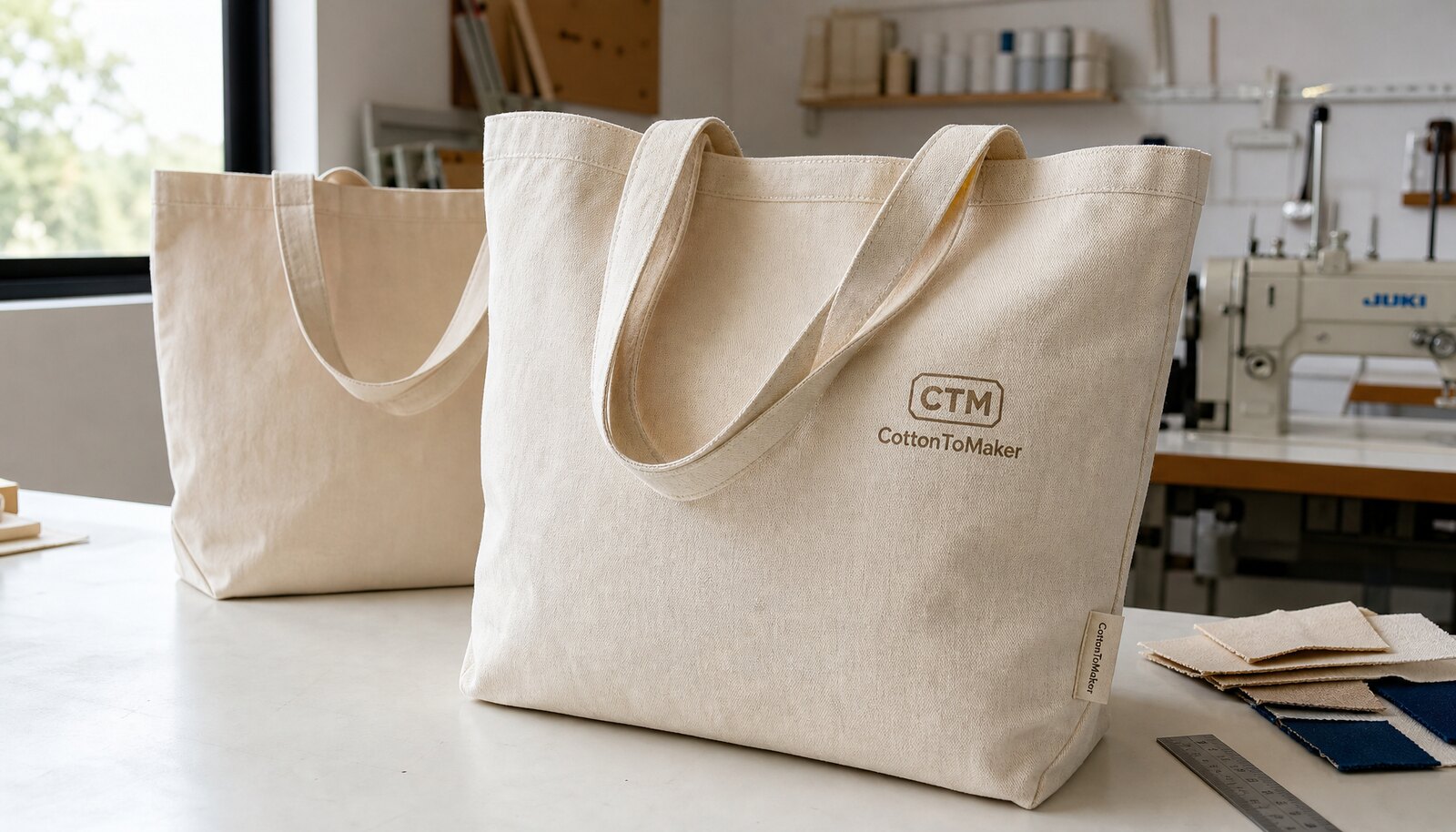
Why subscription-box totes need a different print decision
Canvas book fair totes for subscription boxes are not judged like retail totes or event giveaways. The buyer is paying for a product that must survive carton compression, repeated folding, and the first unboxing experience, while still arriving with a clean face and a predictable print result. In a subscription program, the decoration method affects more than appearance. It affects carton fit, kitting speed, damage risk, and whether the same tote can be reordered without re-engineering the job.
That is why the print method should be selected as a procurement choice, not a purely creative one. A one-color logo may be the lowest-risk option if the tote is a recurring insert and the brand needs consistency. A seasonal full-color graphic may work for a one-off campaign, but if the artwork changes every box cycle, the supplier may need new tooling or materially more labor each time. Premium decoration such as embroidery or a sewn patch can improve perceived value, but it can also raise unit cost and slow the line if the factory is not strong on stitch control or attachment consistency.
For buyers, the first question is not 'Which method looks best?' It is 'What job is the tote doing in the box?' If the tote is a thank-you insert, cost and fold efficiency matter most. If it is a hero item inside the shipment, print quality, color fidelity, and tactile impression carry more weight. If it will be reordered quarterly, repeatability matters more than a one-time visual win. Once that role is fixed, the comparison gets clearer and the quote review becomes commercial instead of aesthetic.
The best procurement decisions also account for fulfillment. A tote that arrives folded too thick to fit the box, or with a print that scuffs against the carton wall, creates downstream labor and customer-service problems. Buyers should therefore evaluate decoration together with tote structure, fold plan, and pack-out method. That is the real context behind this category.
In practice, the strongest sourcing teams treat the tote as a combined construction-and-decoration item. They specify the body, the artwork, the fold, and the pack plan together, then ask the factory to quote the same configuration every time. That is the simplest way to make a canvas tote comparison meaningful.
Sometimes the most expensive-looking method is not the most expensive landed result. A screened logo on the right canvas weight may outperform a cheaper-looking transfer once reject rates, rework, and packing damage are counted. Procurement buyers should think in terms of total delivered units that meet spec, not just unit price on the first page of the quote.
- Start with the tote’s commercial role: insert, gift, premium item, or resale accessory.
- Compare print methods by handling risk, not only by artwork style.
- Treat packaging and fold behavior as part of the decoration decision.
- Repeat orders favor methods that can be reproduced with stable tooling and clear QC records.
Freeze the tote spec before you compare suppliers
A common sourcing mistake is asking for prices before the tote spec is frozen. On canvas totes, small changes alter both cost and print quality. If the supplier assumes an 8 oz body while the buyer expects 10 oz, the unit price will look attractive but the bag may not hold shape or accept decoration the way the buyer expects. If the artwork area is large and the canvas is too light or too loose, ink opacity and registration can drift. Procurement buyers should lock the tote spec before requesting final quotes.
At minimum, the RFQ should define body dimensions, gusset depth, handle length, handle width, seam type, reinforcement at the handle anchor, and target canvas weight in both oz and GSM. If the supplier can share weave density or fabric composition, include that too. Do not rely on 'heavy canvas' or 'premium canvas' as a standalone description. Those phrases are marketing language, not production instructions. The factory needs a measurable target if you want a comparable bid.
The finish of the canvas matters as well. Natural, undyed canvas usually gives screen print and water-based inks a workable visual base, but coarse texture can make fine details harder to hold. If the tote is dyed, bleached, or coated, color consistency and ink adhesion may shift. If the tote is meant to be flat-packed inside a subscription box, state the folded footprint and the direction of the fold so the factory builds the bag to a real packing condition rather than a generic retail standard.
One practical rule helps avoid late changes: define the tote before the art. Buyers often approve artwork on a mockup first, then discover that the print sits too close to a seam or is too large for the face panel after production starts. The better sequence is body spec, fold spec, artwork placement, then decoration method. That order reduces the chance of a late revision and a delayed shipment.
For comparison quotes, include a simple reference pack in the RFQ. A line drawing, one approved sample photo, and a finished-size sketch often remove ambiguity faster than a long narrative brief. The goal is not to over-document the tote. It is to eliminate the few dimensions and locations that create most of the cost and quality variance.
If the program includes repeat ordering, note that in the spec sheet. A supplier that knows the tote will be reordered can preserve screens, stitch files, or transfer settings, which matters for consistency and for avoiding a second setup charge later.
- State the target canvas weight numerically; do not accept only descriptive terms.
- Include body dimensions, gusset, handle construction, and fold footprint in the RFQ.
- Ask for weave or fabric detail if the factory can provide it, especially for premium programs.
- Confirm that the art area fits the actual panel after seam allowance and folding are considered.
How the main print methods compare on canvas
The commercial comparison should start with the artwork, then move to volume, then to durability. Screen print is usually the first method buyers consider because it performs well on simple graphics, especially one- or two-color logos, and it tends to become cost-effective at higher volume. The process is mature, the finish can be sharp, and the method is familiar to most tote factories. The tradeoff is setup. Each color adds a screen, registration step, and curing requirement, so the economics weaken when the art changes often or includes many colors.
Water-based screen print is a useful variant when the buyer wants a softer hand and a more natural look on cotton canvas. It can work very well on light or undyed canvas, but it requires disciplined control of viscosity, mesh, and curing. Buyers should not assume that every supplier can deliver the same result. On textured canvas, opacity may drop and the factory may need extra passes. That does not make the method poor; it means the quote should include process expectations and sample approval on the actual fabric.
Transfer-based methods, including DTF and heat transfer, are often chosen when the art changes each cycle or when the program starts as a short run. They reduce the need for new screens, which helps when the buyer is still validating demand. The downside is durability under repeated folding and the possibility of edge lift, cracking, or a stiffer hand feel. For subscription-box inserts, those issues matter because the tote often arrives tightly folded and may be handled multiple times before it reaches the end user.
Embroidery and woven or sewn patches create a different value proposition. They are best for premium badges, small logos, or retail-style presentation rather than full-panel graphics. Buyers should think of them as value-adding construction rather than simple print methods. The price can rise quickly, but the perceived quality can also improve if the factory controls thread tension, patch edges, and placement. The wrong choice is usually not the method itself; it is using a premium decoration route for a job that needs speed, low unit cost, and frequent artwork changes.
Blank tote plus local decoration is sometimes the best answer. It can reduce risk when demand is not proven or when regional fulfillment matters more than factory-side decoration. But the buyer then owns more of the decoration risk later in the supply chain, which means the local partner must be checked with the same seriousness as a factory decorator.
A final caution: artwork complexity matters more than the visual mockup suggests. A logo with a fine reverse line, a small multi-color emblem, or a tight white knockout can be easy on a screen but expensive on a transfer or patch. The buyer should rate the art against the process, not the other way around.
- Screen print: best for simple, repeatable graphics and stable demand.
- Water-based screen print: good for a softer hand on natural canvas, with tighter process control needed.
- DTF/transfer: useful for short runs and changing artwork, but inspect fold durability carefully.
- Embroidery/patches: best for premium badges, not broad full-color artwork.
Buyer-grade comparison matrix: cost, MOQ, artwork limits, and breakpoints
Procurement teams need more than a recommendation matrix. They need a decision tool that shows where each method is commercially strong and where it becomes risky. On canvas, durability is not just about ink chemistry. It also depends on fabric texture, folding stress, cure quality, and how the tote will be packed. A method that looks excellent in a flat sample may show edge wear once the bag is folded into a subscription box and reopened several times.
The most useful quote comparison includes setup cost, MOQ guidance, artwork limits, and the break-even volume where one method starts to overtake another. For example, screen print can be the lowest landed-cost route once the same logo is repeated over multiple cycles. By contrast, DTF may be better at very low volume or when the design changes frequently, but the recurring unit cost and hand feel may be less attractive as the program scales. None of this is theoretical; it is normal decoration economics.
Do not let a supplier steer the discussion only toward decoration style. Ask what happens to the cost curve when the order doubles, when a second color is added, or when the artwork changes next season. A supplier that can answer those questions clearly is likely thinking like a production partner rather than just a quote taker. One that cannot usually treats every order as a fresh custom job, which is expensive in repeat programs.
A practical decision threshold: if you expect the same art to run again within six months and the order is above roughly 300 units, screen print is usually worth pricing first. If the art changes frequently or the first order is a market test under 300 units, a transfer or local decoration path can be more efficient. If the tote is positioned as a premium insert and the logo is small, embroidery or a sewn patch can justify itself above roughly 100-200 units, provided the buyer accepts the higher unit cost.
Decision-making should also account for artwork complexity. Fine text below about 8-10 pt, gradients, photographic detail, or multi-color shading can increase reject risk on screen print and push the job toward transfer or patch solutions. Conversely, large simple art on natural canvas can favor screen print even at moderate volume because the process is straightforward and repeatable. The buyer’s job is to match the art to the process, not to chase the cheapest quote that ignores the decoration constraints.
- Ask for setup cost separately from piece price.
- Request the volume where each decoration method becomes efficient.
- Test the finished tote after folding, not only as a flat sample.
- Use durability failure modes as part of the bid comparison.
What to ask suppliers before award
For a procurement buyer, supplier qualification is more than checking whether the factory can sew a tote. You need to know whether the supplier can execute the specific decoration method at the required quality level. That starts with capability questions: Do they own or control the print process in-house? Do they subcontract embroidery or transfers? Can they repeat the job with the same placement and shade on a reorder? Can they show recent production photos or process records, not just a catalog? If the supplier cannot answer those questions clearly, the risk of quote drift is high.
Useful documents to request go beyond samples and prices. Ask for a business registration or factory registration document, export capability proof where relevant, a material composition declaration, and any compliance certificates required by your market. If the tote uses dyed fabric, ask for dye-lot or color-control records if the factory can share them. If the print is subcontracted, ask who owns the final QC sign-off and how rejected units are handled. A reliable supplier will be able to explain the actual production chain. A weak one will only show a quote and a hand sample.
The country or region matters for practical reasons, not as a shortcut judgment. The issue is lead-time reliability, compliance expectations, and logistics risk. If you are buying into a market with strict labeling or material rules, ask how the factory handles documentation and whether they have shipped similar products to your destination market. Longer transit routes can also hide variation in carton condition, so the packing spec must be robust enough to survive the journey. Buyers should think in terms of operational control rather than slogans about low-cost sourcing.
One useful check is whether the supplier can work from a repeatable tech pack. Send the same spec to every bidder and compare their questions. Strong suppliers will ask about artwork position, fold size, print face protection, pack count, and reorder cadence. Weaker bidders often skip these details and underprice the job. For procurement, those extra questions are not a nuisance. They are a sign that the factory understands the commercial realities of subscription-box tote programs.
Ask to see how the supplier separates approved samples from bulk production. A factory that retains a master sample, labels work-in-progress, and can identify rejects by batch is much easier to manage on repeat orders. That is especially important if the tote is part of a recurring book fair or membership box program where the same spec must be recreated later with minimal drift.
If the supplier uses multiple sites, ask which site produces the body and which site handles decoration. Mixed-site production is workable, but it needs clear handoff controls. Buyers should not assume one purchase order automatically creates process discipline across more than one facility.
- Ask whether printing, embroidery, or transfer work is in-house or subcontracted.
- Request business registration, export capability proof, material declaration, and required compliance documents.
- Confirm who signs off on quality if more than one production site is involved.
- Treat the supplier’s questions as part of qualification; strong factories ask about pack-out and reorder logic.
Sample approval that actually reduces risk
A decorated tote should pass through a clear sample sequence. First, approve the blank tote to confirm body dimensions, fold behavior, handle symmetry, and seam construction. Second, approve the strike-off or decorated sample to judge logo size, color, placement, and print sharpness. Third, approve the pre-production sample, which shows the total result once sewing, decoration, and packing are combined. Skipping one of these stages often leads to disputes later, especially when the tote must fit inside a subscription box rather than simply hang on a retail hook.
The sample should be inspected under normal usage conditions. That means daylight or the same lighting the customer will likely see, plus a fold-and-unfold check. If the design is near a seam, gusset, or handle anchor, inspect it from the angle a consumer will see after opening the box. Hold the tote at arm’s length, because small print shifts may not matter on a factory bench but can be obvious in an unboxing video or customer photo. If the print method is a transfer, wait for the recommended cooling time before judging adhesion; some edge issues only appear after the material settles.
This is also the stage to define acceptable variation. Buyers should not assume the factory understands whether a slight logo drift is tolerable or whether a darker shade on a second sample is acceptable. Spell out the acceptable range in writing, then attach the approved sample or images to the PO. If your brand is sensitive to appearance, mark the master sample and ask the factory to keep a retained reference. That simple habit reduces back-and-forth on repeat orders.
Practical sample tests do not require a full lab. A procurement team can still do useful checks on site or by mail. Rub the print with a white cotton cloth, fold the tote several times along the expected fold line, and examine the print edges after reopening. Check whether the tote springs open, whether the handle length still looks balanced, and whether the face panel wrinkles in a way that hides the logo. Those simple checks often reveal more than a perfect-looking product photo.
If the bag will be distributed by a subscription service, test a sample inside the actual box cavity. That step catches the mistake where a tote looks correct as a standalone bag but is too bulky when inserted with other items. A sample that passes on the bench but fails in the box is not an approved sample; it is a production risk in disguise.
For repeat programs, ask the factory to tag the approved sample with production date, color reference, and method reference. This is not administrative excess. It is the easiest way to keep the next order aligned with the first one when personnel changes or the buyer rotates to a new sourcing manager.
- Approve blank, decorated, and pre-production samples in sequence.
- Test the tote under the same fold and handling conditions the customer will face.
- Set acceptance limits for placement, color, and edge quality in writing.
- Keep a retained master sample for repeat orders.
QC thresholds to write into the PO
QC on printed canvas totes works best when the standard is written in measurable terms. Start with the obvious dimensions: body size, gusset, handle length, and folded footprint. Then define the decoration tolerances. A small logo near the upper panel may need a tighter placement window than a large artwork centered on the face. If the print moves too close to the seam or fold line, it can look crooked even if the factory considers it within a loose internal tolerance. Buyers should specify the actual margin they can accept.
The next priority is print durability. For screen print, request evidence of a rub test and, if the program involves fold stress, a repeated fold test as well. For transfer-based decoration, ask for edge-lift inspection and a fold-reopen cycle test. If the tote will be stored or packed against other items, test the print after brief compression in carton-like conditions. In procurement terms, the defect is not just a visible flaw at the factory; it is a customer-visible flaw after shipping and unpacking.
A practical acceptance standard can combine general visual inspection with AQL sampling. Many buyers use General Inspection Level II and separate defect definitions for major and minor defects, but the exact standard should reflect your brand tolerance and market risk. A major defect on this product would include wrong size, open seam, broken handle anchor, severe misprint, ink transfer, stain, or obvious delamination. A minor defect might include loose thread ends, slight off-color variation within the approved window, or a small cosmetic mark outside the logo area. The important point is that the categories must be written before production starts.
Do not over-focus on one defect and miss the pack-out condition. If the tote ships in a polybag, check whether the face print rubs against the bag or carton. If it ships nested or folded without a bag, check whether stack pressure creates a crease through the logo. Some of the most common complaints are not sewing failures at all; they are pack-related appearance problems that the factory should be asked to control explicitly.
QC also needs an escalation rule. If the first pre-shipment inspection finds a repeated defect, the factory should stop packing, rework the affected lot, and send a containment photo before continuing. Buyers should write that stop-and-fix trigger into the purchase order or quality agreement. That is more useful than a generic promise to 'ensure quality.'
Finally, define the sample size and who pays for reinspection if the lot fails. Those terms matter in tote programs because the unit value can be low, but the handling cost and schedule disruption can be high. A clear failure path reduces arguments later and pushes the factory to solve the problem early.
- Define body dimensions, handle length, and folded footprint with tolerances.
- Use rub, fold, and edge-lift tests to evaluate print durability.
- Write major and minor defect categories into the PO before production starts.
- Inspect pack-out as part of QC, not as a separate afterthought.
Packaging and kitting: the tote has to fit the box
Subscription-box totes are often lost in the handoff between manufacturing and fulfillment. Yet packing is one of the biggest sources of avoidable problems. If the tote is folded too thick, it may force the box to bulge or crush other contents. If the print face is left exposed in a carton, the ink or transfer can scuff. If the tote unfolds too easily, the kitting line slows down and labor cost rises. The pack method should therefore be specified with the same care as the fabric weight or print color.
The buyer should define folded dimensions, stacking direction, and face protection. If the tote is inserted as a loose flat item, the risk profile is different from a tote packed with tissue or a bagged premium insert. A simple specification can say which panel must face outward, whether the handles are tucked inside, and whether a separator sheet must sit between printed faces. For recurring programs, it is worth giving the 3PL a written pack diagram instead of assuming the process will be obvious. Kitting teams work quickly; they should not have to interpret a decorated product on the fly.
The outer carton spec matters too. If multiple totes are packed together, the carton should be sized so the stack does not buckle the print surface. If the order includes printed labels or barcodes, define whether those labels go on the tote polybag, the inner pack, or the master carton. Misplaced labels create scanning problems and can turn a correct tote into a fulfillment exception. In short, packaging is not the end of the process. It is part of the product design and should be approved with the same discipline as the decoration method.
If the bag is meant to sit beside books or other rigid items, consider whether edge protection is needed at the print location. A patch or embroidery can tolerate some rubbing better than a large transfer, while a large screen print may require better fold control. That is another reason to decide packaging and decoration together rather than as separate workstreams.
For buyers managing seasonal programs, it helps to document the pack-out in a one-page visual. Show the open tote, the folded tote, the carton orientation, and the top-load sequence. That small control document can prevent a lot of avoidable kitting mistakes later.
The right pack spec also helps with reorder continuity. If the original order used a certain fold direction to fit a specific cavity, repeat that in the re-order instruction set so the new batch does not arrive correct on paper but incompatible with the existing box line.
- State the folded footprint and the direction of the fold in the pack spec.
- Protect the print face if the tote will rub against carton board or other items.
- Give the 3PL a simple pack diagram for repeatable kitting.
- Confirm carton counts, barcode locations, and whether inner bags are required.
How to read quotes as landed cost, not just unit price
To compare suppliers properly, build the quote around the same commercial assumptions. A unit price without the supporting details can hide the real cost of setup, handling, and rework. Ask each supplier to quote the same canvas weight, tote dimensions, decoration method, print size, color count, fold method, and pack count. If one supplier includes screens and another excludes them, or one quotes blank tote only while another includes decorating and packing, the numbers are not comparable.
The comparison should also include the expected breakpoints. Screen print may be the strongest value once the design repeats, while a transfer may be better for lower-volume or changing art. Embroidery and patches can provide a premium effect, but the added labor or component cost may outweigh the benefit unless the tote is positioned as a higher-value item. Buyers should ask the factory to show what changes when the order doubles, when a second decoration location is added, or when the artwork changes next cycle. Those scenarios expose the actual cost curve.
Freight and packing are part of the landed cost, not an afterthought. A tote that ships in a larger carton because it is not folded efficiently can cost more in freight than a slightly higher decoration method. Likewise, a quote that excludes replacement samples, artwork revisions, or extra approval rounds may look cheap at first and then become expensive later. The buyer’s goal is not the lowest factory price; it is the lowest risk-adjusted cost that still meets the unboxing standard.
When possible, ask the factory to quote line items for fabric, cutting, sewing, decoration setup, decoration labor, packing labor, inner packaging, carton materials, and outbound preparation. This makes it easier to compare a direct factory bid with a trading-company bid or a regional decorator quote. If the suppliers are not quoting on the same basis, the decision is not truly commercial yet. It is still just a price list.
For subscription-box programs, the cheapest quote can become expensive if the bag takes longer to pack or if the print scuffs during transit. A slightly higher landed unit cost may be the better choice if it reduces rejects, improves box fit, and lowers kitting time. That is the right way to think about the order: delivered tote, not factory tote.
If you expect the design to repeat, consider asking for a reorder price schedule. A factory that can hold screens, files, or embroidery data and price the repeat more efficiently is often the better long-term partner, even if the first order is not the absolute cheapest.
- Use identical assumptions across all bids before comparing price.
- Ask for line-item quotes so setup, labor, and packing are visible.
- Check the cost impact of added colors, extra print locations, and artwork changes.
- Include freight-ready packing in the landed-cost view, not only the factory price.
Specification comparison for buyers
| Print method | Best commercial use | Setup cost / tooling | Typical MOQ guidance | Artwork complexity limit |
|---|---|---|---|---|
| Screen print | Stable one- to two-color logos on repeat subscription-box programs | Moderate setup: screens, registration, and curing controls; each color adds cost | Often most efficient at about 300-1,000 pcs per art version; below 300 pcs, setup can dominate | Best for simple spot art, bold text, and flat shapes; fine gradients are harder on textured canvas |
| Water-based screen print | Natural look for brand marks where a softer hand is preferred | Similar to screen print, with tighter control on ink viscosity, mesh, and absorbency | Usually workable at 300-1,000 pcs if the supplier has stable in-house print control | Best for one-color or two-color art with clean edges; light textures may reduce opacity |
| DTF / heat transfer | Short runs, seasonal graphics, and artwork that changes every box cycle | Lower artwork setup than screen print, but transfer film and application labor add recurring cost | Often attractive at 50-300 pcs and still usable up to 1,000 pcs when artwork changes frequently | Handles small text, fine lines, and multicolor art better than screen print, but not ideal for very large coverage areas |
| Vinyl transfer | Simple names, short text, or very limited promotional runs | Low setup but higher labor per piece | Usually only practical at 25-200 pcs or for emergency replacement orders | Best for small text or simple marks; not suited to large illustrations or soft gradient art |
| Embroidery | Premium badge, small logo, or retail-ready add-on tote | Higher setup and labor due to digitizing and stitching | Often most efficient at 100-500 pcs when perceived value matters more than minimum price | Best for compact logos and badges; not suitable for broad artwork or very fine copy |
| Woven patch / sewn patch | Brand badge that needs a premium look without stitching the full logo into the tote body | Moderate setup for patch production plus sewing labor | Usually practical at 100-500 pcs when the design is stable | Best for small emblem-style art; not ideal for detailed image reproduction |
| Sublimation / all-over print on treated substrates | Only for coated or blended substrates, not standard cotton canvas | High tooling dependence and substrate restrictions | Rarely the right choice for plain canvas tote programs | High-coverage art is possible only on compatible materials; not a default option for cotton canvas |
| Blank tote plus local decoration | Urgent programs, regional fulfillment, or uncertain demand | Low factory setup if the tote is shipped blank; decoration happens closer to the 3PL or market | Useful for pilot runs of 25-200 pcs or when regional decoration is preferred | Depends on local decorator capability; the tote body should stay simple |
Buyer checklist before sampling
- Confirm the canvas weight in oz and GSM, plus the weave density if the supplier can provide it; do not accept the phrase 'heavy canvas' without a numeric spec.
- Define the tote use case: box insert, gift-with-purchase, premium brand item, or resale accessory. The print method should match that commercial purpose.
- Lock the artwork version, print size, color count, and placement from seam, hem, or handle anchor before asking for final pricing.
- State the fold method, folded footprint, and whether the tote must fit a specific subscription box cavity or kitting workflow.
- Request a blank sample, a decorated strike-off, and a pre-production sample; do not approve production from a digital mockup alone.
- Ask for ink type, curing method, and documented durability checks such as rub resistance, fold cracking, and edge lift on transfer prints.
- Require line-item pricing for fabric, cutting, sewing, decoration setup, decoration labor, packing, cartons, and any special insert or tissue requirement.
- Confirm overrun and underrun tolerances in writing, along with the handling of rejects, reprints, and replacement pieces.
- Check whether the supplier can produce repeat orders from stored screens, transfer files, or embroidery data without a new setup charge.
- Ask for the packing instruction sheet, carton count, inner pack spec, and whether the decorated face must be protected in transit.
Factory quote questions to send
- What exact canvas weight do you recommend for this tote size, and can you state both oz and GSM on the quote?
- Which print method are you quoting, what is included in the setup cost, and what increases the price if we change one color to two colors or add a second print location?
- What is the MOQ by decoration method, by artwork version, and by colorway? Please separate blank tote MOQ from decorated tote MOQ.
- How do you control curing or bonding for this print method, and what durability checks do you perform before shipment?
- Can you provide a decorated strike-off and a pre-production sample from the same production line, not just a lab sample or photo proof?
- What are your tolerance limits for print placement, seam alignment, handle symmetry, and folded size? Please give millimeters or inches.
- What is the pack-out method for subscription-box insertion, and will the print face be protected with tissue, polybag, or another separator?
- What is the lead time broken into fabric, cutting, sewing, printing, curing or drying, packing, and outbound cartonization?
- What documents can you share to confirm factory capability, such as business registration, export license, material sourcing records, and recent internal QC results?
- What is your overrun and underrun policy, and how are misprints, damaged units, and color drift handled?
Quality-control points to confirm
- Canvas weight must match the approved spec within the supplier’s stated tolerance; if the factory cannot state the tolerance, the buyer should request it before award.
- For printed areas, use an agreed sample reference and set a placement tolerance in the PO. A practical starting point is ±5 mm for small logos and ±8 mm for larger art, unless your brand standard is tighter.
- Print edges should be clean with no visible pinholes, smudging, incomplete coverage, or misregistration at normal viewing distance of about 30-50 cm.
- For screen print, request a dry rub test and a folded rub test on the approved sample. Define a pass/fail rule in advance, such as no visible transfer onto a white cloth after the specified rub count.
- For transfer or DTF, inspect after a fold-and-reopen cycle and after edge rubbing. Acceptable performance should exclude peeling, edge lift, or cracking that is visible without magnification.
- Stitching at the handle anchors and side seams should be straight, secure, and free of skipped stitches. Ask the supplier to state stitch density or stitch-per-inch if available.
- A useful seam-strength check is a pull or load test on the handle anchor area. For procurement, define a pass/fail threshold in your tech pack or QC sheet rather than relying on subjective inspection alone.
- Handle length and symmetry should be checked against the approved sample so the tote hangs evenly. A visible left-right mismatch is a common complaint in consumer use.
- Color consistency should be checked against the approved strike-off and across the bulk lot. If a Pantone target is used, require the supplier to note whether the match is approximate or lab-dyed to standard.
- The tote should fold cleanly into the agreed footprint without leaving a permanent crease through the logo area. A fold-memory test is especially important when the print sits near a center line.