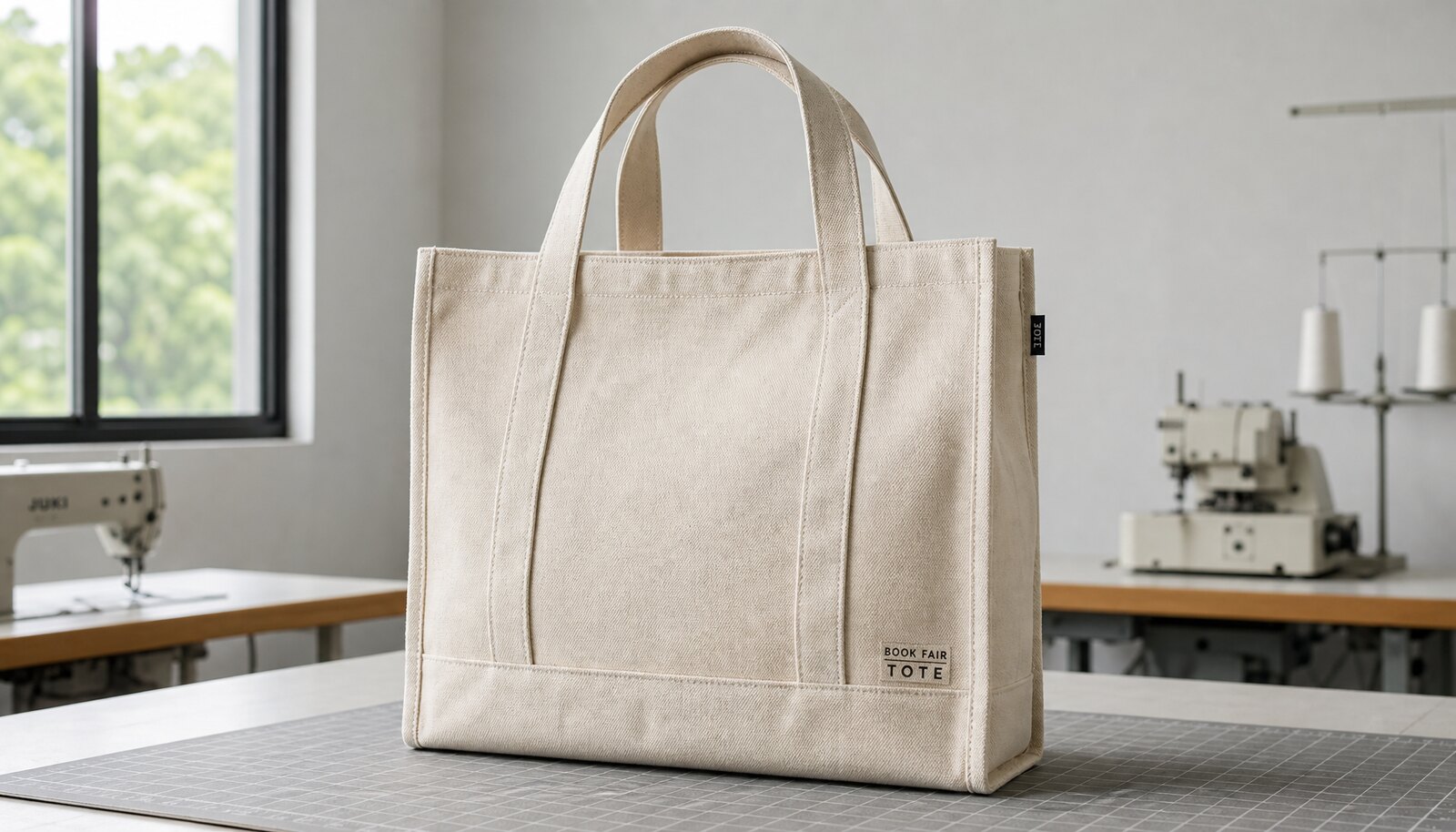
1. What hotels actually need from a book fair tote
For a hotel book fair, the tote is part utility item and part brand carrier. It needs to hold books, catalogs, brochures, and sometimes small boxed gifts without collapsing or looking improvised. That means procurement should define the real use case before talking about price. A tote that only looks good empty can fail on the distribution table if the contents are heavy, awkward, or densely packed. For this reason, a hotel program should specify expected load, appearance standard, and distribution speed together, because the bag has to work both as packaging and as a guest-facing object.
Hotels also care about how the bag reflects on the event. The tote may be used in the lobby, at a conference desk, or in a retail or book-fair setting where the guest keeps it after the event. A bag with straight seams, balanced handles, and a clean logo placement can make the program feel intentional. A bag with crooked stitching, weak handles, or blotchy print does the opposite. If the tote will be photographed, sold, or reused, quality expectations should be higher than for a one-time promo item.
The most useful procurement question is not “How cheap can this be?” but “What minimum build will survive our use case without brand complaints?” Once that is clear, the RFQ becomes much easier to write. Start with the contents the tote must carry, the carry distance, whether the guest will keep it, and whether the hotel wants a utility bag or a premium presentation piece. That distinction drives fabric weight, handle build, finishing, and inspection depth.
- Define the tote by use case, not only by item name.
- List the actual contents the bag must carry.
- State whether the tote is disposable, reusable, retailable, or keep-worthy for guests.
2. Spec choices that change performance, appearance, and cost
Canvas tote pricing changes quickly with fabric weight, weave quality, handle construction, print complexity, and packing format. For most hotel book fair programs, a practical starting point is 10–12 oz canvas, roughly 340–420 GSM, because that range usually balances body, print appearance, and freight cost. Below that range, the tote can look soft and may show distortion or print-through more easily. Above it, the bag becomes heavier to sew, more expensive to ship, and less efficient in carton packing. The right choice depends on the contents: a tote carrying a few brochures can be lighter, while one that carries hardback books usually needs more structure.
Size and handle geometry matter as much as fabric. A common commercial profile is around 38 × 42 cm with an 8–10 cm gusset, but that only works if the finished dimensions are written clearly. Buyers should specify finished size after sewing, the handle width, the handle drop, and whether the bag must stand upright when loaded. If the handle drop is too short, the tote is awkward over the shoulder. If the gusset is too narrow, the tote may fit the artwork spec but fail in actual use.
If the hotel wants a premium look, ask for cleaner finishing rather than simply heavier fabric. A neat hem, even top edge, symmetrical gusset, and centered print often add more perceived value than a small fabric upgrade. Procurement teams should also decide early whether the bag needs an open top, closure tab, button, or zipper. Each added feature creates cost and QC risk, so only include it if the use case justifies it.
- Specify finished size, not cut size.
- Use GSM or oz plus tolerance.
- Tie handle drop and gusset depth to the contents the tote must carry.
- Add closures only if the use case truly needs them.
3. Comparing supplier routes before you send the RFQ
A procurement quote is only comparable if the supplier route is known. A direct factory, a trading company, and a stockist can all offer canvas totes, but they do not control the process in the same way. A direct factory is usually best when you need tighter control over fabric, sewing, print placement, and QC follow-up. A trading company may be helpful if the order mixes product types, needs language support, or requires faster coordination. A stockist may ship quickly, but the tote is often limited to existing construction and packaging choices.
The buyer should verify who actually makes the bag, who prints it, and who signs the sample. If the quote comes from an intermediary, ask for the production site name, the sample room location, and the QC contact. Do not assume the person sending the quote has authority over the production line. That distinction matters when defects appear and the buyer needs rework or replacement. If responsibility is unclear at the quotation stage, it will be harder to resolve disputes later.
When comparing suppliers, ask the same questions in the same format. Request a line-by-line quote, a sample turnaround date, and a declaration of whether the supplier controls fabric sourcing or buys through a market. Ask for audit documents if available: business license, factory address, recent social compliance summary, and any quality-management certificate the supplier claims to hold. Even if you do not require formal certification, these documents help confirm that the supplier is a real production organization, not just a sales desk. The goal is not to collect paperwork for its own sake; it is to reduce hidden risk before you release a PO.
- Confirm the actual production site and the QC signer.
- Compare suppliers on identical spec sheets only.
- Request business registration, site address, and production role before shortlisting.
4. Supplier vetting: documents, audits, and red flags
For a procurement-grade purchase, supplier vetting should be more than a price review. Ask for the documents that tell you whether the supplier can produce consistent canvas totes at scale. Useful documents include a business registration, factory address, production line photos, recent audit summary if available, and any quality system documents the supplier already uses internally. If the supplier claims certifications or compliance capability, ask for copies rather than verbal assurance. The point is to confirm actual capability, not marketing language.
A useful vetting step is a short virtual or on-site factory review focused on the tote process: fabric storage, cutting, sewing, print application, and packing. Ask where incoming fabric is checked, where samples are stored, how the approved sample is referenced on the line, and how rejected pieces are handled. If the supplier cannot describe the process clearly, they may still be fine for a simple order, but they are less suitable for a hotel program that needs repeatable presentation quality.
Red flags are usually practical, not dramatic. Be cautious if the supplier will not name the actual factory, avoids answering who owns final QC, cannot explain how print color is controlled, or refuses to discuss rework responsibility. Also watch for quotes that omit key items such as sample fees, labels, packing, or carton markings. A low initial price can hide missing scope. If the supplier resists a written defect classification or says “we check everything carefully” without a method, the buyer should press for measurable standards before proceeding.
- Ask for registration, site address, and production photos.
- Review the process flow: fabric, cutting, sewing, print, packing, and carton release.
- Treat vague answers on QC ownership or claim handling as a risk signal.
- Reject quotes that omit sample, label, packing, or carton-mark costs.
5. How to write a quote that produces usable numbers
To get useful pricing, the RFQ must force all suppliers to quote the same tote. Start with a one-page spec that includes finished dimensions, fabric weight, color, handle construction, print method, print area, label type, packing method, carton quantity, and target order volume. If any of these items is missing, the supplier may fill the gap with a cheaper assumption. That leads to apples-to-oranges pricing and creates friction later when the sample looks different from the quote.
The quotation should separate recurring cost from one-time cost. Setup charges for screen printing, label tooling, sampling, and artwork preparation should be itemized. If you expect reorders, ask for a price at MOQ, at a mid-volume level, and at a higher-volume tier. That reveals whether the supplier’s price structure scales normally or if the low quote only works at a very specific quantity. For hotels planning recurring book fairs or seasonal events, that information matters more than a single quoted unit price.
Procurement teams should also ask for the quote validity period, payment terms, and raw-material assumptions. If cotton prices move or the supplier has not locked the fabric source, the unit price may not hold. A good quote tells you what is included, what is excluded, and what could change before shipment. If the supplier cannot define those points in writing, the buyer should treat the quote as preliminary rather than award-ready.
- Use one spec sheet for every supplier.
- Split unit price, setup cost, sample cost, and packing cost.
- Ask for volume-tier pricing and quote validity.
6. Sample approval: what must be true before bulk production
A pre-production sample should prove fit, appearance, and construction—not just the logo. For a hotel book fair tote, the sample must match the approved size, handle length, gusset depth, print placement, and reinforcement method. It should also show how the bag behaves when filled with the actual books or catalogs the hotel plans to distribute. An empty tote can look acceptable while a loaded tote twists, sags, or makes the print area wrinkle. That is why sample approval should include a real-world load check.
The approval process should be formal. Measure the sample, inspect the seam lines, check the label placement, verify the print color and alignment, and then load the bag with a test stack of books or equivalent weight. If the tote is meant to stand upright, verify that it can do so without folding in at the gusset. Approve the sample only when it matches the spec within the agreed tolerance. Keep one sealed golden sample with the supplier, one with the buyer, and one attached to the PO file if possible.
A strong sample record prevents disputes later. If the bulk shipment differs from the approved sample, the buyer can point to a specific reference rather than arguing over memory. Ask the supplier to mark the approved sample version, date, and revision number. If there are multiple artwork versions or colorways, each should have its own approval reference. In procurement, a clear sample trail saves time, protects the hotel brand, and makes claim handling much easier if the final shipment drifts from the agreed build.
- Load the sample with real books or equivalent weight.
- Measure the sample after pressing, not only after production flattening.
- Keep a dated golden sample and reference photos.
- Tie each artwork version to its own approval record.
7. Quality inspection checklist with measurable thresholds and AQL thinking
This is the section that should do most of the work in a procurement file. A useful inspection checklist separates critical, major, and minor defects and assigns a method for checking each one. For canvas book fair totes for hotels quality inspection checklist work, the main controls are fabric weight, finished size, seam integrity, handle reinforcement, print quality, label placement, and carton accuracy. Visual inspection alone is not enough. Buyers should ask for simple test methods and pass/fail language so that the inspector and supplier can use the same standard.
A practical approach is to inspect at three stages: pre-production sample approval, in-line inspection, and final random inspection. For final inspection, many buyers use an AQL-based approach rather than checking every piece. The exact AQL level depends on order size and buyer policy, but a common procurement setup is to keep critical defects at zero tolerance, major defects around AQL 2.5, and minor defects around AQL 4.0. If your organization uses different thresholds, write them into the PO or QC plan. The important point is that the standard must be defined before production starts.
Examples make the standard usable. A bag with a wrong logo, a torn seam, or a broken handle stitch is a critical reject. A bag with a print shifted visibly off-center, reinforcement missing on one handle, or a size out of tolerance enough to affect use is a major defect. Minor issues may include a few loose threads, light fold marks, or tiny natural slubs that do not weaken the fabric or harm presentation. If the hotel is using the bag for a premium event, tighten the tolerance; if it is a mass giveaway, some minor cosmetic variation may be acceptable. The key is consistency, not perfection theater.
- Use three stages: sample approval, in-line check, final random inspection.
- Write critical, major, and minor defects before production.
- Use AQL only if your pass/fail thresholds are also defined.
- Reject visual-only QC for any order where brand presentation matters.
8. Detailed defect list, test methods, and pass/fail examples
A procurement checklist becomes much more useful when every common defect has a test method. For fabric, ask for a measured GSM or oz check using a cut swatch from the bulk roll or finished bag panel. For size, use a ruler or tape measure after the tote is pressed flat. For seams, inspect stitch continuity, seam allowance consistency, and the handle attachment area under light pull. For print, use visual placement checks plus a dry rub and, when relevant, wet rub test. For packing, verify the count, fold direction, carton marking, and gross weight. These are simple methods, but they create a real acceptance framework.
Pass/fail examples help prevent argument. If the approved spec says the bag width is 38 cm with ±0.5 cm tolerance, then a 38.4 cm bag passes and a 39.2 cm bag does not. If the print is supposed to sit 4 cm from the bottom edge and one sample is 4.1 cm, that can pass; if the print is 6 cm high and visibly shifted, it fails. If the handle reinforcement is supposed to use an X-box and the supplier delivers a straight stitch only, that is not a styling variation; it is a construction defect.
The same logic applies to print quality. Screen print should not crack, peel, or smear under normal handling. Dry rub and wet rub checks should be performed on approved samples and random bulk pieces. A tote that leaves visible ink on a white cloth after light rubbing should not be released for hotel use. Finally, define rework authority: if a defect can be corrected without damaging the bag, who pays for the correction and how is that recorded? If the defect cannot be corrected, the supplier should know in advance whether the remedy is replacement, credit, or rejection.
- Use a cut-swatch GSM check for fabric verification.
- Measure finished dimensions after pressing flat.
- Apply dry rub and wet rub checks to printed areas.
- Write pass/fail examples into the QC sheet so inspectors do not improvise.
9. Packing, carton loading, and warehouse handling
Packing affects both cost and presentation. For hotel programs, flat-packed totes are usually the most efficient because they save carton space and make warehouse handling easier. But the fold method must protect the print area and keep the tote from developing hard creases in visible places. Ask the supplier to state exactly how the tote is folded: face-in or face-out, handles tucked or laid flat, and whether the bag is wrapped in a polybag. If you are sending the bags directly to a hotel warehouse or event site, the fold method matters as much as the exterior carton label.
Carton loading should be planned around the destination, not only the factory’s convenience. Overpacked cartons can bulge, crush bag corners, and split in transit. Underpacked cartons waste freight and increase handling. A practical shipping spec includes pieces per carton, carton dimensions, gross weight target, master carton text, and whether palletization is required. If the event site is humid or if the shipment is sea freight, you may also want moisture protection or desiccants. These are small decisions, but they can determine whether the bags arrive ready for use or require rework at destination.
The buyer should also ask for carton markings that support receiving control: PO number, item code, colorway, quantity, and destination. If the order is split across multiple hotels or properties, ask the supplier to carton-pack by destination or add clear labels that prevent misrouting. Receiving teams care less about supplier convenience than about fast, error-free identification on arrival. If the tote arrives well-packed but mislabeled, the procurement team still inherits a warehouse problem.
- Define fold method and whether the print face is protected.
- Set a max gross weight and an efficient piece count per carton.
- Use clear carton marks for PO, item code, color, quantity, and destination.
- Add moisture protection only when transit conditions justify it.
10. Lead time, landed cost, and claim handling
Lead time slips most often because the project starts too late or the sample takes too long to approve. For canvas totes, separate sample lead time from bulk lead time and from transit time. A supplier quote that says “20 days” is incomplete unless it states what that 20 days includes: fabric procurement, print setup, sewing, packing, and factory dispatch. For hotel events, build in time for inspection and one correction cycle. If the tote must arrive before a book fair, the schedule should not depend on the fastest-case scenario.
Landed cost is the right comparison metric, not only ex-factory unit price. Include the tote price, print setup, sample cost, labels, packing, carton charges, inspection cost, freight, duty, and destination handling. A slightly higher unit price can still win if it includes better packing, lower rejection risk, or shorter corrective turnaround. Procurement should also compare claim risk: a supplier with a clear rework promise and better QC may be cheaper in the final analysis than a supplier that quotes low and argues later.
Claim handling should be written before order release. Decide what happens if defects are found during inspection, on arrival, or after unpacking. Will the supplier replace defective pieces, issue credit, rework at their cost, or allow partial rejection? How many business days does the supplier have to respond? Who pays for return freight if the issue is confirmed? These terms matter because hotel programs are time-sensitive. A supplier that cannot answer them clearly is not just a sourcing risk; it is an operational risk for the event team.
- Separate sample time, production time, and transit time.
- Compare landed cost, not only unit price.
- Write defect-response terms into the order confirmation.
- Ask who pays for rework, replacement, and return freight if goods fail inspection.
Specification comparison for buyers
| Decision area | Option A | Option B | Procurement comparison / acceptance criteria |
|---|---|---|---|
| Supplier type | Direct factory | Trading company | Factory is better when you need control over fabric, print, and QC. Trading can help with speed or mixed categories. Verify the actual production site either way, and confirm who signs off on the pre-production sample. |
| Fabric spec | 10–12 oz canvas / 340–420 GSM | Under 10 oz or over 12 oz | 10–12 oz is a common commercial range for book-fair use. Accept only if the actual measured GSM or oz matches the RFQ tolerance and the tote still stands and carries load without distortion. |
| Construction | Self-fabric or cotton web handles with X-box + bartack reinforcement | Simple straight-stitch handle attachment | Accept if reinforcement is symmetrical, stitch density is consistent, and no seam opening appears after load test. Straight stitch alone is often weak for book loads. |
| Print method | 1-color screen print | Heat transfer / digital transfer | Screen print is usually more cost-efficient for volume and simpler art. Accept if print is centered, fully cured, and passes rub and tape checks without peeling or bleeding. |
| Bag size | Approx. 38 × 42 cm with 8–10 cm gusset | Smaller flat tote or oversized shopper | Accept if the finished size fits the intended books/catalogs and stays within agreed tolerance, typically ±0.5 cm for width/height and ±0.3 cm for gusset if your spec allows. |
| Testing method | Load test + seam check + print rub test | Visual inspection only | Do not approve visual-only samples for hotel book fairs. Ask for load test results, seam failure point, and at least a simple dry rub / wet rub check on the print. |
| Packing | Flat-packed, carton qty optimized, master carton marked | Overpacked cartons or random fold method | Accept if fold orientation protects the print, carton count is accurate, and gross weight is manageable for warehouse handling. Reject if bag corners crease hard or carton bulges. |
| Commercial terms | Clear MOQ, sample cost, lead time, claim handling | Quoted unit price only | Buy the quote with the clearest breakdown, not just the lowest unit price. Accept only if sample turnaround, defect claims, rework terms, and inspection responsibility are written in the PO or order confirmation. |
Buyer checklist before sampling
- Confirm the intended use: book fair giveaway, hotel retail item, welcome kit tote, or event handout.
- Write the finished size, gusset, handle length, and handle drop in millimeters, not generic descriptions.
- Specify fabric weight in GSM or oz, plus color, weave, and any wash or pre-shrink requirement.
- State the print method, print location, number of colors, artwork file type, and acceptable color tolerance.
- Define reinforcement at handle attachment: X-box, bartack, or double-stitch, and require symmetry on both sides.
- Set a real inspection plan: pre-production sample approval, in-line check, final inspection, and carton verification.
- Ask for a measured load test on the approved sample using books or equivalent weight before bulk release.
- Require carton size, pieces per carton, fold direction, inner packing, and master carton mark text in writing.
- Tie all quotation versions to one spec sheet so the factory cannot quote a cheaper build than the approved sample.
- Agree in advance on claim handling for defects found after receipt: replacement, credit, rework, or partial refund.
Factory quote questions to send
- What is the exact measured fabric weight in GSM or oz, and what tolerance do you guarantee on bulk production?
- Can you share the yarn count, weave type, and whether the canvas is bleached, dyed, enzyme-washed, or pre-shrunk?
- What is the handle construction: self-fabric, cotton webbing, or woven tape, and how many reinforcement stitches are used at each attachment point?
- What is the expected seam strength or load test method for this tote, and can you share the test result from your sample room or QC record?
- Which print method is included in the quotation, what curing method is used, and how do you control color fastness and rub resistance?
- Can you provide a pre-production sample, how many days does it take, and who pays if the first sample needs one round of correction?
- What is the MOQ by color, print design, and packing format, and what increases MOQ besides printing complexity?
- Can mixed artwork, mixed logos, or mixed colorways be run in the same order, and what is the price impact?
- What packing method do you recommend, how many pieces per carton, and what is the max gross weight per carton?
- Which inspection standard do you use, what AQL level do you normally quote, and can you share your defect classification sheet?
Quality-control points to confirm
- Fabric weight: verify actual measured GSM or oz from a cut sample, not only supplier declaration. Accept only if the result is within the agreed tolerance; reject if the fabric is obviously lighter, uneven, or has weak spots that affect durability.
- Fabric appearance: check for slubs, thin streaks, holes, dye marks, and shade variation across panels. Minor natural variation can be acceptable, but visible panel mismatch or weak areas are not.
- Finished dimensions: measure body width, height, and gusset after pressing and folding. A practical buyer tolerance is often ±0.5 cm on width/height and ±0.3 cm on gusset, unless your spec is tighter.
- Handles: confirm equal handle length, equal attachment height, and no twisting. Reject if one handle is visibly longer, the apex is off-center, or the attachment stitches start to pull under load.
- Reinforcement: inspect X-box or bartack stitching at each handle end. Accept only if stitching is symmetrical, tight, and complete; reject if reinforcement is missing, broken, or does not cover the stress point.
- Seams: check side seams, bottom seam, gusset joins, and top hem. Reject skipped stitches, open seams, fraying at the seam allowance, or puckering severe enough to distort the tote shape.
- Print quality: check placement, registration, opacity, edge sharpness, and cure. A good print should not crack, smear, transfer, or wash off under reasonable handling; reject obvious bleeding, ghosting, or off-center placement beyond tolerance.
- Color fastness: perform a dry rub and wet rub check on printed areas and dyed fabric if applicable. Accept if the print does not stain the cloth or transfer to a white cloth under moderate rub; reject if there is visible ink loss or smear.
- Accessories and labels: verify label spelling, orientation, placement, and attachment strength. Reject upside-down labels, missing labels when required, or loose stitching that causes labels to peel.
- Packing: verify fold method, piece count, carton mark accuracy, carton strength, and gross weight. Reject carton count errors, crushed bags from overpacking, or cartons that cannot withstand normal stacking.