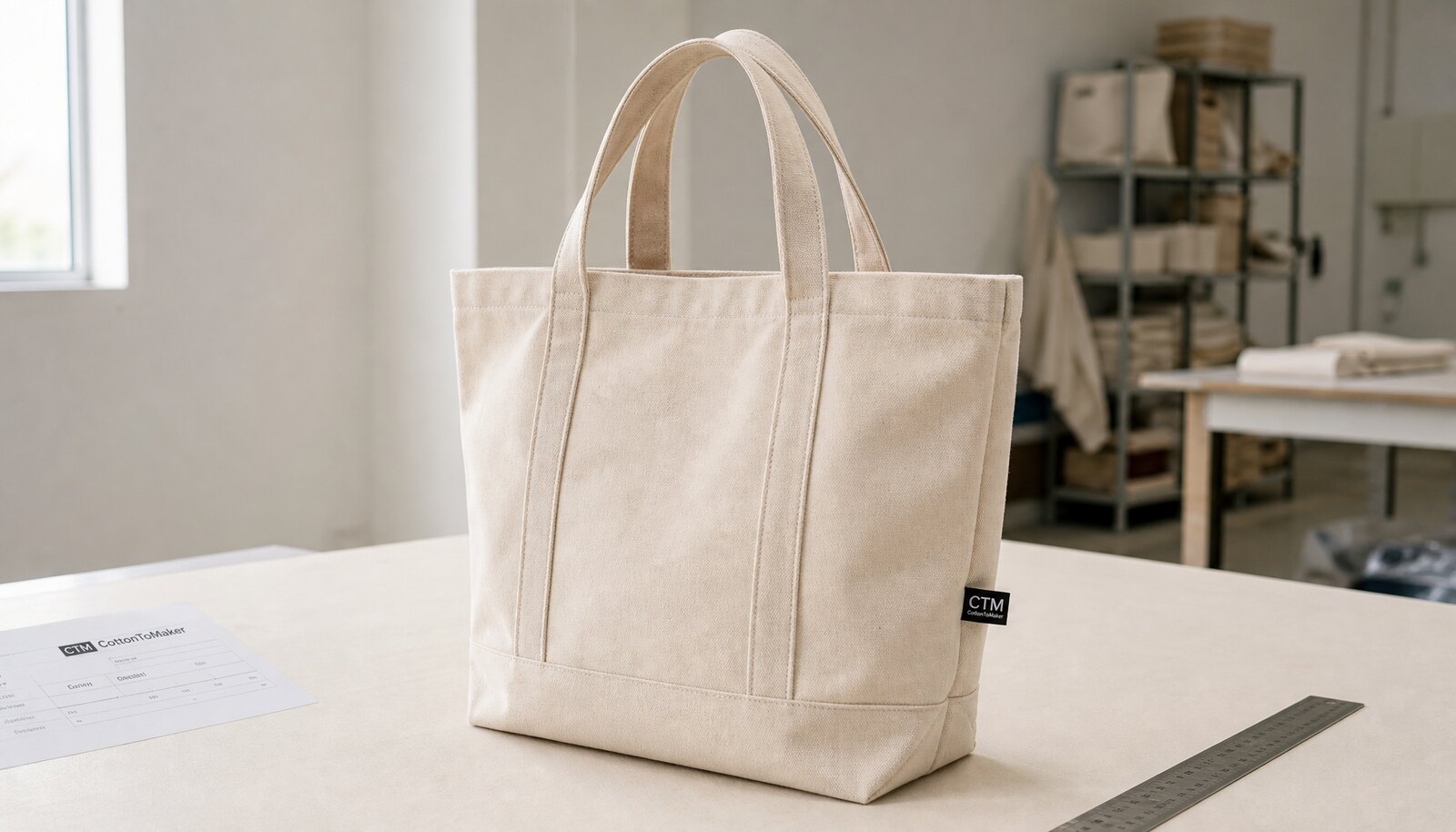
Why Tote Quotes Drift When the Buyer Leaves the Use Case Unclear
Wineries do not buy canvas tote bags for one reason only. The same bag may be used as a tasting-room purchase add-on, a wine-club insert, a holiday gift container, a book fair style merchandising item, or a branded handout at a regional event. Each use case changes what matters in the quote. A tote that only needs to look presentable for a short giveaway is a different product from a retail tote that sits on a shelf, supports the brand, and gets reused. If the RFQ does not explain the use case, factories fill in the blanks with their own assumptions, and the quotes drift apart.
That drift is not just about price. It affects fabric weight, handle reinforcement, gusset depth, packing style, decoration method, and the way the factory sets its quality target. A buyer may think they are comparing the same tote from three suppliers when one has quoted a lightweight promo bag, one has quoted a retail tote, and one has added extra features that were never requested. The result is noisy pricing and wasted time. A better RFQ starts by stating the channel, the customer expectation, and the practical task the tote must perform.
For winery procurement, the bag is often part of the merchandise mix rather than a standalone accessory. It sits beside bottles, label-forward packaging, gift sets, and branded paper goods. That means the tote has to fit the visual language of the brand as well as the product it carries. Buyers should think in terms of presentation, load requirement, and repeat use, not only cost per piece. If the tote is meant to improve perceived value at retail, a slightly stronger build or cleaner finish may matter more than the lowest possible unit price.
The keyword buyers often search for includes more than one intent: some are looking for winery totes, others are looking for book-fair style canvas totes that can be adapted for wine programs. The practical answer is the same: define the tote by size, construction, and decoration, then send that exact spec to the factory. The more precise the brief, the easier it is to compare offers without guessing which quote is truly comparable.
- Identify the channel: tasting-room retail, event giveaway, wine-club bundle, book-fair style merch, or gift-shop merchandising.
- State whether the tote must feel premium, carry weight, or only serve as a branded handout.
- Describe the contents the tote must hold so the factory can size the gusset and handles correctly.
- Tell the supplier whether repeat ordering is likely, because that affects price-break logic and sample discipline.
Choose the Tote Structure Before You Ask for Price
The tote structure drives most of the commercial difference between offers. A flat open-top canvas bag is simple to cut and sew. Add a gusset, an inside pocket, a zipper closure, lining, or a heavier handle and the labor content changes quickly. For most winery needs, an open-top tote with a sensible bottom gusset and reinforced handles is enough. Extra construction should be tied to a real function, not added because a catalog photo looked more premium.
Fabric weight is where many RFQs become vague. Use both ounces and gsm so the supplier cannot interpret the spec two ways. Ten oz canvas is usually acceptable for lighter promotional use. Twelve oz is the most practical middle ground for retail, gifting, and repeated carry. Sixteen oz gives a more substantial hand feel and is a better fit when the tote needs to carry bottle weight or when the brand wants a more premium, durable impression. The key is to match the weight to the load and the presentation, not to assume one canvas weight works for every program.
Handle construction deserves the same level of specificity. Self-fabric handles are usually lower cost and visually consistent with the body fabric. Cotton webbing handles often feel stronger and more premium in the hand. Buyers should define the handle length, handle drop, and the way the handle is attached to the bag body. If the tote will carry heavier content, specify reinforcement at the attachment point, such as bartack or box-X stitching. Do not leave that choice to the factory if the bag must support a bottle purchase or a weighted gift set.
Gusset depth should be stated directly in centimeters or inches. A tote that needs to hold two bottles, a catalog, or a fair-style bundle may need a deeper gusset than a flat gift bag. Without that dimension, factories will guess based on their own standard patterns. One supplier may treat a 4 cm gusset as enough; another may quote 10 cm because that is their default merch tote. That is one of the easiest ways for a quote to look comparable while the actual product differs.
- Use 10 oz for lighter promotion, 12 oz for retail and repeat use, and 16 oz for heavier or more premium carry.
- State the weight in both oz and gsm, and say whether it refers to finished fabric or base fabric.
- Specify handle length, handle drop, handle width, and reinforcement method.
- Define gusset depth and top hem so the factory cannot rely on a stock pattern.
Use a More Useful Comparison Table Than a Simple Price Sheet
Procurement buyers need a table that compares actual tote decisions, not generic supplier claims. The useful comparison is between fabric weight, construction, handle type, decoration method, and packing format. Those are the variables that change the product in the factory and the experience on receipt. If two quotes use different assumptions for those variables, the price comparison is misleading, even if the unit price looks close.
A practical table also helps the buyer separate factory-to-factory scenarios. One factory may specialize in low-MOQ promotional bags and run excellent small screen print jobs, but struggle with premium finishing or tight color matching. Another may be better suited to retail-ready tote programs with stricter folding and packing standards. A third may quote a lower number by outsourcing print or packing and then add lead-time risk. Buyers do not need theory; they need a way to see which supplier fits which commercial scenario.
For canvas book fair totes for wineries factory quote checklist work, the biggest mistake is to treat decoration as an afterthought. The logo size, the number of colors, the location on the panel, and the line thickness all affect whether the artwork is manufacturable on canvas. A clean one-color screen print is still the most efficient option for many winery logos, but it is not the only option. Heat transfer can help with fine detail, embroidery can elevate the retail feel, and a woven label can make a plain tote look more finished. Those alternatives should be chosen for the brand and the artwork, not because a supplier happened to offer them first.
If the artwork includes a website, small tagline, or serif font, ask the supplier to identify the minimum readable line thickness and the smallest type size they can hold without loss. That is more useful than asking whether the print is ‘high quality.’ Quality is not a slogan; it is a measurable outcome tied to the printing method and the artwork.
- Ask the supplier to state the exact canvas weight and the expected hand feel of the finished bag.
- Ask for the handle material, reinforcement pattern, and stitch count if the factory can provide it.
- Require the print method to be named in writing: screen print, heat transfer, embroidery, or woven label.
- If the logo has small text, ask for the minimum line thickness and minimum type size the factory can reproduce cleanly.
- Ask whether the quote assumes one side print, two-side print, or a blank back panel.
Screen the Supplier for Capability, Traceability, and Subcontracting Risk
A low quote is only meaningful if the factory can actually make the tote at that standard. Start with a simple capability check: who cuts the fabric, who sews the bag, who prints the logo, and who packs the cartons? If those steps are split across sites, the buyer should know where the handoff points are and who owns the final quality decision. A direct factory can be efficient for repeated programs, but an agent or trading company can still work if the real production site is disclosed and the QC structure is clear.
Procurement should ask for documents, not just verbal reassurances. Request the factory name, site address, and the department that manages quality for the order. Ask which certifications are currently valid and whether copies can be shared on request. Depending on the buyer’s internal rules, that may include ISO documentation, social compliance audits, or material-related documents. The point is not to collect paperwork for its own sake; it is to verify that the supplier is organized enough to support a repeatable tote program.
Subcontracting deserves direct attention because it is where color drift, packing inconsistency, and lead-time slips often begin. If printing or final packing is outsourced, the buyer should ask what controls keep those steps aligned with the approved sample. Request recent photos or video of a very similar tote, not a random product shot. If possible, ask for the factory’s policy on approving outside partners and how they prevent one subcontractor from swapping in a different fabric or print setup. That is a more useful control than a generic promise that ‘quality will be checked before shipment.’
Traceability can be light or detailed depending on the program, but the supplier should at least be able to connect the sample to the bulk order through a fabric lot, raw material batch, or production record. For winery merchandising, that matters when a reorder needs to match a previous season. It also helps when a buyer wants to prove that the bulk goods were made to the same standard as the approved sample. If the supplier cannot trace the order back to its material source, the buyer has less leverage if the run varies later.
- Ask whether sewing, printing, and packing are all in-house or partially subcontracted.
- Request the real factory name and site, not only the sales office contact.
- Ask for current certifications if they are relevant to your procurement process.
- Ask how the supplier traces the fabric lot or raw material batch used for the order.
- Request recent photos or video of the same construction and print method, not just a similar tote.
- Ask which outside partners, if any, touch your order and what controls are used to manage them.
Lock the Sample Path Before Bulk Cutting Starts
The sample process should prove more than logo placement. It should confirm the hand feel of the canvas, the cleanliness of the seams, the strength of the handles, the accuracy of the dimensions, the quality of the print, and the way the tote folds for packing. The cleanest path is digital proof first, then a pre-production sample, then a golden sample that becomes the physical reference for bulk production. Once that sample is signed off, the factory should not change the fabric, the print process, or the build without written approval.
A buyer gains time by tightening the sample stage, not by skipping it. The sample is where incorrect gusset depth, handle drop, or logo position is caught before fabric is cut in volume. It is also where retail presentation issues show up. A tote that looks fine flat on a table may fold badly, wrinkle at the logo, or sit crooked in the carton. The sample should be checked under normal daylight and, if possible, in the same folded state that the customer will see on arrival. For book-fair style and winery merchandising programs, presentation is part of the product.
The sample should be retained by procurement or merchandizing as the golden reference, and any later production change should be compared against it. If the factory wants to adjust thread color, switch the canvas source, alter the handle width, or change the fold method, the change should be documented and approved. That keeps small improvements from becoming untracked deviations. Buyers who let changes slide during sampling usually discover the drift when the order arrives, not when it is still cheap to fix.
If the order has multiple artwork versions, limit the sample scope to the pieces that truly matter. One functional sample is usually enough to prove structure, but the buyer should verify each logo variation before approval. The practical goal is not to perfect every detail forever; it is to establish a reliable production standard that the factory can repeat on the next reorder without re-litigating the basics.
- Approve a golden sample and retain it as the production reference.
- Measure finished size, gusset, handle length, and handle drop on the sample.
- Check print placement and color in daylight, not only on a screen.
- Do not allow bulk cutting until sample changes are fully closed.
- Record any approved variation in writing so the re-order can follow the same standard.
Use MOQ and Price Breaks to Reveal the Real Cost Curve
MOQ is usually tied to fabric roll efficiency, print setup, sewing line planning, and packing labor. Small orders cost more per piece because the fixed work has to be absorbed over fewer units. That is normal. What is not acceptable is a quote that hides the reason for the increase or quietly reduces the tote spec to make the minimum order appear attractive. If the buyer wants a specific fabric weight, a specific print method, and a specific packing style, the factory should quote that exact combination.
The most useful quote request is to ask for several realistic quantity points rather than one number. If the winery expects repeat orders, ask for price breaks at 500, 1,000, 3,000, and 5,000 pieces, or at the actual volume bands that match demand. That lets procurement see where setup costs are spread out and where the unit price becomes more stable. It also reveals whether the factory is genuinely competitive at scale or only at a single volume. For a seasonal gift program or recurring retail line, that difference matters more than a one-time discount.
A buyer should also decide whether the first order is a test run or a program launch. Test runs often justify a higher unit price because the buyer is paying to validate the tote, the artwork, and the supply chain. Reorder pricing should be compared separately, because repeat business should usually benefit from a more efficient setup. If the supplier cannot explain how the price changes across those scenarios, the RFQ is too loose. The answer should show the cost curve, not just a single point on it.
If the supplier offers a lower MOQ by changing fabric weight, removing reinforcement, or shifting to a less durable print method, the buyer should see that as a different product, not a better price. It is common for a quote to look lower because the supplier quoted a bag that is easier to make, easier to pack, and less demanding on print quality. That may be acceptable for some promotions, but it should not be mixed into a comparison for retail tote bags.
- Request price breaks at more than one volume level.
- Separate setup fees from unit price so the quote is transparent.
- Tell the supplier whether this is a test run or a recurring program.
- Reject any quote that reaches the target price by lowering fabric weight or simplifying the build without disclosure.
- Compare test-run pricing and reorder pricing as two different purchasing decisions.
Treat Packing, Labeling, and Cartons as Part of the Product Spec
Packing affects presentation, damage risk, and labor cost. A tote folded badly can arrive wrinkled, asymmetrical, or hard to stack even when the sewing is correct. That matters in winery retail because the customer sees the bag as merchandise, not just a carry item. For a giveaway program, bulk packing may be fine, but it still needs to be specified. If the buyer does not define the fold, the carton count, and the labeling method, the factory will choose the easiest line method, not necessarily the one that fits the channel.
Packing should be tied to the receiving workflow. A retail tote may need an individual polybag, a hangtag, or a barcode so store staff can place it on shelf or scan it into inventory. A tasting-room handout may simply need a bulk carton with a predictable count per carton and clear outer marks. If the tote is going into a gift set, the buyer should define how the fold presents the logo and whether the handles need to sit on top or tucked inside. That is a small detail in the RFQ, but a large detail on arrival.
Country-of-origin labeling and carton marks should be listed up front, not added later. The same goes for pack ratios, inner boxes, dozen packs, and pallet requirements if the goods are shipping to a warehouse. Many quote disputes begin when a buyer assumes one style of pack and the factory quotes another. The fix is simple: state the pack format in the RFQ and ask the factory to repeat it in the quote line by line. That makes packing a confirmed cost element instead of a late-stage surprise.
A practical rule is to keep packing simple unless the channel needs more. Every extra layer adds labor, material, and inspection points. Buyers should not pay for retail presentation if the totes are being used as handouts. At the same time, they should not accept rough bulk packing if the bags are going straight into gift-shop inventory. The right pack is the one that matches the channel and the receiving process, not the supplier’s default.
- Specify whether the tote is retail-ready or shipment-only.
- Define individual polybag, dozen pack, or bulk pack explicitly.
- State fold direction so the logo face and handle layout look correct on arrival.
- Add barcode, hangtag, carton mark, and country-of-origin rules to the RFQ instead of handling them later.
- Ask the supplier to confirm carton quantity and outer label format in the quote.
Build the Lead Time Around the Real Work Sequence
A reliable lead time is a chain of steps, not a single date. The supplier should break the schedule into sample approval, fabric booking, cutting, printing, sewing, packing, and dispatch. That matters in winery procurement because the tote may be tied to a release event, harvest calendar, holiday gifting window, trade show, or book-fair style merchandising date that cannot move. A quote that gives only a final ship date hides the schedule risk.
The buyer should also make approval timing explicit. If artwork is not final, screens cannot be locked. If the sample is not approved, bulk cutting should not begin. If the packing spec changes late, the factory may have to repack or rework completed goods. A supplier who promises a very short schedule without explaining the critical path is signaling risk, not speed. Buyers should ask where the schedule is tight and which step is most likely to slip before they commit. That question usually produces a more honest answer than asking for the earliest possible delivery date.
Lead time planning should include one revision cycle and one transportation delay. That is especially important when the order crosses borders or when the goods are scheduled for seasonal promotion. A six-week promise with no buffer can become an eight-week reality if a sample needs correction or if a packing change is requested late. Procurement should control the approval side as strictly as the supplier controls production. The best schedule is one that both sides can actually meet.
If the supplier can show a production sequence for a similar tote order, that is more useful than a generic promise of efficiency. The buyer does not need a glossy timeline; the buyer needs a believable one. Ask what step usually creates the bottleneck. If the answer is unclear, the factory may not be planning the order in enough detail. For tote programs with a fixed in-store or event date, that uncertainty should be treated as a risk line in the quote comparison.
- Ask for a schedule broken into sample, bulk, packing, and dispatch steps.
- Leave time for one revision cycle and one logistics delay.
- Treat fixed winery event dates as hard deadlines.
- Compare only suppliers who can explain the production critical path.
- Ask which step is most likely to slip and how the factory mitigates it.
Turn the Factory Quote Into a Landed Cost Comparison
The cheapest factory price is not always the cheapest delivered cost. Compare the full chain: fabric, sewing, print setup, packing, sample charges, export documents, inland freight, ocean or air freight, customs duty, brokerage, and final delivery. One supplier may look low because it quotes EXW only. Another may look high because it includes destination delivery or more complete packaging. Procurement should normalize those offers before any decision is made.
For tote programs, hidden cost often sits in setup and packaging rather than in the canvas itself. A low unit price can be offset by separate screen fees, sample charges, or a carton spec that is more expensive than the buyer expected. That is why a line-by-line quote matters. The buyer should be able to see where the money goes and which parts are fixed costs versus variable costs. Once the quote is normalized, the real commercial difference between suppliers becomes visible.
A practical comparison sheet should use the same quantity, same artwork version, same pack style, same quality target, and same delivery basis. If one factory is quoting FOB and another is quoting landed delivery, those offers should not be compared line by line until they are put on the same basis. The same applies to sample charges and freight assumptions. A quote checklist is not just a formality; it is the tool that keeps procurement from selecting the wrong supplier because the number was incomplete rather than competitive.
Buyers should also watch for subtle exclusions. Cartons, inner polybags, barcode labels, origin labels, hanging tags, palletization, and rework allowances may all be priced separately. Ask the supplier to list exclusions in writing. If the quote is silent, procurement should assume the item is not included and treat it as a risk to the landed cost. This is where a more disciplined RFQ saves money: the less the buyer has to interpret, the less room there is for later add-ons.
- Normalize all offers to the same Incoterm or delivery basis.
- Separate unit price from setup, sample, packing, and freight.
- Include customs and inland delivery when comparing landed cost.
- Require the supplier to state exclusions in writing.
- Use the same artwork, packing, and quality standard across all quotes.
Use Receiving QC That Matches How the Tote Will Actually Be Used
Final inspection should reflect the tote’s real job. The buyer should check size, handle symmetry, seam quality, print placement, and packing accuracy before accepting the goods. If the tote is going into retail, the receiving team should also check folded presentation, odor, carton condition, and whether the bag looks clean when removed from the pack. For a winery program, the bag is part of the brand experience. Small defects matter because the customer sees them immediately.
QC should not stop at a visual glance. If the tote is meant to carry bottles, literature, or a gift bundle, ask for a practical load check or at least a clear reinforcement spec before release. For receiving, verify that carton counts match, labels are correct, and no lot has been mixed without notice. Compare bulk goods against the approved golden sample, not against memory. Many disputes happen because the buyer remembers the sample as better than it was or assumes the factory will ‘obviously’ repeat it exactly. The approved sample should be the reference, full stop.
Use a defect classification that the factory understands: critical, major, and minor. A broken handle attachment, wrong print position, or missing label is not the same as a light fold wrinkle. When a supplier has the categories defined before production starts, it is easier to decide what can be reworked and what must be rejected. If the order is small, buyers sometimes relax QC too much. That creates more cost later if the bags are used in customer-facing merchandising. It is usually cheaper to reject a bad run than to let a weak tote carry the brand into the market.
A more operational QC plan is better than a generic checklist. Measure at least a few bags from different cartons, not only the top carton. Review print on daylight or a consistent light source. Check handle seam tension, stitch skip, edge fraying, and panel skew. On arrival, look for oil marks, stains, smell, and carton damage before the goods are put into stock. For a tote program that will be reordered, receiving QC is the last chance to verify that the factory can repeat the approved spec consistently.
- Inspect size, handle symmetry, stitch quality, print placement, and carton count on arrival.
- Check for odor, stains, and visible fabric defects before goods are accepted.
- If the bag carries weight, ask for reinforcement or load-test confirmation.
- Compare bulk goods against the approved golden sample, not against memory.
- Use critical, major, and minor defect categories so acceptance decisions are consistent.
Specification comparison for buyers
| Spec decision | Recommended option | When it fits | Buyer risk to check |
|---|---|---|---|
| Fabric weight | 10 oz for lightweight promotion, 12 oz for retail and repeat use, 16 oz for a heavier premium feel | Use 10 oz for handouts; 12 oz for shelf-ready merch and wine-club inserts; 16 oz when the tote must feel substantial or carry more weight | Confirm whether the stated weight is finished fabric or base cloth, and ask for oz plus gsm |
| Bag construction | Open-top tote with bottom gusset and reinforced handle attachment | Best for tasting rooms, gift shops, event merch, and simple book-fair style tote programs | State gusset depth, top hem, and whether the corners use box-X or bartack reinforcement |
| Handle style | Self-fabric handles or cotton webbing handles | Use webbing when the tote must hold more weight or look more durable in retail | Check handle width, handle drop, stitch pattern, and whether the handle is cut on grain |
| Decoration method | 1-color or 2-color screen print for most winery logos | Best for natural canvas and repeat programs with stable artwork | Confirm screen count, print placement, minimum text size, and whether the back panel is blank |
| Decoration alternative | Heat transfer for fine detail, embroidery for premium branding, woven label for a cleaner retail finish | Use when the artwork has small detail or the bag must look more finished on shelf | Ask whether the method is in-house or outsourced and how the finish holds up after folding and handling |
| Packing format | Bulk pack for giveaways, individual polybag for retail, or dozen pack for wholesale | Match pack style to channel, not to the factory default | State fold direction, carton count, barcode needs, and insert or hangtag rules |
| Finish details | Natural canvas, clean inner seams, simple hem, optional pocket only if the use case needs it | Keep the build simple unless a feature supports retail value or carrying function | Each added feature changes cost, lead time, and defect risk |
| Order strategy | Price breaks at 500, 1,000, 3,000, and 5,000 pieces if those volumes fit demand | Useful when the winery expects seasonal repeats or reorders | Make sure every price break uses the same spec, packing, and delivery basis |
| Documentation | Golden sample, line-by-line quote, packing spec, and agreed QC standard | Best when procurement needs traceability and repeatable reorders | Check that sample approval, revision control, and exclusion list are written down |
Buyer checklist before sampling
- State the finished size, gusset depth, handle length, and handle drop in inches or centimeters.
- Define canvas weight in both oz and gsm and say whether that weight applies to the finished bag or the base fabric.
- Specify the decoration method, number of print colors, print placement, and whether the back panel is blank.
- Attach the artwork file, any Pantone references, and a note on minimum text size or line thickness.
- Confirm whether the tote is for tasting-room retail, event giveaway, wine club bundle, book fair display, or gift-shop merchandising.
- Set the order quantity now and the likely reorder quantity so the supplier can quote realistic price breaks.
- Require a digital proof, a pre-production sample, and a golden sample before bulk cutting starts.
- List packing method, fold direction, inner polybag requirement, carton count, barcode needs, and hangtag or country-of-origin labeling.
- Ask for the production lead time by stage: sample, bulk cutting, printing, sewing, packing, and dispatch.
- Request a line-by-line quote that separates fabric, sewing, decoration, sample fee, packing, setup, and freight assumptions.
Factory quote questions to send
- What canvas weight will you use, and can you state it in both oz and gsm?
- Is sewing, printing, and final packing done in-house, or is any part subcontracted?
- What is your MOQ for this exact size, fabric weight, print method, and packing spec?
- What is included in the unit price, and what is excluded, such as cartons, labels, inner polybags, and freight?
- How many colors are included in the quoted print price, and what is the extra charge for additional colors or larger artwork?
- What sample stages do you provide before bulk production, and what is the charge and turnaround time for each stage?
- Can you share the factory name, site location, and the department that owns QC for this order?
- What certifications do you hold that are relevant to this order, and can you share current documents if requested?
- Can you trace the fabric lot or raw material batch used for the sample and the bulk order?
- What is the expected production lead time after sample approval, and what steps most often delay it?
Quality-control points to confirm
- Finished size matches the approved spec within the agreed tolerance, including gusset and handle drop.
- Canvas weight matches the approved oz or gsm spec and does not feel materially lighter than the golden sample.
- Seams are straight, reinforced at stress points, and free of skipped stitches, broken threads, or loose ends beyond the agreed limit.
- Handle attachment is strong and symmetrical, with consistent box-X or bartack reinforcement where specified.
- Print placement, color, and registration match the approved sample, with no blur, pinholes, or obvious ghosting.
- Panels are not skewed, the tote stands properly, and the top hem lies flat without puckering.
- Polybag, inserts, cartons, and labels match the packing spec and carton counts are accurate.
- No oil marks, stain marks, odor issues, or visible fabric defects appear on finished goods.
- If a lot code or batch marker is required, it is present and legible on the agreed location.
- Any approved sample-only feature, such as a pocket or label, is present and placed correctly.