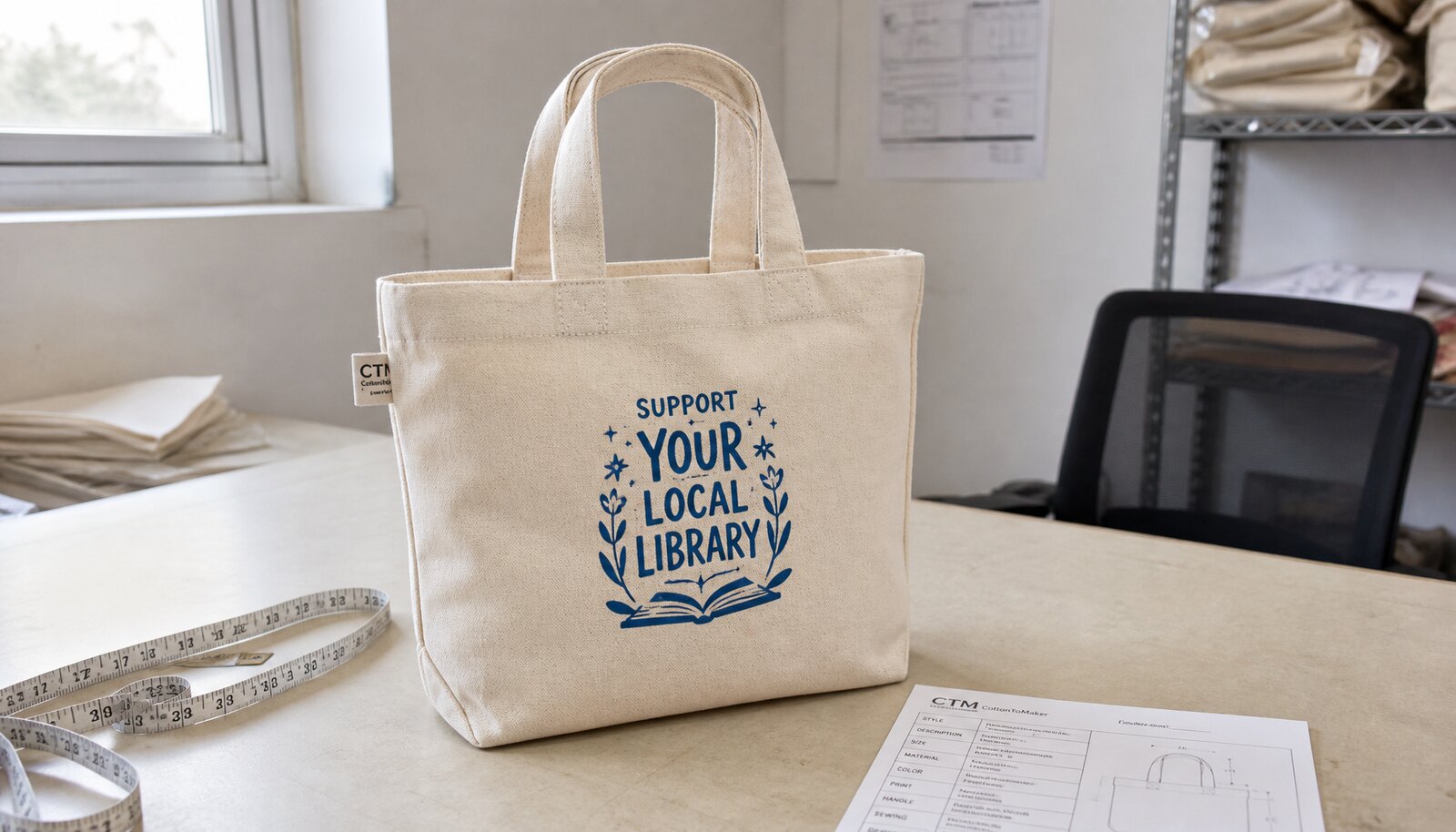
Why Subscription Box Tote Samples Need a Different Standard
A canvas book fair tote for a subscription box is not judged the same way as a retail tote sitting on a shelf. In a retail setting, the buyer can be distracted by visual appeal, while in subscription fulfillment the bag has to pass through a much tighter chain of practical requirements. It needs to ship flat, fit the box, survive pallet handling, open cleanly inside the parcel, and still look intentional when the customer pulls it out. If the tote arrives too bulky, too floppy, or too marked up by the fold line, the buyer may discover the problem only after packaging is already locked and the launch date is close.
That difference matters because a good-looking sample can still fail commercially. A tote may photograph well on a sample table while behaving poorly in the carton: the print may crease on the fold, the handle may spring back and add thickness, or the body may be too soft to lay flat without wrinkling. Procurement teams should therefore judge the sample across the whole chain: fabric, construction, artwork, pack-out, receiving, and end-user presentation. The best approval process looks less like a design sign-off and more like a controlled release of a small manufacturing program.
The right standard depends on the intended role of the tote. If it is only a subscription insert, buyers usually care most about flat pack size, low odor, easy folding, and print clarity at close range. If it is a book fair tote or a resale item, the bag must also carry weight comfortably, keep its shape, and tolerate repeated use. That is why the procurement brief should state the end use in plain language before any artwork is sent. A supplier cannot optimize to the right target if the target is not written down.
- Define whether the bag is an insert, a premium add-on, or a resale tote before sampling begins.
- Approve the tote in its folded and packed state, not only as a loose, open sample.
- Include odor, dust, and finish quality when the product goes straight to consumer unboxing.
Start With the Base Spec Before You Look at Artwork
The quickest way to waste sample cycles is to send a logo before the base spec is locked. For canvas totes, the body material and construction drive the commercial result more than the graphic does. A 10 oz canvas can work for lighter promotional use, but it will feel softer and less structured. A 12 oz canvas, roughly 340 gsm, is often the best default for subscription box and book fair programs because it balances cost, body, and print stability. Move to 14 oz or 16 oz only when the tote must carry heavier books, survive repeated retail use, or support a more premium brand position.
Fabric weight alone is not enough. Buyers should specify whether the canvas is raw natural, bleached, washed, or dyed. They should also identify the build: single-layer body, gusseted side wall, boxed corner, lined interior, or unlined interior. A tote can look similar across all of these options while behaving very differently in the box and in the hand. For example, a gusset improves capacity but can increase folded thickness. A lined bag may feel more premium but may also make the carton pack less efficient. These tradeoffs need to be made intentionally, not discovered after the first sample arrives.
Dimension control deserves the same attention. Write finished size, cut size if needed, gusset depth, top hem width, and handle details on one sheet. Handle length and handle drop should be separate line items. A tote that is 2 cm wider than expected may still look acceptable in a photo, but it can interfere with carton fit or warehouse kitting. Likewise, a slightly shorter handle may pass a casual visual check while feeling wrong when the tote is loaded with books. Good procurement practice is to eliminate ambiguity before the factory starts cutting fabric.
- Write finished size, cut size, and tolerance ranges on the same specification sheet.
- State handle length and handle drop separately; do not combine them into one vague handle note.
- Tell the factory whether the canvas must be raw, bleached, washed, or dyed before printing.
Construction Choices Change Cost, Strength, and Carton Fit
The way a tote is built affects more than appearance. A single-layer canvas body is usually the simplest and lightest option, but it may need cleaner finishing to avoid raw-edge fray or a flimsy feel. A gusseted construction can improve capacity and give the tote a more useful shape for books or bundled inserts, though it often increases the folded footprint. A boxed corner can help the bag sit better on a table or in a box, but it may add sewing complexity. A lined construction gives a more finished interior and can conceal seam allowances, but it also adds thickness, sewing time, and cost.
Handle construction deserves equally careful attention. Self-fabric handles usually preserve a natural, cohesive look and are common on canvas book fair totes. Webbing handles can offer better load distribution and a cleaner edge, but they can also change the visual style and may require a different stitch path. Buyers should ask how the handles are anchored: simple top stitching, bar-tacks, a box-x reinforcement, or a folded reinforcement patch. A handle anchor that looks neat in photos can still fail if the seam allowance is too narrow or if the reinforcement is not wide enough to spread load across the fabric.
For procurement purposes, these construction choices should be translated into inspection points. Ask the supplier to identify seam allowance width, stitch density, and reinforcement style in millimeters or stitches per inch, not in marketing language. If the factory claims the bag is “strong,” ask what the stitch path is and where the load is transferred. If the product will be resold or used repeatedly, not just inserted once, insist on reinforcement details that match the use case. That is how the approval process becomes commercially useful rather than descriptive only.
- Specify whether the body is single-layer, gusseted, boxed corner, lined, or unlined.
- Ask for handle anchor details: bar-tack, box-x, folded reinforcement, or top-stitch only.
- Request stitch density and seam allowance in measurable terms, not general quality language.
Compare the Supplier Route Before You Approve the First Sample
Two quotes can look similar while hiding very different production risk. A direct factory with in-house cutting, sewing, and printing usually offers the cleanest control path for a repeat tote program because one team controls the critical steps. That does not automatically mean the price is best, but it does mean the buyer can interrogate the process more clearly. If the factory says it controls the full line, ask which operations are truly in-house: fabric inspection, cutting, stitching, print, trimming, finishing, packing, and cartonizing. The answer should be specific, not general.
Trading companies can still be useful, especially when a buyer is sourcing several product types or needs one contact point across regions. The tradeoff is transparency. A trading company may present a polished sample while the actual production factory is different from the one implied in early conversations. That matters because a sample made in one workshop can mask problems that appear later in bulk production. The buyer should ask for the actual factory name, production responsibility by step, and proof that the sample route matches the bulk route.
This distinction is not about ideology; it is about control. If the order is simple, repeating, and time-sensitive, direct factory control often reduces ambiguity. If the order is part of a larger program and the trading company can document the source and manage multiple categories, it may still be viable. What buyers should not accept is a vague answer about who made the sample. The deeper the chain, the more important it is to understand where the sample was sewn, printed, and packed. Otherwise, the approval becomes a statement about the sample room, not about the production line.
- Prefer direct factory control when repeatability and revision discipline matter most.
- Use a trading company only when it can identify the actual factory and document process ownership.
- Treat a polished sample as incomplete until the full production route is transparent.
What the Physical Sample Has to Prove
A useful sample proves the tote can be manufactured to the agreed standard, not just that it can be photographed. Start with visible workmanship: straight seams, clean corners, consistent thread trim, even stitch pitch, and correct print placement. Then look at the details that fail in use: loose fibers inside the bag, seam twist when the tote is set on a flat surface, puckering near the handle anchors, and rough edge finishing. If the product smells strongly of finishing chemicals, oil, or damp storage, that is also a sample failure for many subscription programs because the bag is going directly to the consumer.
The sample should be checked against the spec sheet with measurements recorded in writing. A procurement buyer should note body width, body height, gusset depth, top hem depth, handle width, handle length, handle drop, and print position from the top edge and side seam. If the sample misses a dimension, decide whether the miss is cosmetic or functional. A cosmetic miss may be tolerable if it does not affect fit or customer experience. But any deviation that changes carton fit, folding behavior, or load performance should trigger revision, not approval.
The bag should also be inspected in at least three states: empty, partially loaded, and fully loaded. Empty checks reveal shape and workmanship. Partially loaded checks the way the body collapses and whether the print creases at the fold. Fully loaded checks seam behavior and handle stretch. That sequence is far more informative than a quick visual glance. It tells the buyer whether the bag is simply presentable or truly ready for bulk release.
- Inspect the bag empty, half-loaded, and fully loaded.
- Record every measurement directly on the sample sheet.
- Treat odor, dust, and raw fiber shedding as approval items when the tote ships straight to consumers.
Set Print, Color, and Decoration Acceptance Rules Early
Canvas is forgiving in some ways and unforgiving in others. It can hide small imperfections in the base cloth, but it can also make print defects stand out more clearly than on smoother substrates. For one- or two-color logos, screen printing is usually the most practical choice because it gives strong opacity, reliable repeatability, and a predictable cost structure. It also works well when the artwork is simple and the buyer wants a clean, stable result across multiple reorders. If the brand artwork is more complex, or if the order is short and needs fast turnaround, other methods may still work, but the acceptance criteria should be tighter.
The key is to approve on the actual canvas base, not on a digital proof alone. Natural canvas changes how colors read. A light ink can look softer, a dark ink can appear slightly muted, and the same Pantone can shift depending on the weave, finish, and moisture content of the fabric. Buyers should decide whether they want an exact laboratory match or a practical visual match on the production substrate. In most procurement programs, the practical match is the better commercial choice because it reduces back-and-forth while preserving a clean brand presentation.
Color approval should include the method of reference. If the supplier uses a Pantone target, note whether the target is the ink formula only or the print as viewed on canvas. Ask for a strike-off, a printed sample, or at minimum a swatch on the same fabric family. Then run a simple rub check by hand. Look for edge fuzz, ink cracking, transfer, or early flaking around folds. If the tote is meant to be reused, that rub check matters more than a perfect-looking flat photo.
- Approve artwork size and placement on the real bag, not only on a mockup.
- Judge color on the exact canvas base that will be used in bulk whenever possible.
- Run a rub check and inspect for cracking, transfer, and edge fuzz before sign-off.
Construction and Load Testing Should Match the Real Use
A book fair tote is ultimately judged by what it carries. If the bag is expected to hold hardcover books, catalogs, or bundled subscription items, the sample should be tested with a realistic load and then inspected for failure points. The objective is not to destroy the tote for drama; it is to see whether the construction can handle normal customer use with a sensible safety margin. A useful test loads the bag beyond the expected service weight and then checks handle stretch, seam pop, corner distortion, and bottom seam stability. If the handles elongate noticeably or the body twists under load, the sample has not proven the design.
The most important construction areas are usually the handle anchors and the bottom seam. These are the spots where force concentrates when the tote is lifted, swung, or set down. Ask whether the factory uses bar-tacks or a box-x reinforcement at the handle attachment. Check whether the seam allowance is wide enough to stay secure after folding, sewing, and load cycling. If the bag is unlined, inspect the inside for thread ends, fray, or loose fibers. If it is lined, check whether the liner changes the pack thickness too much or creates unwanted bulk at the corners.
Buyers should also separate the demands of first-use performance from repeated-use performance. A tote intended only as a giveaway insert does not need the same endurance as a tote that will be used weekly. That said, even a one-time insert still needs to survive warehouse handling, transport, and the customer’s first loading event. The approval standard should therefore define the expected service life. If the bag is likely to be kept and reused, the procurement spec should ask for stronger anchors, cleaner stitching, and a more stable fabric weight than a one-off promotional item would require.
- Test the bag under weight, then inspect handle anchors and bottom corners.
- Look for seam pop, corner bulge, handle stretch, and body twist under load.
- Define whether the tote is a one-time insert or a repeated-use item before setting durability expectations.
Make the Packing Spec Work for Fulfillment, Not Against It
For subscription box programs, packaging is part of the product spec. A tote that looks excellent as a free-standing sample can still be a bad fulfillment item if it does not fold the way the warehouse needs. Flat packing is often the best starting point because it keeps carton count predictable and makes kitting faster. But the fold should be chosen deliberately. If a fold line lands across the printed logo, the factory should explore a different fold orientation, a tissue insert, or a sleeve that keeps the decoration protected. The right answer depends on the carton depth, the visibility requirements, and how the customer will first see the bag on unboxing.
The packing approval should include the inner pack and the master carton. Ask for carton dimensions, pieces per carton, gross weight, and any moisture protection such as a polybag or liner. These are not minor logistics details; they affect warehouse receiving, stackability, and damage rates. A supplier can technically ship the product while still creating receiving problems if the carton spec is vague or inconsistent. Buyers should also confirm whether the count is by piece, by weight, or by approximate volume. Only one of those is acceptable in a controlled bulk program: exact count.
If barcode labels, SKU labels, or destination marks are part of the fulfillment process, they should be placed on the quote and on the sample carton photos. The warehouse team should be able to receive the product without opening every carton to understand what is inside. For this reason, carton and label approval should happen alongside tote approval, not after it. The most efficient sourcing teams treat the bag and the pack method as one combined deliverable.
- Approve the folded dimension and pack style, not only the finished open bag.
- Confirm exact pieces per carton, carton size, gross weight, and moisture protection.
- Check whether the logo or print sits on a fold line that could crease or crack in packing.
Read the Quote for Hidden Cost Drivers and MOQ Logic
A useful quote should be detailed enough that a buyer can compare one supplier with another on the same basis. At minimum, the quote should separate fabric, cutting, sewing, print setup, decoration, packing, and export carton details. If everything is rolled into one unit price, the buyer cannot tell which part of the spec is driving cost or whether the supplier has quietly downgraded the bag for bulk production. A quote that hides construction details is not a clean commercial basis for approval.
The biggest price variables are usually fabric weight, construction complexity, decoration count, finishing steps, and packing method. A 12 oz natural canvas tote with one-color screen print and flat packing is a different commercial object from a 14 oz lined tote with multiple colors, label stitching, and tissue-packed retail presentation. Buyers should avoid comparing those two as if they were interchangeable. If the business wants a low-risk reorder path, standardize the body and change only the print. Changing body color, handle color, and print at the same time increases MOQ pressure and creates more revision points than most teams need.
MOQ logic should be asked in a granular way. Does the MOQ change by body color, print version, handle color, or carton configuration? Is there a surcharge for custom dyed fabric, special finishing, or mixed-color orders? Can the supplier combine multiple artwork versions within one bulk run, or does each version require a separate minimum? These answers matter because the cheapest quote on paper can become the most expensive order once revision fees and minimums are counted. A procurement buyer should be looking for the lowest total risk, not just the lowest unit price.
- Request separate pricing for fabric, print, sewing, packing, and any setup charges.
- Compare MOQ by body, by color, by decoration, and by carton configuration.
- Do not compare a sample made from premium fabric against a bulk quote built on a lower-grade canvas.
Use a Real Approval Workflow and Avoid the Usual Mistakes
A sample approval workflow should be compact enough that the team actually follows it. The most practical sequence is simple: issue a one-page spec sheet, review photos or a strike-off only as a pre-screen, inspect the physical sample, mark changes directly on the sheet, and sign a golden sample only when the production route and pack format are both confirmed. After that, keep the signed sample, artwork file, measurement sheet, and QC notes together in one place so future bulk lots can be judged against the same reference. Without version control, even a good approval process decays quickly.
The most common mistake is approving by image alone. Another is forgetting the pack-out use case, which leads to a tote that looks fine on the bench but fails in the actual subscription box. A third mistake is treating the first sample as proof of bulk capability when the supplier has not confirmed fabric lot, decoration method, or carton spec. Buyers should resist the pressure to “just approve it” if the sample is close but the route is unclear. Close is not enough when the order must repeat across multiple cartons, delivery dates, and possibly multiple reorders.
The approval should answer one commercial question clearly: can this supplier make the exact tote, in the exact pack format, at the exact quality level required for the program? If the answer is yes, the golden sample is the control point. If the answer is maybe, the sample should be revised before bulk release. That discipline prevents the most expensive type of procurement problem: a product that looks acceptable in isolation but creates exceptions in receiving, packing, or customer presentation.
- Use one controlled spec sheet and one signed golden sample.
- Approve photos only as a preliminary step, not as final sign-off.
- Reject any sample that changes fabric, print method, or pack format without written notice.
Specification comparison for buyers
| Spec decision | Recommended option | When it fits | Buyer risk to check |
|---|---|---|---|
| Sourcing route | Direct factory with in-house cutting, sewing, and printing | You need a repeatable tote program with one accountable production line | Confirm the factory really owns the key operations and is not brokering them out |
| Sourcing route | Trading company with named and verified factory source | You want one contact for a multi-item program or multi-country sourcing | Ask for the real factory name, audit evidence, and process ownership by step |
| Construction type | Single-layer canvas with reinforced top hem | You want a lighter bag that packs flat for subscription boxes | Check whether the top hem holds shape after folding and loading |
| Construction type | Gusseted body with bottom reinforcement | The tote will carry books, catalogs, or heavier inserts | Confirm gusset symmetry, bottom seam strength, and carton fit after folding |
| Handle build | Self-fabric handles with box-x or bar-tack reinforcement | You want simple, scalable construction and a natural look | Measure handle width, stitch density, and anchor reinforcement length |
| Handle build | Webbing handles sewn into canvas body | You need stronger hand feel or better load distribution | Check webbing edge quality, stitch path, and whether it marks the body during use |
| Fabric weight | 12 oz canvas, roughly 340 gsm | Best default for most subscription box and book fair programs | Check weave tightness, shrinkage after finishing, and whether the bag feels limp |
| Fabric weight | 14 oz to 16 oz canvas | The tote must feel premium or carry heavier contents | Watch for added bulk in box-out and whether the bag still folds cleanly |
| Decoration method | Screen print for one to two solid colors | You want clean logos, repeatability, and better cost control | Check ink opacity, cure, rub resistance, and registration drift |
Buyer checklist before sampling
- Confirm the tote’s end use first: subscription box insert, premium add-on, or resale/book fair giveaway. The use case determines fabric weight, finishing, and pack-out tolerance.
- Lock finished dimensions, cut size, gusset depth, top hem width, handle width, handle length, and handle drop on one specification sheet.
- State the base material clearly: raw natural canvas, bleached canvas, piece-dyed canvas, or washed canvas. If finishing matters, say so.
- Request the fabric weight in both oz and gsm, and ask for weave details if available, such as plain weave density or yarn count range.
- Define construction: single-layer body, gusseted body, boxed corner, bound seam, lined interior, or unlined interior.
- Specify reinforcement: bar-tacks, box-x stitches, seam allowance width, bottom seam reinforcement, and whether the handles are self-fabric or webbing.
- Approve artwork size, placement, Pantone target, print count, and whether the logo must stay off fold lines, side seams, or bottom seam areas.
- Ask for a pre-production sample made from production or near-production fabric, not a concept sample built from a better or different material.
- Measure and record sample dimensions to a stated tolerance range; do not rely on visual approval alone.
- Check seam quality at the handle anchors, side seams, gusset corners, and bottom seam intersections.
Factory quote questions to send
- What exact fabric weight, weave, yarn count range, and finish are you quoting, and can you provide a production swatch or close-match photo under neutral light?
- Will the bulk bag use the same fabric lot family and the same print process as the sample, or is the sample a concept version only?
- What construction do you quote: single-layer, gusseted, boxed corner, lined, bound seam, or other variant? Please break out the differences in cost.
- What seam allowance, stitch density, and reinforcement detail are included at the handle anchors, side seams, and bottom seam?
- What tolerance do you allow on finished width, height, gusset depth, handle length, and handle drop?
- Is the tote printed before or after final sewing, and how does that affect placement tolerance and fold-line risk?
- How many print colors are included in the unit price, and what are the setup, plate, or screen charges if artwork changes?
- What is the MOQ by body color, by print version, by handle color, and by packaging format?
- Can you quote the same bag as flat packed, folded with tissue, or insert-ready for a subscription box, and what changes in price or lead time?
- What is the sample charge, what revisions are included, and is any part deductible from the bulk order if we proceed?
Quality-control points to confirm
- Use an AQL-based inspection plan for bulk approval, with critical defects rejected at zero tolerance and major/minor defects defined before inspection starts.
- Critical defects should include open seams, handle pull-out risk, missing reinforcement, wrong size beyond tolerance, wrong artwork placement, and wrong pack count.
- Define measurement tolerances on the spec sheet. A practical starting point for many tote programs is ±0.5 cm to ±1.0 cm on key body dimensions and handle length, unless the box fit requires tighter control.
- Set a pull-strength expectation for handles and seam anchors. Ask the factory what test method they use, what load is applied, and what failure point is acceptable.
- Request a rub-resistance check on the print. The acceptance target should be written in measurable terms, such as no visible transfer after repeated dry rubbing under agreed pressure.
- Add a shrinkage limit if the canvas is washed, dyed, or heat-set after sewing. Buyers commonly ask for no more than low-single-digit shrinkage after the agreed condition test.
- Check for stitch consistency, skipped stitches, loose thread tails, uneven stitch pitch, and needle damage along visible seams.
- Inspect handle anchors for bar-tacks or dense reinforcement stitches, and check whether the fabric puckers or tears under load.
- Verify the bag stands and folds the same way as the signed sample. A tote that collapses differently can create pack-out and presentation issues.
- Check print registration, opacity, edge sharpness, and ghosting at folds. Natural canvas can make poor print control look worse than it does in photos.