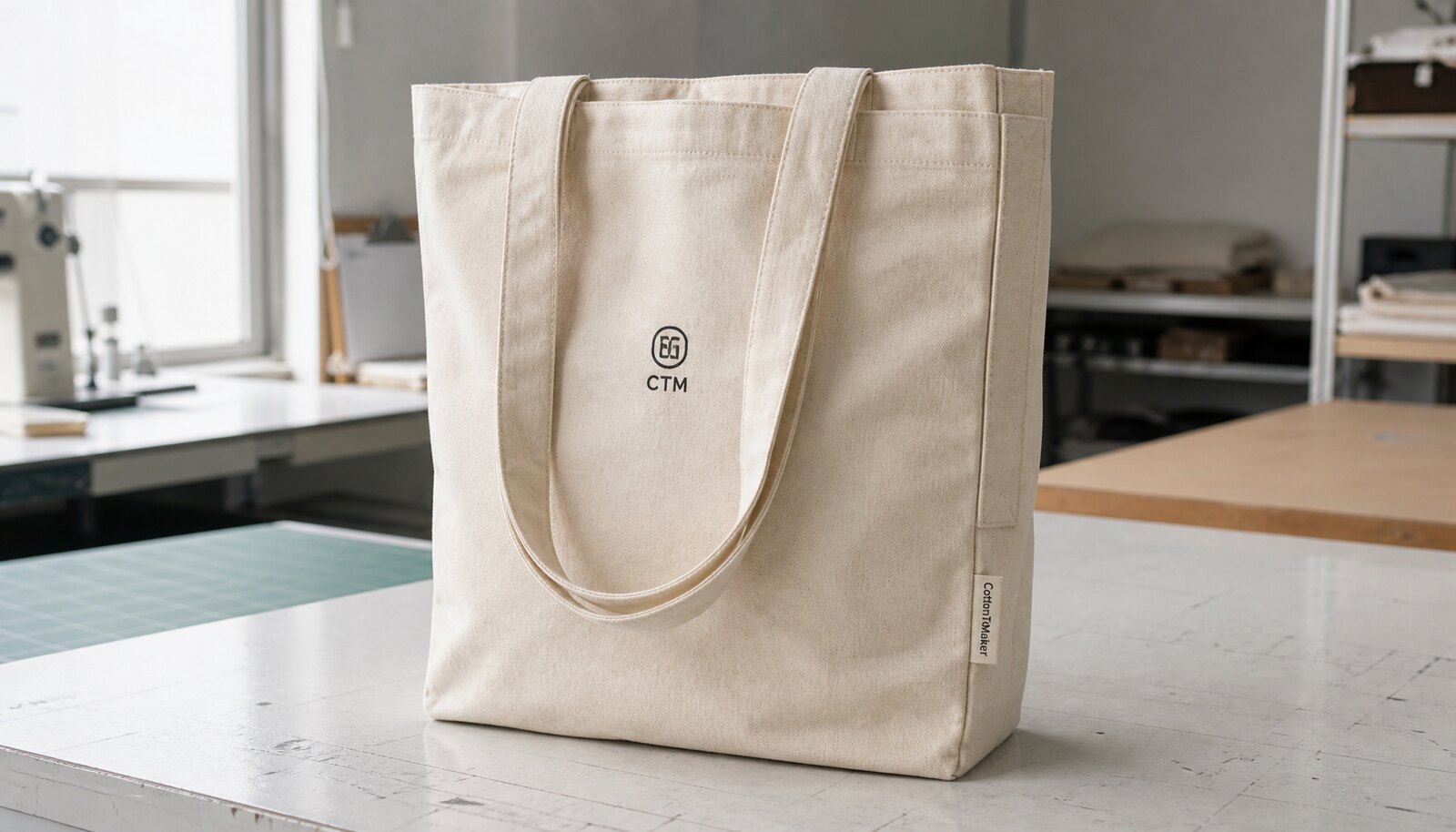
Start With the Use Case, Not the Tote
A canvas tote for a subscription box is not the same purchase as a trade-show giveaway or a bookstore retail bag. It has to fit a packaging system, survive warehouse handling, and still look intentional when the customer opens the box. That means the first decision is not logo color or decoration method. It is the use case: Will the tote sit inside a book fair pack, carry a monthly kit, hold a stack of paperbacks, or ship as a standalone retail accessory? Each answer changes the bag build, the fold method, the carton spec, and the price structure.
For subscription boxes, the tote often has to behave like a component rather than a standalone product. Buyers need the flat folded size, the open size, and the load capacity to work together. A bag that looks strong on a mockup can still be wrong if it occupies too much carton volume, wrinkles badly after folding, or creates extra labor at the fulfillment center. The useful question is not “what is the standard tote?” It is “what build fits this pack-out with the least waste and the fewest surprises?”
The content inside the tote matters just as much as the tote itself. A lightweight promo insert only needs enough structure to survive packing and a short carry cycle. A book fair tote that will routinely hold hardbacks, catalogs, or bundled merchandise needs stronger handle anchors, a tighter seam plan, and a fabric weight that will not sag after the first use. If the tote will be reused, buyers should define the expected life of the bag up front: one-time insert, occasional reuse, or repeated daily carry. That determines whether the program should optimize for first-cost or for durability.
- State the packed product weight and whether the tote carries books, samples, or bundled merchandise.
- Measure the available insert space inside the box before choosing finished bag dimensions.
- Decide whether the tote must stand upright when filled or simply lie flat in the carton.
- Specify whether the bag is a disposable insert, a reusable utility tote, or a retail-grade branded item.
- Capture the warehouse fold method early so the factory can build around the real pack-out process.
Choose Fabric Weight and Composition That Support the Program
The word canvas covers a wider range of constructions than many buyers expect. In sourcing terms, the same label may be used for light plain-weave cotton, denser duck-style cloth, bleached fabric, greige fabric, or cotton/poly blends. That is why a buyer should never accept “canvas” as a complete description. For most canvas book fair totes for subscription boxes, 8–10 oz canvas is a practical middle ground. It usually provides enough body for printing and folding without inflating sewing time or freight cost. If the program needs a more premium handfeel or repeated use, 12 oz can make sense, but only if the added weight still fits the budget and handling plan.
Composition affects both brand perception and performance. A 100% cotton bag usually supports an eco, bookstore, or craft-positioned story more naturally, while a cotton/poly blend can reduce wrinkling or lower cost. The right choice depends on the buyer’s priority, not on supplier preference. If the tote is meant to look like a retail item, a cleaner handfeel and more stable panel may matter. If the tote is a fold-flat insert, recoverability and carton efficiency may matter more. Ask the supplier to quote the same build in the actual composition they intend to use, not in a generic marketing description.
Weave type is where quality can drift without warning. A tighter plain weave generally gives a smoother print surface and cleaner type edges, while a looser or more irregular weave can create a rustic look but may complicate ink coverage. Ask for a daylight fabric photo and a close-up macro shot of the weave. If the supplier offers options, compare those options on the actual project use case. Buyers do not need a textile lecture; they need a fabric that prints cleanly, folds predictably, and does not introduce avoidable defect risk.
- Translate ounces into GSM in the RFQ so every supplier quotes the same fabric basis weight.
- Ask for the finished bag weight if freight charges or shipping thresholds are tight.
- Require the supplier to state whether the canvas is natural, bleached, dyed, greige, or blended.
- Request a daylight fabric photo and a close-up of the weave before sample approval.
- Judge body, stiffness, and fold behavior from the physical sample, not from a spec sheet alone.
Real Supplier Comparison: Cost, Risk, and Decision Criteria
Procurement teams get better results when they compare supplier routes instead of only comparing unit price. A direct factory, a trading company, a local decorator, and a kitting partner can all quote the same tote, but the commercial meaning of the quote is different each time. A direct factory often gives the cleanest visibility into sewing and printing cost, while a trading company may add coordination value if you need several SKUs or a more managed buying process. A local decorator can be the best answer for urgent short runs, but it usually carries a higher unit price. A fulfillment partner can simplify operations, but the markup may be hidden inside handling fees rather than the tote line itself.
The comparison should include cost impact, risk level, and decision criteria. A lower price from a print-first supplier may look attractive until the buyer learns that sewing is subcontracted and quality control happens at a second site. A sourcing agent may solve communication issues but add another layer of margin and lead time. The question is not which route is always best; it is which route is best for this order’s risk profile. If the tote is going into a recurring subscription box, repeatability and reorder control are worth more than a small first-order discount.
The most practical way to compare suppliers is to ask the same exact questions in the RFQ: who cuts the fabric, who sews, who prints, where packing happens, and who signs off on inspection. If the supplier cannot answer those questions cleanly, the quote should be treated as incomplete. The buyer is not just purchasing bags; they are purchasing a process that needs to repeat without silent changes.
- Ask who cuts, sews, prints, packs, and inspects the order.
- Request a factory profile, redacted production photos, and a pack-out photo set.
- Confirm whether a broker, trading company, or subcontractor is involved anywhere in the chain.
- Ask for the name and role of the person who signs off on first-run quality.
- Verify that the same production route will be available for reorders, not only the first order.
Specify Size, Gusset, Handles, and Reinforcement as One System
A tote’s dimensions are not just a style choice. They determine sewing time, carton density, insertion speed, and how the finished bag feels in use. Buyers should define finished width, height, and gusset depth, then state whether those measurements are taken after pressing or after packing. For book fair programs, gusset depth often matters more than width because books and catalogs add thickness at the base. For subscription box inserts, folded footprint may matter most because the bag has to fit neatly alongside the rest of the kit. A vague reference such as “standard tote size” usually creates avoidable back-and-forth later.
Handle design is a common failure point in low-cost sourcing. Buyers should specify handle width, handle length, drop length, and the material used: self-fabric, webbing, cotton tape, or another strap. Self-fabric handles usually look more unified with the bag and can support a clean retail aesthetic. Webbing can improve abrasion resistance and may reduce labor in some constructions. Either way, the key is the load path. Ask how the handle is attached, where the reinforcement sits, and whether the top edge is doubled or bound. A bag intended to carry books needs a stronger handle anchor than a light giveaway tote.
Reinforcement should be written into the specification. For the average custom canvas tote, a box-X plus bar tack at the stress points is a reliable default. At minimum, ask for secure stitching at handle roots, stable top hems, and seam allowances that match the bag size. A larger bag with a light seam can pass a visual check and still fail under repeated use. To avoid that problem, request a simple load-test description before approval: how much weight the bag should hold, how long it should hold it, and what failure point would be unacceptable.
- State finished dimensions and confirm whether they are measured after pressing, sewing, or folding.
- Specify gusset depth separately instead of assuming the factory will infer it from the artwork.
- Provide handle drop length, width, and material, not only total handle length.
- Require the reinforcement pattern: box-X, bar tack, double row, or another agreed method.
- Ask for a simple load-test description before the order is released to bulk.
Choose the Decoration Method Before You Compare Quotes
For canvas book fair totes, decoration should be selected before the buyer starts price comparison. The most efficient default is usually one-color screen print. It delivers good opacity on canvas, scales well, and is easier to inspect than more complicated decoration methods. If the design is simple and repeatable, screen print is often the most commercial option. It keeps setup straightforward and reduces the risk of the logo looking weak, fuzzy, or too glossy on a textured surface. For most subscription-box programs, that balance matters more than decorative complexity.
Other logo methods can work, but each changes the procurement profile. Heat transfer and digital transfer are useful when the design needs more detail, but they can feel less integrated with the fabric and may not age as well through folding and abrasion. Embroidery can make the bag feel premium, but it adds needle density, potential puckering, and extra cost. Woven patches can also add value, though they introduce another component and another quality-control checkpoint. If the logo is small, thin, or typographically delicate, ask the supplier to show how it will hold up on real canvas—not on a polished digital proof.
Logo placement is just as important as the decoration method. A logo that looks fine on a mockup can end up too low, too close to a seam, or too small to read once the bag is folded or filled. Put placement in millimeters from the top edge and centerline. If color accuracy matters, specify a Pantone reference and ask for a strike-off on the actual canvas shade. If the logo includes fine type, define the minimum stroke width the printer should preserve. Natural SEO note: buyers looking for a custom logo order guide should focus on repeatable decoration first, creative variation second.
- Default to one-color screen print unless the artwork or brand position truly requires a different method.
- Specify print size and placement in millimeters from seams and centerline.
- Use Pantone references only when color matching matters to the brand or campaign.
- Approve the print on the actual canvas shade, not on paper or a smooth digital proof.
- Ask whether the logo will be printed in-house or passed to another workshop.
Build the MOQ Strategy Around Setup, Not Just Volume
Minimum order quantity is usually a setup story, not just a volume story. A factory may tie MOQ to screen creation, fabric allocation, handle style, color runs, packaging configuration, or inspection labor. If the buyer only asks for “your MOQ,” the answer may be hard to interpret and even harder to compare. A better RFQ breaks MOQ into variables. Ask for the minimum by style, by color, and by print configuration. If the supplier adds a second print color, a special handle, or a custom fold, the MOQ may change. That is normal; what matters is whether the change is visible in the quote.
For planning, it helps to ask for a price ladder rather than a single threshold. A tote program that may repeat later should show pricing at several volume points so the buyer can see where setup costs stop distorting the unit price. Even when a supplier cannot formally quote every tier, they can usually show where the economics improve. That gives procurement a clearer basis for award and forecast planning. Avoid accepting a number without understanding whether it includes one-time setup charges or only recurring production cost.
The hidden cost risk is the one-line quote. A low unit price can mask charges for folding, carton labels, mixed cartons, barcode stickers, extra samples, or outsourced print setup. If the supplier will not separate setup from recurring cost, the comparison is weaker. Buyers do not need a complicated pricing model; they need a quote that can survive a second order without a surprise reset.
- Ask for MOQ by style, color, and print configuration separately.
- Separate one-time setup from recurring unit cost in every quote.
- Request a price ladder at multiple quantities if the program may scale.
- Check whether special folding, mixed cartons, or extra labels trigger a hidden surcharge.
- Treat a low MOQ as useful only if the production method is still controlled and repeatable.
Treat Sample Approval as a Gate, Not a Courtesy
Sample approval should function as a control gate. Too many tote programs move from mockup to bulk before the buyer has seen the real structure, the real fabric, and the real logo on the real bag. Start with a blank sample when the shape is new. That lets the buyer judge body, handle drop, gusset behavior, and seam quality without the artwork distracting from the construction. Then move to a printed pre-production sample made on final fabric with the final logo placement and final fold method. If the tote must fit inside a subscription box, the sample has to prove that fit, not just show the logo.
Measurements matter as much as appearance. Check finished width, height, gusset depth, handle length, print size, and the logo offset from the top seam and centerline. Photograph the approved sample with a ruler and keep the approval record in a version-controlled spec file. That way, if production later drifts, procurement has a dated reference instead of a memory-based dispute. For repeat orders, preserve the exact approved artwork file and the sample in the same folder as the PO history.
If the sample is wrong, do not “fix it in bulk.” That shortcut usually creates a larger problem later. A change to print placement, handle length, stitch quality, or fold method should be corrected and re-approved before production starts. A short delay in the sample stage is usually cheaper than a pallet of bags that cannot pass receiving or kitting. A good supplier will understand that sample approval protects both sides.
- Approve a blank sample first if the bag structure is new.
- Approve a printed pre-production sample on final fabric and with final packing.
- Measure and photograph the sample with a ruler and date stamp if possible.
- Archive the approved sample, artwork, and approval record for reorders.
- Reject any request to move to bulk before sample defects are corrected.
Specify Packing, Cartons, and Warehouse Intake Requirements
Packing is a commercial decision, not just a final step. For subscription-box programs, the tote often needs to arrive in a fold that is easy for the fulfillment team to handle. Flat fold in master cartons is usually the most efficient approach because it keeps the bags countable, reduces unnecessary packaging, and supports cleaner warehouse intake. But the factory cannot guess the fold. Buyers should tell the supplier exactly how the tote will be opened, refolded, and inserted into the box or mailer. Even a minor fold difference can create extra labor at the 3PL.
Individual polybags should be used only when the receiving warehouse, retailer, or compliance program requires them. Otherwise they add cost, waste, and handling time. What matters more is cleanliness and repeatability: the bags should arrive dry, clean, odor-free, and protected from crushed print. Ask for carton count, inner bundle count if applicable, carton dimensions, and gross weight. If the shipment will move by sea or sit in storage, ask for moisture protection and palletization details. The buyer should also define carton labels exactly as they need to appear on receiving paperwork.
Carton quality deserves more attention than it usually gets. A weak master carton can crush or split even when the tote itself is perfect. Ask what carton grade the supplier uses and whether they check the fully packed box weight before shipment. If the carton is too heavy for one-person handling, the warehouse cost rises. If the carton is too loose, the bag can shift and get creased or damaged. For the most practical procurement result, specify carton performance as clearly as the bag itself.
- Define the fold direction and carton pack method with a photo or sketch.
- Set a maximum carton weight that your warehouse can handle safely.
- State whether cartons are packed by color, SKU, or mixed lot.
- Require carton marks, lot codes, and destination labels exactly as written on the PO.
- Add moisture protection and pallet notes if the shipment will travel by sea or store for a while.
Control Lead Time With Milestones, Not Hope
Lead time on a custom tote is usually a sequence of smaller clocks, not one single number. A common planning window might be 7–14 days for sampling and 25–35 days after approval for bulk production, but those figures vary by material availability, decoration complexity, season, and supplier capacity. Buyers should treat them as planning placeholders rather than promises. If the order needs specialty fabric, custom dyeing, washing, or outsourced decoration, the schedule can stretch. If the tote is tied to a book fair date or a box launch, plan backward from the warehouse receipt date, not the factory ship date.
The best control mechanism is a milestone schedule. Lock the art, approve the blank or pre-production sample, start production, check the first run, release carton packing, and confirm ship date. Ask the supplier which milestones they control directly and which depend on outside vendors. Artwork changes late in the process are expensive because they may require new screens, new labels, or a new approval cycle. Procurement does better when lead time is managed as a calendar of checkpoints rather than a vague promise that production will be “fast.”
For a repeat subscription program, reorder value matters almost as much as first-order speed. Ask whether the factory can retain print screens, keep the pattern on file, or reserve fabric for the next run. If they can, ask how long they will keep those assets and whether any storage fee applies. That question is not just administrative. It determines whether the second order will match the first order without a fresh round of setup cost.
- Set an art freeze date before screens or samples move forward.
- Plan inspection before final carton release or container stuffing.
- Ask the factory to break the schedule into sample, approval, production, packing, and transit milestones.
- Check whether the supplier can retain screens, patterns, or files for a reorder.
- Keep a time buffer for receiving, customs, and warehouse intake at destination.
Compare Landed Cost, Tolerance, and Reorder Value Before Awarding the PO
A tote award should never be based on the lowest ex-works price alone. The quote has to be normalized first. That means the same fabric weight, composition, size, logo method, handle spec, reinforcement method, packing quantity, carton size, sample charge, and Incoterm. Without that normalization, two quotes can look similar while hiding very different value. One supplier may be using lighter canvas or looser tolerances; another may include stronger reinforcement and cleaner pack-out. A buyer who compares only line totals may award the wrong quote for the wrong reasons.
The landed-cost view should include the factory price, inland transport, export handling if relevant, freight, import duty, destination trucking, warehouse receiving, and any kitting labor. For a subscription box, the real cost is not the invoice line from the factory. It is the total cost to get ready-to-pack totes into the fulfillment flow on time and in acceptable condition. Sometimes a slightly higher unit price is the better commercial decision because it reduces repack labor, prevents damage, or improves warehouse speed. That is especially true when the tote is handled many times before the customer sees it.
Tolerance and reorder value should also influence award. Ask what overrun or underrun range the supplier allows, how shortages are handled, and what happens if the shipment is short or mislabeled. Then ask how the next order will be repeated: will the artwork be archived, will the fabric spec be stored, will the print settings be retained, and will the same route be available again? The best supplier is not only the cheapest producer; it is the one who can repeat the approved build without silent changes.
- Compare quotes only after the spec is aligned line by line.
- Separate tooling, sampling, and setup fees from recurring unit cost.
- Add freight, duty, destination handling, and kitting labor to the landed-cost view.
- Ask for overrun, underrun, and shortage handling rules in writing.
- Confirm how the supplier will manage reorders without silent spec drift.
Specification comparison for buyers
| Supplier route | Typical cost impact | Risk level | Decision criteria | When it fits |
|---|---|---|---|---|
| Direct factory | Lowest base price at scale; setup fees more visible | Medium | Choose when you need full control of fabric, sewing, print, and repeat orders | Best for custom runs, stable reorders, and tighter QC expectations |
| Trading company / sourcing agent | Usually 5%–15% higher after service margin and coordination costs | Medium to high | Choose when you need multi-item coordination or a single point of contact | Useful for mixed SKU programs or when you lack local sourcing bandwidth |
| Local decorator / regional bag shop | Higher unit price, lower freight, faster small-batch turn | Low to medium | Choose when speed matters more than unit economics | Best for short runs, urgent reorders, or domestic delivery deadlines |
| Print-first promotional supplier | Competitive on logo application; sewing may be subcontracted | Medium to high | Choose only if they can prove who sews and who inspects | Works when decoration is simple and the supplier can show real production control |
| Kitting/fulfillment partner with bag sourcing | Convenient bundled service, but markup may be hidden in handling | Medium | Choose when the bag is part of a larger subscription box assembly flow | Useful if one partner handles pack-out, warehousing, and final assembly |
| Material | 8-12 oz cotton canvas, 120-220 gsm cotton, recycled cotton, or blended fabric selected by use case and target price | Before price comparison | Different cloth weights, backing, or certification claims make quotes hard to compare | |
| Construction | bag size, gusset, handle drop, seam allowance, stitch density, reinforcement patch, and loading expectation | Before sampling | Weak stress points create returns and failed inspections | |
| Decoration | screen print, heat transfer, embroidery, woven label, or hangtag matched to fabric texture and brand durability needs | Before artwork approval | The wrong method can crack, bleed, pucker, or fail on the chosen fabric |
Buyer checklist before sampling
- Finished tote size, gusset depth, and folded footprint that match the subscription box insert space
- Fabric composition, weave type, and weight in GSM or oz/yd², stated in one unit on the RFQ
- Logo method, artwork size, print placement coordinates, Pantone reference, and minimum stroke width
- Handle width, handle length, drop length, attachment method, and reinforcement spec at the stress points
- Packing format, fold direction, carton count, outer carton dimensions, and any 3PL or barcode requirements
- Sample approval plan for blank sample, printed sample, and pre-production sample on final materials
- Target ship date, Incoterm, destination, and who owns inspection, freight booking, and customs paperwork
- Acceptable overrun or underrun tolerance, plus the remedy if the shipment is short, mislabeled, or outside spec
- Document request list: factory profile, material spec sheet, in-line QC photos, and a carton pack-out photo set
- Reorder plan with version control so future runs match the approved spec without silent changes
Factory quote questions to send
- What is the exact fabric composition, weave type, and finished fabric weight you are pricing for this tote?
- Are you quoting the finished bag size or the cut size, and what tolerance do you use after sewing and folding?
- Is the MOQ based on style, color, print design, or packaging configuration, and what setup fee sits behind that MOQ?
- Please break out the price for sewing, printing, reinforcement, labeling, folding, and carton packing separately if possible.
- Will the logo be printed in-house, or is any step outsourced to another print shop or sewing subcontractor?
- What sample charge applies, and is it credited back after bulk order confirmation?
- What carton size, gross weight, and packing quantity per carton do you recommend for warehouse intake?
- What are your standard overrun and underrun tolerances, and how do you report and resolve any shortage?
- Can you share a redacted QC report, first-run photo set, or factory audit evidence that shows how you control quality?
- How many days do you need for blank sample, printed sample, pre-production approval, and bulk production after approval?
Quality-control points to confirm
- Finished dimensions should fall within an agreed tolerance on length, height, and gusset after sewing and folding; set the tolerance in writing before sample approval
- Target seam construction should be consistent and measurable: for typical canvas tote construction, ask for at least 6–8 stitches per inch on main seams and secure backtacking at seam starts and ends
- Top hem, side seams, and handle attachment seams should be straight, evenly spaced, and free from skipped stitches, loose loops, or broken thread tails
- Handle attachment should use the agreed reinforcement pattern, with no popping, seam opening, or twisting after a basic load test
- Logo placement should match the approved sample within the agreed tolerance for top offset, centerline offset, and size; no obvious skew or blur is acceptable
- Print coverage should be even, with no pinholes, puddling, ghosting, cracking, or excessive ink bleed visible on the approved fabric color
- For color-sensitive programs, define acceptable shade variance in advance and request a lab-dip or strike-off approval before bulk; if you do not use formal Delta E, at least set a visual accept/reject standard against the approved sample under daylight
- Fabric should be free of contamination, oil marks, dye streaks, hard nodes, and obvious thin spots that create see-through patches
- Carton labeling should match the PO, SKU, color code, pack count, and ship-to details exactly; one mislabeled case can disrupt warehouse receiving
- Random packed units should open cleanly without dust, odor, moisture damage, or over-compression creases that do not relax after unpacking