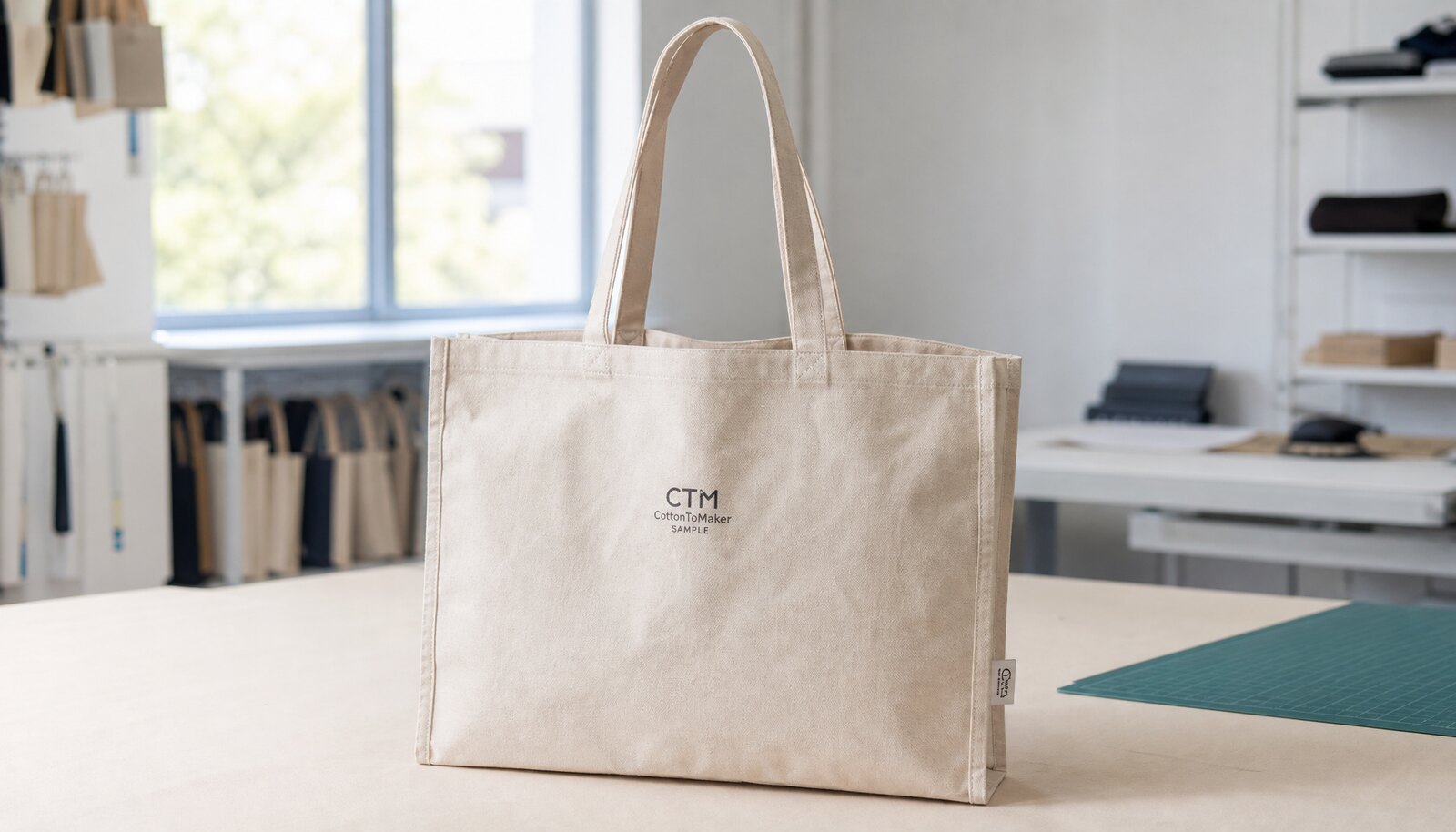
What this tote is actually doing in the program
A canvas book fair tote used in a subscription box or event giveaway is doing three jobs at once. It carries product, it carries branding, and it often becomes the reusable item that outlives the campaign itself. That makes it closer to packaging than to a generic promotional bag. If the tote does not fit the contents cleanly, or if it fails after a few uses, the item will be judged against the whole program, not just the tote line on the PO.
That is why the first procurement decision is not the logo. It is the use case. A tote for flat books and inserts needs different structure than a tote that is inserted into a box as a premium add-on. An event giveaway tote also faces different expectations than a retail-style bag handed to attendees. When the use case is defined up front, the supplier can quote a real spec instead of guessing.
- Define the tote around the contents first, then the brand treatment.
- Decide whether the bag ships inside a box, in a carton, or pre-kitted with other items.
- State whether the tote is meant to be disposable, reusable, or premium enough to keep in circulation.
Start with contents, fit, and carry behavior
For book fair totes, the most useful spec starts with the item bundle. Books create a different load profile than apparel, paper goods, or samples because they concentrate weight at the bottom seam and force the handle attachment to work harder. A tote that looks fine in a flat sample can distort badly once it is loaded with hard edges or stacked inserts. That is where dimension, gusset, and handle geometry matter more than a photo reference.
A practical starting point for many programs is a medium canvas body with a 3-4 in gusset and a handle drop that matches the intended carry mode. If the bag will sit in a subscription box, you may want a flatter fold and shorter handles. If it is meant for events, a deeper body and longer drop make it easier to carry by hand or over the shoulder. The point is to tune the tote to the pack-out, not force the pack-out to fit a pretty sample.
- Match body width and gusset to the actual carton or contents, not to a standard tote catalog size.
- Check whether the tote needs to stand upright on a table, since that affects bottom construction.
- If the bag will be reused, test how it hangs when partially loaded, not only when full.
Build a quote-ready spec sheet before asking for prices
The fastest way to get comparable quotes is to give suppliers a spec they can execute without interpretation. A buyer-ready spec sheet should name finished dimensions, fabric weight, construction details, print location, color targets, packing method, and the acceptance standard for approval. If any of those items are left vague, the factory will fill in the blanks using its own default, and the quote may look cheap only because it is not pricing the same product.
For canvas tote programs, the most common quote gap is not the unit price. It is the missing assumptions around sewing labor, handling, and packing. A supplier can quote one bag with self-fabric handles, a simple open top, and a flat fold, while another is pricing webbing, reinforced seams, and printed retail-style packing. Those are not equivalent products, even if the front-view render looks similar.
- State finished dimensions with tolerance, not just nominal size.
- Define handle width, handle length, and handle drop separately.
- Tell the supplier whether the tote needs a side label, woven label, or hangtag and where it goes.
- Attach the final artwork file and the print placement diagram to the RFQ.
Fabric weight and construction decide the real cost
Canvas weight is the obvious cost lever, but it only tells part of the story. An 8 oz canvas tote may be cheaper on paper, but if the bag needs extra reinforcement to survive books, the apparent savings disappear. A 12 oz tote can cost more up front, yet it may reduce complaint risk and make the bag feel closer to a retail product than a giveaway. Buyers should compare the whole build, not the fabric number in isolation.
As a working rule, 8 oz suits light inserts and event handouts, 10 oz is a balanced default for mixed use, and 12 oz is better for book-heavy kits or premium reuse programs. Ask the supplier how the seam allowance, bartack placement, and handle attachment change at each weight. Those details affect both the feel of the bag and the number of defects you can expect in production.
- Ask whether the canvas is pre-shrunk or whether final size is quoted after a wash process.
- Confirm whether the handles are self-fabric or separate webbing, because that changes both cost and durability.
- Request the actual stitch density at the main seams and the handle root, not a generic statement that the tote is reinforced.
Compare sourcing routes by commercial tradeoff, not by habit
The right supplier route depends on the business problem you are solving. A direct factory usually gives the best control over fabric, sewing, and print when the tote will be reordered or customized repeatedly. A trading company can be easier when the tote is part of a broader giveaway kit and you want one point of coordination. A local decorator with imported blanks may be the fastest option when the event date is fixed and you need domestic kitting, but the blank quality becomes a separate risk that must be checked before print approval.
The commercial tradeoff is simple. Direct factory sourcing usually wins on repeatability and landed cost when the spec is stable. Trading companies reduce coordination overhead but add markup and potential translation risk. Local finishing can shorten delivery, but it pushes more QC burden onto the buyer because you are relying on the quality of a blank bag you did not control at source.
- Use a direct factory when the tote is strategic, repeatable, or highly spec-sensitive.
- Use a trading company when you need speed in quote management or when the tote is only one line in a broader order.
- Use local finishing only if you can inspect the blank tote before print and you understand the durability of the blank stock.
Print, labels, and branding choices should be made for durability
Screen print is still the most practical option for most canvas book fair totes because it handles simple artwork well and usually gives the cleanest unit economics at scale. For 1-3 spot colors, it is generally the safest route if the goal is durable branding on natural canvas. DTF or heat transfer is more useful when the art is complex, the run is short, or the approval timeline is compressed. The tradeoff is that these methods need more testing for rub resistance, edge lift, and fold cracking after packing.
For buyer control, the key is to define not just the print method but the acceptable result. Specify the imprint location, maximum color count, ink coverage, and whether the print must avoid seams or gusset folds. If the tote has a woven side label, contrast label, or small care tag, those should also be part of the approval sample. Brand details that look minor in a mockup often become the first visible defect in bulk production.
- Limit artwork to the number of colors you can support economically and technically.
- Approve print placement on a sewn sample, not just on a flat digital proof.
- If the artwork crosses a seam or fold line, require the factory to confirm how it will be aligned in production.
MOQ, pricing, and landed cost need to be read together
MOQ is not a standalone number. It is a function of fabric sourcing, color setup, print setup, and sewing complexity. A standard natural canvas tote with one-color screen print can often support a lower first order than a custom-dyed tote with multiple labels and a special fold method. For a new subscription box or event giveaway, a first run in the 1,000 to 3,000 piece range is often workable, but only if the rest of the spec is kept disciplined.
Landed cost should be built from the real quote, not from the unit price alone. Include sample charges, plate or screen charges, packing costs, carton dimensions, and freight by volume. A bag that is cheap to sew can still become expensive once it is folded into a large carton or repacked at destination. The lowest quote is often the one with the most assumptions hidden outside the line item.
- Ask for a quote that separates sewing, printing, packing, and setup charges.
- Compare suppliers only after the same fabric weight, same size, same print method, and same carton spec are locked.
- Check whether a lower MOQ is achieved by using substitute fabric or more expensive labor, because that changes the real economics.
QC needs measurements, sampling, and pass/fail criteria
A serious tote buying guide needs more than a visual inspection list. Buyers should issue a defined acceptance plan that starts with a pre-production sample and then moves into bulk inspection. For most programs, the sample should be made from the actual fabric, actual print method, and actual trim. If the sample uses different materials or a different decoration process, it is only a visual reference, not an approval basis for bulk production.
For inspection, use a sampling framework that the factory understands, such as an AQL-based plan with zero critical defects and buyer-defined major and minor defect limits. That keeps the conversation objective. On the product side, set measurable tolerances: body dimensions within plus or minus 0.5 in, handle length within plus or minus 0.25 in, and print registration within 1/8 in for simple logos unless the artwork requires tighter control. Add a proof-load test that reflects real use, for example 1.5x the intended working load for 60 seconds with no seam failure or unacceptable deformation.
- Measure the bag after pressing and before packing so wrinkles do not distort the result.
- Check stitch density, bartacks, and loose threads under the same inspection light every time.
- Reject any carton lot that mixes approved and unapproved variants unless the PO explicitly allows it.
- Use the approved sample as the physical benchmark for color, placement, and feel.
Packing and carton rules affect damage risk and freight cost
Packing is one of the easiest places to lose margin on canvas tote programs. If the tote is folded too loosely, the print can scuff. If it is folded too tightly, the creases may look bad when the customer opens the box. If the carton is oversized, the freight cost rises without adding value. Buyers should treat packing as part of the product spec, not as a warehouse detail left to the factory.
A practical carton spec usually includes inner pack quantity, master carton count, carton dimensions, gross weight target, and whether the tote is flat-folded, nested, or lightly stuffed. For bulk shipments, many buyers also set a gross weight ceiling that keeps the carton easy to handle manually. If the tote is inserted into a subscription box at origin, the fold direction and print protection become especially important because the bag will be seen immediately on opening.
- Specify inner pack and master carton quantity together so the factory cannot improvise.
- Ask for print-face protection if the ink is sensitive to rub or pressure marks.
- If the tote is going into a kit, define who inserts it and at what stage of the packing flow.
Use a clean RFQ packet to avoid quote gaps and schedule slip
The most useful procurement move is to issue one clean RFQ packet and get every supplier quoting the same thing. That packet should include a dimensioned tech sheet, artwork file, packing instruction, required quantity by color, approval timing, and destination terms. If you are buying canvas book fair totes for subscription boxes event giveaway planning, this matters because the item often sits at the intersection of merchandising, fulfillment, and marketing. Each team tends to optimize a different priority unless the spec is written down.
Before you send the RFQ, decide what is fixed and what can move. Fixed items might include fabric weight, print location, and box fit. Flexible items might include handle color or label style if the cost and lead time are better. A supplier can usually quote faster and more accurately when they know which variables are open and which are not. That reduces rework later, when a visually acceptable sample turns out to be operationally wrong.
- Shortlist suppliers that can show a similar tote construction, not just a similar quote price.
- Ask for a sample timeline in writing, including remake time if the first sample is not approved.
- Require the supplier to confirm which process steps are in-house and which are outsourced.
- Keep one owner for the final spec so marketing, operations, and sourcing do not issue competing instructions.
Specification comparison for buyers
| Spec decision | Recommended option | When it fits | Buyer risk to check |
|---|---|---|---|
| Sourcing route | Direct factory | Best for repeat programs, custom sizes, and tighter control of fabric and sewing | Confirm whether cutting, sewing, and printing are actually done in-house or subcontracted |
| Sourcing route | Trading company | Useful when you need faster quote turnaround or a tote bundled with other giveaway items | Watch for markup layers, spec translation errors, and sample drift between quote and bulk |
| Sourcing route | Local decorator with imported blanks | Works for urgent regional events, kitting, or small runs with short delivery windows | Check blank tote quality first; print quality does not fix a weak base bag |
| Fabric weight | 8 oz canvas | Lowest-cost option for light inserts, paper goods, and one-time event handouts | Can sag with books or heavier contents and may feel too soft for reuse |
| Fabric weight | 10 oz canvas | Balanced default for many book fair totes and subscription box inserts | Still requires handle reinforcement and a clear load target |
| Fabric weight | 12 oz canvas | Better for book-heavy kits, premium giveaways, and reuse-oriented programs | Raises unit cost, carton weight, and freight volume |
| Print method | Screen print | Best for 1-3 spot colors and larger volumes with repeat artwork | Needs registration control and proper cure testing |
| Print method | DTF or heat transfer | Useful for short runs, multi-color art, or fast sample cycles | Check rub resistance, fold cracking, and hand feel after packing |
| MOQ strategy | 1,000-3,000 pcs on the first run | Common starting range for custom canvas tote programs with modest customization | A low MOQ can hide higher setup cost or weaker material flexibility |
Buyer checklist before sampling
- Approved finished size includes body width, body height, gusset depth, handle length, and handle drop, all matched to the actual contents or box fill.
- Fabric spec names the canvas weight in oz or GSM, weave style, fiber content if relevant, color method, and whether the cloth is pre-shrunk or washed.
- Artwork file is vector-based, with Pantone targets, print placement, maximum ink coverage, and acceptable color variation defined against a physical strike-off.
- MOQ is stated separately by color, by artwork version, and by packing variant so the quote cannot hide a split-order penalty.
- Sample approval includes stitch density, seam allowance, bartack quality, print sharpness, and acceptable odor, stains, or loose fibers.
- Carton spec covers inner pack quantity, master carton quantity, carton dimensions, gross weight limit, and pallet plan if the shipment is warehoused.
- Lead time includes sample making, sample approval, fabric booking, bulk sewing, printing, curing, packing, and dispatch or export booking.
- The quote separates unit price, sample fee, plate or setup fee, packing cost, and freight assumptions so landed cost can be compared on equal terms.
- The supplier states whether the tote will be shipped flat-folded, lightly stuffed, or nested, and how printed surfaces will be protected from scuffing.
- A named acceptance standard is attached to the PO so the factory knows what is pass/fail before bulk production starts.
Factory quote questions to send
- What finished tote size do you recommend for a book fair or subscription box kit with our exact contents, and what dimensions will you guarantee after pressing?
- Is the quoted canvas 8 oz, 10 oz, or 12 oz, and is that weight measured before or after any wash or shrink treatment?
- What seam construction do you use at the side seams, bottom seam, and handle attachment, and what is the stitch density in those areas?
- What proof-load test do you run on the handle and body seam, and what is the acceptance criterion before bulk packing begins?
- Which print method is included in the price, how many colors are covered, and what is the extra cost for a second print location or a larger imprint?
- What is the MOQ by color and by artwork version, and what price changes if we split the order across two campaigns or two destinations?
- Can you provide a pre-production sample made with the actual fabric, actual print method, and actual trim or label placement we will use in bulk?
- How do you protect the printed face during packing, and what inner pack count do you recommend to prevent scuffing in transit?
- What carton size, gross weight, and pallet pattern do you expect for this tote, and are there any carton limits we should know before booking freight?
- What parts of the schedule depend on our approval, and what parts depend on your fabric or print capacity?
Quality-control points to confirm
- Measure finished size on a flattened, pressed sample, not on a wrinkled bag straight from packing.
- Use a written dimensional tolerance of plus or minus 0.5 in, or plus or minus 1.0 cm, on body width and body height unless the program requires a tighter fit.
- Set handle length tolerance at plus or minus 0.25 in, or plus or minus 0.6 cm, and confirm handle drop on both sides is symmetrical within the same tolerance.
- Inspect seam allowance consistency and require no skipped stitches, broken threads, or loose thread tails longer than 0.5 in on visible exterior seams.
- Set stitch density expectations in the RFQ, typically 6-8 stitches per inch on main seams, with bartacks or equivalent reinforcement at stress points.
- Specify a load or proof test before bulk release, such as 1.5x intended working load held for 60 seconds with no seam opening, handle failure, or visible permanent deformation beyond your accepted limit.
- Use a physical approved sample for print placement and color, and reject obvious shifts in hue, registration, or scale that are outside the approved strike-off.
- For print registration, set a maximum misalignment of 1/8 in, or 3 mm, for simple logos unless the artwork has tight borders or fine type that require a stricter limit.
- Inspect fabric for slubs, open weave, oil marks, dye streaks, and shade variation across the panel, not just on the print area.
- For bulk inspection, use an AQL plan that matches the risk profile of the order, such as zero critical defects and buyer-defined major and minor defect limits, rather than a vague visual check.