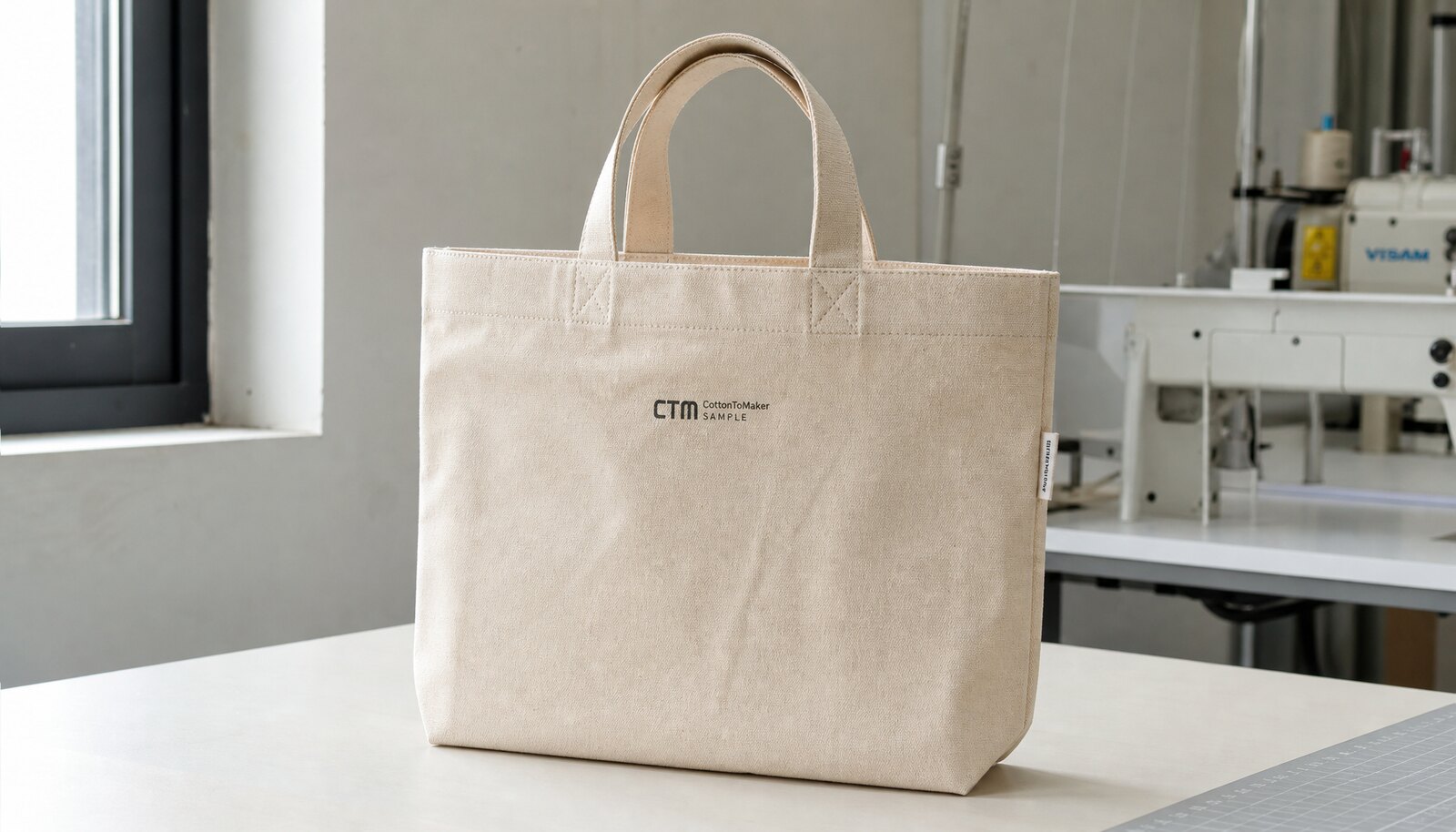
Why sample approval decides the whole order
For canvas book fair totes for schools, the sample is not a courtesy step. It is the point where the buyer finds out whether the factory can actually make the bag that was quoted. Fabric weight, handle build, print method, packing format, and even the way the bag sits on a table are all visible only after the sample is in hand. If the sample feels thin, the seams are uneven, or the print is already soft at the sample stage, the bulk order is almost never safer than that first piece. It is usually worse, because the production run repeats the same weaknesses across every carton.
Procurement teams often spend time comparing unit price before the sample is locked down. That sequence creates false savings. A supplier can win on price by quoting a lighter canvas, a cheaper print method, or a loose packing format, then quietly reveal the tradeoffs later. The sample should answer one question: can this tote be repeated in bulk without substitutions? If the answer is not clearly yes, the buyer should treat the sample as a draft, not an approval. For school events, that distinction matters because the delivery date is fixed and there is rarely time to rework weak bags after receiving.
- Approve function first, then appearance.
- Keep one signed master sample and one factory reference sample.
- Do not allow fabric, print, or packing substitutions without written notice.
Build the RFQ spec before you ask for a sample
The sample approval checklist starts before the factory cuts anything. If the RFQ is vague, the sample will be vague too, and the buyer ends up approving whatever the supplier felt like making. For school book fair totes, the spec should spell out the finished size, gusset depth, handle length, top hem, canvas weight, color, print placement, label type, and packing format. It should also say how the tote will be used. A bag for a light reading handout has a different target than a bag that needs to carry several books, flyers, and a small purchase home from the fair.
A useful school tote spec gives the factory enough information to quote and sample without guesswork. A common baseline is 10 oz canvas for light giveaways, 12 oz for day-to-day school carry, and 16 oz only when the buyer wants a more substantial hand feel or heavier load capacity. The bag size should match the contents, not just the catalog space. A 15 x 16 in tote can still feel too shallow if the gusset is missing or the handles are too short for the intended carry style. If students are expected to carry the bag on the shoulder, the handle drop needs to be written into the spec, not implied.
- Use one spec sheet for dimensions, materials, artwork, packing, and approval rules.
- State handle drop, not just handle length.
- Ask for fabric weight in both oz and GSM so every supplier quotes the same basis.
Choose the supplier route that can actually repeat the sample
The sourcing route matters because not every supplier has the same level of control over sample and bulk continuity. A direct factory is usually the strongest choice when the buyer wants the sample to match the bulk run closely. It gives more visibility into the sewing line, the print setup, and the team that will handle finishing. A trading company can still be useful, especially when the buyer wants to consolidate several items or needs someone to manage communication, but the buyer should ask who made the sample, who will make the bulk order, and what proof exists that the sample and production flow are linked. If the answer is vague, the approval risk rises immediately.
What the buyer wants is not a nice story about capabilities. The buyer wants evidence. Ask for the factory business name, the actual production location, recent photos of the sewing area, and the person responsible for sample sign-off. If the supplier claims certification or audit coverage, ask for the certificate number, scope, and expiry date rather than a logo on a slide. If they say the bulk order will move to a different site, ask how they will keep the same canvas, same ink, and same stitch standard. For a school tote project, consistency is worth more than a low first quote because the school will receive the bags as one lot, not as a series of corrected samples.
- Direct factory: strongest for repeatability and traceability.
- Trading company: acceptable if they can prove who actually makes the tote.
- Ask for factory evidence, not just sales claims or a polished product page.
Audit the supplier before you approve the sample
A procurement buyer should treat the sample supplier like a mini audit, even when the order is modest. Start with basic production evidence. Ask for a factory profile, the number of sewing lines, the bag-making process, and a clear statement of whether the supplier is the manufacturer, a contract packer, or a trading intermediary. Then ask for traceability evidence: where the fabric comes from, whether the same canvas roll or an equivalent bulk roll will be used, and how the factory prevents substitution between sample and production. For book fair totes, that last point matters because buyers often notice the difference only after the goods arrive and the canvas feels lighter or the weave looks looser.
The audit should also cover working discipline. Look for incoming material control, sample retention, production change control, and final inspection ownership. If the supplier says they have quality certification, the buyer still needs to know what that actually covers. A certificate does not guarantee the exact tote you are buying, but it does tell you whether the supplier can document a process. Ask whether the factory keeps approved masters for fabric, print placement, label style, and carton pack. If they cannot produce those records, the sample approval is fragile because there is no clear reference for the bulk run.
- Ask who owns sample retention and who signs off production changes.
- Request photos or videos of cutting, stitching, print, and packing stages.
- Verify whether the supplier can trace the sample to the bulk order by style code or PO reference.
What the first physical sample must prove
The first sample should prove that the tote works in the way the school will actually use it. That means the bag is not being judged as a flat mockup or a marketing object. It should be checked as a carry item. Look at body shape, base stability, corner definition, handle symmetry, and how the top opening behaves once the bag is filled. A tote that looks attractive when empty can become awkward once books are added, especially if the gusset is too shallow or the handles are attached too high. If the bag collapses when set down, the user experience is weaker even if the print is perfect.
The sample also needs to show whether the factory understood the artwork placement. On coarse canvas, print edges can sink into the weave, shift near seams, or look dark and heavy if the ink application is too thick. If the artwork sits close to a seam or folds over the gusset, ask the factory to produce a corrected sample that reflects the real bulk layout. The objective is not to admire the prototype. It is to find the failure points early while the factory can still adjust cutting, stitch path, or print position. In other words, the sample is a test of repeatability, not just design.
- Check the bag empty and loaded, not only flat on the table.
- Confirm the logo position relative to seams, hem, and gusset lines.
- Reject samples with panel twist, weak base shape, or uneven handle set.
Control printing, branding, and artwork before the price hardens
For most school book fair totes, one or two color screen print is the most efficient option because it is clear on natural canvas and easier to quote consistently. If the artwork is more complex, the supplier may suggest heat transfer or digital print. Those methods can work, but they need closer inspection because the finish, hand feel, and durability are different from screen print. The buyer should approve not only the logo but also the color target, print size, placement tolerance, and how the art will look on actual canvas texture. A vector file on a screen is not enough to approve the final look.
This is also where quote logic often gets messy. A supplier may quote a low base bag price and then add charges for each color, each screen, artwork cleanup, label attachment, or print setup. That is normal if the line items are explicit. It is a problem if the supplier hides them until after sample approval. The buyer should ask whether the quote includes screen setup, whether repeat orders need new plates or only new screens, whether a woven label is sewn in or heat applied, and whether the artwork is placed by a template or manually. Manual placement can look fine on one sample and drift in bulk. If the school logo must be exact, ask for a measured placement spec in centimeters or inches.
- Approve artwork on the real fabric, not on a mockup alone.
- Ask whether each color adds setup cost or only print cost.
- Keep a physical color target if brand consistency matters.
Check school-specific compliance instead of assuming the bag is low-risk
A tote for a school book fair is not automatically a simple commodity. The compliance profile depends on how the bag is marketed, where it is sold, and which market receives it. If the tote is intended for children or will be distributed through a school program to younger students, the buyer should confirm whether local children's product rules apply. If the destination market has chemical, labeling, or origin requirements, those rules may apply to the bag body, the print ink, the label, the packaging, or any added components such as zippers or coated trim. The safest approach is to ask the supplier to name the requirements that apply to the exact tote build, not to a generic canvas bag.
Do not accept a certificate that references a different style, fabric, print, or product code. That is a common shortcut and it is not useful for procurement approval. Ask for test reports or declarations only after confirming they match the exact materials being quoted. If the market is the United States, the buyer may need to consider children's product tracking, lead, or phthalate questions depending on the product's use and marketing. If the market is the EU or UK, ask about chemical compliance declarations and labeling in the destination language. The point is not to burden every tote with every possible rule. The point is to confirm which rules actually apply before the PO is released, because compliance gaps are far more expensive after the goods arrive.
- Ask whether the tote is treated as a children's item in the destination market.
- Confirm whether the print ink, label, or trim changes the compliance profile.
- Match every certificate or declaration to the exact style code and material set.
Use a QC checklist that is tied to real use, not an invented threshold
The weak point in many tote approvals is the load test. Buyers sometimes write down a random number and a random time, then act as though that created a standard. It does not. A better approach is to define the heaviest realistic school carry in the approval sheet and use that as the internal test basis. For example, if the bag is expected to hold a stack of books, flyers, and a small purchase, the load should reflect that kind of use. The point is not to prove laboratory durability. The point is to see whether the seam, handle attachment, and body shape survive a practical carry without obvious distortion.
Record the actual test load, the number of carry cycles or carry minutes, and the observed result. Then inspect the stress zones: handle-to-body joints, top hem, corner seams, and the base. A bag can look clean in a static photo and still show handle stretch or seam creep after a short real-world test. If formal validation is needed, specify a separate lab method in the PO or quality agreement rather than inventing a home-grown threshold and calling it a standard. That keeps the checklist honest and prevents arguments later about whether the test was meaningful.
- Base the load test on the heaviest realistic school use, and write the chosen load into the checklist.
- Inspect the stress zones after loading and after the bag is set down again.
- If the project needs formal validation, define the lab method separately from the internal sample check.
Compare quotes line by line, not just by unit price
The fastest way to compare supplier quotes is to force every supplier to quote the same spec and the same commercial basis. If one supplier prices 10 oz natural canvas with bulk packing and another prices 12 oz bleached canvas with woven labels and polybags, the comparison is not real. It is just a list of different products. A good quote separates the base bag, handles, print setup, label cost, packing cost, carton markings, and sample fee. It should also state the incoterm clearly, because EXW, FOB, and DDP are not interchangeable prices. The lowest unit price is often only the cheapest subtotal.
Illustrative example: Supplier A quotes $1.08 EXW for a 10 oz flat tote with one-color print, bulk packed, and no label. Supplier B quotes $1.24 FOB for the same size bag, but includes a woven side label, carton marks, 50-piece packing, and sample fee credit back after order placement. B is not automatically overpriced. If the school needs retail-ready packs or a labeled distribution format, B may be the safer value because the extra line items are already visible. The buyer should also ask where price changes when handle width increases, when the print changes from one color to two, when a label is added, or when the pack count per carton changes. Those are the real cost drivers, not the headline number alone.
- Compare only after the fabric weight, print method, packing, and incoterm are fixed.
- Ask for line items on handles, labels, packing, and setup charges.
- Request price breaks at 500, 1,000, and 3,000 pieces if the order may scale.
Packing and carton details affect approval more than most buyers expect
School tote orders often fail on logistics rather than on the bag itself. A tote can pass the visual sample and still become a problem if the packing format is wrong. Bulk packs may be fine for a book fair handout program, but retail-ready distribution may require individual polybags, barcodes, warning labels, or hangtags. The sample should show the intended packing route, because packing changes the carton count, the freight density, the receiving workflow, and the chance of crease marks or ink rub during transit. If the factory has not decided the final pack plan, the approval is incomplete.
Ask for carton count, carton size, gross weight, and master carton marks before the sample is signed off. If the bag will be exported, the carton marking language and handling icons should be readable and consistent. If the school or distributor wants faster receiving, a clean carton label is a real efficiency gain. If the supplier proposes a higher pack count per carton, ask how they are protecting the tote body and print surface from compression. More pieces per carton can lower freight cost, but it can also flatten the bag and make the first impression worse on arrival. The right answer depends on the distribution plan, not on the factory's convenience.
- Match packing to the actual distribution channel.
- Confirm carton count, carton size, and gross weight on the sample order.
- Verify that carton marks and product labels are readable by the receiving team.
Specification comparison for buyers
| Spec decision | Recommended option | When it fits | Buyer risk to check |
|---|---|---|---|
| Sourcing route | Direct factory with a pre-production sample from the same sewing line and print line planned for bulk | When you need repeatability, traceable production evidence, and control over substitutions | Brokered samples can look correct while the bulk run changes fabric roll, ink, stitching method, or trim source |
| Fabric weight | 10 oz for light event handouts, 12 oz for day-to-day school book carry, 16 oz for premium or heavier use | When the tote must hold books without collapsing or feeling overbuilt | Underweight canvas stretches, shows strike-through, and can distort after repeated use |
| Bag structure | Flat tote for lightweight handouts, 4 in gusset for books and bulkier takeaway packs | When students will carry paperbacks, flyers, and small boxed items | A flat body may look fine on paper but feel too shallow once books and folders go in |
| Print method | One or two color screen print on the main panel for simple school artwork | When the logo, event name, or slogan is clean and bold | Heat transfer may crack and digital print can soften on coarse canvas if the supplier is not disciplined |
| Handle build | 1 in wide handles with double stitching and dense bartacks at the stress points | When the bag is expected to be reused and carried by students | Weak bartacks, narrow tape, or short stitch runs are usually the first failure point |
| Labeling route | Woven side label plus seam care label when the school or distributor needs branding and traceability | When the tote is for resale, distributor stock, or a managed school program | Missing label details can create inventory confusion and compliance gaps |
| Packing route | Bulk packed with clear master carton marks, or retail-ready polybagging if the channel requires it | When bags move through school distribution, warehouse receiving, or export freight | Overstuffed cartons crush the bag body and unclear pack counts slow receiving |
| Quote structure | Base bag price plus separate line items for print setup, label, packing, carton marks, and sample fees | When you want a quote that is actually comparable across suppliers | A low unit price can hide expensive setup or packing charges that appear only after approval |
Buyer checklist before sampling
- The spec sheet fixes finished size, gusset depth, handle length, fabric weight, print method, and packing format before sampling starts.
- The sample uses the same fabric weight, print process, and label construction that the bulk order will use, or the supplier states every difference in writing.
- The supplier provides production evidence, not just a sales promise: factory name, sewing line location, sample-to-bulk continuity, and who will own final QC.
- The sample is checked against the heaviest realistic school carry defined in the spec, and the pass/fail rule is written down before testing begins.
- Print placement, size, and color are approved against a physical sample or approved color reference, not a digital proof alone.
- Seams, bartacks, and top hems are inspected inside and outside for loose thread, skipped stitches, uneven reinforcement, or distortion under load.
- If the destination market has children's product, chemical, labeling, or origin rules, the supplier confirms which requirements apply to the exact tote build being quoted.
- The quote separates bag cost, print setup, label cost, packing cost, sample fee, incoterm, and lead time so suppliers can be compared on the same basis.
- Packing format, carton count, carton size, and carton marks are confirmed against the receiving plan before bulk approval.
- One signed master sample is archived with date, revision notes, artwork file version, and the name of the person who approved it.
Factory quote questions to send
- Is the sample made on the same factory line that will make the bulk order, and can you identify the sewing line, print line, or finishing team responsible?
- What exact canvas weight are you quoting in oz and GSM, and what tolerance do you allow on incoming fabric rolls?
- Which print method is included, how many colors are covered, and what are the setup, plate, screen, or artwork charges by color?
- Please break the price into base bag cost, handle construction, print setup, woven label or care label, packing, and master carton marking.
- What MOQ and price breaks do you offer at 500, 1,000, and 3,000 pieces, and which line items change at each break?
- Are the sample fee, screen charges, and other setup charges creditable against bulk production, and what conditions apply?
- What are the sample lead time and bulk lead time after artwork approval, fabric confirmation, and deposit payment?
- What packing format is included per carton, how many pieces per carton, and what carton size and gross weight do you expect?
- What overrun or under-run tolerance do you follow, and what inspection or release standard do you use before shipment?
- Can you provide factory documents or evidence such as business license, export capability, recent production photos, and a declaration of who will make the bulk order if you are not the manufacturer?
Quality-control points to confirm
- Finished dimensions stay within the agreed tolerance at the top opening, body height, and gusset depth, and the buyer has written the tolerance on the approval sheet.
- Fabric weight matches the approved sample or the written tolerance in the PO, with the supplier identifying whether the reading comes from mill documentation or incoming roll inspection.
- Handles are equal length, set at the same height, and bartacked cleanly at both attachment points without puckering or skipped reinforcement stitches.
- No open seams, skipped stitches, loose thread tails longer than 1 cm, or distorted top hems are visible on the outside or inside of the bag.
- The bag passes a written use test based on the heaviest realistic school carry for the program, and the inspector records the load used and the observed result rather than relying on a generic threshold.
- Print placement, size, and color are aligned to the approved physical reference, with no strike-through, smearing, or soft edges that would be obvious in classroom distribution or retail use.
- If the product must meet destination-market children's product, chemical, or labeling requirements, the certificate or declaration matches the exact tote construction, print, and trim used in the sample.
- Carton labels, pack counts, inner pack format, and master carton marks match the purchase order and the warehouse receiving plan.
- The signed master sample is retained as the production reference and linked to the exact artwork file and revision history.