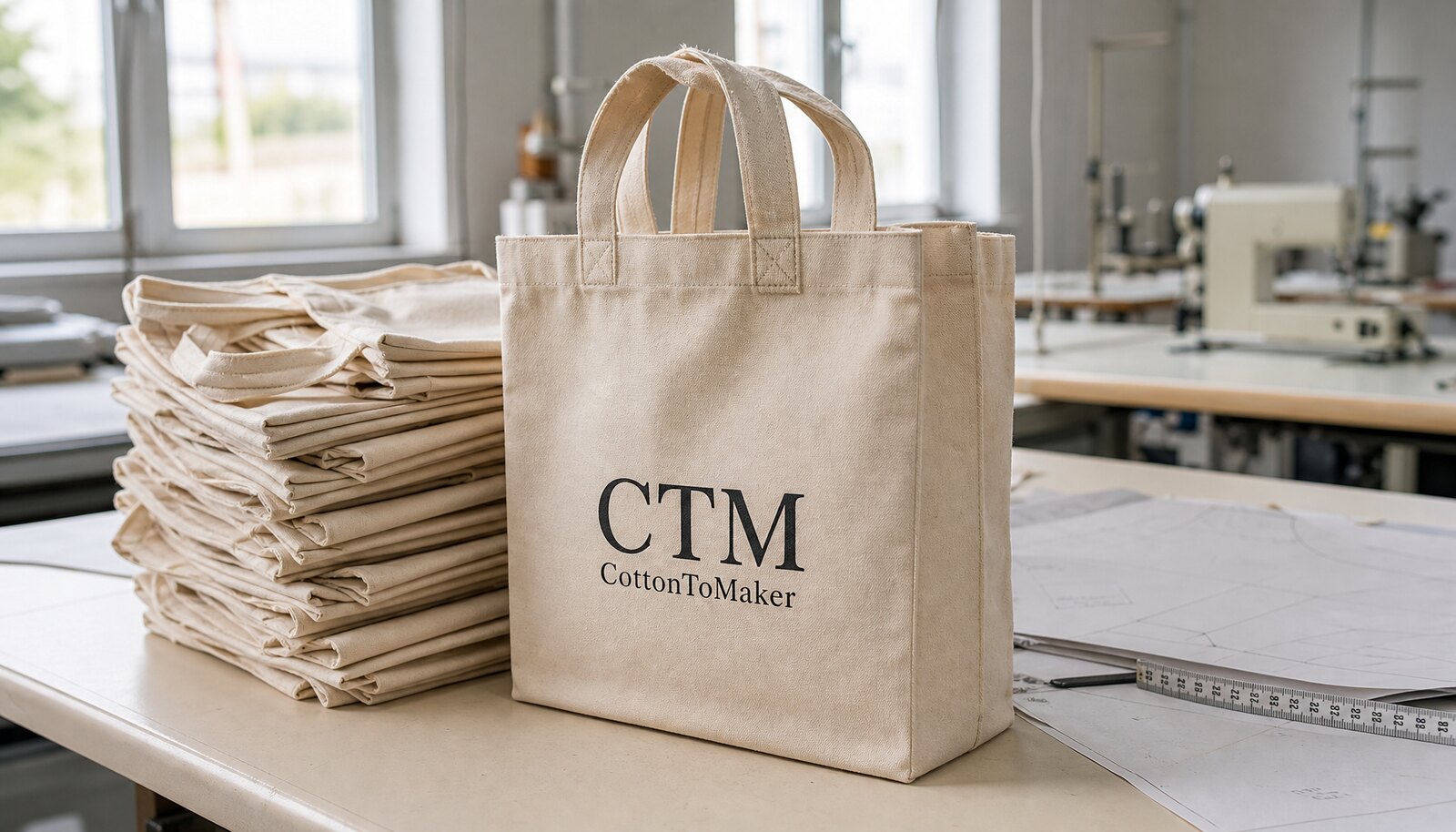
What a retail chain is really buying
A canvas book fair tote looks simple, but retail chains are not buying a blank bag. They are buying a repeatable program that has to work in the store, in the distribution center, and in the customer's hand. A tote used for a book fair promotion has different expectations than one sold as an everyday merch item or bundled as a gift-with-purchase. That difference changes the acceptable fabric weight, the level of finishing, the carton pack, and the room the buyer has on cost.
For chain buyers, the most useful first decision is not decoration. It is the commercial role of the tote. Is it a seasonal launch, a recurring replenishment item, a short-run promo, or a multi-store program that needs identical stock across locations? Once that is clear, the supplier can quote against the right assumptions and the buyer can compare options without mixing launch risk with margin targets.
The fastest way to keep this procurement useful is to standardize the master spec. Define one body size, one base fabric weight, one handle length, and one print method before the RFQ goes out. If the chain needs market-specific artwork, treat that as a controlled variation on the same tote platform rather than a separate product every time. That keeps MOQ, QC, and reorder behavior tied to one program instead of drifting into a pile of one-off versions.
- Decide whether the tote is for launch, replenishment, promotion, or retail sale before asking for price.
- Use one master spec and only vary artwork where the business case is real.
- Treat a book-fair tote as a supply-chain item, not only a print job.
The spec that moves price and margin
Fabric weight is the first real cost lever. In practical chain programs, 12 oz canvas is often the working baseline because it gives the buyer a solid hand feel without pushing cost into a premium tier. A move to 14 oz usually improves structure and makes the bag feel more substantial on shelf, while 16 oz starts to make sense when the retail positioning expects a heavier, more durable look. If the bag is too light, the tote reads as disposable and may not support the brand story. If it is too heavy, the price can move faster than the merchandising plan allows.
Construction details matter almost as much as fabric. A straight stitch with weak handle attachment may pass a quick sample check and still fail once the bag is actually loaded with books. Buyers should define the handle length, stitch path, reinforcement method, and gusset depth before the factory quotes. A tote that stands up better in retail display may need a slightly different bottom seam or side-gusset geometry, and that affects both labor time and carton fold behavior.
Decoration is the next pricing layer. One-color screen print on a flat panel is usually the lowest-risk option for repeat retail runs because it is stable, repeatable, and easy to inspect. Two-color art is still manageable if the print area stays flat and the coverage is not too heavy. Heat transfer can be useful when art changes by region or the program is too small for a full print setup, but the buyer should check rub resistance, cracking, and hand feel. Embroidery, woven labels, contrast panels, or custom dyeing all add complexity and tend to push the program out of the low-MOQ zone.
Packing is part of the spec, not an afterthought. A tote that is packed too tightly can arrive with a hard crease through the logo, while a loose pack can leave the bag misshapen in the carton. Buyers should define the fold, bag count per inner pack, master carton count, and whether the tote needs a polybag or barcode label. On a program like this, packaging decisions can affect cube, freight, and warehouse receiving more than a minor change in print size.
- Use 12 oz to 14 oz canvas as the default comparison band unless the retail position justifies heavier cloth.
- Ask the supplier to price the tote, the decoration, and the packing as separate components when possible.
- Check how the handle reinforcement and gusset geometry affect both load strength and fold pattern.
Sourcing routes and the real tradeoffs
Not every tote should be sourced the same way. A direct factory in Asia is usually the most efficient route for a stable retail program because it gives the buyer the best shot at competitive unit pricing and predictable repeatability. It works best when the spec is frozen and the buyer can absorb the normal approval cycle. The risk is that schedule slippage can hide in fabric booking, screen preparation, or peak-season factory congestion if those items are not called out explicitly.
A regional cut-and-sew partner or nearshore converter is a better fit when transit risk matters more than the lowest possible factory price. These suppliers can be useful for launch windows, replenishment programs, or multi-drop retail calendars because the lead time is often shorter once materials are on hand. The tradeoff is that fabric availability can become the bottleneck, and some programs end up with a higher unit cost because the fabric still has to move long distance before the bag is even sewn.
Stock blank plus local print is the fastest route, but it is only safe when the blank tote has already been approved against the chain's expectations. A blank that is close enough in size but off in shade, handle length, or GSM can create avoidable disputes at receiving. This route is often the right answer for urgent short runs or event fills, but it should not be treated as a substitute for a real custom spec when the tote is being sold as a branded retail item.
Trading companies and sourcing agents can help when the chain is managing more than one tote program at the same time, or when different stores need different versions. Their value is coordination, not manufacturing magic. The buyer still needs to know which factory is actually making the bags, who owns the quality record, and whether the quoted margin includes the agent's fee. For chains that care about reorder behavior, that transparency matters more than the middleman role itself.
- Use a direct factory for stable repeat programs with clear artwork and a forecast.
- Use nearshore or regional production when transit risk and quick replenishment matter more than the last cent of unit cost.
- Use stock blanks only when the blank spec has been approved against the chain's actual requirements.
How MOQ is actually built
MOQ is usually a factory calculation, not a random number. The supplier is looking at fabric utilization, cutting efficiency, print setup, label application, and carton run size. A tote with one body size and one print location can often be made at a lower MOQ because the line stays on one setup longer. Add a second print position, a different handle color, a woven patch, or custom folding, and the practical MOQ rises because every extra step needs setup time and process control.
Retail buyers should ask for MOQ by artwork, by color, and by size. The total order quantity is not enough to tell you how the plant will run the job. A 4,000-piece program split across four artworks behaves like four smaller runs, which means more setup, more inspection points, and a higher chance of visual variation across the lot. If the business goal is to reduce MOQ without sacrificing quality, the better strategy is to keep the body identical and vary only the print where necessary.
The cleanest way to negotiate smaller runs is to standardize the tote platform. Use one canvas weight, one body shape, one handle length, and one packing method, then change only the artwork or the store sticker. That gives the factory a real chance to lower its minimum without forcing shortcuts in sewing or finishing. If the supplier says they can be flexible, ask which part of the spec they are standardizing in order to make that flexibility possible.
Planning bands are useful here. A pilot may be possible at 300 to 1,000 pieces if the supplier is working from stock fabric or a simple blank. A custom printed program often settles into 1,000 to 2,000 pieces as a realistic minimum. Once the order moves into 2,000 to 5,000 pieces per design, the economics usually get more stable for retail chains. These are not universal rules, but they are good enough to tell you whether the quote is a true production offer or just a commercial preference dressed up as an MOQ.
- Ask for MOQ by artwork, color, and size, not only the total piece count.
- Standardize the tote body first if you want a lower MOQ without quality drift.
- If the supplier claims flexibility, ask what they are standardizing behind the scenes.
Lead time should be read as a sequence, not a single number
A serious lead time quote needs to be split into stages. Sample approval is one stage, bulk production is another, and shipping is the third. If the supplier gives only one calendar number, it usually reflects best-case production time, not the full path to receiving stock in the DC. For retail chains, that distinction matters because the launch window is defined by the warehouse receipt date, not by the day the tote leaves the factory gate.
For an Asia export program, a common planning range for a standard tote is about 20 to 45 days of production after approvals, with ocean transit adding roughly 15 to 35 days depending on lane and season. Nearshore production can often be completed in about 10 to 25 days when fabric is already in hand, with shorter transit afterward. Local stock blank printing can move in 5 to 15 days if the blank inventory is on the floor. Those ranges are planning tools, not promises, and they assume the buyer is not changing art after approval.
The schedule usually breaks when something upstream is not locked. Fabric booking is a common failure point because the factory may have sewing space but no confirmed cloth. Screen making, sample revisions, holiday shutdowns, and port congestion can also add time. If the tote program has a fixed event date, the buyer should ask for a milestone schedule that includes artwork approval, sample ship date, sample arrival, bulk start, bulk finish, ready-to-ship date, and transit time. Without those checkpoints, the quote is too vague to manage against.
A better lead time question is: what has to happen before the clock starts? If the answer is deposit receipt, artwork approval, and fabric reservation, then the buyer knows where delays are likely to show up. If the answer is only bulk production after all approvals, the buyer needs to add sample and transit time on top of that number before committing the retail calendar.
- Ask for separate dates for sample timing, bulk timing, and shipping timing.
- Treat the DC receive date as the real deadline.
- Ask which step is the bottleneck: fabric, print setup, sewing, packing, or shipping.
How to compare quotes on a landed-cost basis
The right way to compare tote quotes is to force every supplier onto the same assumptions. That means the same body size, the same canvas weight, the same decoration method, the same packing, and the same destination. A quote for natural 12 oz canvas with one-color screen print and 50 pieces per carton is not comparable to a quote for 14 oz dyed canvas with a woven label and ship-ready inner packs unless every one of those differences is priced out clearly.
Buyers should also separate factory price from landed cost. Freight, duty, inland handling, DC receiving, and any repacking can move the final number enough to change the sourcing decision. That is especially true for short runs or rush programs, where freight can become a larger share of the landed total than the tote itself. If the supplier only gives an ex-factory number, the buyer should treat it as incomplete until the packing, shipment term, and destination are clarified.
The carton spec is a bigger procurement variable than it looks. Many tote programs use master cartons in the general range of 40 x 30 x 30 cm to 45 x 35 x 35 cm, but that only works if the fold method and piece count support it. A 25-piece carton may be easier to receive and less likely to crush the print. A 50-piece carton may be more efficient on cube. A 100-piece carton may save carton cost but create manual-handling issues. The correct answer depends on the DC rules, the bag weight, and whether the chain is palletizing stock on arrival.
When the quoted price looks unusually low, check the assumptions before you celebrate the number. It may be missing packaging, testing, or a real print setup. When the quoted price looks unusually high, check whether the supplier is pricing reserved capacity, a nonstandard fabric, or a small-lot production path. In tote sourcing, the cheapest quote is often the least comparable quote, not the best one.
- Normalize every quote to the same fabric, print, pack, and destination before comparing price.
- Ask for carton dimensions, piece count, and gross weight because they affect freight and DC handling.
- Treat freight, duty, and domestic handling as part of the buying decision, not afterthoughts.
QC that catches tote failures before receiving
QC is only useful when it is specific enough to catch real failures. For a canvas tote, the buyer should not stop at a general statement like must be well made. The inspection plan should define the acceptable fabric weight range, the stitch quality at the handle attachment, the print placement tolerance, and the load requirement. Critical defects should be zero. Major defects are usually handled under ISO 2859-1 with AQL 2.5, while minor defects can often sit at AQL 4.0 if the buyer is comfortable with that risk level.
A practical inspection sample for a low-thousands lot is usually in the 125 to 200-piece range, depending on lot size and the exact ISO table in use. The purpose of the sample is not only to count defects. It is to catch patterns. A few common tote failures show up fast when the inspector is looking carefully: skipped stitches at the handle bar-tack, uneven panel length, crooked logo placement, loose thread tails, folded corners crushed in packing, and print that ghosts or cracks when flexed. Those are not cosmetic nuisances. They are the defects that make a chain program look inconsistent on shelf.
Testing should be tied to the tote's intended use. For a standard retail or book fair tote, a static hold of 8 to 10 kg for 15 minutes is a practical buyer-side check, provided it matches how the bag will be used. If the tote is expected to carry heavier books or bundled merchandise, the buyer can add a handle pull test of 10 to 15 kg on the finished bag and check whether the seam opens or the stitch line shifts. Color approval should be done under daylight-equivalent lighting against the approved sample, not under whatever lighting the warehouse happens to have that day.
Traceability matters as well. The factory should be able to identify the fabric lot, the print run, the carton numbers, and the batch code if a problem appears. That lets the buyer isolate a bad lot instead of treating the whole shipment as suspect. For chain buyers, that distinction matters because one flawed carton can become a store-level issue very quickly if the receiving process is not disciplined.
- Use AQL 2.5 for major defects, AQL 4.0 for minor defects, and zero tolerance for critical defects.
- Measure dimensions, handle length, and print placement against the approved sample instead of eyeballing the bag.
- Require lot traceability, carton numbers, and a documented pre-production approval record.
Packing, cartons, and DC receiving
Packing is part of the product, especially for retail chains that receive at a distribution center. If the fold method is not defined, the logo can crease, the bag can ship asymmetrically, and the store team gets an inconsistent opening presentation. Buyers should specify the fold, the number of pieces per inner pack, whether a polybag is required, where the barcode goes, and what carton marks need to be printed. If the tote is going into a shelf-ready or store-ready flow, that has to be stated in the RFQ before the supplier prices the job.
The carton itself has operational consequences. A carton that is too heavy will slow receiving and can violate warehouse handling limits. As a practical buyer-side target, many chain teams try to keep master carton gross weight in the 12 to 18 kg range when manual handling is expected, but the real limit should follow the retailer's own DC rules. The carton size should also fit the pallet pattern and the cubic limit, not just the factory's standard packing template. That is where a good packing spec can save more money than a small change in print or trim.
For book fair totes, the fold should protect the print face and keep the body from wrinkling hard at the decoration panel. A polybag can help if the chain wants extra protection from dust or moisture, but it adds cost and handling time. The buyer needs to decide whether the warehouse really wants that extra packaging or whether a clean folded pack is enough. There is no universal answer. The right pack is the one that works with the retailer's receiving process, store labor model, and display strategy.
If the order will repeat, ask the supplier to lock the carton spec just as tightly as the bag spec. Reorders often fail because the tote is repeatable but the pack is not. The first shipment arrives well, the second shipment is packed slightly differently, and the DC is suddenly forced to rework cartons or repalletize stock. That is a preventable cost if the carton rules are written into the original approval.
- Define fold method, inner pack, barcode placement, carton marks, and pallet rules in the RFQ.
- Keep carton gross weight within the retailer's manual-handling limit.
- Match carton dimensions to the DC pallet pattern and cube target, not the supplier's default pack.
Which supplier type fits which retail chain
The best supplier is not the one with the lowest quoted price. It is the one whose operating model matches the chain's risk profile. A direct factory is usually best when the chain has a stable tote program, clear artwork, and enough volume to justify a proper sample and approval cycle. That model gives the buyer the strongest control over cost and repeatability, but it also requires the most discipline on spec and timing.
A trading company or sourcing office works better when the chain is juggling multiple SKUs, multiple factories, or multiple markets. The value is coordination across the order set, not necessarily better manufacturing performance. That means the buyer should ask who actually owns the factory slot, who signs off on quality, and who takes responsibility if the order slips. If those answers are not clear, the chain is taking on hidden risk for no real benefit.
Nearshore or domestic converters are often the right answer when launch windows are tight or when the chain wants a faster replenishment cycle. They can support multiple launch windows more easily because transit is shorter and communication is usually simpler. The tradeoff is a higher unit cost and, sometimes, more limited fabric options. If the retailer expects frequent reorder behavior, the key question is whether the converter can repeat the same fabric and print setup without revalidating the job from zero.
A dual-source plan is worth the effort when the tote is tied to a visible retail campaign or a book-fair calendar that cannot slip. In that case, the buyer should keep the same approved sample, the same carton spec, and the same decoration file across both suppliers. Split sourcing only works if the spec is identical and the quality checks are aligned. Otherwise the chain ends up with two versions of the same bag and no clean way to compare sell-through or defect rates.
- Use a factory when price and repeatability matter most.
- Use a trading company when you need coordination across more than one buy.
- Use a nearshore converter when transit risk and quick replenishment matter more than the lowest factory price.
The RFQ and reorder playbook that saves time
A useful RFQ should be short and complete. It needs the tote dimensions, fabric weight, handle length, print artwork, quantity by size and color, destination, Incoterm, target ship window, and packing format. It should also say whether the order is a pilot, a launch, or a replenishment run. Those are not interchangeable commercial events. A pilot can tolerate a slightly higher unit price if it reduces risk. A launch needs a disciplined schedule and a clear approval cutoff. A reorder should be optimized for repeatability and known lead time.
The supplier response should mirror the same structure. Ask the factory to restate the fabric GSM, print method, carton count, carton dimensions, gross weight, MOQ by artwork, sample timing, bulk timing, and what is excluded from the price. That makes the quote auditable. If the supplier cannot repeat the spec clearly, the offer is not ready for procurement review. Buyers waste a lot of time because they evaluate a quote, then discover the important assumptions were never priced at all.
Reorders should be protected on day one. Ask whether screens or plates can be reused, whether the factory can reserve fabric for the next run, and what shade variation is acceptable on a second production cycle. For retail chains managing multiple launch windows, that matters as much as the first-order price. If the tote is going to be repeated across stores or seasons, the buyer should lock the reorder logic, golden sample, and carton spec before the first shipment leaves the plant.
The fastest procurement process is usually the one that is strictest about the basics. One spec sheet, one artwork set, one quantity matrix, one approved sample, and one carton standard will do more to reduce errors than a long list of generic supplier promises. That is especially true for book-fair totes, where the bag looks simple enough to invite shortcuts but still has to survive retail handling and chain-level consistency.
- Send one spec sheet, one artwork file set, and one quantity matrix by size and color.
- State whether the order is a pilot, a launch, or a replenishment run.
- Lock reorder price, reorder MOQ, and approved carton spec before first production starts.
Specification comparison for buyers
| Sourcing route | Fabric and decoration fit | MOQ and lead time planning band | Carton and pack assumptions | Procurement risk and best use |
|---|---|---|---|---|
| Direct factory in Asia | 12 oz to 16 oz canvas; one- or two-color screen print, woven label optional | 2,000 to 5,000 pcs per design is common; 20 to 45 days production after approval, plus ocean transit | 25 to 50 pcs per master carton, export palletized pack, custom carton marks possible | Best unit cost for stable launch and reorder programs, but schedule depends on fabric booking and peak-season capacity |
| Regional cut-and-sew or nearshore converter | 10 oz to 14 oz canvas or stock fabric; simple print, patch, or limited embroidery | 500 to 2,500 pcs; 10 to 25 days if fabric is on hand | 20 to 40 pcs per carton when manual handling matters; cartons may be smaller to protect shape | Lower transit risk and easier reorders, but unit cost rises if fabric must be imported |
| Stock blank plus local print | Pre-made blank tote; one-color screen print or transfer on existing stock | 200 to 2,000 pcs; 5 to 15 days if blanks are in inventory | Pack often follows the blank supplier's carton, so confirm fold, barcode, and overpack before quoting | Fastest path for short launches, but shade, handle length, and construction may not match a custom spec |
| Trading company or sourcing agent | Depends on factory network; useful when chain needs mixed specs across stores | 1,000 to 3,000 pcs if programs can be consolidated; timing similar to factory with added coordination | Can coordinate mixed carton labels or combined shipments, but buyer must know which factory owns quality | Useful for multi-SKU programs, but margin and factory visibility must be clear |
| Dual-source fallback plan | Standardized body and print so two suppliers can run the same spec | 1,000 to 2,500 pcs per supplier depending on capacity; schedule overlap is the goal | Keep carton and artwork identical so received stock is interchangeable | Good for launch-risk mitigation, but only if the spec is frozen and inspections are aligned |
| Material | 8-12 oz cotton canvas, 120-220 gsm cotton, recycled cotton, or blended fabric selected by use case and target price | Before price comparison | Different cloth weights, backing, or certification claims make quotes hard to compare | |
| Construction | bag size, gusset, handle drop, seam allowance, stitch density, reinforcement patch, and loading expectation | Before sampling | Weak stress points create returns and failed inspections | |
| Decoration | screen print, heat transfer, embroidery, woven label, or hangtag matched to fabric texture and brand durability needs | Before artwork approval | The wrong method can crack, bleed, pucker, or fail on the chosen fabric |
Buyer checklist before sampling
- Freeze body size, gusset depth, handle length, and canvas weight before sending RFQs.
- Specify whether the fabric is natural, bleached, or dyed, and whether shrinkage is controlled before or after sewing.
- Define print method, number of colors, print coverage, and any store-group or market-level artwork variation.
- Split the quantity by SKU, color, and destination so the supplier can calculate a real MOQ instead of a blended estimate.
- Require sample timing, bulk timing, and shipping timing as three separate dates.
- Request carton dimensions, piece count, gross weight, and pallet pattern before approving the quote.
- Confirm whether the price includes woven label, hangtag, polybag, barcode sticker, and outer carton marks.
- Ask for the fabric lot reference, color standard, and any available composition or test documentation.
- Keep one approved golden sample and one sealed carton sample on the buyer side.
- Lock reorder price and reorder lead time before the first PO is released so replenishment is not requoted from zero.
Factory quote questions to send
- Is your MOQ based on artwork, color, fabric lot, or finished SKU? State the number for each, not only the total order.
- Which canvas weight are you quoting, and is the GSM measured on finished fabric or greige fabric?
- What is the exact print method, screen count, plate or film setup, and associated setup fee?
- Does the unit price include label, hangtag, polybag, barcode, carton marks, and any outer case labeling?
- What carton count, carton dimensions, gross weight, and pallet pattern are you assuming for this quote?
- Does lead time start after artwork approval, sample approval, deposit receipt, or fabric booking?
- What is the tolerance for shade, print placement, and stitch position against the approved sample?
- Can you support a pre-production sample made from actual bulk fabric and the actual bulk print method?
- What tests can you provide or support for load, seam strength, and print rub performance?
- What is the reorder price, and can you reuse screens, plates, or embroidery files without resetting the full job?
Quality-control points to confirm
- Use ISO 2859-1 sampling with AQL 2.5 for major defects, AQL 4.0 for minor defects, and critical defects set to zero.
- For low-thousands production lots, a 125 to 200-piece inspection sample is a practical pre-shipment benchmark, with the exact count taken from the ISO table for the lot size.
- Fabric weight should stay within plus or minus 5 percent of the approved GSM, or plus or minus 10 GSM, whichever is tighter.
- Body dimensions, gusset depth, and handle length should stay within plus or minus 0.5 cm of the approved sample unless the buyer specifies tighter tolerances.
- Handle attachment should use a box-x, bar-tack, or equivalent stress reinforcement with no open seams, skipped stitches, or asymmetry that affects load path.
- Reject bags with crooked print, bleed, ghosting, pinholes, poor opacity, or visible cracking after a flex check.
- Set print-placement tolerance at plus or minus 0.5 cm from the approved artwork position unless the artwork itself allows more drift.
- Use a buyer-side load test that matches the use case; for a standard retail tote, a static hold of 8 to 10 kg for 15 minutes is a practical baseline.
- For heavier book-fair loads, add a handle pull check of 10 to 15 kg on the finished bag and inspect for seam slippage or stitch breakage.
- Check for needle damage, oil stains, loose thread tails over 1 cm, uneven seam tension, left-right handle mismatch, and crushed corners from packing.